
















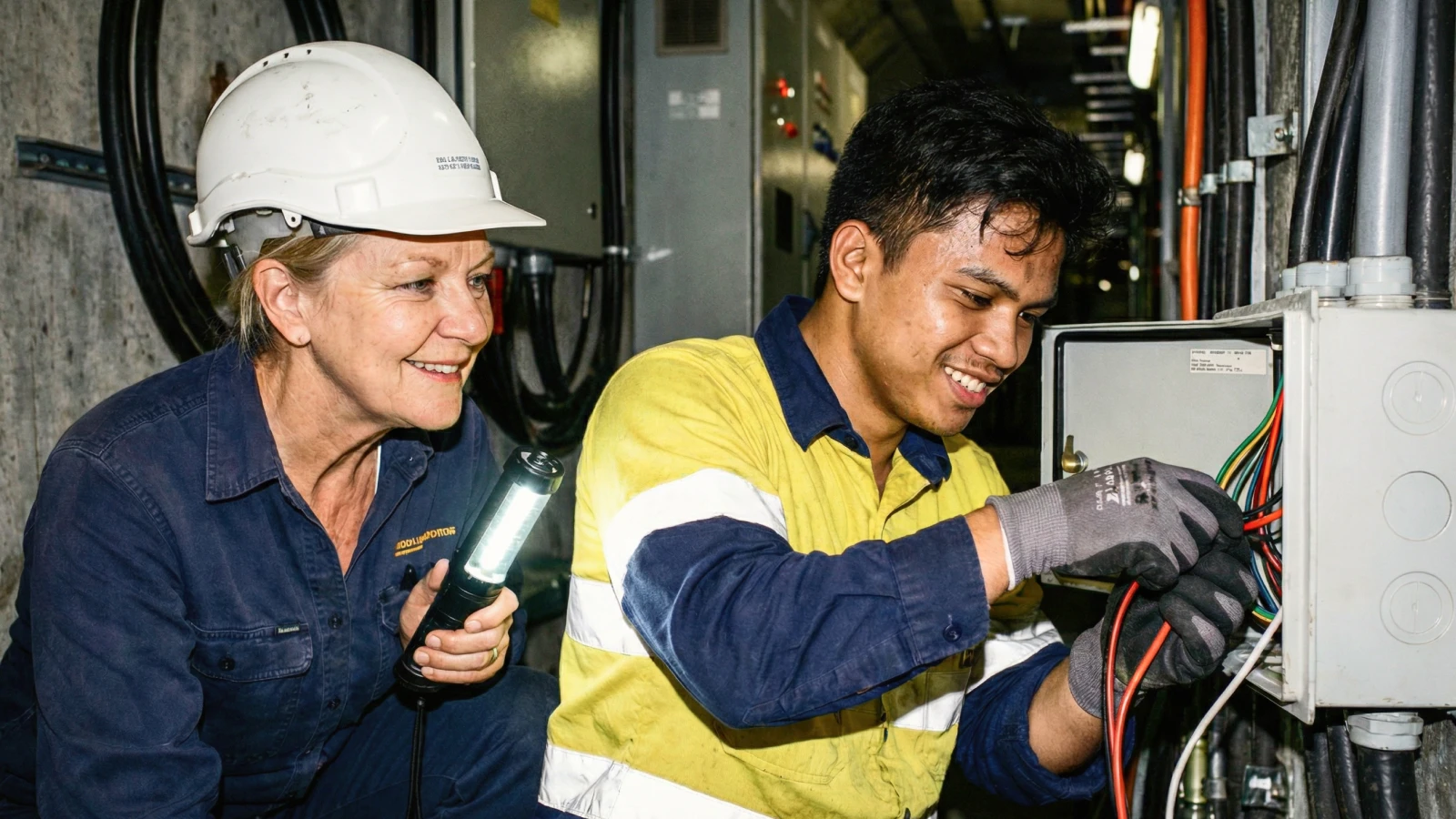
The old playbook for hiring talent is changing. Apprenticeships are proving to be one of the most direct and reliable routes into skilled work – and not just for employees.
The UK Government’s expansion of funded apprenticeships for under-25s in small businesses is a case in point. The scheme, which is set to roll out in April 2026, lowers the cost barrier for smaller employers and makes it easier to bring young people into the workforce at a time when hiring remains cautious and competition for roles is intense.
At a time when rising tuition costs, student debt and uncertainty about outcomes are prompting many young people to reassess their options, it’s not surprising that apprenticeships are being recognised as a practical route towards employment.
While universities have long been positioned as the default route into establishing a career, it’s clear a broader rethink is underway with Employment Hero’s research highlighting that 46% of SMEs value apprenticeships and degrees equally. Government U-turns on university enrolment targets reflect as much. Last year, the Prime Minister scrapped its 50% benchmark, acknowledging that “gold-standard apprenticeships” are also useful means for young people to earn and learn at the same time.
Small and medium-sized enterprises (SMEs) are natural beneficiaries of this shift. Not only are apprenticeships a practical way to build capability over time, they also help manage hiring risk and grow talent in ways that truly fit how smaller organisations operate.
Building Resilience: The Personal Case for the Apprenticeship Route
I know the value of that firsthand, because an apprenticeship was the route that launched my career. Growing up on a council estate in Ireland where financial security wasn’t a given meant that finding stability and holding onto it was incredibly important to me from an early age. My grandfather, the treasurer of the local credit union, showed me what that looked like. I saw him solve cashflow challenges for individuals and local businesses and appreciated the impact he had on our community.
By the time I was 18, I took those lessons and left school to train as a junior accountant in a small firm that served SMEs. The stakes were set immediately: my boss paid my tuition on the condition that if I failed my exams, I’d have to pay him back.
I was working a 9-5 job and studying three evenings a week plus weekends, meeting business owners, seeing cash flow pressures up close, and understanding how payroll and tax affected people’s livelihoods in real time.
That sort of hands-on exposure built a level of confidence that textbooks alone can’t teach. And by the age of 23, I was a qualified accountant earning good money, contributing meaningfully to the businesses I worked with.
Rising Demand: Why UK SMEs Are Investing in Youth
Recent Government figures suggest today’s apprentices are finding similar value in taking similar paths. Take-up for apprenticeships rose by 4.1% year-on-year in the 2024-25 academic year, while completions increased by more than 11%.
There’s appetite for more apprenticeships on both sides, with our research showing that 73% of SMEs want to embrace the Government’s apprenticeship push, but 43% said that navigating the apprenticeship system is complex, potentially affecting hiring decisions. It signals a genuine willingness among small businesses to invest in early-career talent, but access and execution still matter. If apprenticeships are to deliver real value, SMEs need them to be straightforward to onboard, support, and develop apprentices without being buried in admin.
They also need to ensure that every hire delivers. For apprentices in SMEs, that means there’s nowhere to hide. The same was true when I took my course at the start of my career. Rather than being relegated to menial tasks, I was exposed to clients and customers early, which meant I quickly understood the stakes of my role.
Accelerating Careers: From Local Accounting to Global Tech
After qualifying as an accountant and moving to the UK to join a larger firm, the contrast was stark. Decision-making crawled, hierarchies were steeper and the distance from the client was far greater. It reinforced something I’d already learned: responsibility accelerates learning, and smaller businesses tend to offer it much sooner.
Far from limiting my career, that foundation fuelled my growth, giving me the agility to pivot from accounting into tech, which led to leading commercial teams in Australia and Singapore. The resilience I learned juggling work and study at 18 is the same resilience I relied on when scaling businesses years later.
National Apprenticeship Week is a useful moment for employers to take stock. Not just to celebrate success stories, but to ask whether apprenticeships could play a bigger role in their own hiring strategy.
My journey from a junior apprentice to a global tech leader proves that this route builds the kind of resilience and commercial instinct that modern business demands. If I were starting out today, I wouldn’t choose any other journey.