


















Outsourced Payroll UK: Complete Guide for UK Businesses
Published
Outsourced Payroll UK: Complete Guide for UK Businesses
Published
Outsourced payroll UK services allow businesses to hand over payroll processing, tax reporting and compliance management to specialist providers. Instead of calculating PAYE, managing RTI submissions and tracking pension contributions in-house, you submit employee changes and approve reports, while experts handle the rest.
Anyone who has managed payroll before knows that it’s one of the most important operational responsibilities for any UK business. It’s also one of the most complex. From calculating tax and National Insurance to managing statutory payments, workplace pensions, and reporting requirements, payroll involves far more than simply paying employees on time.
UK employers must meet strict reporting obligations to HM Revenue & Customs through the Real Time Information (RTI) system, while also complying with workplace pension duties regulated by The Pensions Regulator. As legislation evolves and workforces become more diverse, managing payroll internally can quickly become time-consuming, technically demanding, and high risk.
We’ll dive into how payroll outsourcing works and if it’s the right approach for your business.
What is outsourced payroll in the UK?
Outsourced payroll is when a business hands over their entire payroll operation, or specific parts of it, to an external provider who processes pay runs, handles tax reporting and manages compliance on your behalf. This means that instead of business owners or HR professionals calculating net pay, chasing timesheets and filing RTI submissions in-house, a third party handles it, while you keep full visibility over your payroll data.
For UK businesses, this means someone else deals with:
- PAYE calculations.
- National Insurance contributions.
- Pension auto-enrolment submissions.
- HMRC Real Time Information reporting.
For SMEs this means it’s possible to get accurate, on-time payroll without the administrative burden or compliance risk. What’s not to like?
In-house payroll vs outsourcing vs payroll software
There’s no “one size fits all” answer to how you should run payroll. A five-person startup has different needs than a 150-employee manufacturer. What matters is understanding the trade-offs so you can make the right choice for your business.
Most UK businesses choose between three approaches:
- In-house payroll: You hire someone (or assign an existing team member) to run payroll manually or with basic tools. Full control, full responsibility.
- Payroll software:You buy cloud-based payroll software and run payroll yourself, but the system handles calculations, RTI submissions and compliance reporting. You’re still doing the work, but the software makes it easier.
- Outsourced payroll: You hand the entire operation to an external provider. They process pay, handle submissions, manage compliance and give you reports to review. You approve, they execute.
Each approach has different time commitments, cost structures and risk profiles. Here’s how they actually compare across the tasks that matter:
| Feature/ responsibility | In-house | Payroll software | Outsourced payroll |
|---|---|---|---|
| Who runs payroll? | Internal payroll officer or finance team. | Internal team using software. | Dedicated external payroll specialists. |
| Pay calculations (gross-to-net) | Manual or semi-automated. | Automated by software. | Fully managed by payroll experts. |
| Tax & deduction accuracy | Employer responsibility. | Employer responsible for correct setup and data. | Managed and checked by payroll provider. |
| RTI submissions to HM Revenue & Customs | Employer submits directly. | Employer responsible for correct setup and data. | Managed and checked by payroll provider. |
| Workplace pension compliance | The employer manages contributions and reporting. | Employer submits via software. | Provider submits on your behalf. |
| Compliance with The Pensions Regulator | Fully employer responsibility. | Employers manage via system. | The provider manages compliance and reporting. |
| Legislative updates | Must be monitored internally. | Software may update rules, but interpretation is required. | Monitored and applied by payroll experts. |
| Statutory payments (SMP, SSP, SPP) | Calculated and managed internally. | Calculated by system, oversight required. | Fully administered by provider |
| Year-end processing (P60s, P11Ds, P11D(b)’s) | Managed internally. | Generated via software, submitted by the employer. | Managed and submitted by the provider. |
| Handling HMRC notices & queries | Employer deals directly. | Employer resolves issues. | Provider liaises on your behalf. |
| Time commitment | High | Medium | Low |
| Compliance risk level | Higher (manual oversight required), | Moderate (system-dependent). | Lower (specialist oversight and support). |
| Overall control vs support balance | High control, high responsibility. | Medium control, high responsibility. | Retained oversight, reduced operational burden. |
Why UK businesses are choosing outsourced payroll
For many business owners, payroll used to be a routine, admin task. Today, it’s a compliance-heavy, risk-sensitive function that demands specialist knowledge and. As regulations evolve and workforce models change, more organisations are turning to outsourced payroll UK services to protect their business and free up internal resources.
Here’s why.
Compliance risk Is increasing
UK payroll compliance is tightly regulated and mistakes can lead to penalties, employee disputes and reputational damage.
Key pressure points include:
- Real Time Information (RTI) reporting to HM Revenue & Customs, which requires submissions every time employees are paid
- Auto-enrolment pension duties overseen by The Pensions Regulator
- Holiday pay calculations, particularly for workers with variable hours or overtime
- Statutory payments, including SMP, SSP and SPP, each with specific eligibility rules and recovery processes
Even small errors, such as incorrect tax codes, late RTI submissions or miscalculated statutory pay, can trigger fines or investigations. So outsourcing payroll to specialists significantly reduces this risk by ensuring compliance is monitored and managed by experts who deal with these regulations daily.
Payroll is more complex than ever
The modern workforce has made payroll far less straightforward than it was a decade ago.
Businesses now routinely manage:
- Hybrid and remote working arrangements, sometimes across multiple UK regions
- Variable pay structures, including bonuses, commission and overtime
- Student loan repayments across multiple plan types
- Salary sacrifice schemes for pensions, electric vehicles or cycle-to-work benefits
Each element introduces calculation nuances and reporting requirements. For businesses without a dedicated payroll professional, keeping pace can quickly become overwhelming.
Outsourced payroll UK providers combine technology and human oversight to handle this complexity accurately and efficiently.
It saves time and resource
Payroll is deadline-driven and unforgiving. Directors, finance managers and HR leads often find themselves pulled into last-minute queries, manual corrections or compliance checks.
Outsourcing allows leadership teams to:
- Step away from monthly payroll processing.
- Reduce time spent resolving errors.
- Avoid constant legislative monitoring.
- Focus on strategic growth initiatives.
Instead of payroll being a recurring operational stress point, it becomes a managed, predictable service.
It reduces cost
At first glance, outsourcing may seem like an additional expense. In reality, it often proves more cost-effective than maintaining payroll internally.
When running payroll in-house, businesses must consider:
- Salary and on-costs for a payroll officer.
- Ongoing training and CPD.
- Payroll software licences.
- Time spent on compliance and administration.
- Risk of penalties or costly errors.
By contrast, outsourced payroll UK services typically operate on a predictable per-employee-per-month model, with built-in expertise and compliance oversight.
For growing SMEs especially, outsourcing can deliver professional-grade payroll support without the fixed overhead of a full-time hire.
What does outsourced payroll include
When businesses explore outsourced payroll UK services, one of the first questions is: what exactly is included?
While service levels can vary, a fully managed payroll solution typically covers every stage of the payroll lifecycle, from data processing to compliance submissions and employee support.
Here’s what you can expect.
Payroll processing
At the core of any managed service is accurate, timely payroll processing.
This includes:
- Gross-to-net pay calculations.
- Income tax and National Insurance deductions.
- Student loan and attachment of earnings orders.
- Overtime, bonuses,commission and expenses.
- Salary sacrifice arrangements.
A managed provider ensures calculations are aligned with current UK legislation and updated tax codes, reducing the risk of costly errors.
RTI submissions to HM Revenue & Customs
Under the Real Time Information (RTI) system, employers must submit payroll data every time employees are paid.
A managed payroll provider will:
- Submit Full Payment Submissions (FPS).
- Submit Employer Payment Summaries (EPS) where required.
- Monitor and respond to HMRC notices.
- Keep reporting deadlines on track.
This significantly reduces the risk of late filing penalties.
Payslip generation and distribution
Employees receive compliant, itemised payslips each pay cycle.
This may include:
- Secure digital payslips via an employee portal.
- Clear breakdown of deductions and contributions
- Historical payslip access
Integrated platforms, such as Employment Hero, allow employees to access payslips alongside leave balances and personal details in one place.
Pension administration and auto-enrolment support
Workplace pension compliance is overseen by The Pensions Regulator and requires ongoing monitoring.
Managed payroll services typically cover:
- Auto-enrolment assessments.
- Contribution calculations.
- Pension file submissions.
- Declaration of your enrollment to TPR.
This helps ensure ongoing adherence to pension duties without adding pressure to your HR team.
Statutory payment management
Statutory payments can be complex and eligibility rules frequently change.
A managed provider will calculate and administer:
- Statutory Maternity Pay (SMP).
- Statutory Sick Pay (SSP).
- Statutory Paternity Pay (SPP).
- Other family-related statutory payments.
They also ensure correct recovery reporting where applicable.
Year-End processing (P60s, P11Ds)
Year-end payroll obligations are handled for you, including:
- Issuing P60s to employees.
- P11D reporting for benefits in kind (where applicable).
- Final submissions and reconciliation.
This removes one of the most time-sensitive and compliance-heavy periods of the payroll calendar.
BACS payment files (if required)
Many providers generate BACS or EFT payment files ready for upload to your bank, streamlining the payment process and reducing manual entry errors.
Dedicated payroll specialist support
Perhaps the most valuable element of outsourced payroll UK services is access to real people, not just software.
With a managed solution, you typically benefit from:
- A dedicated payroll specialist or account manager.
- Expert guidance on legislative changes.
- Support with HMRC queries and notices.
- Assistance during audits or internal reviews.
Simplify payroll with Employment Hero’s outsourced payroll
Payroll is one of the most critical and compliance-sensitive responsibilities in any business. From accurate tax calculations to Real Time Information reporting and workplace pension obligations, the stakes are high and the margin for error is small.
For many growing organisations, managing payroll internally can quickly become time-consuming and complex. Employment Hero’s outsourced payroll services offer a smarter alternative: combining technology, expert oversight and structured processes to ensure payroll runs accurately, compliantly and on time, every pay cycle.
By partnering with a trusted provider like Employment Hero, businesses can:
- Reduce compliance risk and administrative burden.
- Gain access to payroll specialists who understand UK legislation.
- Improve accuracy and consistency across payroll processes.
- Free up HR and finance teams to focus on higher-value work.
Want to find out more?
FAQ’s
Yes, for most UK businesses with 10+ employees. Outsourcing saves 60-120 hours annually, eliminates compliance risk, removes single points of failure and typically costs less than running payroll in-house when you account for salary, software, training and HMRC penalties.
No, not for payroll processing. The provider handles calculations, submissions and compliance. However, you’ll still need someone (typically HR, finance, or a business owner) to:
- Collect and submit employee changes (new starters, leavers, pay adjustments).
- Review pre-payroll reports.
- Approve final pay runs.
- Answer employee queries about pay dates or policy.
This takes 1-3 hours per pay cycle instead of 5-10 hours. Some businesses keep a part-time HR or finance person who manages payroll coordination alongside other duties.
Switching to outsourced payroll typically takes 60-90 days from initial consultation to your first managed pay run. The process includes:
- Initial consultation and service setup (1-3 days).
- Data collection and migration (1-2 weeks).
- System configuration and testing (3-5 days).
- Parallel payroll run (to verify accuracy).
- First live pay run.
Most providers recommend starting at the beginning of a new tax month or quarter to simplify migration. Employment Hero handles data migration for you, you provide employee records, payroll history and HMRC credentials and we do the rest.
Yes, if you choose a provider with proper security credentials. Employment Hero is:
- ISO 27001 certified (international standard for information security).
- Uses AES-256 encryption for data at rest and in transit.
- Requires multi-factor authentication (MFA) for account access.
- Stores data in UK and EU data centres to comply with GDPR.
We conduct regular third-party security audits and penetration testing. Look for providers with ISO 27001 certification, GDPR compliance, UK-based data centres and clear data processing agreements. Avoid providers that can’t prove their security credentials or offshore data storage outside GDPR jurisdictions.
Fully managed payroll means the provider handles everything: data entry, calculations, payslip generation, RTI submissions, pension reporting and year-end processing. You submit employee changes and approve reports—they do the rest. This saves the most time and eliminates compliance risk. Part-managed payroll (hybrid) means you run the payroll calculations using software, but the provider handles specific tasks like HMRC submissions, pension declarations, or year-end reporting. Part-managed is cheaper but requires more of your time and expertise. Most UK businesses with 20+ employees choose fully managed payroll for maximum time savings.
To download the guide, we just need a few quick details.
Related Resources
-
 Read more: What Is an Employee Experience Platform? A Complete Guide for UK Businesses
What Is an Employee Experience Platform? A Complete Guide for UK Businesses
Simplify HR and payroll with our employee experience platform guide for UK businesses. Improve engagement and compliance. Download your free…
-
 Read more: Outsourced Payroll UK: Complete Guide for UK Businesses
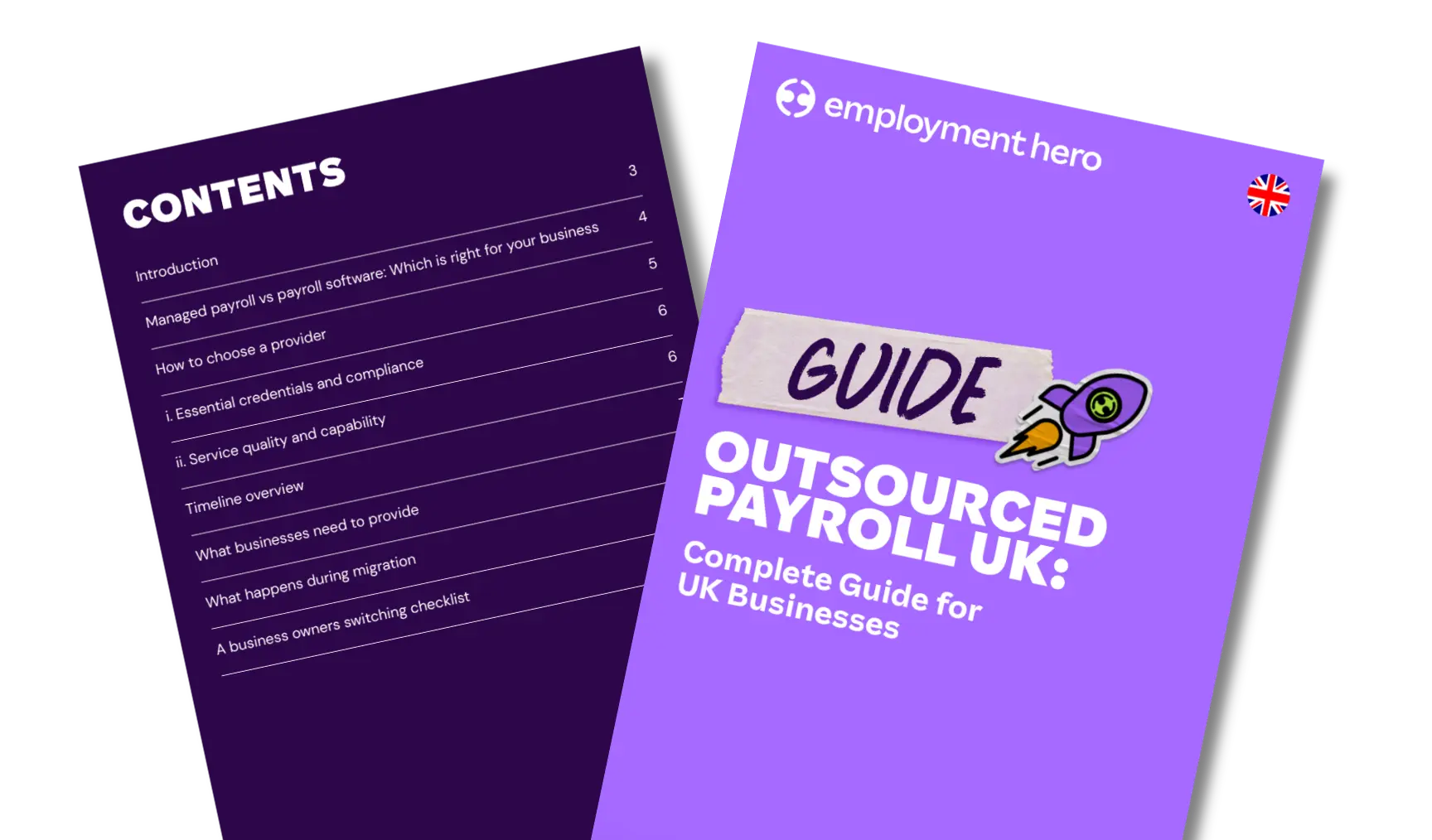
Outsourced Payroll UK: Complete Guide for UK Businesses
Master your pay runs with our outsourced payroll UK guide. Learn how to save 120 hours a year and stay…
-
 Read more: The Ultimate Guide to the Employee Life Cycle
The Ultimate Guide to the Employee Life Cycle
Learn the full scope of the employee life cycle and how it impacts recruitment, onboarding and retention.
