 Australia
  New Zealand
  Singapore
  Malaysia
  Canada (Français)
 United Kingdom





UK Hiring Compliance Guide: Right to work, DBS and Interviews
Published
UK Hiring Compliance Guide: Right to work, DBS and Interviews
Everything you need to train your hiring managers to hire confidently and lawfully
Last Updated
Foreword by Simon Obee
Head of HR Advisory at Employment Hero

“Most employers I speak to know the Equality Act 2010 exists. But way fewer realise how much of it applies before anyone is hired, or that a job applicant can bring a discrimination claim without ever having worked for the business. There’s no cap on compensation in discrimination claims, and the tribunal time limit for bringing one is planned to extend from three months to six months on 1st October 2026.
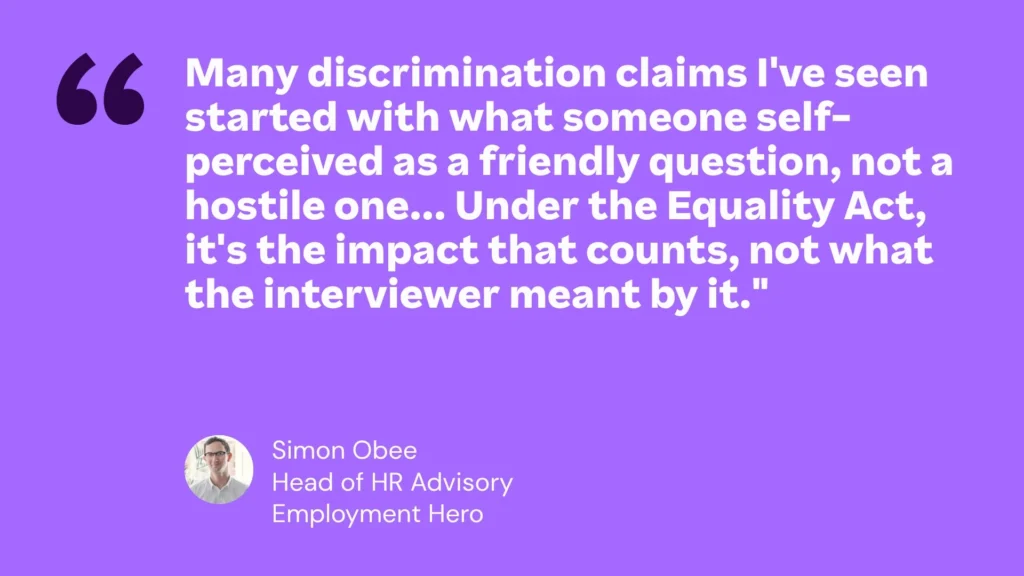
In my experience, the problem is rarely that employers intend to discriminate. It’s that hiring decisions are made by managers who have had little or no training on their legal obligations, working from assumptions rather than the law. The Equality Act assesses the effect of a decision on the candidate, not the intention behind it, so good faith isn’t a defence.
That’s why process matters more than awareness. Structured interview questions, the same checks applied consistently to every candidate and up-to-date notes explaining decisions will protect a business far better than relying on individual managers to remember the right thing at the right moment.
In addition to this, UK employment law is undergoing its biggest shift in years, with changes made by the Employment Rights Act 2025 being introduced throughout 2026 and 2027.
In particular, from January 2027, employees are expected to gain unfair dismissal rights after six months’ service rather than two years, with the compensation cap removed, meaning probation periods should be reviewed and aligned accordingly.
Many employers know the Employment Rights Act exists, but over half of businesses (53%) we spoke to for a recent Employment Hero report said they’re still worried about it, especially unintentionally breaching new employment laws.
There are major changes in immigration law too. From 1st October 2026, the duty to carry out right to work checks is due to extend beyond employees to a much wider group, including contractors, agency workers and those engaged through platforms.
This guide sets out what your hiring managers need to know and what to do about it.
It also includes the option to download and takeaway a free interview template and scorecard.
If you need tailored support, Employment Hero’s HR Advisory team works directly with employers to interpret legislation, update policies and manage risk.”
What’s in this guide:
- Right to work checks 2026 and what changes on 1st October
- One law, nine protected characteristics
- Writing the job ad
- Shortlisting and sifting
- What your managers should and shouldn’t ask
- Health and disability questions: what you can’t ask before an offer
- Criminal record checks
- Candidate data and AI screening
- When treating candidates differently is lawful
- Keeping records
- Feedback and rejections
- What’s changing under the Employment Rights Act 2025
- Plus: a free interview template and scorecard your managers can use straight away
One law, nine protected characteristics
UK discrimination law runs through a single piece of legislation: the Equality Act 2010. It applies across England, Scotland and Wales. Northern Ireland has its own separate equality legislation, so if you hire there, check the NI position too.
The Act protects nine characteristics:
- Age
- Disability
- Gender reassignment
- Marriage and civil partnership
- Pregnancy and maternity
- Race
- Religion or belief
- Sex
- Sexual orientation
Protection starts at the job advert. It covers advertising, shortlisting, assessment, interview, offer, terms and even references after someone has left. There’s no point throughout the hiring process where the Act doesn’t apply.
The six things that count as unlawful
Your managers might think of discrimination as one thing. It’s actually six.
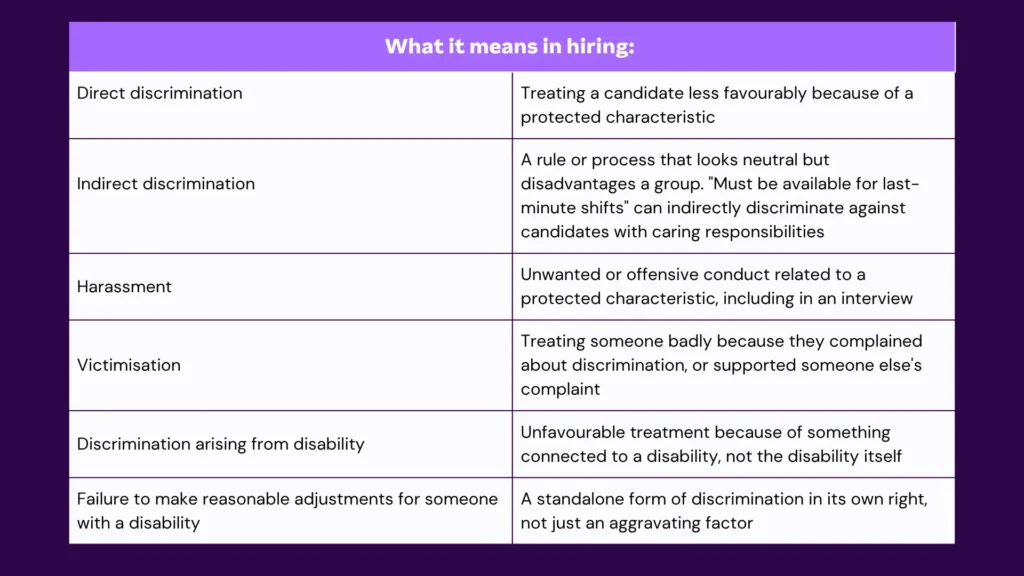
Three points to cover in training:
Intent doesn’t matter. It can still be discrimination where nobody meant any harm. A tribunal looks at effect, not motive.
Association counts. A candidate can be discriminated against because of someone close to them: a disabled child, a partner’s religion, without having the characteristics themselves.
Pregnancy and maternity work differently. For every other characteristic, the test is whether someone was treated less favourably than a comparator. For pregnancy and maternity, it’s unfavourable treatment, with no comparison needed at all. That’s a lower bar for a claimant, and it’s why pregnancy is the characteristic to be most careful about in a hiring context.
Writing the job ad
Protection starts before anyone applies. A job ad that narrows the field on a protected characteristic is discrimination even if nobody ever complains, and it’s the easiest thing in the hiring process to get right because you can edit it before anyone sees it.
The language to watch:
- Age-coded wording. “Young and energetic”, “digital native”, “recent graduate” and “mature” all signal an age preference. If you want someone adaptable, say adaptable.
- Gendered role language. “Salesman,” “he’ll be responsible for,” or describing a role as suiting a particular temperament that reads as male or female.
- “Native English speaker.” This is a nationality proxy. If the role needs a specific standard of written or spoken English, describe the standard and the task.
- Physical requirements stated as attributes. “Must be physically fit” is a problem; “involves lifting up to 20kg several times a day” is the actual requirement, and a candidate can tell you whether they can do it, with or without adjustments.
- Degree requirements the job doesn’t need. A degree filter narrows on age, race and disability at once. Ask for the capability, not the credential, unless the role genuinely requires it.
Two things worth adding to every ad. Say that adjustments are available and how to request them, so a candidate doesn’t have to disclose a disability to a hiring manager to find out whether the process can flex. And include the salary or a range—it isn’t a legal requirement in the UK, but it’s the direction of travel, and it’s a fair-pay signal candidates increasingly expect.
Shortlisting and sifting
This is where indirect discrimination usually happens and it’s the stage most employers never audit. A sift looks objective because it’s applied to everyone, but a neutral-looking rule that disadvantages a group is still unlawful unless you can objectively justify it.
Agree your criteria before the applications arrive. Once you’re reading CVs, it’s very easy to build criteria around the candidates you like and much harder to explain later why the bar moved.
The common proxies to look for:
- Unbroken employment history. Gaps disproportionately affect carers, disabled candidates and people who’ve been ill. Ask about the gap rather than screening on it.
- “Must live within X miles.” In some areas this maps closely onto ethnicity. If the role needs someone on site at short notice, say that instead.
- Degree requirements. Same problem as in the ad, now doing real damage to your shortlist.
- Continuous recent experience in the sector. Often a proxy for age, and frequently not what the job needs.
Blind or anonymised sifting is the most practical mitigation available—removing names, addresses, schools and dates from what the sifter sees. It won’t fix a flawed criterion, but it stops the criterion being applied unevenly.
One point on automated tools: if software produces your shortlist, a manager approving it without seeing how it was built isn’t doing meaningful human review. That distinction matters legally as well as practically, and the Candidate data and AI screening section below covers what’s now expected.
What your managers should and shouldn’t ask
Interviews are where most hiring discrimination happens, because they’re the least scripted part of the process. But the questions are only half of it. Most of what goes wrong is an assumption formed before anyone sits down, so it’s worth training your team on both.
Age
Age comes up more often than managers realise, and rarely as a direct question. It’s more likely to surface as an assumption about someone’s skills—that an older candidate won’t pick up new systems, or that a younger one lacks judgement. It’s worth training your team to notice that, because it shapes shortlisting long before anyone gets to interview.
The questions to avoid are age itself, when someone left school, and anything implying a role suits a particular generation. Job ad language matters just as much: “young and energetic” and “digital native” both narrow the field on age grounds.
There are genuine exceptions where a role has a legal minimum age, such as selling alcohol. And age is the one characteristic where direct discrimination can be objectively justified, though that needs a legitimate aim and evidence the treatment is proportionate. A preference for a younger team is neither.
Sex, sexual orientation and gender reassignment
The rule here is simple enough: keep the conversation on the job. Questions about relationships, sexuality or someone’s gender history have no bearing on whether they can do the work, and should not be asked.
The subtler risk is a manager deciding a role is better suited to men or women and then assessing candidates against that. It rarely gets said out loud, which is exactly why it’s worth naming in training.
Marriage, civil partnership, pregnancy and maternity
Marital status, family plans, pregnancy and childcare are all off limits, including the friendly versions.
“How do you manage the school run?” is the same question with a warmer face, and it’s usually asked by someone trying to build rapport rather than screen anyone out.
Where a role has genuine scheduling demands, the fix is to ask about the requirement rather than the person’s circumstances. “This role includes one weekend in four, is that something you can commit to?” is a fair question to put to every candidate. “Do you have kids?” isn’t, and it also tells you nothing about whether they can work on the weekend.
Pregnancy needs particular care because the legal test is lower here than anywhere else: unfavourable treatment is enough, with no comparison to another candidate required.
Race
Race covers colour, nationality and ethnic or national origins. The questions to train out are “where are you originally from?” and anything about accents—both usually meant as small talk, both could expose you to a claim.
Immigration status needs separate handling. You have a duty to check someone’s right to work, and a duty to check everyone the same way. The next section covers how to do both.
Religion or belief
This is broader than most managers expect. It covers philosophical beliefs as well as organised religion, so it isn’t only about the major faiths.
Questions about religious observance are the ones to avoid. Where a role has fixed hours or set shifts, the answer is to state them and ask every candidate whether they can work them. That gets you the information you need without asking anyone why they might not be able to.
Disability
Covered in its own section below, because the rules on health and disability questions are stricter than most employers realise, and they apply before anyone reaches an interview.

Right to work checks 2026 and what changes on 1st October
This one sits outside discrimination law, and it’s the compliance change UK employers should be preparing for right now.
Every employer must check that a person has the right to work in the UK. Do the check correctly, keep the right evidence and you get a statutory excuse: protection against liability if it later turns out the person didn’t have permission. Get it wrong and civil penalties reach £45,000 per worker for a first breach and £60,000 for a repeat breach.
What’s changing
From 1st October 2026, section 48 of the Border Security, Asylum and Immigration Act 2025 extends the checking duty well beyond employees. It brings in:
- Workers and individual sub-contractors
- Agency and temporary workers
- Individuals engaged to deliver services under a contract that allows them to substitute another person to do the work in their place.
- Casual and zero-hours workers
Businesses that operate an online platform that matches service providers with clients, where the service provider then contracts with the client or customer directly, will also be required to carry out right to work checks.
Organisations that use agency staff can also be held liable if they don’t insist that the agency they use carries out right to work checks on the staff it supplies.
The Home Office updated its draft Code of Practice on 30 June 2026 to cover how this works in practice, including arrangements involving substitution clauses and contracting chains.
Two things to be clear on. First, this doesn’t make any of these people employees for employment law purposes. It just means the business engaging them picks up right to work obligations and penalty exposure. Second, genuinely self-employed people in business on their own account, contracting directly with their own clients, stay outside the scheme. The real risk for most businesses is classifying someone as self-employed when they aren’t.
When to check, and how
The check must be completed before the person starts work. In practice, offer stage is the moment to do it: after a conditional offer, before the contract is issued. That gives you time to resolve anything unexpected without having to withdraw a signed agreement, and issuing the contract first is the sequence that catches employers out.
Most checks run through the Home Office online service using a share code, which the candidate generates and gives to you. British and Irish passport holders can be checked manually, but for everyone else the share code route is the main one that gives you a statutory excuse.
Where someone’s permission to work is time-limited, you’ll need a follow-up check before it expires. Diarise it at the point of hire rather than trusting anyone to remember two years later. Losing track of an expiry date is one of the more common ways an otherwise compliant employer ends up exposed.
Check everyone, the same way
Every candidate who reaches the job offer stage should have their right to work checked. If some are asked for documents and others aren’t, and the difference comes down to a name, an accent or an assumption about where someone is from, that’s race discrimination. The candidate has been treated differently because of who they are, which is unlawful for the same reason everything else in this guide is.
The basis for checking should always be the stage someone has reached, never who they appear to be. Build it in as a standard step and you have both the fair process and the compliant one.
Practical steps before October
- Consider all the different types of people that will perform work for you from 1st October 2026 onwards. Categorise them: employee, worker, sub-contractor, agency, platform, genuinely self-employed, etc
- Make sure that you understand which types of worker you will need to conduct right to work checks for and how you will do this
- Add an express term to agency and staffing agreements requiring the agency to carry out checks and evidence them on request
- Check your onboarding platform stores the evidence in a form you could produce on request
Health and disability questions: what you can’t ask before an offer
If your application form asks about health, sickness absence or disability, you may already be in breach.
“If there’s a health question on your application form, you may already be in breach of the Equality Act. It’s a common mistake, and it’s usually because people are using an application form they inherited rather than one they wrote themselves.”
Simon Obee, Head of HR Advisory at Employment Hero
Section 60 of the Equality Act 2010 restricts asking about a candidate’s health or disability before you make a job offer. The exceptions are narrow, such as: to work out whether adjustments are needed for the assessment process, for diversity monitoring, for positive action, or where a function is intrinsic to the role.
If an exemption doesn’t apply, then health questions need to be asked after the job offer is made. If a position requires a medical check, it won’t be a breach of section 60 to make a conditional offer subject to medical checks and enquiries to be carried out after the offer is made.
Reasonable adjustments
The duty to make reasonable adjustments for individuals who have a disability applies to the recruitment process, not just the job. If a candidate asks for a reasonable adjustment, you’re expected to make it. Common ones include:
- A video or phone interview instead of in person
- Extra time on a task or assessment
- Assistive technology, or accepting a submission in a different format
- Interview questions shared in advance
- A different room, or a break partway through
Say in your job ads and invitations that adjustments are available and how to request them. Candidates shouldn’t have to disclose a disability to a hiring manager to find out whether the process can flex.
Criminal record checks
A criminal record isn’t a protected characteristic under the Equality Act 2010, but it’s governed separately and getting it wrong still creates discrimination exposure.
Three levels of check exist in England and Wales, through the Disclosure and Barring Service (DBS): Basic, Standard and Enhanced. In Scotland it’s Disclosure Scotland; in Northern Ireland, AccessNI.
Standard and Enhanced checks are only available for eligible roles, which are set out in legislation rather than chosen by the employer. If a role isn’t eligible, a Basic check is the only option.
Under the Rehabilitation of Offenders Act 1974, most convictions become spent after a set period, and a candidate generally doesn’t have to disclose them. Refusing to hire someone over a spent conviction is unlawful in most cases.
It’s only possible to discriminate on the basis of unspent criminal convictions where they are relevant to the role. Employers should therefore avoid blanket screening. A flat “no criminal records” rule is an indirect discrimination risk, given the documented disparity in conviction rates across ethnic groups. Assess relevance to the role instead, and document how you did it.

Candidate data and AI screening
If any part of your hiring process scores, ranks or sifts candidates automatically, the rules changed earlier this year, and most employers haven’t caught up.
On 31st March 2026 the Information Commissioner’s Office (ICO) published Recruitment Rewired, a report on automated decision-making in recruitment, alongside draft guidance for consultation. The report draws on voluntary engagement with more than 30 employers between March 2025 and January 2026, plus public perceptions research and the ICO’s earlier audits of AI recruitment tool vendors.
The ICO report found that most employers using AI to screen and score candidates don’t recognise that they’re carrying out automated decision-making at all, which means the required safeguards aren’t in place.
The legal ground shifted too. The Data (Use and Access) Act 2025, in force from 5th February 2026, rewrote how UK GDPR treats solely automated decisions. The old near-prohibition has been replaced with a permissions-plus-safeguards model. More room to use automation, conditional on getting the safeguards right. Stricter rules still apply where special category data is involved.
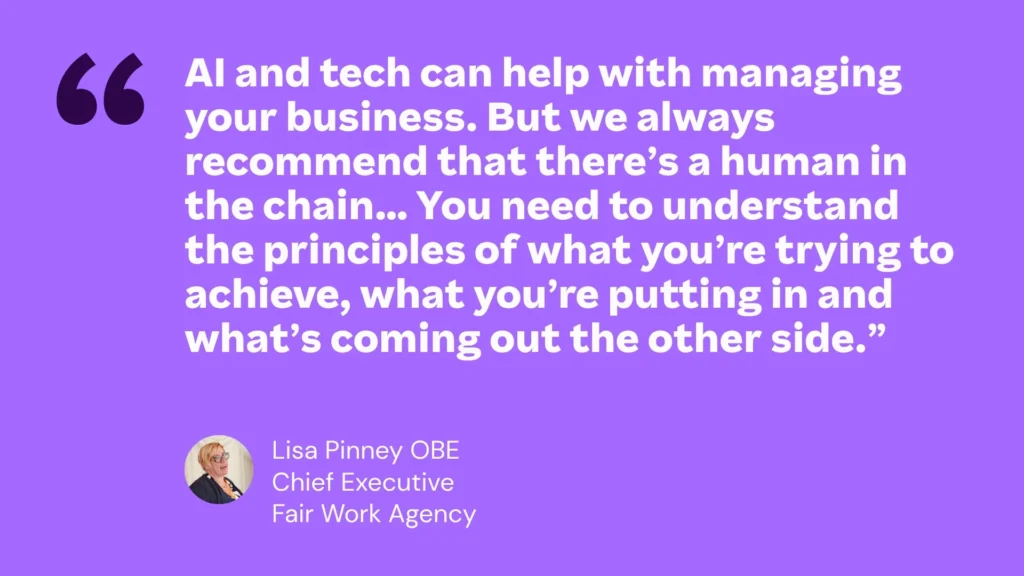
The Fair Work Agency took the following view in an interview with Employment Hero:
What the ICO expects
- Acknowledge it. Know which of your tools make or materially shape a decision with limited human input
- Run a data protection impact assessment (DPIA). The ICO notes one is likely to be required for automated decision-making in recruitment
- Tell candidates. Transparency about what’s automated and how it works
- Give a real right to challenge. Candidates must be told how to request human review, and that route has to actually function. A form that goes nowhere isn’t a process
- Monitor for bias. Documented reviews across protected characteristics, on a regular cadence
- Ask your vendor. Get their bias testing in writing, in the contract, before you buy
The consultation on that draft guidance closed on 29th May 2026, and the ICO plans to publish a final version in winter 2026. The draft is the best available signal of what will be expected, so it’s worth aligning to it now rather than waiting.

Where Employment Hero fits
At Employment Hero, our AI Recruitment Agent powered by Hero AI screens and scores applicants, then hands the decision to you. You can see how a candidate was assessed and why. The shortlist is yours to change.
That’s the difference between AI that does the work and AI that makes the call, and it’s the human in the chain both regulators are asking for.
It’s also why productivity gains hold up under scrutiny.
- REEL Cinemas filled 59 roles from 12,000+ applicants and cut its time to hire to 15 days.
- UK tech firm Extend Robotics cut CV sifting by 70% and doubled its hiring capacity.
- Squared evaluated up to five times more candidates and dropped phone screening altogether.
Same compliance posture, but far less admin.
When treating candidates differently is lawful
There are narrow, specific circumstances where a protected characteristic can lawfully come into a hiring decision. Your managers should know these exist, and know how tight they are.
Occupational requirement (Schedule 9, Equality Act 2010). Where having a characteristic is a genuine requirement of the role. Recruiting a female security officer to conduct searches of women is the textbook example.
Positive action in a tie-break (section 159). Where candidates are as qualified as each other, an employer may take a protected characteristic into account to address under-representation. This applies at the point of a genuine tie and nowhere else, so it applies only where you genuinely cannot separate two candidates on merit.
Objective justification. Available for indirect discrimination, and uniquely for direct age discrimination. It requires a legitimate aim and evidence that the treatment is a proportionate way of achieving it.
The disability exception. You can specifically recruit a disabled person without risking a disability discrimination claim.
The law here is really complex, and each of these is narrower in practice than it sounds on paper. If you’re planning to rely on one, take professional advice first.
Employment Hero’s HR Advisory service includes unlimited access to HR and employment law advice. It’s the kind of question worth asking before you write the job ad, not after.
Keeping records
The guide keeps saying “document your reasoning.” Here’s what that means in practice.
Keep, for every candidate who reaches the interview stage: the questions asked, the scores or assessments given, the evidence behind each score, the reason for the decision, and any adjustments offered and provided. And keep your evidence of right to work checks 2026 separately, in a form you could produce on request.
The practical point is about timing rather than volume. Notes written during or immediately after an interview carry real weight. Notes reconstructed months later, after a complaint has arrived, carry very little—and a tribunal can usually tell the difference.
How long to keep them: at minimum, long enough to cover the claim window. That’s currently three months less one day from the act complained of, and it will extend to six months on 1st October 2026 under the Employment Rights Act 2025. Six to twelve months is a reasonable working default, balanced against your data protection obligation not to keep candidate data longer than you need it.
Feedback and rejections
Rejections are a claim trigger, and mostly for an avoidable reason: a candidate who hears nothing fills the silence with their own explanation, and that explanation is often “it was because of who I am.”
Three things make this safer, and all three are also just better practice.
Give a reason tied to your criteria. “We were looking for more experience managing a team of this size” tells the candidate something true and specific. It also demonstrates the decision was made on the criteria you set out.
Keep the reason consistent with your notes. The risk here is a manager softening a rejection with a kinder-sounding reason that contradicts the scorecard. If a claim follows, the two versions sit side by side, and the inconsistency does more damage than the original decision would have.
Respond to requests for feedback. A candidate is entitled to ask, and a business that goes quiet at that point looks like it has something to hide.
None of this needs to be labour-intensive. It needs to be consistent, which is a process problem rather than a workload one.
What’s changing under the Employment Rights Act 2025
The Act received Royal Assent on 18th December 2025 and is being phased in across 2026 and 2027. It reshapes obligations across the whole employee lifecycle, and two of those changes bear directly on how you hire.
Unfair dismissal, from 1st January 2027. The qualifying period drops from two years to six months, and the statutory cap on the compensatory award is removed. It applies to dismissals from that date, so anyone hired from around the end of June 2026 will have protection by January. Probation periods should be reviewed and aligned accordingly.
Zero-hours and low-hours work. Wider restrictions on exclusivity terms have been in force since 6th January 2026. The right to guaranteed hours based on hours regularly worked, and to reasonable notice of shifts, is expected in 2027. If you hire casual or seasonal staff, the offer you make at the recruitment stage is what these rules will bite on.
Implementation dates have already moved once, so treat any timetable as provisional and check before you brief your team.
The Act goes considerably wider than recruitment: statutory sick pay, family leave, harassment duties, collective redundancy, flexible working and equality action plans all change too, and enforcement now sits with the new Fair Work Agency. For the full picture and timings, see our Ask the Experts breakdown of the Employment Rights Act 2025 and the in-depth Employment Rights Act 2025 Guide (updated May 2026).

What this means for your hiring managers
Recruitment is about to carry far more weight than it used to.
When unfair dismissal protection starts at six months and compensation is uncapped, hiring quickly and resolving problems during probation becomes much harder. There is far less room to correct a hiring decision after the fact.
None of that argues for slower hiring. It argues for better-structured hiring: consistent questions, a robust audit trail, decisions you can explain six months later. Which happens to be exactly what discrimination law has always asked for.
Where to get help
- The Advisory, Conciliation and Arbitration Service (ACAS), for employment relations guidance and the Early Conciliation route a claimant must usually go through before a tribunal claim
- The Equality and Human Rights Commission (EHRC), for Equality Act guidance and codes of practice
- GOV.UK, for right to work checks 2026, DBS and the current Employment Rights Act timetable
- ICO, for data protection and automated decision-making in recruitment
Worth knowing: the time limit for a discrimination claim is currently three months less one day from the act complained of, adjusted while Early Conciliation is running. Under the Employment Rights Act 2025 this will extend to six months on 1st October 2026. It’s a short window either way, and it starts at the interview.
Turn this into something your managers can use
Reading this is the easy part. Getting twelve hiring managers to interview consistently is the hard part, and it doesn’t happen through training alone.
The template at the end of this guide is where to start. It’s yours to adapt, share and reuse, and it builds the record you’d want if a decision were ever questioned.
Get hiring compliance out of your head and into your process
Better-structured hiring isn’t just lower-risk, it’s better hiring. Consistent questions and documented reasoning are how you actually compare candidates fairly, and pick the right one.
Employment Hero is an AI-powered Employment Operating System. Job ads, applications, structured interview workflows, right to work evidence, contracts and onboarding all sit in one place, so the check happens because it’s the next step, not because someone remembered.
AI Recruitment Agent powered by Hero AI handles the screening and scoring. You keep the decision, and the reasoning stays visible.
Disclaimer: This guide is general information only, current as at 26th August 2026, and is provided in good faith to assist UK employers. It isn’t legal advice and shouldn’t be relied on as a substitute for it. Employment law changes frequently. Check the current position with a qualified adviser before acting.
Download the template
Related Resources
-
 Read more: Leeds is outpacing Manchester in the race for talent ahead of Roses derby, new Employment Hero research finds
Leeds is outpacing Manchester in the race for talent ahead of Roses derby, new Employment Hero research finds
New Employment Hero research shows 61% of Leeds workers moved to the city, and small business employment grew 12.1% vs…
-
 Read more: Employment Hero Partners with Leeds United Foundation for Supporting Our City Awards
Employment Hero Partners with Leeds United Foundation for Supporting Our City Awards
Employment Hero launches Hero Foundation in the UK alongside Leeds United Foundation to help people facing barriers to employment find…
-
 Read more: Pressure is a privilege: Sara Essa on performing when it counts
Pressure is a privilege: Sara Essa on performing when it counts
Sport broadcaster Sara Essa on pressure, setbacks and building something that lasts, ahead of Beyond the Boundary at Headingley, 15th…