
















UK employers are bracing for the Autumn Budget as fears mount that higher employment taxes could further slow the labour market.
A new survey of 1,000 senior business leaders commissioned by Employment Hero reveals raising labour costs – such as employer National Insurance Contributions – risks hindering the Government’s mission to stimulate economic growth and manage inflation.
Along with other significant findings, the data points to heightened anxiety among business leaders, showing 86% are concerned about the impact of upcoming Budget decisions and 59% believe small firms are not adequately considered when policy is set.
The figures, drawn from Employment Hero’s real-time data and a survey of 1,000 small business leaders, were launched as part of a wider bid to highlight the importance of keeping employment costs down and underscore just how widespread caution around potential increases to employer costs is becoming.
Recovery Remains Fragile
After a challenging 18 months, many small firms have only recently started to see improved hiring conditions and stabilising demand.
According to Employment Hero’s data, as many as 7 in 10 (72%) business leaders say that the Budget announcement in 2024 had an impact on them, with 37% saying it had a big impact (8 on a scale of 0-10) overall, and 43% of small businesses with 150-499 employers feeling the largest impact.
Higher Employment Costs Could Stall Progress
At a moment when the labour market appears to be steadying, the 2025 Budget, which could bring with it higher employer costs, may well halt momentum.
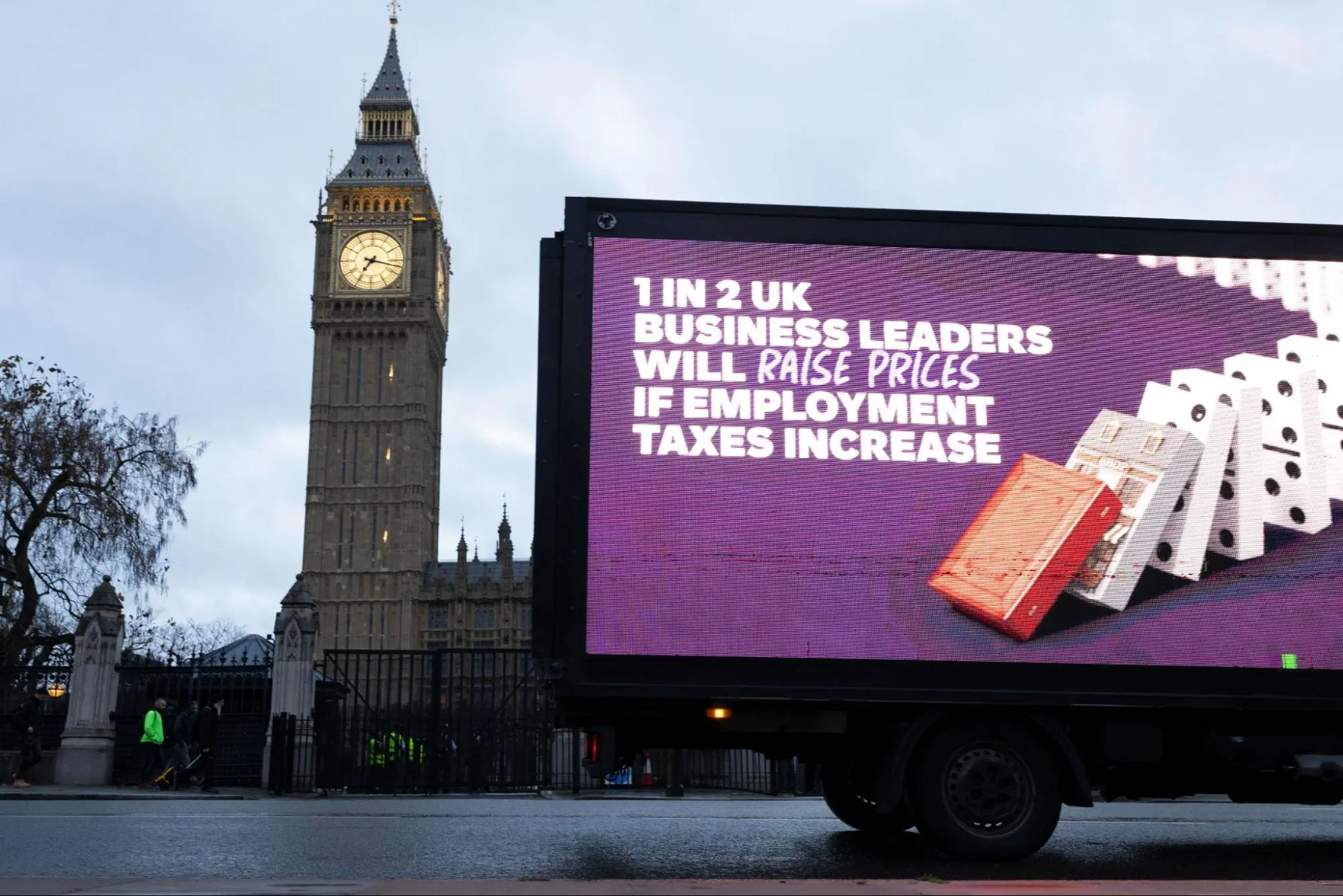
Employment Hero’s data shows that one in two businesses (49%) would consider raising prices if staffing expenses increase, one third (33%) would delay hiring and almost a quarter (24%) would consider redundancies.
Employment, meanwhile, is up 2.3% month-on-month and 4.3% compared with three months ago, continuing the steady recovery that began in March after the sharp drop following the 2024 Budget. Year-on-year growth shows momentum has been relatively slow too. At 1.9%, progress is well below the 7-8% levels seen before April 2025.
While wages are up 2.4% month-on-month and 6.9% compared with three months ago, reflecting strong short-term momentum beginning in March and accelerating between September and October, they’re only up 1.5% year-on-year. Not only is that lower than inflation, year-on-year figures have been in steady decline for months, with 2.1% in September, 3.7% in August, 2.6% in July 2.6% and 4.1% in June.
Taken together, the findings point to a potential cooling effect on job creation and consumer prices if employer burdens rise further.
Warning for Employers
Kevin Fitzgerald, UK Managing Director at Employment Hero, notes that the Budget should be used to restore confidence rather than knock it. Highlighting the immediate impact of last year’s Budget on hiring activity, he says:
“When you tax small businesses, you tax everyone. It creates a domino effect – higher costs lead to higher prices, fewer jobs and less money in people’s pockets. Small businesses employ the majority of our workforce. Make life harder for them, and you make it harder for Britain to grow.
He stresses that “the Autumn Budget is an opportunity to learn from past mistakes”, pointing out that Employment Hero’s “data shows the real impact last year’s employment taxes had on small businesses.”
That’s not to say businesses have thrown in the towel. Fitzgerald makes clear that businesses “remain resilient as ever – with October tracking a 2.3% growth in employment.
“If the Government wants to continue this job growth and control inflation, they can’t keep penalising the very businesses that power our economy. We simply can’t afford a repeat performance. The way to get Britain working again is to back small businesses, not burden them”, he adds.
Insolvency Activity Rises
Real time market signals also suggest businesses are preparing for tougher conditions. Insolvency specialists have seen a sharp rise in demand, historically a sign that firms are facing stress.
Kellie Linward, founder of Archer International, a restructuring and insolvency recruitment company, says demand for services like hers has accelerated since late summer. Given that they work with businesses vulnerable to collapse, she notes:
“When this market gets busy, it is often an early warning signal that businesses are starting to struggle. Since the summer holidays, it has ramped up,” she explained. “Costs have risen, cash is tight, and some firms simply are not willing to take the risk of hiring right now.”
Selective Hiring Amid Cost Pressures
Despite rising restructuring activity, Linward noted a strategic shift among employers who are continuing to hire in certain specialist areas but doing so more selectively. “Businesses are looking for value over volume. We are talking to clients we would not typically have spoken to two years ago,” she added.
Bridget O’Keefe, founder of London-based beauty and blow-dry bar, Blush and Blow, echoes the anxieties so many other small businesses are dealing with.
She claims that if taxes continue to rise, she’ll be “left with one of two decisions: take the hit ourselves”, a prospect she considers impossible given the disproportionately high tax burden on the personal care industry, “or pass the increase onto our clients.”
Small firms, which account for 99% of UK businesses, remain central to Britain’s economic performance. With hiring recovery still fragile, industry leaders argue that any rise in the cost of employment risks triggering a pause in recruitment and broader investment plans.
O’Keefe adds: “The fundamental problem is that the Government is looking in the wrong place for the money they so desperately need.
“It is getting harder and harder to have a healthy bottom line without constantly increasing prices, and at some point the pushback from our clients will leave us in a stalemate.”
Waiting for the Chancellor’s Signal
With only days until the Budget, many small employers are holding back on hiring and major spending decisions until they see whether the Chancellor opts to prioritise growth or raise revenue.
For now, the mood among small firms remains cautious, with the next wave of economic signals expected to determine whether the labour market continues to strengthen or enters another period of hesitation.