














Small businesses (SMEs) are bucking national unemployment trends as year-on-year hiring growth surges to 4.4%, according to Employment Hero’s January Jobs Report.
As staff numbers climb, Employment Hero’s data – tracking real-time figures from over 115,000 SME employee records – shows that SMEs are acting as a vital buffer for the UK economy against the national unemployment rate of 5.2%.
Is the UK job market recovering? SME hiring vs national trends
The unemployment figures, taken from the Office for National Statistics’ (ONS) latest Labour Market Overview, has painted a sobering picture of a weakening UK labour market, with payrolled employees falling by 134,000 over the last year.
However, the 4.4% in SME employment (up from 2.5% year-on-year in December) suggests a two-speed labour market. As larger organisations shed staff amid high interest rates and economic shifts, smaller businesses are moving through a U-shaped recovery that began in October.
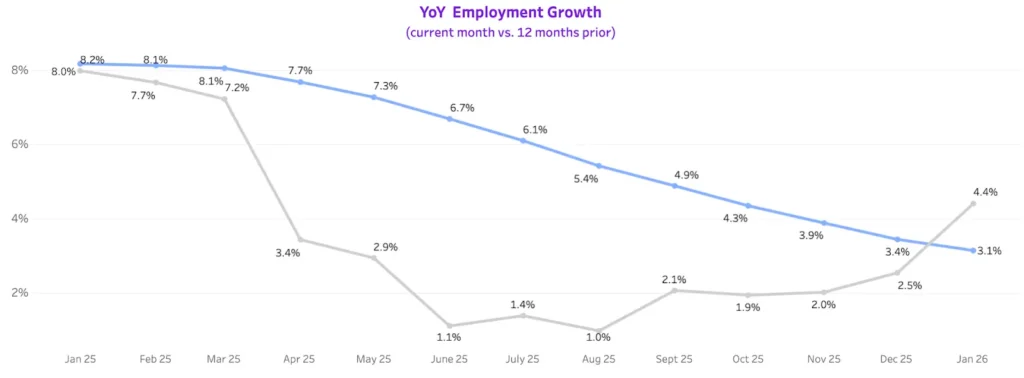
Some of that is likely being driven by specific pockets of growth; for example, Employment Hero figures show Gen-Z employment in construction and trades surged by 16.8% in January as younger workers move toward vocational roles. Clearly, For SMEs, the focus has shifted back to growth, even as the wider economy stutters.
Are SMEs prioritising job security over pay rises?
Still, SMEs are finding that increasing staff numbers is coming at a significant cost even as national inflation – as reported by the ONS – cools to 3.0%.
In fact, the ONS Business Insights and Conditions Survey (BICS) report released last week shows that 36% of businesses with over 10 employees now name the cost of labour as their top business challenge.
Employment Hero’s data shows how SMEs are reacting to this pressure: for the first time in 12 months, month-on-month wage growth in small businesses turned negative, standing at -1% in January.
In the North of England, that turn was even higher, with wages dropping 4.9% month-on-month. Taken together, the figures suggest that some SME leaders are prioritising job creation and security over individual pay increases as they brace for April’s tax and regulatory shifts.
While previous Employment Hero data has highlighted a period of stagnation in terms of employment growth alongside growing wages, January’s marginal -1% month-on-month wage growth dip suggests employers should be mindful of further impact on pay growth.
“January’s wage dip is an early warning sign,” says Kevin Fitzgerald, UK Managing Director at Employment Hero.
“With ONS data confirming that labour costs are the number one concern for 36% of employers, we’re seeing a strategic pivot. While it’s encouraging to see hiring growth trending upwards, the recovery is delicate. If costs continue to rise faster than confidence, hiring could be the next casualty.”
How does the inflation drop affect SME workers?
Despite month-on-month challenges, the year-on-year figure is a positive sign of resilience among SMEs. Jobs Report figures show year-on-year wage growth coming in at 5.6% and inflation dropping to 3.0%, pay is now rising faster than the price of goods and services, meaning SME employees are seeing their purchasing power increase for the first time in months.
The shift marks the first time since June 2025 that earnings have outpaced price hikes, offering a potential reprieve for a workforce that has spent the better part of a year seeing their income eroded by double-digit inflation.
What should UK employers expect for the rest of 2026?
For SMEs, however, the rest of the year will be a balancing act. While it’s good news that prices across the country are rising more slowly, the actual cost of running a business – from rent to energy bills – remains high. With the Bank of England now considering interest rate cuts as early as March, there is some hope that business financing will become cheaper. However, that optimism could be tempered by upcoming tax and regulatory changes, which will likely force SMEs to be extremely cautious with spending.
While SMEs have proven resilient in hiring so far, the sustainability of that growth also depends on their ability to manage challenges like the upcoming National Minimum Wage spike without further compromising wage growth. For now, SME owners will likely spend the next few months focused on balancing these increased statutory costs against the need to retain the staff they have worked so hard to recruit during the recent recovery.
Strategic steps for managing 2026 labour costs
- Audit payroll systems now to ensure readiness for the National Minimum Wage increases (rising to £12.71 in April).
- Review recruitment budgets to ensure the current hiring momentum is sustainable through Q2 cost spikes.
- Benchmark regional pay to stay competitive, particularly in the North where wage volatility is highest.