


















A UK Business Owner’s Guide to Running a Payroll Audit
Published
A UK Business Owner’s Guide to Running a Payroll Audit
Published
Most UK business owners hear “payroll audit” and think of brown envelopes from HMRC, penalties and sleepless nights. But here’s the reality: a proactive payroll audit isn’t a punishment, it’s a strategic advantage.
Small payroll errors happen all the time. An incorrect tax code, an outdated employee record, a missed RTI submission. Left unchecked, these mistakes compound into compliance issues and potential HMRC investigations. But caught early through a systematic audit? Most are fixed in minutes.
Think of a payroll audit as a health check for your employment processes. It’s your chance to verify accuracy, ensure HMRC compliance and often uncover cost savings you didn’t know existed. Regular audits should be part of your business rhythm, not something you scramble to do when HMRC comes knocking.
In this guide, we’ll walk you through exactly how to conduct a payroll audit for your UK business. You’ll get a practical checklist, understand what errors to look for and learn what to do if you find mistakes. A comprehensive audit takes 2-3 hours for most SMEs, time that’s more than worth the investment.
What is a payroll audit (and why UK businesses need one)
A payroll audit is a systematic review of your payroll processes to verify that you’re paying employees accurately, meeting HMRC compliance requirements and maintaining proper records. It’s a detailed check that everything in your payroll system matches reality.
There are two types to understand:
- Internal audit (proactive): You conduct this yourself or through your accountant to catch errors before they become problems and maintain control over compliance.
- HMRC audit (reactive): This happens when HMRC opens a compliance check into your business, usually triggered by red flags like repeated late filings, significant underpayments or employee complaints.
Why SMEs need regular payroll audits
- HMRC compliance
UK payroll has strict requirements: Real-Time Information (RTI) submissions, PAYE and National Insurance contributions deductions, auto-enrolment pension duties, statutory payments and IR35 rules. Get these wrong consistently and penalties start at £100 and escalate quickly. - Cost savings
Audits regularly uncover overpayments to former employees, incorrect tax codes, duplicate payments and overtime miscalculations. - Process improvements
Beyond compliance and cost, audits reveal workflow inefficiencies. Undocumented processes, manual calculations that should be automated and knowledge gaps when team members leave.
The difference between proactive businesses and those constantly firefighting? The proactive ones audit regularly and find small issues while they’re still small.
Common payroll errors that cost UK businesses
Most payroll mistakes aren’t malicious; they’re the result of manual processes, outdated information or misunderstanding complex regulations. Here are the most common:
- Incorrect tax codes
HMRC issues tax code changes via P6 and P9 notices. If you don’t update these in your system, you’ll over-withhold or under-withhold PAYE, causing problems for both you and your employees. - Employee misclassification
Treating someone as a contractor when they should be on payroll (or vice versa) creates issues with National Insurance, pensions and employment rights. With IR35 rules now applying to medium and large businesses, the stakes are high. - Outdated employee records
Leavers who remain on the payroll system are surprisingly common. You continue processing them, your headcount is wrong and RTI submissions don’t match your actual workforce. - Pension auto-enrolment errors
Contribution rates, eligibility assessments and annual re-enrolment requirements create multiple opportunities for error. Get it wrong and you’re dealing with The Pensions Regulator, a separate compliance headache. - Failed RTI submissions
Your Full Payment Submission (FPS) must reach HMRC on or before each payday. Late submissions can trigger automatic penalties starting from £100 depending on the size of your organisation. even if you’ve paid employees correctly.
Most of these errors are caught within minutes during an audit and easily corrected. The key is finding them before HMRC does.
How to conduct a payroll audit: Step-by-step
Before you start
Choose your timing carefully. Don’t audit during payroll processing week. Avoid March through April if possible (end of tax year). Pick a quiet period where you can focus for 2-3 uninterrupted hours.
Gather your documents:
- Payroll reports (current and previous 3-12 months).
- Bank statements showing salary payments and HMRC remittances.
- HMRC correspondence (P6, P9 notices, compliance letters).
- Employment contracts.
- Timesheets or attendance records.
- Pension scheme statements.
What to do if you find errors
If you discover an error that happened in the current tax year (6th of April 2025 to the 5th of April 2026), you can correct it relatively simply via the following.
Step 1: Correct the next payroll run
Adjust the affected employee’s pay in the next available payroll. If you overpaid, don’t just deduct the full amount without discussion. Speak to the employee first and agree on a repayment approach. If you underpaid, pay the shortfall immediately plus any interest if the amount is significant.
Step 2: File an amended Full Payment Submission (FPS)
Log into your payroll software and submit a corrected FPS to HMRC with the accurate figures for the affected pay period. This updates HMRC’s records and ensures their data matches your corrected payroll.
Step 3: Document everything
Create a clear audit trail: note what was wrong, why it happened, how you corrected it and when. This documentation is crucial if HMRC ever queries the discrepancy as it shows you identified and fixed the issue proactively.
Step 4: Communicate with affected employees
Transparency builds trust. Send a brief, clear explanation to any employees affected by the error. Explain what happened, how you’ve corrected it and what they can expect in their next payslip. This prevents confusion and potential complaints to HMRC.
Fixing previous tax year errors
Errors from closed tax years (before the 6th of April 2025) require a different process because you can’t amend submissions for those years directly.
Contact HMRC’s employer helpline
Call 0300 200 3200 (Monday to Friday, 8am to 8pm, Saturday 8am to 4pm). Be ready with specific details: which employee(s), which tax year, what the error was and the amount involved. HMRC’s advisors can walk you through the exact correction method for your situation.
Make a voluntary disclosure if you underpaid tax
If your error resulted in underpaid PAYE or National Insurance to HMRC, tell them proactively. Voluntary disclosure typically reduces or completely eliminates penalties. HMRC treats businesses who self-report errors far more favorably than those who wait to be caught.
Handling overpayments vs. underpayments
For overpayments to employees
You can usually recover genuine payroll overpayments through deductions from future pay, but it’s best practice to discuss and agree a repayment plan with the employee first.
For underpayments to employees
These are more serious, especially if they caused a National Minimum Wage breach. Pay the employee immediately, and correct the payroll record.
When to bring in professional help
Some errors are complex enough that professional advice pays for itself:
- Large systematic errors affecting multiple employees across several pay periods. These can create complicated ripple effects through tax codes, NI calculations and pension contributions.
- Errors spanning multiple tax years where you’re unsure which EYU process to use or how to calculate corrections.
- HMRC has already opened a compliance check into your business. At this point, get an accountant or payroll specialist involved immediately.
- You’re genuinely unsure how to correct an error properly—getting it wrong twice is worse than getting expert help the first time.
The cost of professional advice is usually far less than the cost of penalties for incorrect corrections and it gives you confidence that you’ve handled the issue properly.
How often should you audit your payroll?
There’s no legal requirement, but here are some minimums you could work to:
- 1-10 employees: Annual comprehensive audit + quarterly quick checks.
- 11-50 employees: Quarterly comprehensive audits.
- 51+ employees: Monthly reconciliation + quarterly comprehensive audits.
Trigger additional audits when:
- You discover one payroll error.
- After payroll software migration.
- After staff turnover in payroll/HR.
- Before company sale or investment.
- You receive HMRC compliance check letter.
- After rapid business growth.
- End of tax year (March/April).
The businesses that struggle with compliance only look at systems when forced to. Those that sail through HMRC checks treat auditing as routine maintenance.
Ready to simplify your payroll compliance?
Regular payroll audits catch errors while they’re small, keep you HMRC-compliant and often uncover cost savings that pay for the time invested.
The difference between businesses that dread payroll and those with confidence in their systems? A proactive approach to auditing and the right tools to make compliance effortless.
Employment Hero’s payroll system makes compliance effortless and audits fast.
Our built-in audit trail logs every action automatically. Historical reports accessible instantly. Audit-ready reports in one click. With real-time compliance checks, your tax codes update automatically from HMRC. NMW validation runs on every payroll. Auto-enrolment is monitored continuously and RTI submissions are confirmed immediately.
Payroll reconciliation is made easy with automated reconciliation reports that highlight discrepancies instantly. HMRC submission tracking gives year-to-date visibility of every FPS and EPS. All this saves you precious time. What takes 2-3 hours manually takes 20 minutes in Employment Hero. Pre-built audit reports and year-end compliance packs generate in one click.
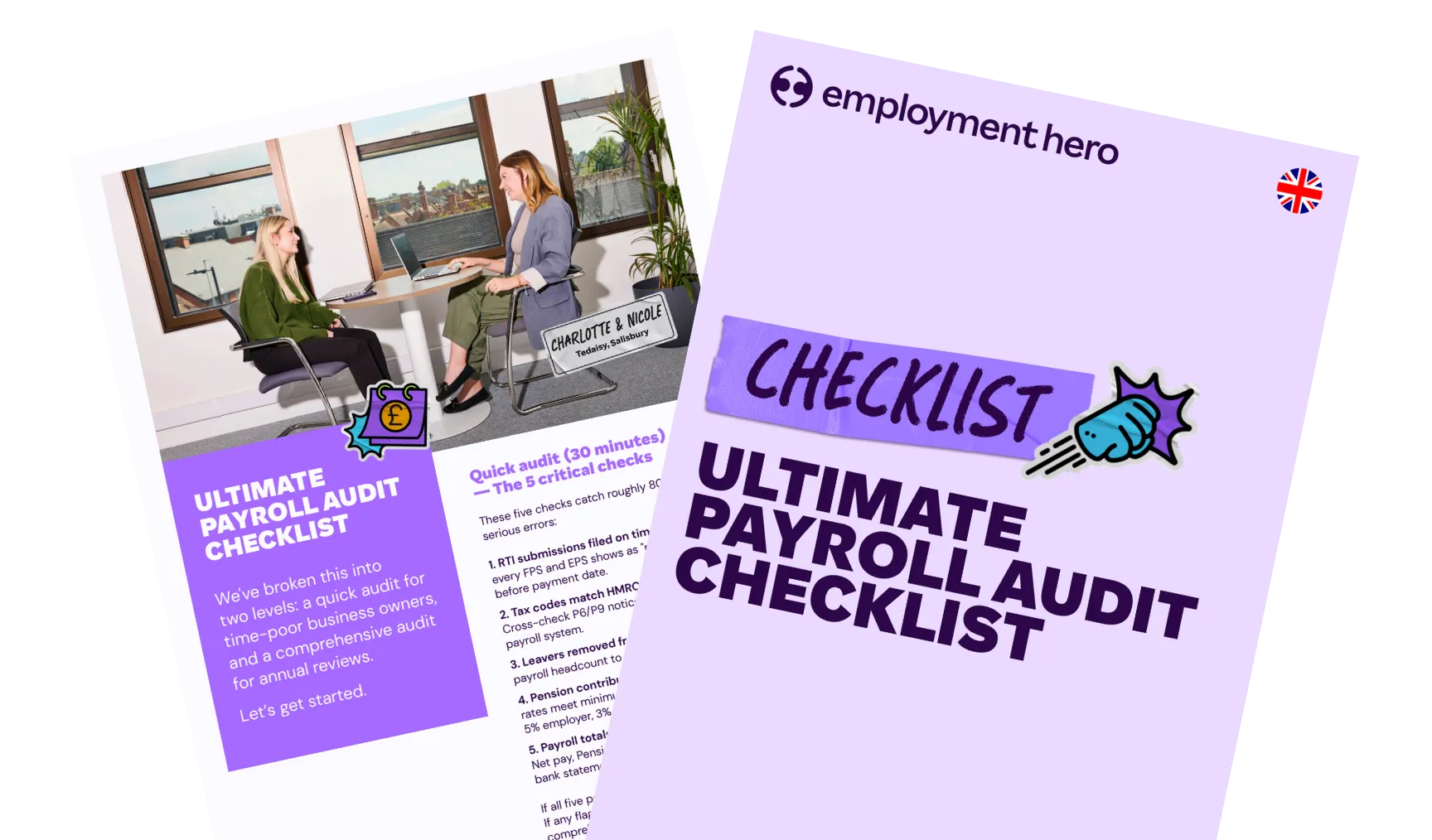
Start with our free UK Payroll Audit Checklist to conduct your first comprehensive audit. Then book a demo to see how Employment Hero’s AI-powered payroll keeps you audit-ready every day.
FAQs about payroll audits
No. Most small businesses can audit internally using a structured checklist. However, if your payroll is complex, you’ve found errors you can’t fix, or HMRC has opened a compliance check, professional help is wise.
Repeated late or missing RTI submissions, significant underpayment of PAYE/NICs, employee complaints, random selection, or industry-wide compliance sweeps. HMRC looks for patterns, not one-off mistakes.
Quick audit: 30 minutes. Comprehensive audit: 2-3 hours for most SMEs under 50 employees. The first audit takes longer—subsequent audits get faster.
Use HMRC’s Earlier Year Update (EYU) process. Contact the Employer Helpline on 0300 200 3200. Make voluntary disclosure if you underpaid tax—this typically reduces or eliminates penalties.
You need HMRC-recognised software for RTI reporting—you can’t submit manually. While you can technically audit with spreadsheets, modern payroll software makes audits much faster and more reliable with built-in reports and compliance checking.
To download the checklist, we just need a few quick details.
Related Resources
-
 Read more: A UK Business Owner’s Guide to Running a Payroll Audit
A UK Business Owner’s Guide to Running a Payroll Audit
Follow our step-by-step guide for business owners to streamline processes and avoid costly errors.
-
 Read more: CPD Seminar in Leeds | Employment Rights Act: Are Your Contracts About to Become Non-Compliant?
CPD Seminar in Leeds | Employment Rights Act: Are Your Contracts About to Become Non-Compliant?
Are your 2025 contracts a legal trap? Join our CPD seminar at Headingley Stadium to master the Employment Rights Act.…
-
 Read more: CPD Seminar in Bristol | Employment Rights Act: Can you afford to lose 20k this year?
CPD Seminar in Bristol | Employment Rights Act: Can you afford to lose 20k this year?
Are your 2025 contracts a legal trap? Join our CPD seminar at Headingley Stadium to master the Employment Rights Act.…
