


















What Is an Employee Experience Platform? A Complete Guide for UK Businesses
Published
What Is an Employee Experience Platform? A Complete Guide for UK Businesses
Published
The expectations of employees across UK workplaces have shifted dramatically in recent years. Meaningful benefits, seamless digital tools and a strong sense of connection are no longer “nice to have”, they’re essential. For business owners and HR professionals, this creates both an opportunity and a challenge; how to deliver a consistent, engaging experience while managing the growing complexity of HR, payroll and compliance. According to the Work That Works report, 9 in 10 business leaders agree there is significant potential for innovation within their HR function, highlighting the need for smarter, more integrated solutions.
This is where an employee experience platform comes in. At its core, it’s a centralised solution designed to manage and improve the entire employee journey, bringing together HR, payroll, engagement, benefits and communication tools into one connected system.
The timing is no coincidence. With flexible working options now the norm, competition for talent increasing and UK compliance requirements becoming more complex, businesses are under pressure to modernise how they support their people. Relying on disconnected systems is no longer sustainable, both from an operational and employee experience perspective.
In this guide, we’ll explore what an employee experience platform is, how it works and why it’s becoming an essential tool for modern UK businesses.
What is an employee experience platform?
An employee experience platform (EEP) is a unified digital platform that brings together HR management, payroll, employee engagement, benefits, communication and learning into one system, giving employees a single place to manage their working life and giving HR teams a single place to manage their people.
This might sound like any standard HR software, but the difference lies in everything else an EEP can do. Rather than relying on multiple disconnected systems that become an administrative burden for business leaders and HR managers, an employee experience platform brings together key workplace functions into one unified platform. This typically includes:
- HR management.
- Payroll.
- Employee engagement tools.
- Benefits.
- Internal communication.
- Productivity features.
By consolidating HR and payroll systems into a single, unified platform, businesses can reduce the burden of juggling multiple documents, disconnected tools and fragmented data. This creates a more seamless, consistent experience for employees, while significantly cutting down administrative complexity for both HR and payroll teams
Why are businesses investing in employee experience platforms?
The rise of employee experience platforms reflects a broader shift in how people work and what they expect from their employers.
Remote and hybrid working have made it essential for businesses to provide digital-first tools that employees can access anytime, anywhere. At the same time, there are growing expectations around flexibility, wellbeing and workplace experience, with employees placing greater value on benefits, communication and career development.
Behind the scenes, many HR teams are also dealing with increasing administrative workloads and fragmented systems. Managing separate tools for payroll, HR, engagement and benefits can be inefficient, time-consuming and prone to errors.
As a result, more businesses are moving away from disconnected software and towards all-in-one platforms that unify the employee experience. Employee experience platforms are designed to meet this need, helping organisations streamline operations while delivering a more modern, engaging and supportive workplace.
What does an employee experience platform do?
An employee experience platform supports every stage of the employee lifecycle, bringing together the tools businesses need to manage, engage and support their people in one place. Instead of switching between multiple systems, HR teams and employees can access everything through a single, connected platform.
Here’s how an employee experience platform adds value across the entire journey:
Recruitment and onboarding
A strong employee experience starts before day one. Employee experience platforms help businesses create a smooth and professional employee onboarding process.
- Digital onboarding streamlines the process with online forms, contracts and workflows.
- Document management ensures all employee records are securely stored and easily accessible.
- Pre-boarding experiences allow new hires to complete tasks, access information and feel connected before they officially start.
HR management
At the core of any platform is day-to-day HR functionality, helping teams manage their workforce efficiently.
- Employee records are centralised and kept up to date in one system.
- Leave management allows employees to request time off and managers to approve it.
- Performance reviews can be tracked and managed through structured frameworks and regular check-ins.
Payroll and compliance
Employment Hero commissioned research found that 4 in 10 businesses have incurred fines or penalties for payroll compliance. So it’s clear that managing payroll and staying compliant with regulations is critical for UK businesses. An employee experience platform simplifies this process.
- Integrated payroll connects directly with employee data to reduce manual input.
- Tax and compliance support helps businesses stay aligned with UK regulations.
- Automated calculations minimise errors and save time on payroll processing.
Engagement and communication
Keeping employees engaged and informed is essential for productivity and retention.
- Internal communication tools make it easier to share updates and company news.
- Recognition systems allow businesses to celebrate achievements and milestones.
- Feedback and surveys give employees a voice and help organisations improve the workplace experience.
Benefits and financial wellbeing
Modern employees expect more than just a salary. Employee experience platforms help businesses offer meaningful benefits.
- Employee benefits can be managed and accessed in one place.
- Discounts and perks add everyday value for employees.
- Earned wage access supports financial wellbeing by giving employees more flexibility over their pay.
Learning and development
Supporting growth and development is key to long-term engagement and retention.
- Training tools enable employees to build new skills and complete learning programmes.
- Career progression tracking helps employees and managers plan development and future opportunities.
By connecting all of these functions, an employee experience platform creates a more seamless, efficient and engaging workplace that benefits both employees and HR teams. It’s a win-win.
What are the benefits of an employee experience platform for UK businesses?
As the modern landscape of work continues to evolve, UK businesses are under increasing pressure to do more with less. This means there’s a constant balancing act between employee expectations, administrative demands and regulatory requirements. An employee experience platform helps organisations meet these challenges by bringing people, processes and technology together in one place.
Here’s why more UK employers are adopting this approach:
Reduce HR admin
Manual HR processes can be time-consuming and prone to errors. From updating employee records to processing leave requests and payroll data, it’s a lot to manage and administrative tasks often take up a significant portion of HR teams’ time. In fact, according to the Work That Works report, over half of SMEs are spending one whole day a week on administrative tasks related to employment/HR/Payroll.
An employee experience platform can reduce the administrative burden through automating routine tasks, reducing paperwork and duplication. With features like employee self-service and automated workflows, businesses can free up HR teams to focus on more strategic priorities.
Improve employee engagement
Engaged employees are more productive, motivated and likely to stay with the business. However, maintaining engagement can be challenging, especially in distributed or fast-growing teams.
By offering centralised communication tools, recognition systems and feedback channels, an employee experience platform makes it easier to keep employees connected, informed and valued.
Create a better employee journey
Employee experience is no longer limited to a single moment, it spans the entire lifecycle, from recruitment through to offboarding.
An employee experience platform helps businesses deliver a consistent and positive experience at every stage, whether it’s a smooth onboarding process, ongoing performance conversations or access to benefits and development opportunities.
Support hybrid work
With remote and hybrid working now a permanent feature of many UK workplaces, businesses need tools that are accessible anytime, anywhere.
Cloud-based employee experience platforms provide secure, flexible access to HR tools and information, ensuring employees can stay connected and productive regardless of location.
Ensure compliance
Navigating UK employment law and payroll regulations can be complex, particularly for growing businesses.
An employee experience platform helps support compliance by integrating payroll, automating calculations and maintaining accurate records. This reduces the risk of errors and helps businesses stay aligned with tax requirements and employment policies.
Key features of an employee experience platform
To deliver a seamless and effective employee journey, an employee experience platform should combine a wide range of tools into one unified system. These features are designed to streamline HR processes, improve engagement and provide employees with a more connected workplace experience.
Here are the key capabilities to look for:
- Core HR management: A centralised hub for managing employee data, including personal details, job information and employment history. This ensures accurate record-keeping and reduces duplication across systems.
- Integrated payroll: Payroll functionality that connects directly with HR data, helping to automate salary calculations, reduce errors and ensure employees are paid accurately and on time.
- Employee self service: Self-service portals allow employees to update their details, request leave, access payslips and manage their information independently — reducing the administrative burden on HR teams.
- Onboarding workflows: Structured onboarding processes that guide new hires through tasks such as completing documentation, setting up accounts and accessing company resources, creating a smooth start from day one.
- Leave and attendance management: Tools for tracking time off, managing holiday requests and monitoring attendance, with clear visibility for both employees and managers.
- Benefits and rewards: A central place for employees to access benefits, perks and recognition programmes, helping to improve satisfaction and overall employee wellbeing.
- Performance management: Features that support goal setting, regular check-ins and performance reviews, enabling continuous feedback and employee development.
- Reporting and analytics: Built-in reporting tools that provide insights into workforce data, helping HR teams make informed decisions around performance, engagement and operations.
- Mobile accessibility: Mobile-friendly platforms or apps that allow employees to access key features on the go, supporting flexible and hybrid working environments.
- Integrations with other business tools: The ability to connect with other systems, such as accounting software, communication tools or learning platforms, ensuring a more cohesive and efficient tech stack.
How to choose the right employee experience platform
With a growing number of solutions on the market, choosing the right employee experience platform can feel overwhelming. For business owners and HR leaders, the key is to focus on platforms that not only meet current needs but also support long-term business growth and employee engagement.
Here are five essential factors to consider:
1. Look for an all-in-one platform
Many businesses rely on multiple disconnected tools for HR, payroll, engagement and benefits. While this can work in the short term, it often leads to inefficiencies, duplicate data and increased admin.
An all-in-one platform, like Employment Hero, brings everything together in a single system, helping to streamline processes, improve data accuracy and create a more seamless employee experience.
2. Consider payroll integration
For UK businesses, payroll is one of the most critical and complex functions. Using separate payroll software can create additional admin and increase the risk of errors.
Platforms like Employment Hero offer fully integrated payroll, where employee data flows directly into payroll calculations. This helps ensure accuracy, supports compliance and reduces the need for manual input.
3. Prioritise employee self-service
Employee self-service is essential for reducing HR workload and empowering employees.
Platforms that allow employees to manage their own information, request leave, access payslips and update details can significantly cut down on administrative tasks, freeing up HR teams to focus on more strategic initiatives.
4. Ensure scalability
Your HR technology should grow with your business. What works for a small team may not be suitable as your organisation expands.
Choose a platform that can scale alongside your business, supporting more employees, additional features and evolving HR needs without requiring a complete system change.
5. Evaluate user experience
Even the most feature-rich platform will fall short if it’s difficult to use. Adoption is key to success, both for HR teams and employees.
Look for a platform with an intuitive, user-friendly interface, accessible across devices. A strong user experience encourages engagement, improves efficiency and ensures you get the most value from your investment.
Unlock efficiency and engagement with Employment Hero
Employee expectations, workplace dynamics and HR responsibilities have all evolved and the technology supporting them needs to keep pace. Employee experience platforms bring together the tools businesses need to reduce HR admin, improve engagement, streamline payroll and create a more connected employee journey.
For UK businesses, the benefits are clear. By replacing fragmented systems with a single, unified platform, organisations can operate more efficiently while delivering a modern workplace experience that supports attraction, retention and productivity.
Want to learn more about employee experience platforms?
FAQ’s
An employee experience platform (EEP) is a unified digital system that brings together the tools employees and HR teams need to manage working life in one place. This includes:
- HR management.
- Payroll.
- Onboarding.
- Leave.
- Benefits.
- Communications.
- Learning and performance.
Rather than navigating multiple disconnected systems, employees access everything through a single platform and HR teams manage everything from one central hub.
Traditional HR software is built primarily for HR administrators. Its job is to store employee records, process payroll and support compliance reporting. An employee experience platform does all of this, but it is also designed to serve employees directly. That means giving employees self-service access to their payslips, leave balances, benefits, training and communications without having to go through HR. The shift is from a back-office admin tool to something employees genuinely use day to day.
No. Employee engagement platforms focus on a specific part of the employee journey:
- Surveys.
- Recognition
- Internal communications.
An employee experience platform is broader. It covers the full employment lifecycle, from recruitment and onboarding through to payroll, benefits, development and offboarding, with engagement tools built in as one component rather than the entire product.
At a minimum, a strong employee experience platform should include:
- Core HR management.
- Integrated payroll.
- Employee self-service.
- Onboarding workflows.
- Leave and attendance management.
- Benefits and rewards.
- Performance management.
- Mobile accessibility.
For UK businesses specifically, look for built-in support for PAYE, RTI reporting and auto-enrolment pension compliance, as these are non-negotiable from a regulatory standpoint.
UK employment compliance covers a wide range of obligations, including PAYE and Real Time Information (RTI) reporting, auto-enrolment pension contributions under the Pensions Act 2008, statutory leave entitlements, National Minimum Wage calculations and right to work checks. A UK-built or UK-configured employee experience platform should handle these automatically, updating calculations when regulations change and maintaining the audit trails needed to demonstrate compliance.
Five things matter most:
- Payroll integration that handles UK compliance natively (not as a bolt-on).
- A strong employee-facing mobile app that staff will actually use.
- GDPR compliance and UK data residency.
- Integration with your existing tools.
- UK-based support.
A platform that ticks every feature box but has poor adoption among employees delivers very little value in practice, so it is worth involving a sample of employees in the demo process before making a final decision.
Yes. Employment Hero’s platform combines HR management, integrated payroll, onboarding, leave and attendance, performance, learning and compliance into one system. The EH Work superapp gives employees mobile access to payslips, leave, benefits, earned wage access, discounts and financial wellbeing tools in one place. It is built for UK employment law and supports PAYE, RTI, auto-enrolment and right to work compliance.
To download the guide, we just need a few quick details.
Related Resources
-
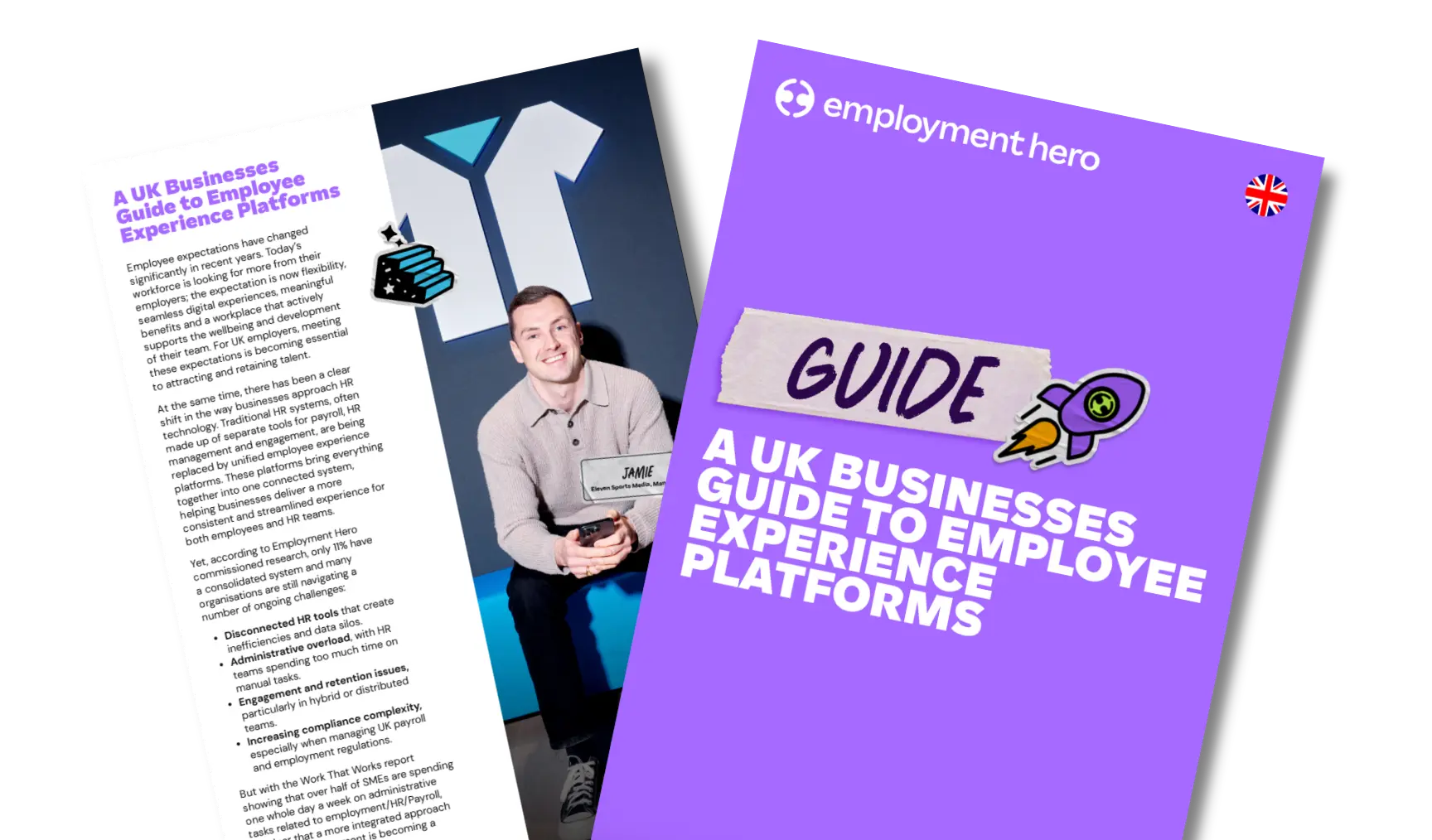 Read more: What Is an Employee Experience Platform? A Complete Guide for UK Businesses
What Is an Employee Experience Platform? A Complete Guide for UK Businesses
Simplify HR and payroll with our employee experience platform guide for UK businesses. Improve engagement and compliance. Download your free…
-
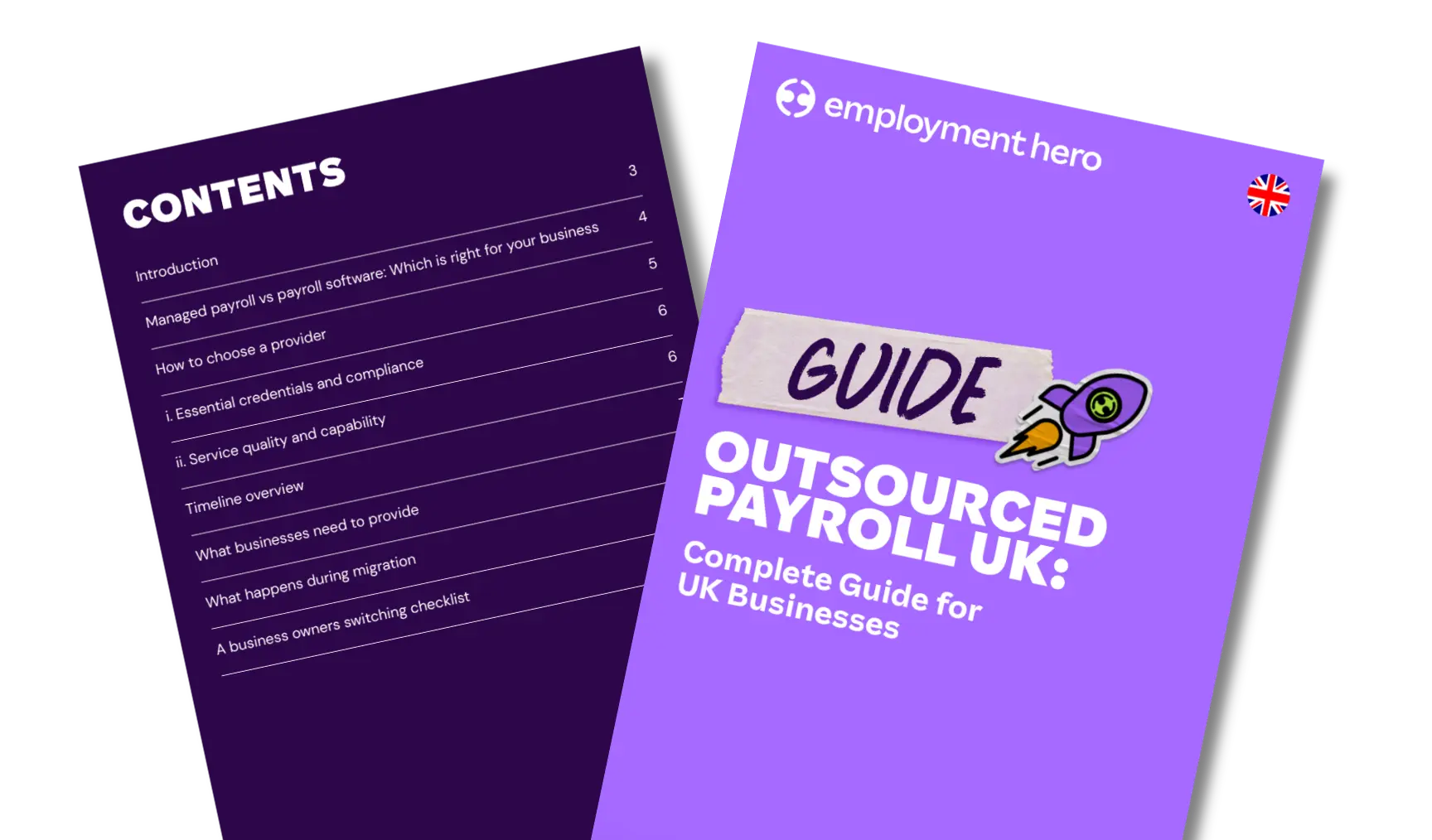 Read more: Outsourced Payroll UK: Complete Guide for UK Businesses
Outsourced Payroll UK: Complete Guide for UK Businesses
Master your pay runs with our outsourced payroll UK guide. Learn how to save 120 hours a year and stay…
-
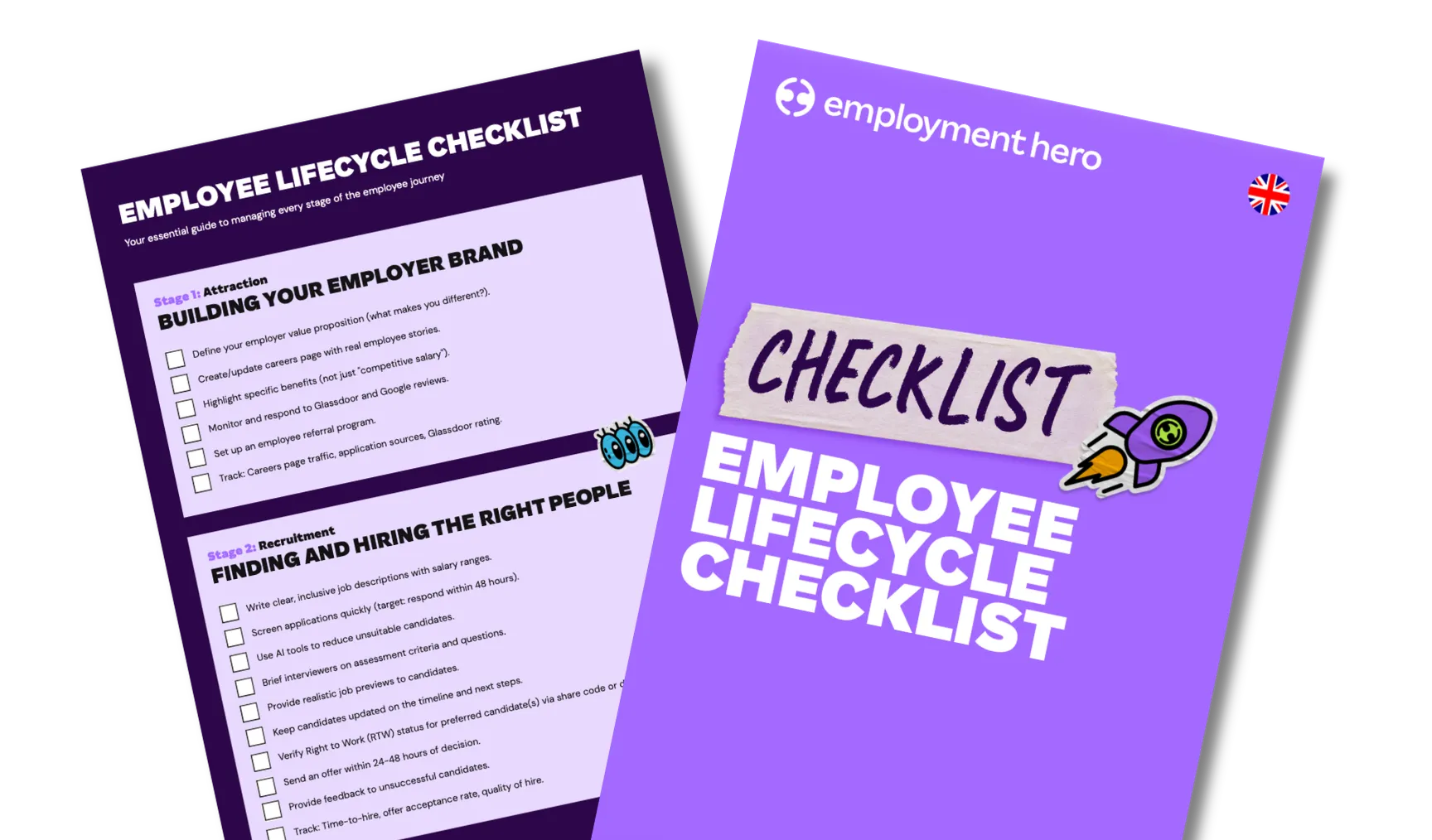 Read more: The Ultimate Guide to the Employee Life Cycle
The Ultimate Guide to the Employee Life Cycle
Learn the full scope of the employee life cycle and how it impacts recruitment, onboarding and retention.
