


















Budget & Pay Review Season: Shifting the Strategy for 2026
Published
Budget & Pay Review Season: Shifting the Strategy for 2026
Last Updated
Pay review season can be one of the most challenging times of the year for employers. Budgets are tight, expectations are high and salary conversations can feel uncomfortable, especially if the process is not well planned.
But when it’s done right, pay review season becomes much more than an administrative exercise. It’s a chance to recognise contribution, reinforce fairness and show your people that their work genuinely matters.
Rather than reacting at the last minute, businesses that take a structured and transparent approach can turn their salary review process into a powerful driver of engagement, performance and retention.
Here’s how to reduce complexity, improve confidence and make your annual pay review work harder for your business in 2026.
Why pay reviews matter more than ever in 2026
Employee expectations around pay have changed and they’re not going back.
People now have greater access to salary information, clearer views on their market value and higher expectations of fairness and transparency at work. Salary benchmarking tools, job ads with salary ranges and pay transparency laws (in some regions) are all influencing what employees expect from employers.
That means a “one-size-fits-all” increase with little explanation is unlikely to land well.
When employees don’t understand how pay decisions are made, trust erodes and motivation suffers. And once trust is lost, it’s hard to rebuild, especially if your competitors are offering clearer career pathways and more transparent reward strategies.
Handled well, however, salary reviews help align individual contributions with business goals, reward the right behaviours and set a clear tone for the year ahead.
The risks of getting it wrong
Even well-intentioned pay reviews can create tension if the process feels inconsistent, rushed, or unclear. Here are the biggest risks to watch out for.
- Disengagement: Unclear or inconsistent pay decisions can quickly lead to frustration and loss of trust. Employees may feel their effort isn’t recognised, or that decisions are arbitrary. When people feel undervalued, you’ll often see it show up in reduced productivity, less discretionary effort and declining morale across teams.
- Retention issues: High performers who feel overlooked are more likely to seek opportunities elsewhere. And replacing them is often far more costly than retaining them, especially when you factor in recruitment, onboarding and lost momentum. A strong annual pay review can be a key retention lever, particularly for critical roles.
- Pay equity concerns: Without a clear framework, bias can creep in. That increases the risk of unexplained pay gaps across gender, tenure, or job families, creating both reputational risk and potential compliance issues. A fair and well-communicated process supports morale, strengthens culture and helps protect your business.
A fair and well communicated process supports morale, strengthens culture and helps protect your business.
Key steps in the salary review process
An effective salary review process is built on preparation. Having the right foundations in place makes execution far smoother and helps your managers feel confident in the conversations that follow.
1. Set clear objectives
Before reviewing numbers, be clear on what you are trying to achieve. Your objectives might include:
- Closing pay gaps and improving internal equity.
- Retaining high performers or hard-to-replace roles.
- Ensuring pay stays competitive with the market.
- Rewarding impact and outcomes (not just tenure).
- Supporting growth plans and future workforce needs.
Define your overall approach to pay. If your organisation aims to lead the market, budgets need to reflect that ambition. If financial constraints exist, it is important to balance pay with other meaningful benefits and development opportunities. The clearer the purpose, the easier it is to make consistent decisions and explain them.
2. Gather accurate and reliable data
Sound decisions rely on good data. Without it, salary reviews become subjective and employees can sense that immediately.
- Market benchmarking: Use reputable salary data to understand current market rates for comparable roles. This is especially important for high-demand positions where salary expectations may have shifted significantly over the past year.
- Performance insights: Review performance outcomes and contributions over the year. Pay decisions should be grounded in evidence, not assumptions.
Helpful inputs might include:
- Performance review outcomes.
- Goal achievement and measurable results.
- Role complexity and scope changes.
- Behaviours aligned with company values.
- Skills growth and capability development.
This approach supports fairness and helps explain outcomes with confidence.
3. Involve the right people
Salary reviews should never happen in isolation. HR plays a key role in guiding the process and ensuring consistency, while managers bring essential insight into individual performance, development and role expectations.
Finance leaders are also crucial especially when you need to align pay decisions to business sustainability and budget realities.
To run a smoother annual pay review, define roles clearly:
- Managers recommend and justify changes.
- HR calibrates decisions and checks fairness.
- Finance validates budget impact and affordability.
- Leadership signs off on final outcomes.
Managers should also be supported and trained to make recommendations and communicate outcomes clearly. If they can’t explain decisions with confidence, the process quickly loses credibility.
4. Communicate clearly and transparently
Transparency does not mean sharing individual salaries, but it does mean being open about how decisions are made.
Explain the factors considered, such as market data, performance and business affordability. When employees understand the framework, they are far more likely to trust the outcome, even if it is not exactly what they hoped for.
Best practices for an effective annual pay review
Once the foundations are in place, these practices help strengthen your approach.
Focus on pay equity
Fairness should be a priority in 2026. A pay equity review can highlight inconsistencies related to gender, tenure or role changes.
A pay equity review can highlight inconsistencies related to:
- Gender.
- Tenure.
- Location.
- Role changes or promotions.
- Hiring history and legacy pay differences.
Addressing these issues supports compliance and sends a clear message about your organisation’s values. It also helps managers feel confident they’re operating within a fair and consistent system.
Reward performance meaningfully
Small increases spread evenly across the workforce rarely motivate anyone. Where budgets are limited, it is often more effective to make meaningful investments in your strongest contributors and have honest conversations with others about development and expectations.
Remember that reward goes beyond pay. Career progression, learning opportunities and additional leave can all play a valuable role. To do this well, your salary review process needs:
- Clear performance differentiation.
- A shared definition of “high performance”.
- Calibration to avoid inconsistency across teams.
- A communication plan that managers can follow.
Plan with the future in mind
Pay reviews should not focus only on the past year. Consider how your decisions affect long term sustainability.
Consider:
- Which roles are critical to your growth plans?
- Where are skills shortages likely to hit?
- What does succession planning require?
- Are you at risk of losing key talent to competitors?
HR software can help you model different scenarios and understand the impact of pay changes on your overall wage bill before decisions are finalised.
Common pitfalls to avoid during pay reviews
Many challenges during pay review season are preventable.
- Unexpected outcomes: Pay reviews should never come as a shock. If someone is surprised by their pay outcome, it often means there wasn’t enough ongoing feedback throughout the year. Regular check-ins, performance conversations and development planning reduce tension when salary review time arrives.
- Passing the blame: Managers should not attribute outcomes to HR or budget constraints alone. Even when budgets are tight, managers need to own the message. Employees don’t just want an answer, they want clarity, context and a plan. Ownership builds trust.
- Overlooking consistent performers: liable employees who quietly deliver strong results are often missed until they leave. Make sure your annual pay review includes a way to identify “quiet contributors” who are critical to team stability and delivery, even if they aren’t the loudest voices in the room. Avoiding these mistakes helps protect engagement and retention.
How technology can simplify pay reviews
Managing pay reviews through spreadsheets and email increases risk and slows everything down. It also creates version control issues, delays approvals and makes it harder to track equity and budget impact.
Modern HR platforms create a single source of truth and streamline the entire process.
With the right technology, you can support:
- Automated workflows for manager recommendations, HR review and finance approval.
- Real-time visibility into pay equity and budget impact.
- Secure generation and distribution of personalised pay review letters.
- Consistent documentation and audit trails.
- Faster approvals and fewer errors.
By reducing manual administration, technology frees up time for the conversations that really matter, the ones that shape performance, motivation and retention
Practical takeaways for HR leaders
To make pay review season more effective in 2026:
- Start planning early and allow time for analysis and calibration.
- Set clear objectives so decisions are aligned to business priorities.
- Equip managers with tools, training and messaging support.
- Use data to guide decisions and build confidence.
- Prioritise pay equity to reduce risk and reinforce fairness.
- Use pay to reinforce behaviours and performance you want to see.
- Support decisions with technology to reduce complexity and increase consistency.
Make your 2026 salary review season a culture win
Pay review season is a reflection of your culture.
When handled poorly, it feels transactional and frustrating. When handled well, it reinforces trust, fairness and shared success. It shows your people that their contribution is recognised and that they have a future with your organisation.
With the right structure, clear communication and the support of smart technology, your salary review process can become one of the most positive moments in your HR calendar.
Take the stress out of compensation planning with Employment Hero.
To download the checklist, we just need a few quick details.
Related Resources
-
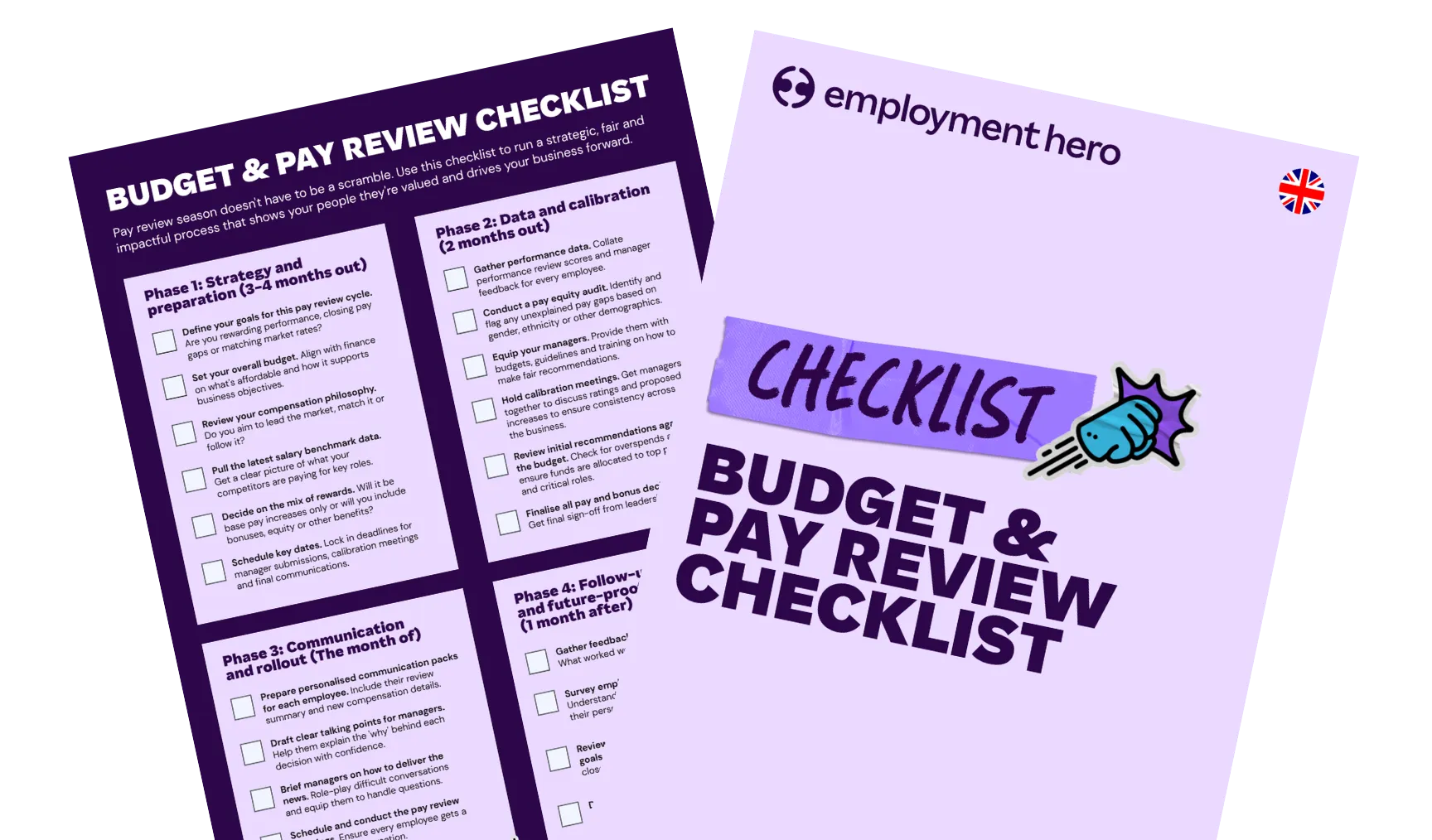 Read more: Budget & Pay Review Season: Shifting the Strategy for 2026
Budget & Pay Review Season: Shifting the Strategy for 2026
Learn how HR leaders can reward performance, boost engagement and show employees they matter.
-
 Read more: GDPR Checklist for HR Managers and Employers
GDPR Checklist for HR Managers and Employers
Check if your HR practices are GDPR compliant with our checklist.
-
 Read more: A UK Business Owner’s Guide to Running a Payroll Audit
A UK Business Owner’s Guide to Running a Payroll Audit
Follow our step-by-step guide for business owners to streamline processes and avoid costly errors.
