


















Pay growth flat as SMEs prepare to enact jobs tax
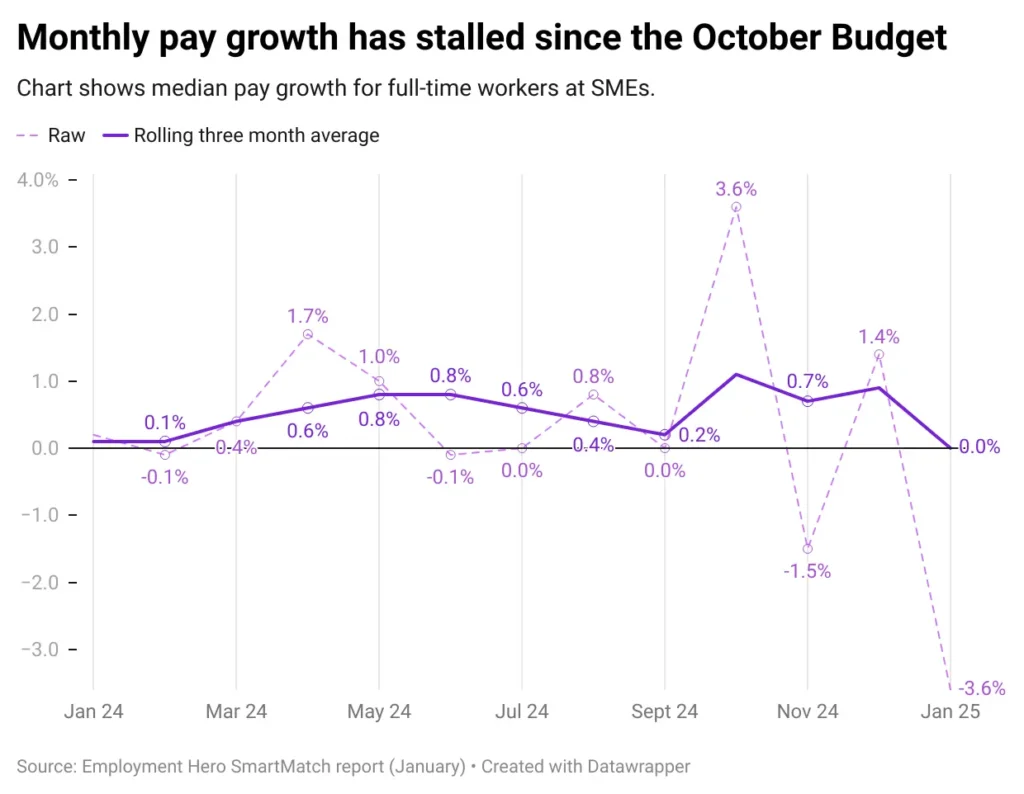
– Employment Hero’s SmartMatch employment report of 90,000 UK employees shows the growth in average monthly pay of full-time employees was 0% across November-January.
– Median full-time employees are making 4.4% more now than they were a year ago.
– Monthly pay growth has stalled since the Chancellor’s Budget, from an average of 1.1% in the three months to October to 0% in the three months to January.
– The Government’s jobs tax is holding back SMEs from sharing benefits of lower interest rates with workers.
London, 6 Feb: Workers at UK SMEs are not seeing sustained growth in wages as their employers prepare to pay the Government more from April, not their employees, as new legislation announced at October’s Budget kicks in.
Employment Hero’s SmartMatch Salary Report uses real-time data from 90,000 employees across small businesses with 1-500 employees in the UK.
Data from the end of January showed growth in average monthly pay for the last three months was 0%, taking into account a slight rise in December and a drop in January and November.
This compared to an average of 1.1% median pay growth in the three months leading to the end of October, when the Government introduced a Budget that significantly increased the cost of employing people in the UK.
Full-time employment growth has also been anaemic since the Budget, suggesting employers are both wary to take on new staff and wary to give existing staff raises.
January saw a slight pickup in full-time employment of 1.4%, but this followed drops of 1.7% in November and 0.2% in December.
PAY UNDERLINES NORTH SOUTH DIVIDE
The impact of the Government’s Budget is being felt hardest in its traditional heartlands in the North.
The median full-time worker at an SME in the north of England saw just 1.6% annual wage growth in the year to the end of January – well below inflation. This suggests the region’s SMEs are facing particular challenges in maintaining competitive pay.
Greater London continues to offer the highest median annual rate at £41,175, significantly above the next highest region, the East of England at £36,597.
Kevin Fitzgerald, UK MD of Employment Hero commented:
“While workers at SMEs are still seeing their pay grow faster than inflation year-on-year, the month-to-month momentum in wage growth has completely stalled. This is particularly concerning as we approach April’s rise in employer National Insurance contributions.
“SMEs want to reward their employees and share the benefits of lower interest rates, but the looming jobs tax is forcing them to be extremely cautious with their wage bills. Rather than giving workers the pay rises they deserve, small businesses are having to set aside funds to cover increased tax burdens. This is well set out in the international research on jobs taxes – it is workers who end up losing the most.”
Related Resources
-
 Read more: South West named UK’s most locally loyal business region as Employment Hero deepens commitment to Bristol
South West named UK’s most locally loyal business region as Employment Hero deepens commitment to Bristol
18 March 2026 – New data from Employment Hero reveals strong regional confidence in the South West, with 84% of…
-
 Read more: Yorkshire businesses show local loyalty as Employment Hero back region with Leeds United partnership
Yorkshire businesses show local loyalty as Employment Hero back region with Leeds United partnership
5 March 2026 – New data from Employment Hero reveals strong regional confidence across Yorkshire & the Humber amid rising…
-
 Read more: Government red tape risks blocking youth jobs as SMEs look to access apprenticeship scheme
Government red tape risks blocking youth jobs as SMEs look to access apprenticeship scheme
February 9, 2026: New Employment Hero research finds 73% of SME leaders intend to leverage new Government apprenticeship schemes following…
