 Australia
  United Kingdom
  Singapore
  Malaysia
  Canada (Français)
 New Zealand




Managing alcohol and drugs in the workplace
Last Updated
Managing alcohol and drugs in the workplace
Last Updated
Navigating the complexities of substance use in your business can feel overwhelming for many New Zealand employers. You want to create a safe environment, boost employee retention and maintain high productivity without overstepping legal boundaries.
Our comprehensive guide provides everything you need to know to handle these sensitive situations with confidence. It helps you streamline your HR processes, reduce administrative burdens and support your team effectively.
The guide includes:
- Your legal obligations as an employer
- How to draft an effective drugs and alcohol policy
- Signs of impairment
- The guidelines around testing
- How to respond to a positive test
Why alcohol and drug management matters at work
Addressing substance use is about much more than just following the rules. It directly impacts the safety and wellbeing of your entire team, which as an employer you are primarily responsible for. When an employee struggles with alcohol or drugs, it often leads to increased absenteeism, lower quality work and a higher risk of workplace accidents.
For a growing New Zealand business, these disruptions can be incredibly costly. You might face lost productivity, expensive recruitment drives to replace staff or even severe legal penalties if an accident occurs.
A proactive approach helps you avoid these pitfalls. By implementing clear management strategies, you create a culture of transparency and trust. Employees feel safer knowing that their employer takes their wellbeing seriously.
Understanding your legal obligations as an employer
As a business leader in New Zealand, you must navigate several key pieces of legislation when dealing with substance use. Ignorance of the law is never a valid defence. Our guide breaks down these complex regulations into simple and actionable steps.
First, you must look at the Health and Safety at Work Act 2015. This law dictates that you have a primary duty of care to provide a safe working environment. If you suspect an employee is impaired and poses a risk, you must take reasonable steps to mitigate that danger.
Next, the Employment Relations Act 2000 requires you to act in good faith. This means you must follow fair processes, communicate openly and give employees a chance to respond before taking any disciplinary action.
Finally, because managing these issues often involves collecting sensitive medical data, you must adhere to the Privacy Act 2020. You can only collect information for lawful purposes connected to your business. The guide details exactly how to meet your legal requirements without getting bogged down in legal jargon or expensive consultation fees.
Creating an effective workplace alcohol and drug policy
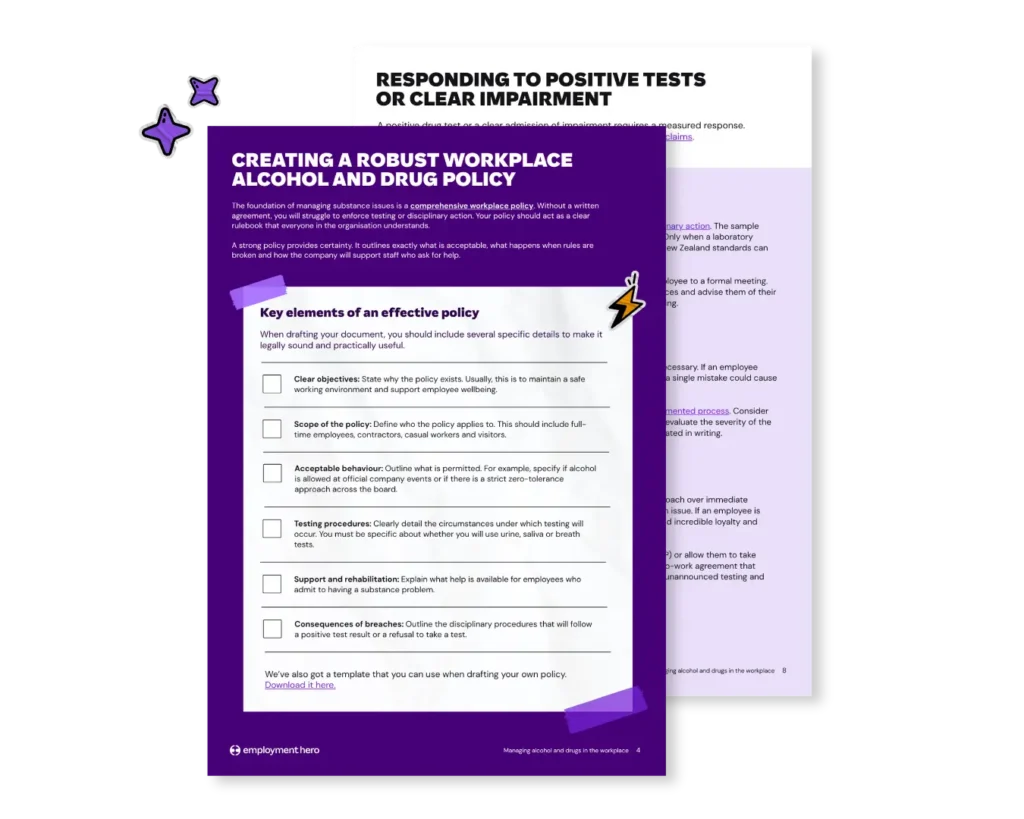
The foundation of any successful strategy is a robust written policy. Without a clear set of rules, you will struggle to enforce standards or support your staff. A strong policy removes ambiguity. It tells your team exactly what is acceptable, what the consequences are for breaking the rules and how the company will support those who need help.
Drafting this document doesn’t have to be a massive administrative burden. Our guide walks you through the essential elements you need to include. You will learn how to define the scope of your policy so it covers full-time staff, contractors and temporary workers alike.
We’ve also got a template that you can use when drafting your own policy. Download it here.
Recognising the signs of alcohol and drug misuse
Early intervention is the best way to prevent a minor issue from becoming a major crisis. However, spotting the signs of impairment can be difficult. It requires vigilance, empathy and a clear understanding of what to look for.
Physical signs are often the most obvious. You might notice an employee has bloodshot eyes, unsteady coordination or a lingering smell of alcohol. But behavioural changes are equally important. An otherwise reliable team member might start arriving late, missing deadlines or becoming unusually irritable with their colleagues. Their overall work performance might take a sudden and unexplained dive.
Recording this information is vital if you need to proceed with reasonable cause testing or formal disciplinary meetings later on.
Drug and alcohol testing in the workplace
Testing your employees is a highly sensitive process fraught with potential legal landmines. You cannot simply demand a urine sample because you feel like it. The courts have established strict parameters around when and how testing can occur in New Zealand. Understanding these rules is crucial to protecting your business from costly personal grievance claims.
Our guide breaks down the four main types of testing. You will discover when you can use pre-employment testing to screen candidates for safety-sensitive roles. We explain the threshold for reasonable cause testing, which applies when you have clear evidence that an employee might be impaired at work. You will also learn about post-incident testing following an accident or near miss. Finally, we cover the complexities of random testing. This method is highly intrusive and is generally only acceptable for specific high-risk industries like construction or heavy manufacturing.
Supporting employees through rehabilitation and recovery
Treating addiction purely as a disciplinary issue often leads to high turnover and a toxic company culture. Many forward-thinking New Zealand businesses now view substance misuse as a health issue first and foremost. Taking a supportive approach can yield incredible long-term benefits for your organisation. It builds immense loyalty, improves your employer brand and saves you the substantial costs associated with recruiting and training new staff.
Our guide outlines practical ways to support a team member who admits they have a problem. We explore the benefits of offering an Employee Assistance Programme. These services provide confidential counselling and professional support at a fraction of the cost of losing a key employee.
By investing in your people during their toughest times, you foster a resilient workforce that will help you scale your business successfully.
Disciplinary procedures and when to act
While support is always the preferred first step, there are times when disciplinary action becomes entirely necessary. If an employee refuses help, repeatedly violates your written policy or works in a role where a single error could cause catastrophic harm, you must take decisive action. Failing to act puts your entire team at risk and compromises your duty of care.
Navigating a disciplinary process requires extreme care. You must follow the legal steps and balance firmness with absolute fairness. This will protect your business from legal backlash and proves that you manage your human resources efficiently and professionally.
Training managers to handle alcohol and drug issues
Your policy is only as good as the people enforcing it. If your frontline managers do not know how to handle suspected impairment, your entire strategy will fall apart. Managers are the eyes and ears of your business. They need the confidence and the skills to address difficult situations head-on without escalating the tension.
Download our complete guide today to unlock these insights. Equip your business with the knowledge it needs to manage substance use effectively, support your team and scale your operations with complete confidence.
The information in this article is current as at 5 April 2026, and has been prepared by Employment Hero Pty Ltd (ABN 11 160 047 709) and its related bodies corporate (Employment Hero). The views expressed in this article are general information only, are provided in good faith to assist employers and their employees, and should not be relied on as professional advice. Some information is based on data supplied by third parties. While such data is believed to be accurate, it has not been independently verified and no warranties are given that it is complete, accurate, up to date or fit for the purpose for which it is required. Employment Hero does not accept responsibility for any inaccuracy in such data and is not liable for any loss or damages arising directly or indirectly as a result of reliance on, use of or inability to use any information provided in this article. You should undertake your own research and seek professional advice before making any decisions or relying on the information in this article.
Download our guide to managing alcohol and drug use in the workplace
Related Resources
-
 Read more: MFA policy: what it is, why you need one and how to write it
MFA policy: what it is, why you need one and how to write it
Learn how to create an MFA policy that protects your business from unauthorised access. Includes a template, implementation steps and…
-
 Read more: Your strategic guide to winning leadership buy-in for HR and payroll system change
Your strategic guide to winning leadership buy-in for HR and payroll system change
Struggling to get sign-off on a new HR or payroll system? This guide walks you through everything you need to…
-
 Read more: The AI Adoption Blueprint
The AI Adoption Blueprint
What does it take to embed AI across an entire team? We’re sharing our training, our policies, and the lessons…
