 Australia
  United Kingdom
  Singapore
  Malaysia
  Canada (Français)
 New Zealand





An employer’s guide to personal grievance and unjustified dismissal claims
Published
An employer’s guide to personal grievance and unjustified dismissal claims
A strong employment relationship is one where both an employer and employee feel respected and understand their roles. The sad reality is that there are times where an employment relationship could break down, leading to significant issues and potential legal action. It’s important that employers are aware of how the personal grievance process works. While ideally their employment relationships should be healthy and happy, they may come up against a claim at some point.
It’s also crucial that employers are aware of specific actions that could open them up to a personal grievance, so they know to avoid them.
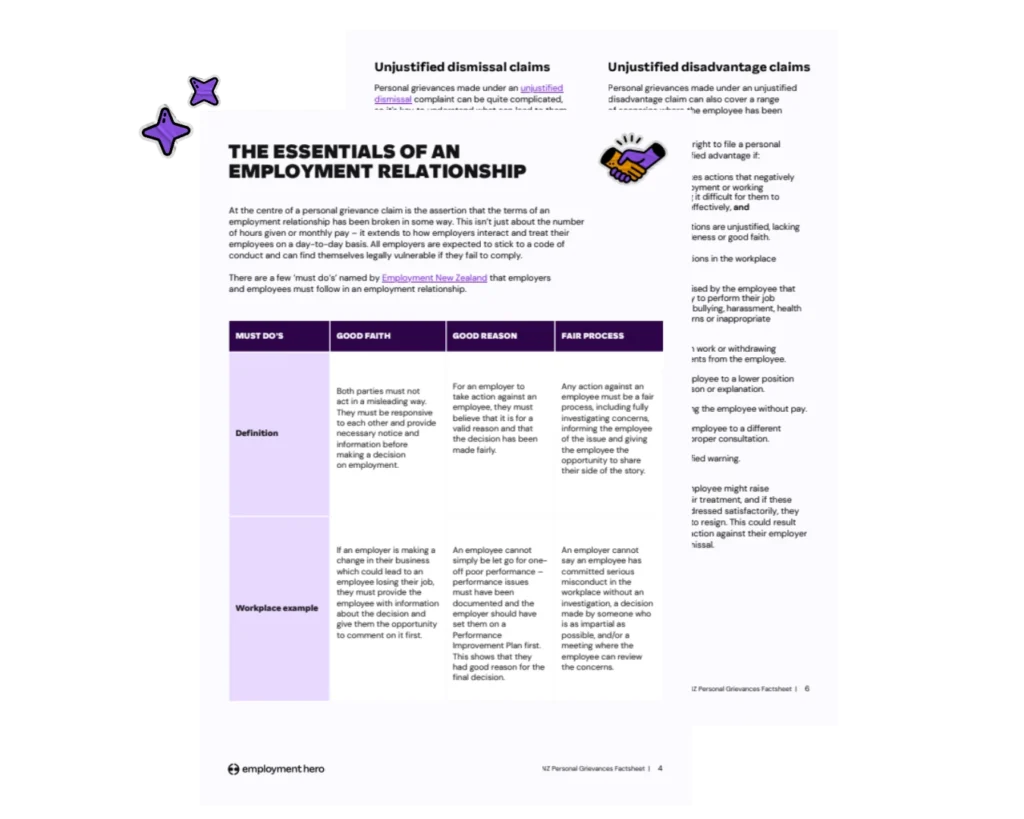
Our factsheet includes:
- The essentials of an employment relationship
- Personal grievance complaints
- Unjustified dismissal claims
- Unjustified disadvantage claims
- The personal grievance process
To download the factsheet, fill in the form on the right.
The information in this article is current as at 25 May 2026, and has been prepared by Employment Hero Pty Ltd (ABN 11 160 047 709) and its related bodies corporate (Employment Hero). The views expressed in this article are general information only, are provided in good faith to assist employers and their employees, and should not be relied on as professional advice. Some information is based on data supplied by third parties. While such data is believed to be accurate, it has not been independently verified and no warranties are given that it is complete, accurate, up to date or fit for the purpose for which it is required. Employment Hero does not accept responsibility for any inaccuracy in such data and is not liable for any loss or damages arising directly or indirectly as a result of reliance on, use of or inability to use any information provided in this article. You should undertake your own research and seek professional advice before making any decisions or relying on the information in this article.
What is a personal grievance in New Zealand?
A personal grievance is a formal legal claim an employee, or former employee, can bring against their employer under the Employment Relations Act 2000 (ERA). It is distinct from a general workplace complaint in a significant way: a personal grievance triggers a defined legal process with enforceable remedies, including financial compensation, reinstatement and penalties against the employer.
A general workplace complaint might be raised informally with a manager or HR and resolved internally without any legal consequence. A personal grievance, by contrast, can escalate to mediation through the Ministry of Business, Innovation and Employment (MBIE) and, if unresolved, to a formal investigation and binding determination by the Employment Relations Authority (ERA). The stakes are higher, the process is structured and the potential outcomes for both parties are significant.
At the heart of a personal grievance claim is the assertion that an employer has breached the employment relationship in a way that caused the employee harm, whether financial, emotional or procedural.
What are the grounds for a personal grievance?
Employees can raise a personal grievance on the following grounds under the Employment Relations Act 2000:
Unjustified dismissal — The employee was dismissed, but the employer either lacked a genuine reason for doing so, or failed to follow a fair process. This is the most common type of grievance and is covered in detail in the next section.
Unjustified disadvantage — The employer took an action (or failed to act) that placed the employee at a disadvantage in their employment, without justification. This covers a wide range of situations short of dismissal, from changes to duties or hours through to demotions or unfair treatment.
Constructive dismissal — The employee was not formally dismissed but felt forced to resign because of the employer’s conduct. If the employer made the working environment intolerable, the law may treat the resignation as a dismissal.
Discrimination — The employer treated the employee less favourably on grounds prohibited under the Human Rights Act 1993. These prohibited grounds include sex, race, age, disability, religious belief, sexual orientation and several others.
Sexual harassment — Unwelcome behaviour of a sexual nature that is either repeated or serious enough to have a detrimental effect on the employee’s employment, job performance or job satisfaction.
Racial harassment — Repeated and unwelcome language, visual material or physical behaviour relating to race, colour or ethnic or national origins, which is hurtful or offensive and is significant enough to detract from the employee’s work or be intimidating.
Duress related to union membership — The employer pressured or penalised the employee because of their membership, non-membership or participation in an employee organisation.
Other grounds include retaliation for refusing work in certain health and safety circumstances, retaliation against whistleblowers, compelling a shop worker to work on Easter Sunday and failing to protect Reserve Forces service.
What is an unjustified dismissal claim?
Unjustified dismissal is the most frequently raised personal grievance in New Zealand. A dismissal is considered unjustified when it fails to meet the standard of what a fair and reasonable employer would have done in the same circumstances, a test set out in section 103A of the Employment Relations Act 2000.
Two elements must be considered, and both matter:
Substantive justification — Did the employer have a genuine and good reason to dismiss? Poor performance, serious misconduct or redundancy may all be legitimate grounds, but the reason must be real, documented and proportionate to the outcome of dismissal.
Procedural fairness — Did the employer follow a fair process? This includes notifying the employee of the concerns raised against them, giving them a genuine opportunity to respond (with a support person present if they wish) and genuinely considering their response before making a final decision.
Employers often assume that if the reason for dismissal was valid, the process is secondary. This is a costly mistake. The ERA and Employment Court have repeatedly found that even where misconduct is established, a flawed process can still result in a finding of unjustified dismissal and significant remedies.
Unjustified dismissal claims cannot be raised when the dismissal occurred during a valid 90-day trial period, provided the trial period was correctly set up in writing prior to the employee starting work.
What is the personal grievance process in New Zealand?
The personal grievance process follows a structured sequence. Here are the key steps:
Step 1: Raising the grievance
The employee must first raise the grievance with their employer, verbally or in writing, within the relevant time limit (see the section below on timeframes). While this step can be done informally, putting it in writing creates a clear record.
Step 2: The employer’s response
Once a personal grievance is raised, the employer has 14 days to respond. During this window, both parties may attempt to resolve the matter directly. Employers who engage constructively at this stage often achieve faster, cheaper resolutions.
Step 3: Mediation through MBIE
If the matter is not resolved between the parties, either party can request mediation through MBIE (Ministry of Business, Innovation and Employment). Mediation is confidential and free of charge. A mediator facilitates discussion but does not impose a decision. The vast majority of personal grievances are resolved at this stage, with MBIE data historically showing settlement rates above 75% in mediation.
Step 4: Employment Relations Authority (ERA)
If mediation does not resolve the matter, either party can apply to the ERA. The Authority investigates the matter, collects statements from both sides, and makes a binding determination. ERA proceedings are more formal and time-consuming than mediation. Decisions can be appealed to the Employment Court.
How long does an employee have to raise a personal grievance?
The standard 90-day rule applies to most personal grievances. An employee must raise their grievance within 90 days of the date the incident occurred, or the date they became aware of it. Failing to act within this window means the right to raise the grievance is generally lost.
The 12-month exception for sexual harassment applies to any incident of sexual harassment that occurs on or after 13 June 2023. Employees have 12 months to raise a grievance in these cases, reflecting the additional barriers people often face in coming forward about this type of harm.
Late claims can still proceed in certain circumstances. If the employer agrees to accept the late claim, the time limit is waived. If the employer doesn’t agree, the employee may apply to the ERA to determine whether the grievance can still be raised.
The ERA may allow this if the delay was due to exceptional circumstances, for example if the employee’s representative failed to file on time, if health issues caused by the problem prevented the employee from acting, if the employment agreement failed to explain the notification period or if the employer refused to give a reason for dismissal.
What are the personal grievance payouts in New Zealand?
If the ERA or Employment Court finds in favour of an employee, a range of remedies may be ordered:
Reinstatement — The employee is returned to their former role. This is the primary remedy under the Act, though it is relatively rare in practice where trust has broken down.
Reimbursement of lost wages — The employee can be compensated for wages lost as a result of the unjustified dismissal or disadvantage, from the date of the incident up to the date of determination, minus any amount they could reasonably have earned elsewhere.
Compensation for hurt and humiliation — This is awarded to acknowledge the emotional and personal impact of the employer’s conduct. Awards have historically ranged from a few thousand dollars to $30,000 or more in serious cases, though awards at the higher end are reserved for egregious conduct.
Penalties — In cases of serious or deliberate breaches, the ERA can impose financial penalties payable to the employee or to the Crown.
As a general anchor: research and reporting on ERA outcomes has consistently indicated that the average cost to employers who lose a personal grievance, including legal costs, back pay, and compensation, commonly falls in the range of $10,000 to $50,000. Cases involving poor process or inadequate documentation tend to result in higher remedies.
Example personal grievance cases in New Zealand
Case 1: Unjustified dismissal — failure of process
An employee was dismissed for alleged misconduct following a customer complaint. While the complaint was genuine, the employer had not provided the employee with adequate details of the allegation, had not given a meaningful opportunity to respond, and had made the decision to dismiss before the investigation was complete. The ERA found the dismissal unjustified on procedural grounds, despite the substantive complaint being legitimate. The employer was ordered to pay lost wages and compensation for hurt and humiliation.
Case 2: Unjustified disadvantage — change in duties
An experienced employee had their duties significantly reduced following a restructure, not through formal redundancy, but through a gradual removal of responsibilities. No consultation took place and no explanation was offered. The ERA found the employer’s conduct amounted to unjustified disadvantage, as the changes were neither discussed nor justified. Compensation was awarded.
Case 3: Constructive dismissal — intolerable working environment
An employee resigned after a series of incidents, including being excluded from team communications, being passed over for projects without explanation and having their concerns dismissed when raised with management. The ERA found that the employer’s conduct had made continued employment so unreasonable that a fair and reasonable employee would have felt compelled to resign and treated the resignation as a constructive dismissal.
Personal grievance letter template
When raising a personal grievance formally, the letter should include the following elements:
[Your full name] [Your address] [Date]
[Employer’s name / Manager’s name] [Business name] [Business address]
Re: Notice of personal grievance
Dear [Name],
I am writing to formally raise a personal grievance under the Employment Relations Act 2000.
Nature of the complaint [Describe what happened clearly and factually, for example: unjustified dismissal, disadvantage, discrimination, or harassment.]
People involved [Name the individuals involved, including any witnesses if relevant.]
Relevant dates [Set out the key dates: when the incident occurred, when you became aware of it, and any related events in sequence.]
Supporting evidence [Note any documentation, emails, messages, or other evidence that supports your account. You do not need to attach everything at this stage, but flag what exists.]
Outcome sought [State clearly what resolution you are seeking, for example: reinstatement, compensation, an apology, a change in working conditions, or a formal investigation.]
I am willing to discuss this matter and participate in mediation if that would assist in reaching a resolution. Please respond within 14 days.
Yours sincerely, [Your full name] [Contact details]
Note: If you are unsure how to frame your grievance, or whether your situation qualifies, seek advice from a union representative, an employment advocate or a lawyer before sending.
How employers can reduce the risk of personal grievances
The best defence against a personal grievance is a well-run workplace. Most successful claims against employers come down to preventable failures: unclear agreements, poor documentation or a process that was not followed properly. Here is where to focus:
Clear employment agreements
Every employee must have a written employment agreement that complies with the Employment Relations Act. It should clearly set out their role, duties, pay, hours and any trial period terms. Agreements that are vague or incomplete create ambiguity that works against employers.
Fair and documented processes
Whether managing performance, investigating misconduct, or implementing redundancies, always follow a fair process. Notify the employee of the issue, give them a genuine opportunity to respond, consider their response and document each step. The process matters as much as the outcome.
Good record-keeping
Keep records of performance conversations, warnings, investigation steps and any decisions made. In an ERA hearing, documented evidence of a fair process is the employer’s strongest defence.
Early intervention
When issues arise, address them promptly and constructively. Many personal grievances could have been avoided if concerns had been raised earlier, before they escalated. An informal conversation handled well is far cheaper than a mediation that was not.
Access to advice
Employment law is not simple and the rules change. When you are unsure, especially around dismissal or restructuring, seek legal or HR advice before acting, not after.
For more information on personal grievances, download our factsheet today by filling in the form on the right.
Register for the factsheet
Related Resources
-
 Read more: The AI Adoption Blueprint
The AI Adoption Blueprint
What does it take to embed AI across an entire team? We’re sharing our training, our policies, and the lessons…
-
 Read more: Employment Essentials: AI Best Practices
Employment Essentials: AI Best Practices
Learn how to use AI in HR without creating privacy, compliance or employment risks in our latest webinar.
-
 Read more: The High Performance Series: The Power of Recovery
The High Performance Series: The Power of Recovery
Learn how elite teams manage recovery and prevent burnout. Join Employment Hero and The Blues for practical HR mental health…

