 Australia
  United Kingdom
  Singapore
  Malaysia
  Canada (Français)
 New Zealand


AI policy template and guide
Published
AI policy template and guide
Last Updated
Artificial Intelligence (AI) is well and truly here. From automating tasks to sparking new ideas, AI is rapidly changing the way we work. For business leaders, it represents a huge opportunity. But with great power comes great responsibility and it comes with the need for clear ground rules.
Letting your team loose on powerful tools without an AI policy template is like giving them company cars with no driving lessons. It’s a recipe for disaster.
You need a framework that empowers your team to innovate while protecting your business from the risks. This template will help you do that, making sure you create a culture that fosters responsible, productive and safe use of AI.
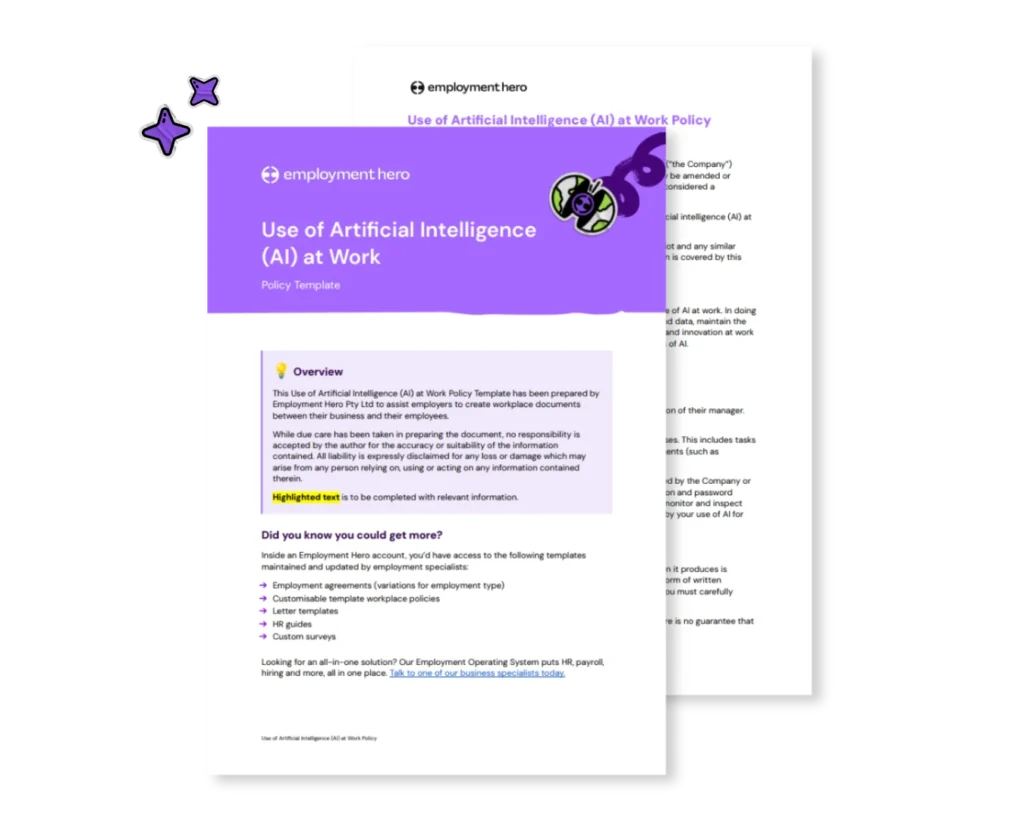
Download our free, customisable AI policy template now by filling out the form.
Understanding an AI policy template
Think of the AI policy template as a launchpad for creating a robust framework. It provides a solid structure, making sure you cover all the essential bases from the get-go.
Instead of starting from a blank page, you get a pre-built foundation that covers critical areas like data security, ethical guidelines and user responsibilities. This helps you to quickly tailor a policy that fits your business like a glove, saving you time and making sure you don’t miss anything important.
The role of AI tools in modern businesses
Using AI has become a genuine competitive advantage that’s been waiting to be unlocked. When used correctly, these smart tools can revolutionise your operations.
AI tools can automate repetitive admin, freeing up your team to focus on high-value work, analyse data to uncover insights that drive better business decisions and help to spark creativity (which is great for your marketing team). But it’s important to remember that embracing it isn’t about replacing people. You want to augment their abilities, drive efficiency and transform the way your team works for the better.
Developing a comprehensive AI policy template
Creating a clear set of rules for your team is crucial for success, but you want to be able to enable it safely. It should clearly outline what’s acceptable and what’s not, so everyone understands how to use AI tools productively and securely.
This guidance helps prevent data breaches, protect your intellectual property and ensure the outputs align with your company’s quality standards and values.
Key considerations for AI policy template development
Before you put pen to paper, you need to ask some big questions. A strong policy is built on a clear understanding of the risks and rewards. Key areas you must consider include:
- Data security: How will you prevent confidential company or customer data from being entered into public AI models?
- Ethical use: What are your standards for transparency and fairness? How will you prevent AI from being used to create misleading content or perpetuate bias?
- Legal compliance: How will you navigate issues like data protection and intellectual property rights for AI-generated content?
Getting these things right gives your confidence your policy is robust and ready for the real world. For complex situations, seeking expert guidance through our HR advisory service can provide clarity.
Effective AI training
The success of your AI policy hinges on whether your team understands and follows it. So putting training in place is essential.
A single, lengthy training session can often lead to information overload and low retention. This is something you want to avoid. To encourage high adoption and compliance, your training should follow a bite-sized, continuous approach.
Instead, break your training in short, digestible modules that focus on specific, high-priority areas, such as the “do’s and don’ts” table or the guidelines on data security. This method confirms that employees can easily absorb and immediately apply the critical rules of your AI framework without feeling overwhelmed. On top of this, regular, short refresher modules are crucial for keeping your team up-to-date as AI tools and your policies evolve.
Guidelines for responsible AI usage
To build a culture of trust, you need to set clear expectations for your team from day one. Your AI policy should include practical do’s and don’ts that are easy for everyone to understand and follow.
| Examples of do’s | Examples of dont’s |
| Do use AI to assist with research, brainstorming, and drafting documents. | Don’t input any personal, confidential, or client data into public AI tools. |
| Do fact-check all AI-generated information for accuracy. | Don’t present AI-generated content as your own original work without review. |
| Do disclose when AI has been used to significantly assist in creating content. | Don’t use AI to create content that is discriminatory, harassing or illegal. |
Integrating AI into existing policies
Your AI policy template shouldn’t live on an island. To keep consistency, it must be integrated with your existing company policies. Think about how AI impacts other areas of the business and update your documentation accordingly.
For example, your ‘Acceptable Use Policy’ for IT should now include rules about approved AI tools. Your ‘Data Protection Policy’ must be updated to reference the handling of data in the context of AI. This creates a seamless and consistent governance framework across the entire business.
Keeping human oversight in AI applications
This is non-negotiable. AI is a powerful assistant, but it’s not the boss. You must maintain human oversight in all AI applications, especially where the stakes are high. AI can make mistakes, reflect biases from its training data and lack the context that a human expert provides.
Having a person review and approve AI-generated work is critical to catch errors, reduce bias and make the final, informed decision. This is particularly critical in areas like recruitment, where an algorithm can’t replace the human judgment needed in the onboarding software and hiring process.
Managing generative AI responsibly
Tools like ChatGPT, Gemini and Claude have opened up a world of creative possibilities, but they also come with specific risks. These models learn from vast amounts of internet data, which means they can inadvertently reproduce copyrighted material or generate plausible-sounding misinformation. Your policy needs clear guidelines on how to use these tools to your advantage without compromising your data or integrity. This includes rules on verifying information and ensuring that any AI-generated content is edited to reflect your brand’s voice and accuracy standards.
Conducting AI risk assessments
You can’t protect against risks you haven’t identified. Before rolling out a new AI tool or application, you should conduct a simple risk assessment. This process involves identifying potential problems, evaluating their likelihood and potential impact and putting measures in place to mitigate them.
Promoting the ethical use of AI
Ultimately, how you use AI is a reflection of your company’s values. Your AI policy template should be a statement of your commitment to using this technology for good. This means building a framework that champions fairness, accountability and transparency.
You want to make sure your use of AI avoids creating or reinforcing bias, that you are transparent with customers and employees about how you use it and that you hold yourselves accountable for the outcomes it produces.
Download the AI policy template
The age of AI tools is here and Employment Hero is here to help you lead from the front. A clear, comprehensive AI policy template is your first and most important step to unlocking the power of artificial intelligence safely and effectively.
Download our free, customisable AI policy template now by filling out the form.
Disclaimer: The information in this template and guide is current as at 29 April 2026, and has been prepared by Employment Hero Pty Ltd (ABN 11 160 047 709) and its related bodies corporate (Employment Hero). The views expressed in this template and guide are general information only, are provided in good faith to assist employers and their employees, and should not be relied on as professional advice. The Information is based on data supplied by third parties. While such data is believed to be accurate, it has not been independently verified and no warranties are given that it is complete, accurate, up to date or fit for the purpose for which it is required. Employment Hero does not accept responsibility for any inaccuracy in such data and is not liable for any loss or damages arising either directly or indirectly as a result of reliance on, use of or inability to use any information provided in this template and guide. You should undertake your own research and to seek professional advice before making any decisions or relying on the information in this template and guide.
Register for the template
Related Resources
-
 Read more: The AI Adoption Blueprint
The AI Adoption Blueprint
What does it take to embed AI across an entire team? We’re sharing our training, our policies, and the lessons…
-
 Read more: Employment Essentials: AI Best Practices
Employment Essentials: AI Best Practices
Learn how to use AI in HR without creating privacy, compliance or employment risks in our latest webinar.
-
 Read more: The benefits of hiring overseas employees for New Zealand businesses
The benefits of hiring overseas employees for New Zealand businesses
Discover the key benefits of hiring overseas employees for your, from accessing global talent to building round-the-clock teams.

