 Australia
  United Kingdom
  Singapore
  Malaysia
  Canada (Français)
 New Zealand



Most owners instinctively know what ‘better’ would look like inside their business. More streamlined processes. More cohesive teams. More time to spend working on the business rather than working in it. The problem is rarely a lack of vision. Instead, it’s the gap between knowing what needs to be done and actually doing it, made wider by the harsh realities of SME ownership.
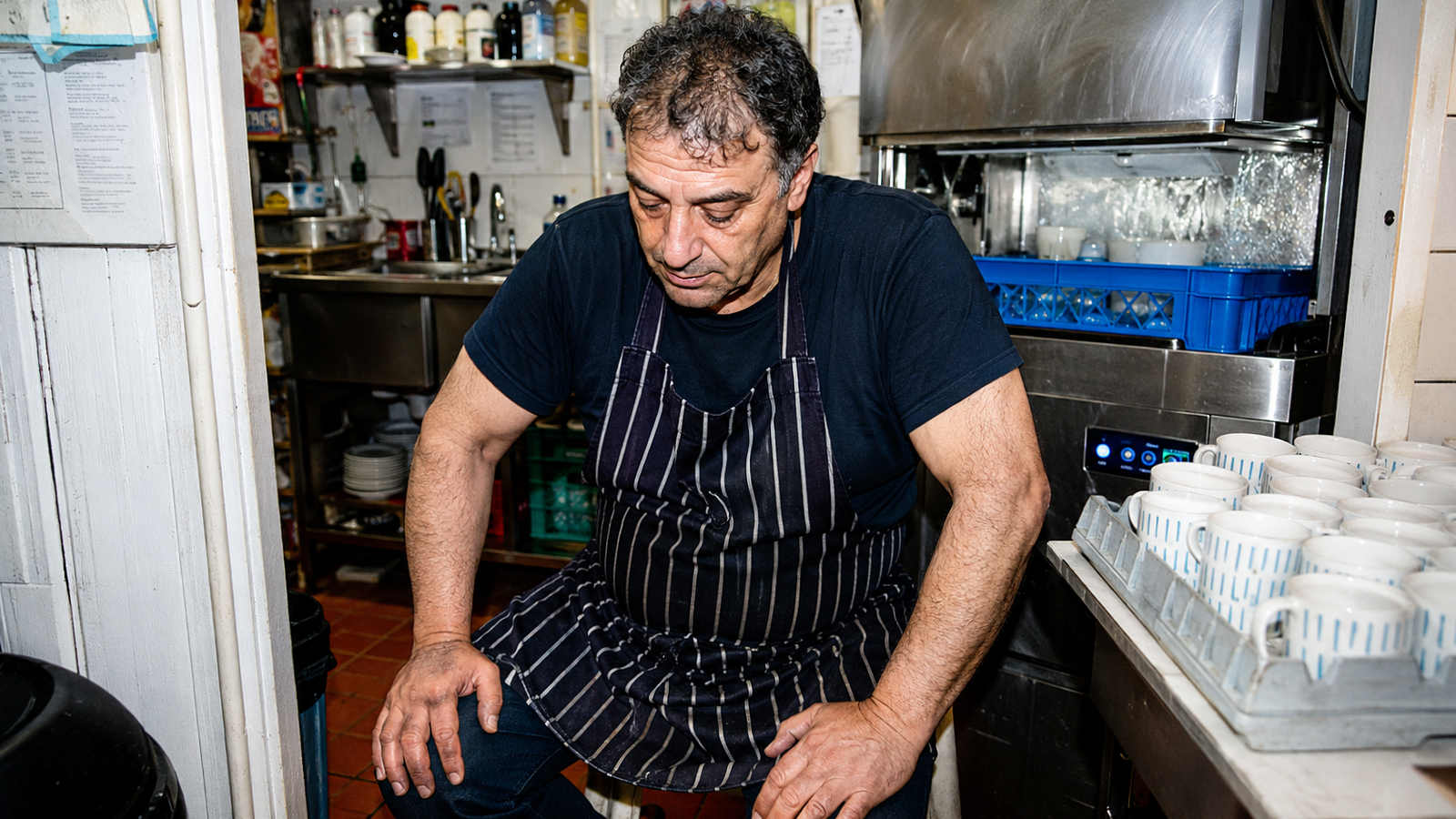
Author, leadership facilitator and small business owner Andrew Horsfield calls this gap ‘the messy middle.’ It’s a place of challenge, setback, struggle and overwhelm. He has spent years working with leaders who’ve found themselves caught in this position, generally due to competing demands. “We’re often all things to our customers and clients, and then at home, we’re a parent or a spouse. So, we’ve got lots of places we need to put our attention, and that’s part of why we get stuck,” he explains.
In his new book Better, Horsfield provides frameworks for business owners navigating the messy middle: how to work out whether their struggle will lead to success or burnout, and how to build tiny improvements into an already overloaded day.
What the Messy Middle Looks Like in a Small Business
Horsfield separates the messy middle into two types of struggles: one type that helps leaders advance and another that holds them back. “There’s the productive struggle, which is the work that’s helping us grow, advance, stretch ourselves, build something that we are proud of,” he says. This concept will be familiar to anyone who has tried to get fit or has started a business from scratch. “It’s that period of trying to work things out, it’s difficult, it needs time and energy and attention and it’s hard, but it takes us somewhere,” he explains.
The second type of struggle is damaging rather than productive, and when people find themselves stuck, that’s often where they are, Horsfield says. “Here, we can be spinning our wheels with habits that don’t serve us particularly well or with stories that used to serve us a long time ago that are no longer true or relevant about how life is for us,” he says. “We’re just going to bed and turning up the same way, week after week, quarter after quarter, with no reflection to say, ‘Well, how could I get better? How could I get more efficient?’”
For many leaders, burnout becomes inevitable in this situation. Horsfield says it’s not just the busyness of being in business that’s to blame. “We’re going through this life by default, rather than by design,” he says “There’s so much on our plates at the moment, and to be able to discern what really matters to us, what needs our time, energy, attention, as opposed to just drifting through all of the work that’s coming our way, is a skill that business owners need.”
He says living without intentionality can lead to regret on top of burnout. He cites the work of Bronnie Ware, a palliative care nurse and author of The Top Five Regrets of the Dying, who found that people at the end of their lives rarely wished they had worked harder. “They want more time. They want more freedom. They want more risk in their lives,” he explains. “That’s why we want people to be avoiding burnout, to step more into a fulfilling life that matters to them, rather than just accumulating days.”
It Would Help If We Could Hear The Danger Music
Horsfield says it can be tough for a business owner to recognise which of the two types of struggle they are experiencing since, to borrow a quote from Jim Carrey in The Cable Guy, ‘in real life, there is no danger music.’ It would be helpful if leaders could hear danger music to know they’re in a bad space, he says, only half-joking.
Instead, he teaches business owners to pay attention to signals that tell them they’re on the right track or are being worn down. In the productive type of messy middle, things may feel difficult but temporary: revenue is coming in yet growth is uneven, decisions bottleneck with the owner, and outcomes vary more than they should. The danger music would start playing when those inefficiencies begin to erode performance: margins tighten, cash flow becomes a constant concern, and the cracks start to show in team culture and customer experience.
While identifying the struggle may be hard, Horsfield says most people have a sense of what better looks like. “Whether that’s a change of career or just getting our kids to eat their vegetables, there are moments in our days where we look at things and say, ‘I just wish that could be better, easier, a bit more efficient,’” he says.
Conquering Fear And Taking Action
Moving out of the messy middle takes action and action takes courage, Horsfield says. “Action is the antidote to fear,” he insists.
He paraphrases an NBA legend as proof. “There’s the Michael Jordan quote, ‘I’ve taken 13,000 shots in my life, and I’ve missed 10,000 of them, but I’ve made the shots because I’ve taken the shot.’” He offers his wedding photographer as another example; when he marvelled at 150 stunning photographs, she pointed out they were selected from 1500 images taken across the day.
Rather than waiting for certainty, Horsfield encourages owners to treat action as an experiment – something to try, learn from and adjust. Being curious and approaching challenges with a spirit of ‘I’m going to try this and see what I can learn’ helps shift the relationship with fear from something paralysing to something manageable.
It’s fine to start small. “I think we look for that silver bullet rather than take the step. But it’s about taking the smallest viable step. We don’t have to pull all our chips into the table at the one time,” he says. “We can just work out, ‘Well, what’s the smallest step that I’m prepared to take that stretches me, that sits comfortably with me?” The action needs to be uncomfortable enough to matter, but not so daunting it never gets taken. “If it’s too big, people get intimidated and they don’t take that step.”
Each attempt also builds confidence. “Each time we do it, we get a little bit better at it,” he says. “We get a little bit more refined in our skills and our approach and our thinking. And of course, we get progressively better, rather than progressively worse, which is always a good thing.”
Being Better Can Begin In A Moment
This practical approach can start tomorrow, Horsfield says. He encourages business owners to use the transitions already built into their day – as they move from the breakfast table to their desk, from one client meeting to the next – to ask themselves three questions: What role am I playing right now? What reputation do I want in this setting? What result am I trying to achieve?
A second reflection works just as well between meetings: What’s working? What would I change? And, what will I do differently next time? After a tough conversation with an employee, an SME owner may ask themselves whether they prepared, did they empathise, did they get the outcome they wanted?
The right people matter too. Horsfield outlines three types of allies every business owner needs: mates, mentors and masters. Mates are the people who are “on our side no matter what, even when it’s our fault.” Mentors are trusted guides who “can help us see things we can’t see” – particularly valuable because employees and clients don’t always give owners the honest feedback they need. Masters don’t need to be in the room: books, courses and online content all count, and can be accessed 24/7.
“Sometimes we feel like we’ve got to find a mountain top or a pretty elusive monk or something to find the reason for our days,” he says. “And sometimes it can be as simple as just between those transitions of our days, taking a little moment to reflect on how on-purpose we are.”