 Australia
  United Kingdom
  Singapore
  Malaysia
  Canada (Français)
 New Zealand



New Zealand employees are taking a low-anxiety approach to AI in the workplace but are reluctant to take credit for its output, according to a global survey shedding light on artificial intelligence use in small and medium businesses.
Findings from Employment Hero’s AI Paradox Report push back against the popular doom-and-gloom narrative with a more nuanced snapshot of how AI is shaping hiring, training and productivity at ground level.
Built on insights from almost 9,000 leaders and workers across Australia, New Zealand, the UK and Canada, the report identifies five paradoxes – where two contrasting phenomena are occurring at the same time within individual businesses. The findings outline a workforce in transition: employers value AI skills but don’t always offer training; AI tools are saving time yet creating work; and people are more productive but can feel guilty about their output.
Among global counterparts surveyed, New Zealand workers are the calmest and most-willing to rely on their employers for AI training. But Kiwi companies are slowest in AI adoption.
“Many businesses are still working out what AI should look like in their workplace which is understandable because it is evolving quickly and there isn’t a one-size-fits-all approach,” says Neil Webster, Employment Hero General Manager New Zealand.
By understanding gaps between perception and experience, small and medium business owners can create clear guidelines that help their teams improve productivity and growth.
AI-Adopting Firms Are Growing Headcount and Reworking Hiring
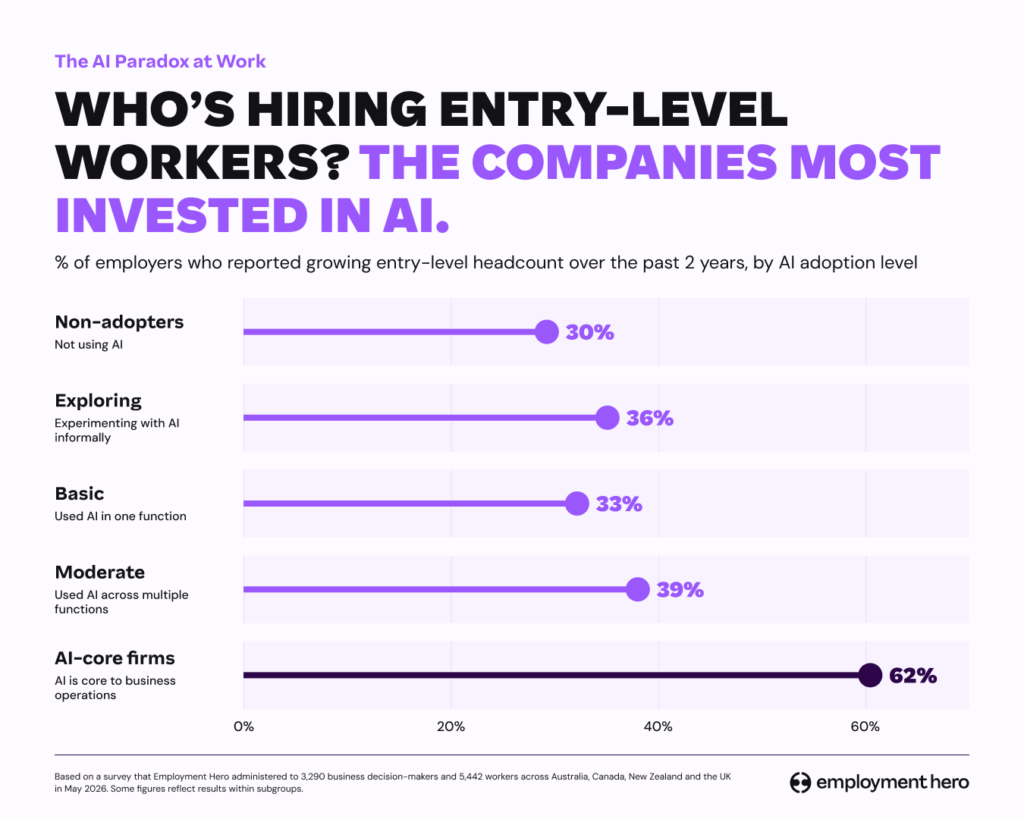
The headline fear that AI will hollow out graduate jobs is challenged by data that shows 34 per cent of New Zealand companies grew their entry-level headcount over the two years.
That figure jumps in businesses where AI is core to operations. Across the four markets surveyed, 62 per cent of AI-advanced firms have expanded their junior ranks, more than double the 30 per cent rate for firms yet to adopt the technology. These businesses are also nearly twice as likely to describe themselves as ‘thriving.’
Looking ahead, nearly 1 in 5 New Zealand business leaders say new roles will be created due to AI, and a further 50 per cent say existing roles will be re-focused, bringing to more than two-thirds the proportion of leaders expecting positive or transformative workforce change rather than outright cuts.
Among the four markets, a smaller group, 16 per cent, did reduce entry-level roles and cited automation as the cause. However, the data doesn’t confirm whether this a direct result of AI driving headcount or a sign that AI-mature businesses are stronger overall. The dominant pattern still remains: the firms on the AI frontline are hiring more people, not fewer.
AI is also influencing recruitment. Globally, AI skills now rank sixth among overall hiring criteria, behind work ethic, communication and quick learning, but ahead of holding a university degree.
In New Zealand, 24 per cent of employers list AI proficiency as a criterion for entry-level roles – fewer than Australia at 30 per cent and UK at 36 per cent. 17 per cent regard AI skills in candidates as essential, while 33 per cent view them as a bonus. AI assistant ‘Claude’ is the fastest-growing search term on Employment Hero’s job ads platform.
Workers Can Feel Guilty About Using AI
The report reveals a paradox between what people achieve with AI and how they feel when they use it. Globally, 60 per cent of employers think their staff view AI positively, when in reality their relationship with the technology is more complicated.
Employees who have built careers on their abilities can feel conflicted when passing off AI-enhanced work as their own. 38 per cent say that using AI to complete parts of their job feels like “cheating.” 37 per cent have experienced guilt when using AI tools to create high-quality work. 32 per cent admit to presenting AI-generated work as their own without disclosing it.
28 per cent go so far as to employ AI covertly, keeping their usage hidden from managers and colleagues. This enhances the risk of shadow AI usage, where staff adopt tools without organisational oversight or feed proprietary information into personal accounts, creating genuine data security and governance risks.
There are benefits for workers who feel they are operating with permission. 50 per cent of average users say AI is helping them build more valuable skills and 53 per cent report a reduction in administrative tasks, rising to 64 per cent and 74 per cent respectively for AI experts.
Webster says the answer isn’t for workers or businesses to pull back from AI, but to be more open about how it’s already being used. “AI’s greatest value is increasing human capability by making things possible that were previously too difficult or costly,” he argues. “Rather than replacing people, it takes on repetitive work in key areas so businesses and their people can focus on higher-value, human-focused work.”
Employees Want AI Training Provided But Also DIY
While employers like their employees to have AI skills, not all are investing in training.
Globally, half of all workers surveyed say their employers do little to help them develop AI skills. Only 38 per cent of businesses run any form of formal AI training program, although this rises to 2 in 3 for AI-core firms.
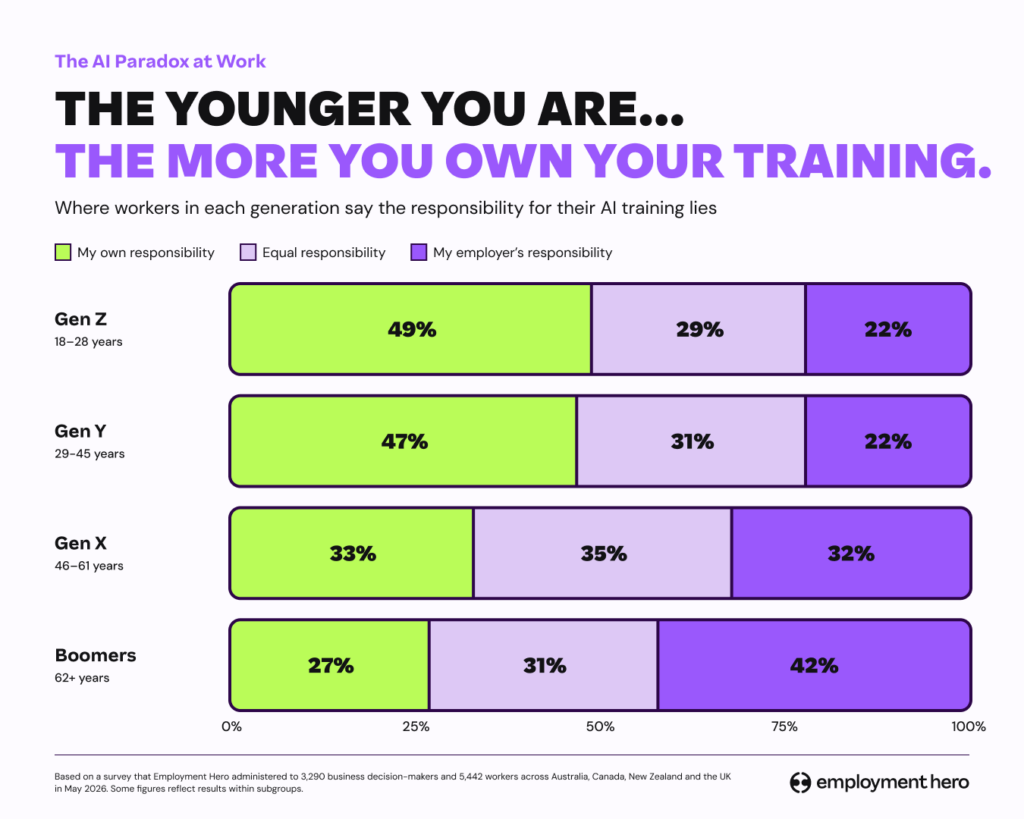
New Zealand employees remain adamant it’s an employer’s job to provide AI training. Of the four markets, they are the only workers who place AI training responsibility on employers – in all others, the scale tips towards self-education.
But that doesn’t mean Kiwi employees are afraid to DIY. 51 per cent admit they have taught themselves AI skills through social media platforms like YouTube, TikTok, Reddit, and Discord either on top of or instead of using a structured workplace resource. These platforms are outside employer control, meaning businesses have limited visibility into the quality or appropriateness of the AI practices their teams are adopting.
For SME owners, this gap represents both a risk and a competitive opening. The risk is a workforce building AI habits without governance or connection to business objectives. The opportunity is that even basic structured training could differentiate an employer in a market where many are offering nothing.
Separate to the issue of entry-level job security, the report highlights a paradox surrounding the confidence of AI experts. 41 per cent of AI-advanced workers say the technology makes them feel more vulnerable to being laid off, and 29 per cent say their job security has decreased because of AI use in their workplace.
“Workers with the most AI competence are the most conflicted. They know what it can do for them but are anxious about the impact it might have on their role and their livelihood,” Webster says.
There is less replacement anxiety among the broader workforce. The average of 34 per cent is the lowest of the four markets surveyed and sits well below the Australian figure of 45 per cent.
How To Close The Gaps And Maximise Gains
While Kiwi workers show an openness towards artificial intelligence, the report highlights an adoption bottleneck at the organisational level.
Only 15 per cent of New Zealand businesses say AI is currently core to their operations, compared to 24 per cent in the UK. The percentage of business owners sold on its benefits also trails other markets. 34 per cent of New Zealand employers believe AI is actively driving innovation in their operations, significantly fewer than counterparts in Australia (45 per cent) and the UK (55 per cent)
By extension, this gap means New Zealand small and medium businesses are capturing fewer tangible rewards: only 35 per cent of Kiwi employers report achieving cost savings through AI, compared to 43 per cent in Australia. Similarly, while global businesses use these tools to ease operational pressure, only 27 per cent of New Zealand workers say AI supports a better work-life balance, compared to 36 per cent of British staff.
Dr Guy Bate, Thematic Lead for Artificial Intelligence at the University of Auckland, says local workplaces are stuck in a cycle where adoption is outpacing maturity. “The paradox is that the adoption of AI may be rising faster than the confidence in what ‘good’ AI use looks like,” says Dr Bate. “Employees are gaining speed but feeling uneasy, while employers see efficiency gains without equivalent innovation.”
To bridge this divide, he says, business leaders must move past simply deploying software and target human attention towards digital workflows. “The way through this is not necessarily more adoption,” he says. “It is the capacity to combine human judgement with AI in ways that improve the quality of work and decision making while retaining human responsibility.”
While New Zealand’s calm, low-anxiety workforce could be viewed as a competitive advantage, lower adoption rates highlight the risk of falling behind comparable nations. Webster says the solution is to reframe this as a runway for growth – but only if business owners are willing to step up, establish clear guidelines, and explicitly champion the technology.
“AI’s greatest value is increasing human capability by making things possible that were previously too difficult or costly,” he argues. “Instead of feeling guilty about using it, people need to feel confident using it, and workplaces need to switch their mindset to having an AI-first approach.”