














How to Create an Employee Training Plan: Template & Guide
Published
How to Create an Employee Training Plan: Template & Guide
Published
Building a business is one thing, but building a team that can carry it forward is where the real magic happens. As an employer, you know that your people are your greatest asset. Investing in their growth isn’t just a nice-to-have; it’s a strategic move that fuels productivity, boosts morale and keeps your best talent from walking out the door.
But where do you start? The idea of creating a full-blown training programme can feel overwhelming. That’s why we’re here to cut through the noise. This guide will walk you through creating an effective employee training plan that aligns with your business goals and delivers real results. No jargon, no fluff—just practical steps and a free template to get you started.
Let’s build a better way to work together.
What should a training programme outline include?
A solid training programme needs a strong foundation. Think of the outline as the blueprint for your team’s development journey. It ensures every piece of training is purposeful, relevant and measurable. A well-structured outline stops training from becoming a box-ticking exercise and turns it into a powerful tool for growth.
Here are the essential components of a robust training roadmap:
- Learning objectives: What should employees know or be able to do after the training? Start with the end in mind. Objectives must be clear, specific and measurable. For example, instead of “Improve communication,” a better objective is “Team members will be able to use the STAR method to give constructive feedback in one-on-one meetings.”
- Target audience: Who is this training for? New hires, aspiring managers or the entire sales team? Defining your audience helps you tailor the content, language and delivery method to their specific needs and existing skill levels.
- Content and topics: Break down the training into key modules or topics. What specific subjects will you cover to achieve your learning objectives? This section should detail the curriculum, from high-level concepts to the practical skills you’ll teach.
- Delivery methods: How will you deliver the content? Options range from in-person workshops and one-on-one coaching to self-paced online courses and virtual reality simulations. The best approach often involves a blended model that combines different methods for maximum impact.
- Timeline and duration: How long will the training take? Specify the duration of each session and the overall timeframe for the programme. A realistic timeline helps employees manage their workload and keeps the training on track.
- Assessment and measurement: How will you know if the training worked? You need methods to assess learning and measure success. This could include quizzes, practical assignments, peer reviews or tracking Key Performance Indicators (KPIs) before and after the training.
- Required Resources: List everything you’ll need to run the programme, including trainers, software, training materials, physical space and budget.
Having these elements clearly defined in your outline provides a clear path forward, making the entire process more manageable and effective.
How do you create an employee training programme that works?
Creating a programme that genuinely delivers value means moving beyond ticking boxes. It’s about crafting an engaging and practical experience that resonates with your team and translates into tangible skills. A training programme that sits on a shelf collecting dust helps no one. One that inspires action and improves performance is a game-changer. Companies that invest in employee training enjoy a 24% higher profit margin than those who spend less.
Here’s how to build a programme that delivers real value:
- Start with a needs analysis: Before you build anything, figure out what you need. A training needs analysis helps you identify the specific skills gaps in your team. We’ll dive deeper into this later, but it involves looking at business goals, team performance and individual career aspirations.
- Align with business goals: Your training initiatives should never exist in a vacuum. Connect every programme directly to a wider business objective. Want to increase customer satisfaction by 15%? Design training focused on communication and problem-solving skills for your customer service team. This alignment ensures your training investment delivers a clear return.
- Involve your people in the process: The best way to create training that people actually want to take is to ask them what they need. Involve employees and their managers in the planning process. They have the on-the-ground insights into the challenges they face and the skills they need to overcome them. This co-creation fosters a sense of ownership and boosts engagement from the start.
- Focus on practical application: Theory is good, but application is better. Design your training around real-world scenarios and hands-on activities. The goal is for employees to walk away with skills they can apply to their job the very next day.
- Measure, gather feedback and iterate: A training programme is not a one-and-done project. Continuously measure its effectiveness against your initial objectives. Collect feedback from participants to understand what worked and what didn’t. Use these insights to refine and improve your programmes over time.
By focusing on these principles, you can create a learning culture that not only closes skill gaps but also enhances the overall employee experience, making your company a place where people are excited to grow.
Why is employee training important for your business?
Investing in your team’s skills is one of the smartest decisions you can make for your business. It’s a direct investment in your company’s future success. When you empower your employees with the right knowledge and tools, the benefits ripple across the entire organisation, impacting everything from your bottom line to your company culture.
Here’s why employee training is so critical for business growth:
- Improved productivity and performance: This is the most direct benefit. Well-trained employees are more confident and competent in their roles. They make fewer mistakes, work more efficiently and produce higher-quality work. This boost in individual performance naturally leads to improved team and company-wide productivity.
- Increased employee morale and engagement: When you invest in your employees’ development, you’re sending a powerful message: “We value you and we’re committed to your success.” This recognition boosts morale and makes employees feel more connected to the company. Engaged employees are more motivated, passionate and committed to your business goals.
- Enhanced staff retention: Losing a good employee is costly. The cost of replacing an individual employee can range from one-half to two times the employee’s annual salary. Providing robust training and development opportunities is a proven retention strategy. Employees are more likely to stay with a company that invests in their future. It shows them a clear path for career progression within your organisation.
- Attraction of top talent: A strong training programme can be a major differentiator in a competitive job market. Top candidates are looking for more than just a salary; they want opportunities to learn and grow. Highlighting your commitment to employee development in your job postings and interviews can help you attract the best talent.
- Adaptability and innovation: The world of work is constantly changing. Training helps your team stay ahead of the curve by developing new skills and adapting to new technologies and processes. A skilled workforce is an agile workforce, better equipped to embrace change and drive innovation.
Ultimately, employee training isn’t an expense; it’s a high-return investment that strengthens your business from the inside out. For a deeper dive into the benefits, check out our guide to training employees.
What makes leadership training effective?
Great managers are made, not born. While some people may have natural leadership tendencies, the practical skills required to lead a team effectively—like coaching, giving feedback and strategic thinking—need to be developed. Effective leadership training moves beyond theory and equips your managers with the tools they need to inspire, motivate and guide their teams to success.
So, what are the key ingredients of leadership development that truly build great managers?
- Focus on practical, actionable skills: Forget long lectures on leadership theories. Effective training focuses on practical skills that managers can use immediately. This includes workshops on conducting effective one-on-ones, navigating difficult conversations, coaching team members for performance and delegating tasks effectively.
- Self-awareness as a foundation: The journey to becoming a great leader starts with self-awareness. Training should include tools like personality assessments (e.g., DiSC or Myers-Briggs) and 360-degree feedback to help managers understand their own strengths, weaknesses, communication style and impact on others.
- Real-world scenarios and role-playing: The best way to learn is by doing. Use role-playing exercises to simulate common management challenges, such as addressing underperformance or mediating a conflict between team members. This allows managers to practise their new skills in a safe, supportive environment before applying them in the real world.
- Ongoing coaching and mentorship: A one-off workshop is rarely enough to create lasting change. Effective leadership development is an ongoing process. Pair formal training with ongoing coaching or mentorship from experienced leaders. This provides a continuous feedback loop and helps managers navigate the unique challenges they face in their roles.
- Measuring impact on team performance: The ultimate test of leadership training is its impact on the team. Track key metrics like employee engagement, team productivity and staff turnover for the teams of managers who have undergone training. This helps you measure the ROI of your programme and identify areas for improvement.
Developing strong leaders is one of the most powerful levers you have for improving your entire organisation. When your managers are effective, their teams thrive.
How can you design an effective employee training programme?
Designing an effective programme is a strategic process that requires careful planning. It’s about breaking down your goals into manageable steps and using varied formats to create a learning journey that is both engaging and impactful. The goal is to build a programme with clear, measurable goals that directly addresses the needs you’ve identified.
Here’s a step-by-step process for designing a programme that works:
- Define clear and measurable goals: Start by revisiting your needs analysis. What specific problem are you trying to solve? Your training goals should be SMART (Specific, Measurable, Achievable, Relevant and Time-bound). For example, a goal might be: “By the end of Q3, 90% of our sales team will be able to conduct a product demo that scores at least 8/10 on our internal quality rubric.”
- Break down content into modules: Once you have your goals, break down the required knowledge and skills into logical modules or lessons. This makes the content more digestible for learners and easier for you to create. For each module, outline the key learning objectives, activities and assessment methods.
- Choose the right delivery formats: There’s no one-size-fits-all solution for content delivery. The best approach often involves a blended learning model that combines different formats. Consider:
- eLearning modules: Great for foundational knowledge and self-paced learning.
- Live workshops (in-person or virtual): Ideal for interactive activities, group discussions and role-playing.
- Coaching and mentoring: Provides personalised guidance and support.
- On-the-job training: Allows employees to apply new skills in a real-world context.
- Social learning: Encourage knowledge sharing through team chats or internal forums.
- Develop engaging training materials: Create materials that are clear, concise and visually appealing. Use a mix of text, images, videos and interactive elements to keep learners engaged. If you’re creating your own training content, an Employee Learning Management System (LMS) can be invaluable. Employment Hero’s LMS, for instance, allows you to build custom courses, upload materials and track employee progress all in one place.
- Create a pilot programme: Before you roll out the training to the entire target audience, test it with a small group of employees. This pilot programme allows you to gather feedback and make any necessary adjustments to the content, format or timing.
This strategic design process ensures that every element of your training programme is purposeful and aligned with your ultimate objectives, setting you up for success from the start.
What’s the best way to create an employee training plan?
Creating a forward-thinking training plan is about aligning your team’s development with your long-term business goals. It’s a strategic roadmap that goes beyond ad-hoc training sessions and builds a sustainable learning culture. The process starts with understanding where your business is going and what skills your team will need to get there.
The best way to build this plan is to conduct a thorough skills gap analysis and use the findings to prioritise your training needs.
A skills gap analysis is the process of comparing your current workforce’s skills against the skills your company needs to achieve its objectives. It helps you answer three critical questions:
- Where are we now? (Current skills).
- Where do we want to be? (Required skills).
- How do we bridge the gap? (Training needs).
By systematically identifying these gaps, you can ensure your training budget is spent on initiatives that will have the greatest impact on your business. This strategic approach prevents you from wasting resources on training that isn’t aligned with your most pressing needs. For a more detailed walkthrough, you can explore our introduction to learning and development.
How do you assess training needs in your team?
Assessing training needs is the crucial first step in building a plan that hits the mark. It ensures you’re solving the right problems. To do this effectively, you need to gather information from multiple sources to get a complete picture of where your team needs support.
Here are some practical methods for identifying training needs:
- Review business goals and roadmaps: Start at the top. What are the company’s goals for the next year? Are you launching a new product, expanding into a new market or implementing new technology? These strategic initiatives will dictate the new skills your team will need.
- Analyse performance data: Your performance management system is a goldmine of information. Look at performance reviews, KPIs and sales data to identify common areas of weakness or underperformance across teams or the entire organisation.
- Conduct surveys and questionnaires: Directly ask your employees what they need. Anonymous surveys can be a great way to get honest feedback on the challenges they face and the areas where they feel they need more support. Ask questions about their confidence in specific skills, the obstacles they encounter in their roles and their career aspirations.
- Hold conversations with managers and employees: Managers have a direct line of sight into their team’s day-to-day performance and skill gaps. Have one-on-one conversations with them to discuss their team’s needs. Also, talk to employees directly during check-ins or career development discussions to understand their personal growth goals.
- Observe employees in action: For some roles, direct observation can be a powerful tool. Shadowing a sales call or watching a customer service interaction can provide immediate insight into where skills can be improved.
By combining these methods, you can build a comprehensive understanding of your team’s training needs, allowing you to create a targeted and effective training plan.
What’s the role of hire training in onboarding success?
The training you provide during the onboarding process is absolutely critical. This initial period sets the tone for a new hire’s entire journey with your company. Effective training during onboarding doesn’t just teach them how to do their job; it integrates them into your company culture and sets them up for long-term success and retention.
Here’s why new hire training is so vital for onboarding success:
- Accelerates time to productivity: A structured training plan helps new employees get up to speed quickly. It provides them with the knowledge, tools and resources they need to start contributing to the team in a meaningful way, much faster than if they were left to figure things out on their own.
- Clarifies roles and expectations: Effective onboarding training clearly outlines the new hire’s role, responsibilities and performance expectations. This clarity reduces the anxiety and uncertainty that often come with starting a new job, allowing them to focus on learning and growing.
- Builds confidence and engagement: When new hires feel supported and equipped to succeed from day one, their confidence soars. This early positive experience is a powerful driver of long-term engagement and commitment.
- Integrates them into the company culture: Onboarding is your first and best chance to immerse new employees in your company’s values, mission and way of working. Training should cover not just the “what” of the job, but the “how” and “why” of your culture.
Streamlining this process with onboarding software can make a huge difference. You can create standardised onboarding workflows, deliver training content automatically and track completion, ensuring every new hire gets a consistent and comprehensive welcome to your team.
How do you gather feedback and iterate on training?
Creating a great training programme isn’t a one-time effort. The key to long-term success is to build a continuous loop of feedback and improvement. Gathering insights from participants after each session helps you understand what’s working, what isn’t and how you can make future training even more effective.
Here’s how to gather feedback and iterate on your training:
- Use post-training surveys: This is the most common and effective method. Immediately after a training session, send out a short survey to participants. Ask for their feedback on the content, the instructor, the format and the overall experience. Use a mix of rating scales and open-ended questions to gather both quantitative and qualitative data.
- Conduct follow-up interviews: For more in-depth feedback, consider conducting short interviews with a small sample of participants a few weeks after the training. This allows you to dig deeper into their experience and understand how they’ve been able to apply their new skills in their roles.
- Talk to managers: Check in with the managers of the employees who attended the training. Have they observed any changes in their team members’ performance or behaviour? Are the new skills being applied on the job? Their perspective is crucial for understanding the real-world impact of the training.
- Analyse performance data: Circle back to the metrics you established at the beginning. Compare pre-training and post-training data to measure the tangible impact of your programme. If your goal was to improve customer satisfaction scores, have those scores gone up?
- Schedule regular reviews: Don’t let the feedback sit in a folder. Schedule regular reviews of your training programmes (e.g., quarterly or annually) to analyse the feedback and performance data you’ve collected. Use these insights to make concrete improvements to your training content, delivery and follow-up.
By treating feedback as a gift, you can turn a good training programme into a great one, ensuring it continues to deliver value for your employees and your business.
Get your training plan started the smart way with Employment Hero
Ready to stop guessing and start building a training programme that drives real results? An effective training plan is your roadmap to a more skilled, engaged and productive team. It empowers your employees to grow and when your people grow, your business grows with them.
Don’t let the planning process hold you back. Download our free Employee Training Plan Template to get a head start. This customisable template provides the structure you need to outline your objectives, content and success metrics, making it easier than ever to turn your training vision into a reality.
Start building a better future for your team and your business.
To download the template, we just need a few quick details.
Related Resources
-
 Read more: EOFY HR Audit: What to Review in March
EOFY HR Audit: What to Review in March
Complete a EOFY HR audit with our practical checklist. Review compliance, people processes and compliance to reduce risk before the…
-
 Read more: How to Choose an HR System: A 2026 Buyer’s Checklist
How to Choose an HR System: A 2026 Buyer’s Checklist
HR software is more than features. Discover how the right system can streamline operations, boost efficiency and future-proof workforce management.
-
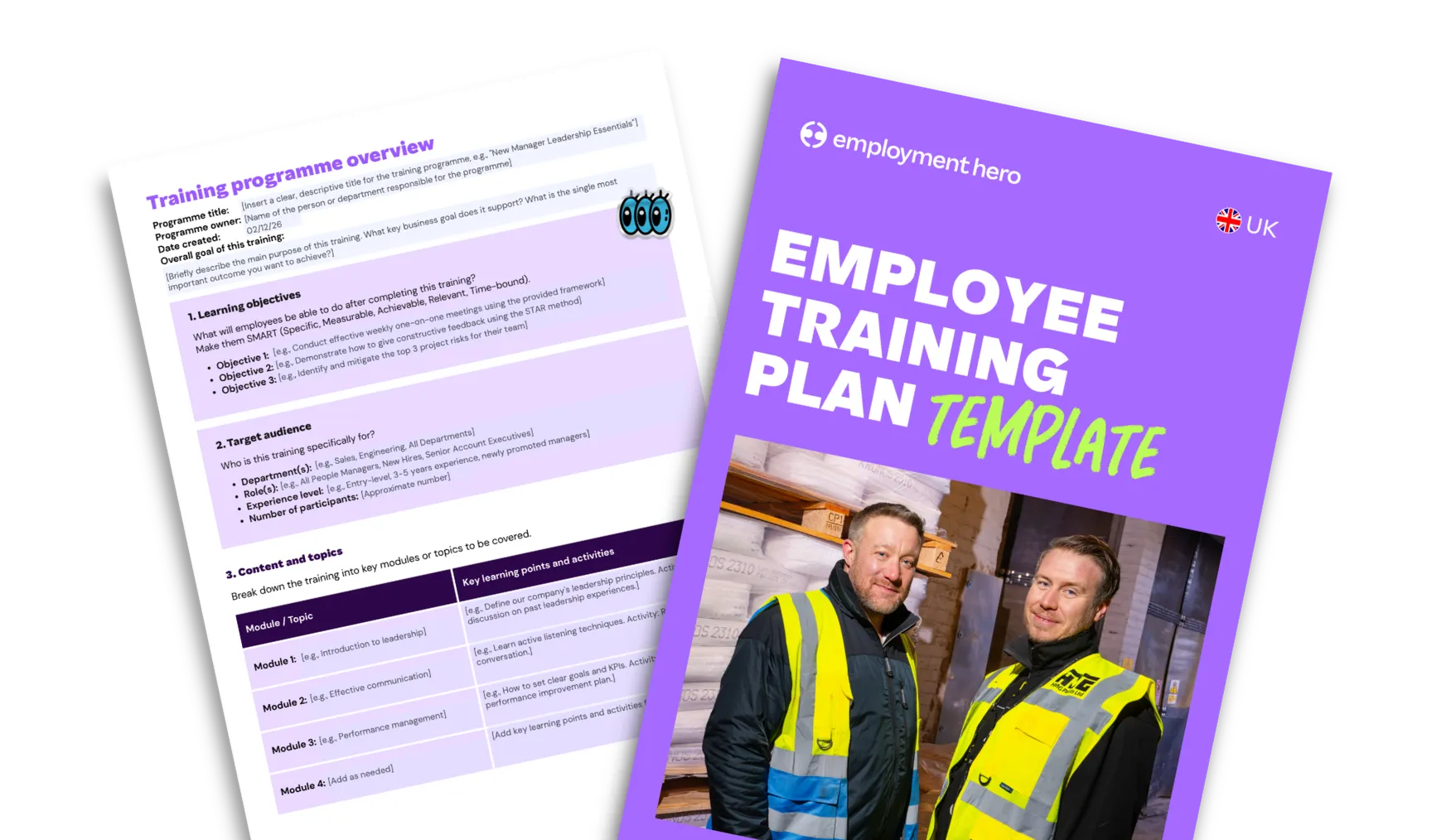 Read more: How to Create an Employee Training Plan: Template & Guide
How to Create an Employee Training Plan: Template & Guide
Ready to build a training program that drives results? Learn how to create an effective employee training outline that aligns…
