


















Short Time Contracts: What You Need To Know
Published
Short Time Contracts: What You Need To Know
Last Updated
Running a business means navigating ups and downs. One minute, orders are flying in; the next, a key supply chain is disrupted or a seasonal lull hits.
In these moments, you need to adapt quickly to protect your cash flow and most importantly, your people. Redundancies often feel like the only option, but they aren’t.
There’s a smarter, friendlier way to handle temporary downturns: short-time working. It’s a tool that allows you to reduce employee hours and pay temporarily, helping you weather the storm without losing valuable team members.
But here’s the critical part: you can’t just decide to do it. A short time contract variation requires a clear legal basis and, above all, your employee’s agreement. Get this wrong and you could face serious legal challenges. Let’s cut through the confusion and get it right.
What is in this factsheet?
This factsheet is your guide to navigating short-time working arrangements legally and effectively. We’ll break down:
- What short-time working means.
- How to implement it with your team’s consent.
- What you are legally required to pay.
Think of it as the go-to resource for making tough decisions the right way, protecting both your business and your people.
With this knowledge, you can approach temporary business challenges not with dread, but with a clear, fair and compliant plan.
What is short-time working?

Short-time working is a temporary arrangement where you reduce an employee’s hours because there isn’t enough work for them. As their hours decrease, so does their pay. The key word here is temporary. It’s a tool designed to navigate a short-term dip in business, not a permanent change.
It’s often confused with a ‘lay-off’, but they are different. A lay-off is when you ask an employee to stay at home and do no work at all for a period. Short-time working simply means they work fewer hours than usual.
UK employment law and short-time working
The legal foundation for short-time working is built on contract law and consent. You can’t just tell an employee their hours are cut. According to the Employment Rights Act 1996 and ACAS guidance, you can only place an employee on short-time working if either:
- Their employment contract contains a specific clause that gives you the right to do so; or
- You consult with them and get their explicit agreement in writing to a temporary variation of contract.
Without one of these, imposing reduced hours is a breach of contract, which could lead to claims of unlawful deduction of wages or even constructive dismissal.
How does short-time working work?
Implementing a short-time arrangement requires a clear, step-by-step process built on communication and transparency. You need to explain the business reasons, agree on the terms with your team and document everything. This isn’t just about legal cover; it’s about maintaining trust when things get tough.
A structured approach ensures that everyone understands the ‘why’ behind the decision and knows exactly what to expect regarding their hours and pay.
Short-time working rules in the UK: A breakdown
To implement short-time working correctly, you need to be aware of several key rules. These protect both you and your employees.
- Contractual clauses or consent: As we’ve covered, you need either a pre-existing clause in the contract or fresh, written consent.
- Time limits: If an employee is on short-time for four consecutive weeks or a total of six weeks in any 13-week period, they may be eligible to claim statutory redundancy pay.
- Redundancy rights: The ability for an employee to claim redundancy is a crucial backstop that prevents employers from keeping staff on reduced pay indefinitely.
- Guarantee pay: Employees may be entitled to a minimum payment from you, known as Statutory Guarantee Pay, for days they would normally work but are not given work.
Short-time working contract clause
If you operate in an industry with predictable fluctuations, like manufacturing or events, including a short-time working clause in your contracts from the start can be a smart move.
A well-drafted clause should be specific. It needs to clearly state the circumstances under which it might be used, how pay will be calculated and how you will communicate with employees. Vague clauses that give you a blanket right to change hours are unlikely to hold up if challenged.
The reasons for short-time working

Short-time working is a response to a temporary business need. It’s a strategic alternative to redundancies when you anticipate that the downturn is not permanent.
Common reasons include:
- Seasonal downturns: Common in hospitality or tourism.
- Supply chain disruptions: A key supplier is unable to deliver materials.
- Loss of a major client: A project is suddenly cancelled or postponed.
- Wider economic pressures: A recession or crisis reduces customer demand.
How long can short-time working last?
This is where the law provides a critical safeguard for employees. While there is no absolute maximum duration, an employee who receives less than half a week’s pay can claim for statutory redundancy pay if they have been laid off or kept on short-time working for:
- Four or more consecutive weeks or;
- A total of six weeks in any 13-week period (where no more than three of the weeks are consecutive).
This rule prevents the system from being used unfairly and gives employees a way out if the “temporary” situation starts to feel permanent.
Short-time working: Notice periods
You should give as much notice as is reasonably practicable before starting a period of short-time working. There is no statutory minimum notice period, but fairness and good employee relations dictate that you should provide clear communication ahead of time. The same applies when you are ready to bring employees back to their normal hours.
Maintaining clear and open lines of communication is vital. Using a centralised HR software can help you send updates and keep records efficiently.
In the event of redundancies
If the downturn in work becomes permanent, the situation may transition from short-time working to a redundancy scenario. At this point, you must follow a fair redundancy process, including consultation and selecting employees for redundancy based on objective criteria.
An employee who has been on short-time working for the periods mentioned earlier (4+ consecutive weeks or 6 in 13) can give you written notice of their intention to claim redundancy. If you fail to provide a written counter-notice within seven days guaranteeing at least 13 weeks of continuous employment, their claim can proceed.
How they work: Lay-offs and short-time working
It’s easy to mix these up, but the distinction is important.
- Short-time working means an employee works reduced hours and is paid for the hours they work.
- Lay-off means the employee is sent home and does no work for at least one full working day.
Both are temporary solutions to a lack of work and both are subject to the same rules around contract clauses, consent and the right to claim redundancy.
Changing the terms in an employment contract
Whether you have a specific clause or not, the best practice is always to seek agreement for a temporary variation of contract. This involves open consultation where you explain the situation and listen to feedback. Once you reach an agreement, document it in a letter that both you and the employee sign. This simple step can prevent a mountain of problems later. A clear onboarding checklist for new hires can be adapted to ensure all variation steps are followed.
Pay during lay-offs and short-time working

Pay is naturally the biggest concern for employees. Here’s how it works. For short-time working, you pay the employee for the hours they have worked. For days they are laid off (or non-working days under a short-time arrangement), they may be entitled to guarantee pay.
Guarantee pay
This is a payment an employer must make, either based on the contract or the statutory minimum. The contractual rate cannot be lower than the statutory minimum.
Statutory guarantee pay
If the employee’s contract doesn’t provide for guarantee pay, they may be entitled to Statutory Guarantee Pay (SGP).
Eligibility
To be eligible for SGP, an employee must have been continuously employed for at least one month, be available for work and not have unreasonably refused an offer of suitable alternative work.
Time limits
SGP is limited to a maximum of 5 days in any 3-month period. The daily rate is capped by the government and is updated each year. It’s a safety net, not a replacement for full pay.
Holiday entitlement
Employees continue to accrue holiday entitlement as normal during a period of short-time working or lay-off.
Benefits during lay-offs and short-time working
An employee’s continuity of service is not broken by a short-time working arrangement. This means they continue to accrue benefits like annual leave. Pension contributions may be affected depending on whether their earnings fall below the threshold for auto-enrolment during the period of reduced pay.
Other work
An employee on short-time working can take another job to supplement their income, as long as their employment contract with you doesn’t prohibit it. Being flexible and supportive on this front can help maintain a good relationship during a difficult period.
Avoiding discrimination
When selecting employees for short-time working, you must use fair and objective criteria. If your selection process is seen to disadvantage employees based on protected characteristics like age, gender or disability, you could face a discrimination claim. For example, selecting only part-time employees for reduced hours could be indirect sex discrimination, as women are more likely to work part-time. Your selection criteria should be based on business needs, such as the area of the business where work has reduced. This is a vital part of your overall HR compliance strategy.
Download the full factsheet
Navigating short-time working requires care, empathy and a solid understanding of the rules. When handled correctly, it can be a powerful tool to protect your business and keep your team together through challenging times.
To help you manage this process with confidence, we’ve created a detailed factsheet that breaks down all the key steps and legal requirements. Download it now to keep on file for when you need it most.
To download the factsheet, we just need a few quick details.
Related Resources
-
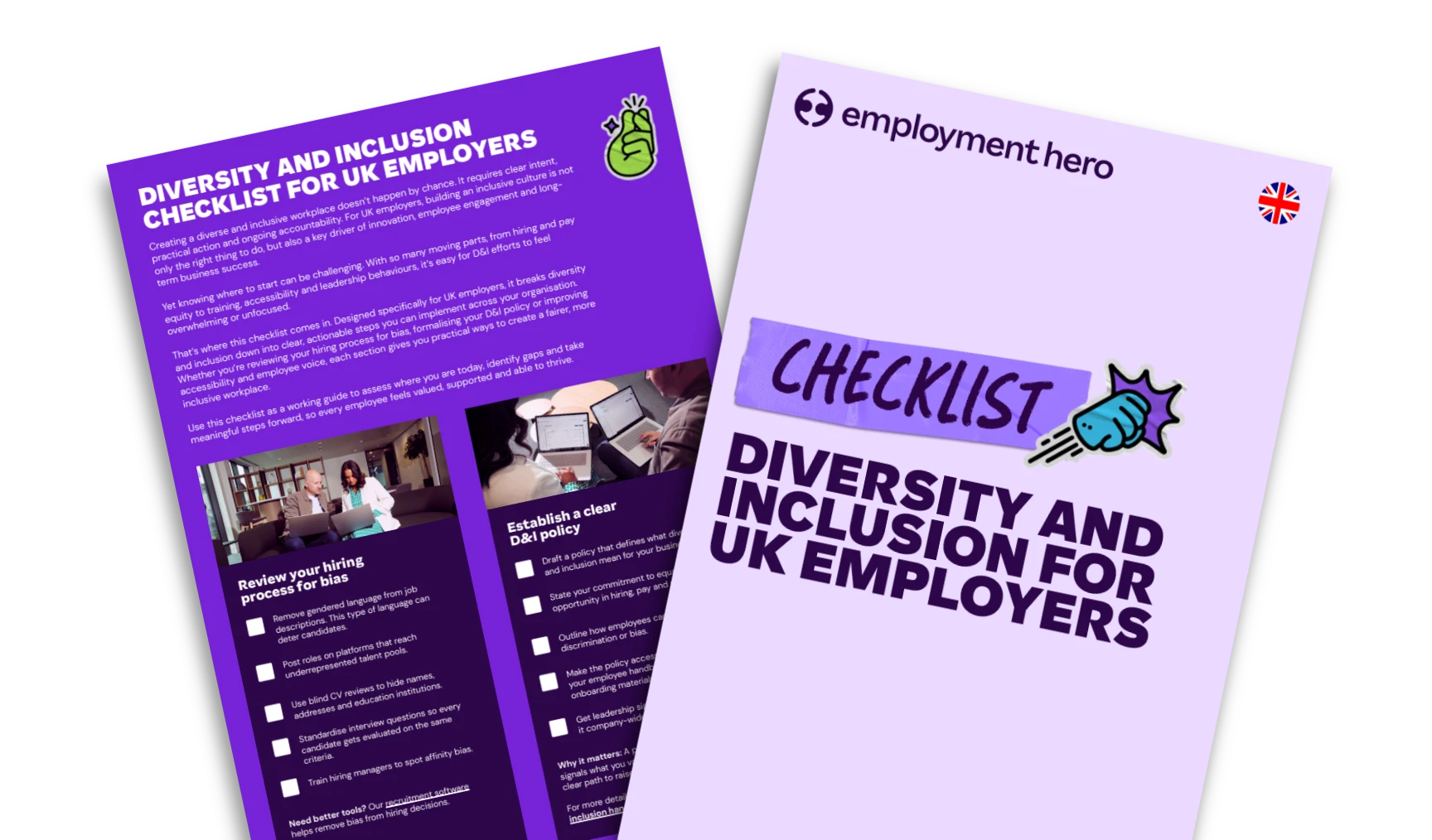 Read more: Diversity and Inclusion Checklist for UK Employers
Diversity and Inclusion Checklist for UK Employers
Create a truly inclusive environment with our diversity and inclusion checklist.
-
 Read more: Workplace Bullying Checklist for UK Businesses
Workplace Bullying Checklist for UK Businesses
Are your employees protected from workplace bullying? Review your processes and learn how to handle arising issues with this checklist.
-
 Read more: Monthly Payroll Checklist for UK Businesses
Monthly Payroll Checklist for UK Businesses
Manage your payroll processing with our monthly checklist. Streamline your tasks and improve efficiency.
