


















Roles and Responsibilities Template for Team Management
Published
Roles and Responsibilities Template for Team Management
Last Updated
For the majority of business owners, the dream of running a business was about solving problems you’re passionate about, innovating, growing and being your own boss. We bet the idea of org charts and writing job descriptions wasn’t even on your mind. But as you scale, it becomes more and more important to define who does what and who reports into who.
Chaos is the enemy of growth. When roles are blurry, accountability disappears. Your best people get frustrated because they don’t know what success looks like and your new hires flounder because they don’t know where they fit.
Luckily, there’s a simple solution to this problem and it comes in the form of clarity. All that’s required is a simple, single source of truth that defines who does what.
This is why Employment Hero has created a roles and responsibilities template to help you and your team understand where everyone fits.
What is a roles and responsibilities template?
A roles and responsibilities template is designed to help HR managers succeed and ensure every person in your business knows what their job is, what their goals are and who they report to.
It’s not just a job description you write once and file away in a dusty cabinet. It’s a living document that clearly maps out a job’s core purpose, specific duties and key requirements. It draws a line in the sand, ensuring there’s no confusion about who owns which outcome. It aligns expectations between managers and employees, preventing the friction that comes from unspoken assumptions.
Benefits of defining roles and responsibilities
Having a roles and responsibilities template and defining them correctly can have a powerful impact on how your business operates. When expectations are clear, teams work more effectively, managers spend less time firefighting and the organisation is better positioned to scale. Below are some of the key benefits of having clarity across your business.
- Improves teamwork and collaboration: Employees understand their role within the wider team, reducing confusion, duplicated effort and tension between colleagues.
- Increases efficiency and productivity: Clear responsibilities help people prioritise the right tasks, speed up decision-making and eliminate wasted time.
- Creates stronger accountability: Defined ownership makes it easier to manage performance, set expectations and address issues proactively.
- Supports smoother operations: Teams can work more consistently and adapt more easily as workloads or business needs change.
- Strengthens the hiring process: Well-defined roles lead to clearer job descriptions, attract more suitable candidates and reduce the risk of poor hires.
- Improves onboarding and retention: New starters know what’s expected from day one, helping them settle in faster and stay engaged for longer.
How to define roles and responsibilities
Defining roles and responsibilities works best when it’s a collaborative process, rather than a top-down exercise. Involving your team helps create clarity, encourages buy-in and ensures roles reflect how work actually gets done, not just how it looks on paper.
Follow these steps to build clear, effective role definitions that support both individual accountability and the wider business.
- Start with your business objectives: Clearly define what the team or department needs to achieve. This ensures every role is aligned with wider business goals and contributes real value.
- Map out key tasks and workflows: Identify the core tasks that need to be completed and how work moves between roles. This helps highlight gaps, overlaps, or inefficiencies in how work is currently done.
- Involve your team in the process: Ask employees to describe their current responsibilities and raise any areas of uncertainty. Involving them early improves accuracy and encourages ownership.
- Clarify ownership and decision-making: Define who is responsible for each task, who supports it and who has final sign-off. This avoids confusion and speeds up decision-making.
- Document roles clearly and consistently: Create clear role descriptions that outline responsibilities, expectations and key outcomes, keeping them practical and easy to understand.
- Review and update roles regularly: As your business grows or changes, roles will evolve. Regular reviews ensure responsibilities stay relevant and aligned with business needs.
How to use a roles and responsibilities template
A roles and responsibilities template is most effective when it’s treated as a working document, not a box-ticking exercise. Used properly, it helps clarify ownership, improve accountability and ensure no critical tasks are overlooked. The key is to complete each section thoughtfully, with a focus on how the role supports the wider team and business objectives.
Write a job description
Start with a short, engaging overview of the role. This should clearly explain what the position exists to do, why it matters to the organisation and how it contributes to business success. Keep it concise but compelling, a strong summary helps candidates quickly understand the purpose of the role and encourages the right people to read on.
Include a list of responsibilities
Next, break the role down into its core responsibilities. Use clear, bulleted points to list the key duties and regular tasks the role involves. Responsibilities should be:
- Specific.
- Action-focused.
- Ordered by importance to reflect where the role spends most of its time.
This level of detail helps set expectations and reduces ambiguity for both new and existing employees.
Include job qualifications and requirements
This section defines what “good” looks like in the position. List the essential skills, experience and qualifications needed to perform the job effectively..
Distinguish between “must-haves” and “nice-to-haves.” This opens up your talent pool to people with the right attitude and potential, even if they don’t tick every single box. Remember, you can teach skills, but you can’t teach attitude. If you need to upskill someone, our guide to learning and development is a great resource.
Outline who this position reports to
Understanding who the position reports into is non-negotiable. Who approves their leave? Who does their performance review? Who do they go to when they’re stuck?
This section defines the reporting structure. It gives new hires immediate clarity on where they sit in the org chart. It also helps existing employees see their path for growth. If they know the role above them, they can start working towards it.
In flat structures or startups, this can sometimes feel fluid, but documenting it prevents the “too many cooks” scenario where an employee is receiving conflicting instructions from three different founders.
Roles and responsibilities template
Stop reinventing the wheel. You don’t have time to format documents from scratch every time you hire. You need a system.
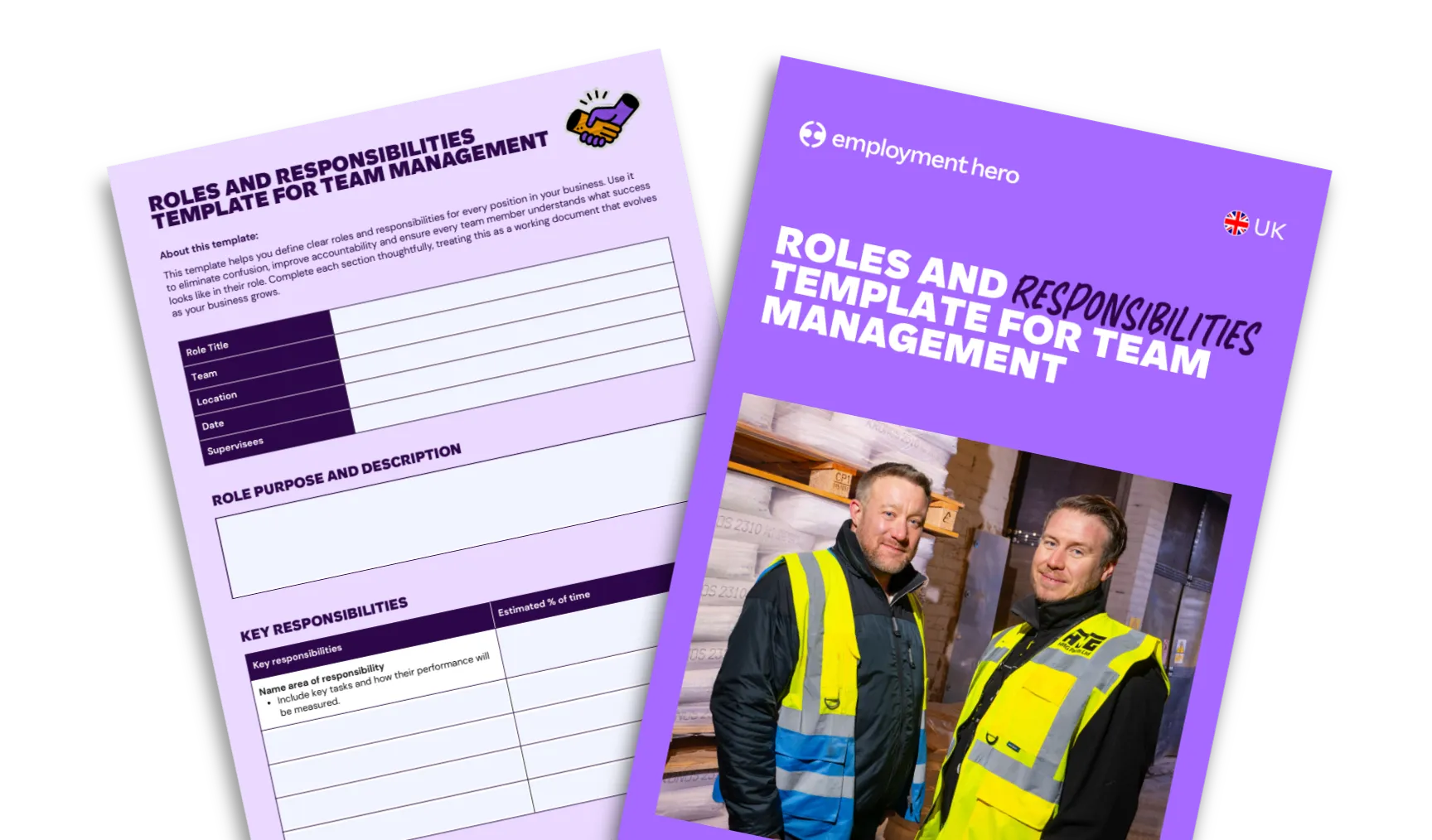
We’ve created a straightforward, ready-to-use template that covers all the bases we’ve just discussed. It gives you a consistent structure for every role in your business, from the intern to the Operations Director.
Defining job responsibilities effectively
Defining job responsibilities is a balancing act. Be too vague and candidates are left guessing what the role actually involves; be too detailed and you risk overwhelming them with a long list of minor tasks. The key is to get specific without getting bogged down in unnecessary detail.
Effective responsibilities focus on outcomes rather than activities. Instead of listing every task an employee might perform, describe what success looks like in the role. For example, “manage payroll processing accurately and on time” is far more meaningful than a long list of individual payroll actions.
Aim to:
- Use clear, plain language that’s easy to understand.
- Group related responsibilities together.
- Prioritise the most important areas of impact.
- Avoid rigid wording that could limit flexibility as the role evolves.
Well-defined responsibilities help candidates understand what they’ll be accountable for, while giving employers the flexibility to adapt how the work gets done.
Crafting a clear job description
A job description is often a candidate’s first real interaction with your business and we all know that first impressions matter. A clear, well-written job description doesn’t just explain the role; it sells the opportunity and sets expectations from the outset.
Start with a strong introduction that explains why the role exists and how it contributes to the wider organisation. This helps candidates see the bigger picture and understand how they’ll add value. From there, outline the key responsibilities, required skills and any essential qualifications in a logical, easy-to-scan structure.
To attract the right people:
- Be honest about expectations and challenges.
- Highlight what makes your organisation and culture unique.
- Avoid jargon or overly corporate language.
- Focus on what success in the role looks like, not just what the person will do.
A clear job description saves time for everyone involved, reducing unsuitable applications and helping candidates self-select before applying.
Understanding job roles and duties
While the terms are often used interchangeably, a job role and job duties are not the same thing and understanding the difference is essential when defining a position.
- The role: Describes the broader purpose of the job. It explains why the position exists, what it contributes to the organisation and how it fits within the wider team or business strategy. The role answers the question: What is this job here to achieve?
- Duties: on the other hand, are the specific actions and responsibilities required to fulfil that role. These are the day-to-day activities that support the overall purpose of the position.
By clearly defining both:
- Employees understand how their work contributes to business goals.
- Managers can set clearer expectations and measure performance more effectively.
- Job descriptions remain flexible as tasks change over time.
When roles are clearly defined and duties are aligned to outcomes, everyone gains a better understanding of what success truly looks like in the position.
Aligning roles and responsibilities with business goals
Every role in your organisation should exist for a reason and that reason should tie back to your wider business objectives. When roles and responsibilities are clearly aligned with business goals, employees understand not just what they’re doing, but why it matters.
Start by identifying your core business priorities, such as growth, efficiency, customer satisfaction or HR compliance. From there, define each role in terms of how it supports those priorities. For example, a finance role may contribute by improving cash flow visibility, while a customer service role may focus on retention and brand reputation.
To ensure responsibilities connect to the bottom line:
- Link responsibilities to measurable outcomes or KPIs.
- Avoid “nice to have” tasks that don’t support strategic goals.
- Regularly review roles as business needs evolve.
- Clearly communicate how individual performance contributes to wider success.
When employees can see how their responsibilities impact the business, engagement and accountability improve. Aligning roles with business goals also makes it easier to prioritise work, assess performance and ensure every position is adding real value to the organisation.
Ready to get organised?
Defining clear roles and responsibilities doesn’t have to be complicated. With the right guidance, tools and HR software, you can create job descriptions that attract the right candidates, set clear expectations and drive real business results.
To make the process easier, we’ve created a ready-to-use template that helps you map out roles, responsibilities and outcomes in a structured, easy-to-follow format.
To download the template, we just need a few quick details.
Related Resources
-
 Read more: Employee Leavers Checklist for Employers
Employee Leavers Checklist for Employers
Ensure a seamless transition for departing employees with our leavers checklist.
-
 Read more: Staff Engagement Plan Template
Staff Engagement Plan Template
Discover effective strategies for creating a staff engagement plan that drives results. Download our template and guide.
-
 Read more: Roles and Responsibilities Template for Team Management
Roles and Responsibilities Template for Team Management
Download our roles and responsibilities template for easy and effective team management.
