














Personalised onboarding: The definitive checklist for setting new employees up for success
Published
Personalised onboarding: The definitive checklist for setting new employees up for success
Published
You’ve found them. The perfect candidate. The one who aced the interviews, impressed the team and has the skills to take your business to the next level. The offer is accepted, the contract is signed. But what happens next could be the difference between a high-performing, loyal employee and a costly hiring mistake.
A generic welcome email and a stack of paperwork on their first day isn’t onboarding. It’s an administrative chore. It tells your new hire they are just another number. To make a real impact, you need to create an experience that shows them they were expected, they are valued and you are invested in their success from the moment they say “yes”. This is where personalised onboarding comes in. It’s your chance to turn a great hire into a truly engaged and productive team member.
What is in this checklist?
This is your action plan for ditching generic onboarding and creating an experience that makes every new hire feel valued from day one. Think of it less as a list and more as a strategic guide.
In the checklist you’ll find a guide to:
- Craft a personalised onboarding experience that feels meaningful.
- Follow a step-by-step framework for designing your onboarding process.
- Boost engagement from the moment a new hire joins.
- Accelerate productivity with clear structure and guidance.
- Build long-term loyalty through a welcoming first-day experience.
- Access practical tools to create a strong onboarding journey for every new team member.
What is personalised onboarding?

Personalised onboarding is a bespoke approach that tailors the new hire experience to an individual’s specific role, skills and learning style. It’s the critical difference between a one-size-fits-all information dump and a guided journey that equips them with exactly what they need to succeed.
Instead of putting every new starter through the same rigid process, personalisation means you consider their unique context. A junior marketer needs a different introduction to the business than a senior finance director. A remote developer has different needs to an office-based sales executive. It’s about delivering the right information, the right introductions and the right goals to the right person at the right time.
Why you must implement a personalised onboarding process
Let’s be direct: generic onboarding is a recipe for disengagement. It makes new starters feel like a cog in a machine, leading to confusion, low morale and a longer time to get up to speed. A personalised approach, on the other hand, is your secret weapon for retention and performance.
It dramatically accelerates a new hire’s time-to-productivity. When they have a clear, relevant path to follow, they can contribute meaningful work much faster. It also fosters a deeper connection to your company culture. By showing you’ve considered their individual needs, you build a powerful sense of belonging from the very start. Ultimately, this significantly reduces the risk of costly early-stage turnover, protecting the huge investment you’ve made in finding top talent.
10 ways to create a personalised onboarding experience
Ready to turn theory into action? This is your practical toolkit. Here are ten powerful, actionable ways to start personalising your onboarding process today and make every new hire feel like they were expected and are already part of the team.
1. Segment new hires based on their role and goals
Stop treating all new hires the same. This is the foundational step of personalisation. A new software developer needs to get familiar with your codebase and tech stack, while a new salesperson needs to dive into product features and target personas. A one-size-fits-all plan will fail both of them.
Start by grouping new hires by department, seniority and specific role. This allows you to deliver relevant content, targeted training and valuable introductions. For instance, all new managers could have a specific module on your leadership principles, while junior team members might get extra support from a dedicated mentor. This segmentation ensures everyone gets what they need to excel, without wading through irrelevant information.
2. Send personalised onboarding emails that build excitement
The first email sets the tone. Ditch the generic, automated template that feels cold and corporate. The pre-boarding phase—the time between signing the contract and day one—is a golden opportunity to build excitement.
A personalised welcome email, ideally from their direct manager, can make a huge difference. Include a brief, friendly introduction to the team, a schedule for their first week so they know what to expect and maybe introduce them to their onboarding buddy. Little touches, like mentioning something you discussed in the interview, show you’re prepared and you genuinely care. It transforms their first day from a source of anxiety into something to look forward to.
3. Use engagement tracking to see what’s working
Don’t guess what’s working—know. If you’re using modern HR platforms, you have powerful data at your fingertips. Smart onboarding software can help you track which resources your new hires are engaging with.
Are they completing the compliance training on time? Are they reading the company values document? Are they watching the welcome video from the CEO? This data provides invaluable insight. If you see that nobody is accessing the guide to your marketing tools, it might be boring, hard to find or simply not relevant. Use these insights to constantly refine and improve the onboarding journey for future hires.
4. Assign a personalised onboarding buddy
Pair each new hire with an onboarding buddy who’s selected based on their role, team or background. Make the match intentional—if your new recruit is remote, connect them with someone who knows the ropes of virtual work. If they’re fresh out of university, team them up with a recent graduate. A good buddy makes all the difference: they answer day-to-day questions, offer context and build confidence from week one.
5. Customise their training pathway
Resist the urge to throw the same slideshow at everyone. Tailor each new hire’s learning modules and training plans to their actual job, skill level and preferred ways of learning—video walkthroughs, interactive quizzes, articles or hands-on sessions. Skip what isn’t relevant and let them dive deeper where it matters most.
6. Offer flexible scheduling and support options
Life happens—and not everyone’s at their best between 9 and 5. Flexible onboarding means offering online sessions, asynchronous training or even shifting key meetings to times that suit your new starter. Factor in their existing commitments so they don’t start their new role stressed or left out.
7. Plan meaningful first projects
Instead of generic tasks, give your new hire an early project that connects directly to their strengths and future responsibilities. Think: “Design a mini campaign” or “Shadow a client call and share two insights.” A project tied to their interests shows trust, builds buy-in and helps them see the value they’re bringing from the get-go.
8. Share a tailored resource kit
Send each starter a bespoke set of resources—like a company jargon-buster, video intros from the team, onboarding checklists or FAQs relevant to their exact department or location. Include recommendations for Slack channels, interest groups or peer networks to help them settle in faster.
9. Celebrate individual milestones and wins
Little wins deserve a spotlight. Set up automated or manager-triggered “congrats” messages for finishing training, delivering on a first project or simply surviving week one. A virtual high five or a shoutout at a team meeting helps them feel recognised and excited for what comes next.
10. Gather and act on personalised feedback
Finally, create opportunities for new hires to provide feedback tailored to their onboarding journey. Send short, role-relevant pulse surveys or ask for open commentary in 1:1 meetings. Use this insight to tweak things in real time, showing every new recruit that their experience—and voice—matters.
Ready to turn theory into action? This is your practical toolkit. Here are ten powerful, actionable ways to start personalising your onboarding process today and make every new hire feel like they were expected and are already part of the team.
Personalised onboarding examples to inspire your process

Making the concept tangible can help spark ideas for your own process. Here are a few real-world, punchy examples of personalisation in action:
- Create a custom 30-60-90 day plan: Don’t use a generic template. Work with the new hire to set role-specific goals. For a designer, a 30-day goal might be “understand the brand guidelines,” while a 90-day goal could be “lead the design for a new feature.”
- Assign a cross-departmental mentor: Assigning a buddy from their own team is great for day-to-day questions. But assigning a mentor from a different department helps them build a broader network and understand how the business works as a whole.
- Create a welcome video: A short, informal welcome video from the CEO or their head of department, addressing them by name, is incredibly powerful. It takes five minutes but shows a level of care that a standard email never can.
- Curate their first-week calendar: Instead of leaving it empty, fill their first week with thoughtful meetings. Schedule a coffee with their mentor, a lunch with the team and 1:1s with key people they’ll be working with.
These small, intentional acts of personalisation add up to create a truly memorable and effective welcome.
The manager’s role in personalised onboarding
Let’s make one thing crystal clear: managers are the most critical factor in a new hire’s success. Onboarding is not just an HR task to be ticked off a list. It is a manager’s core responsibility.
A manager is the one who truly understands the specifics of the role and the team dynamics. Their responsibilities include setting clear expectations from day one, scheduling regular check-ins to monitor progress and offer support, making personal introductions to key stakeholders and providing consistent, constructive feedback. When managers take ownership of onboarding, new hires feel supported, valued and integrated far more quickly.
How to perfect your onboarding process and drive engagement
Onboarding isn’t a single event; it’s a strategic process that lays the groundwork for an employee’s entire lifecycle with your company. Building a world-class onboarding machine is about creating a system that consistently delivers engaged, productive and committed team members.
What is onboarding and why does it matter?
Onboarding is the systematic process of integrating a new employee into your company and its culture. Its ultimate goal is to provide new hires with the tools, knowledge and connections they need to become confident and productive members of the team. Think of it as the single biggest opportunity you have to solidify a great hiring decision and prove to your new star they made the right choice. A strong onboarding process is a direct investment in retention and performance.
Onboarding vs. orientation: What’s the difference?
It’s a crucial distinction. Orientation is a one-day event. It’s the paperwork, the office tour, the IT setup and the basic policy run-through. It’s necessary, but it’s not onboarding.
Onboarding is the entire journey. It’s a strategic process that should last at least 90 days and sometimes up to a full year. It’s designed to fully integrate an employee into their specific role, their team and the company culture. Orientation is a single step; onboarding is the whole staircase.
The key onboarding metrics you must track
If you can’t measure it, you can’t improve it. To prove the value of your onboarding process and get buy-in for future investment, you must track key performance indicators (KPIs).
- New hire satisfaction (eNPS): Are your new employees happy? Ask them for feedback on the process.
- Time-to-productivity: How long does it take for a new hire to become a fully contributing team member? Your goal is to shorten this.
- Manager satisfaction: Are your managers finding the process helpful? Do they feel it equips their new hires for success?
- 90-day and 1-year retention rates: This is the ultimate metric. If your new hires are staying, your onboarding is working.
Onboarding best practices, examples and tools

So what does a great employee onboarding guide look like in practice? It follows a few key best practices. It should always start before day one with effective pre-boarding. It must be a shared responsibility between HR, the manager and the team. And it absolutely must include a mechanism for gathering feedback to drive continuous improvement. For those managing flexible workforces, a tailored approach for casual employees or those requiring remote onboarding is essential. Even accommodating the needs of neurodiverse employees should be a key consideration.
Modern tools are essential for making this happen at scale. Integrated HR software can automate workflows, while communication platforms keep everyone connected.
How to create a winning onboarding strategy in 5 steps
Ready to build your system? Here’s a clear, step-by-step framework.
- Define your goals: What are you trying to achieve? For example, “reduce time-to-productivity by 20%” or “increase 90-day retention to 95%”.
- Map the entire journey: Document every touchpoint a new hire has with your company, from the signed contract to their 90-day review.
- Define roles and responsibilities: Clarify who does what. Who sends the welcome email? Who schedules the team lunch? Who runs the 30-day check-in?
- Build your content and automate workflows: Create the resources you need (checklists, guides, videos) and use technology to automate the delivery.
- Measure, get feedback and iterate: Track your KPIs, ask new hires and managers for feedback and use that insight to make your process better every time.
Download the checklist and build your winning onboarding plan
It’s time to stop leaving your most valuable asset—your people—to chance. A powerful, personalised onboarding experience is your key to retaining top talent and building a team of engaged, high-performers.
Download our comprehensive onboarding checklist to get a step-by-step action plan for designing and implementing a personalised experience that truly sets your new hires up for success.
To download the checklist, we just need a few quick details.
Related Resources
-
 Read more: EOFY HR Audit: What to Review in March
EOFY HR Audit: What to Review in March
Complete a EOFY HR audit with our practical checklist. Review compliance, people processes and compliance to reduce risk before the…
-
 Read more: How to Choose an HR System: A 2026 Buyer’s Checklist
How to Choose an HR System: A 2026 Buyer’s Checklist
HR software is more than features. Discover how the right system can streamline operations, boost efficiency and future-proof workforce management.
-
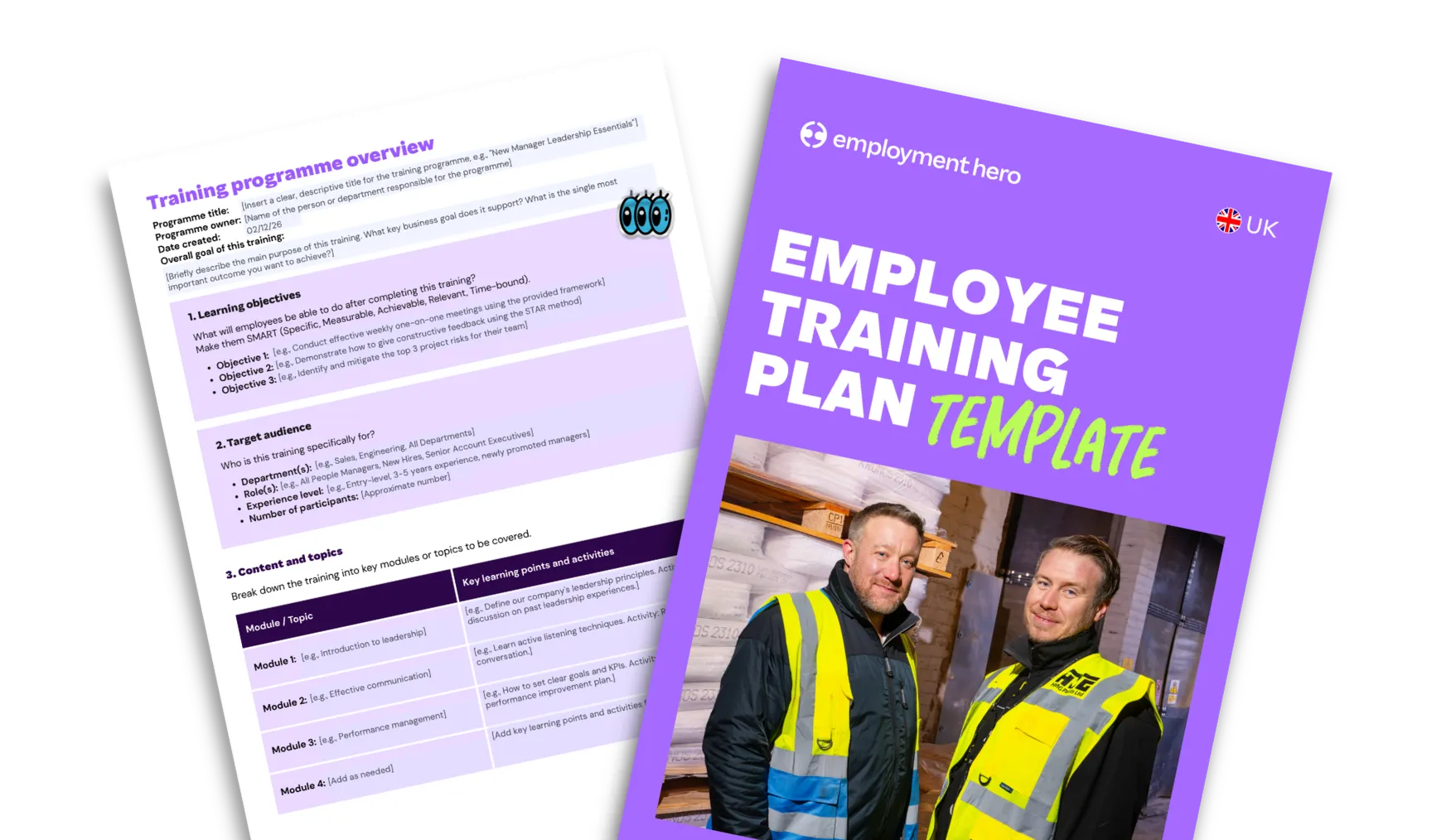 Read more: How to Create an Employee Training Plan: Template & Guide
How to Create an Employee Training Plan: Template & Guide
Ready to build a training program that drives results? Learn how to create an effective employee training outline that aligns…
