














Internship agreements: What to include
Published
Internship agreements: What to include
Published
Hiring an intern is an exciting moment for any growing business. You’re bringing fresh perspectives into the fold, offering someone a vital stepping stone in their career and having additional support can help you refocus your efforts on other priorities.
But before you welcome your new starter, you need to get the paperwork right. We know legal documents can seem daunting, but they are the backbone of a healthy workplace relationship. A solid agreement protects your business, clarifies expectations and ensures your intern gets the valuable experience they deserve.
Let’s cut through the legal jargon and look at exactly what you need to put in writing.
What is in this checklist?
We’re not just ticking boxes here; we’re helping you build a framework for success. Here are the essential clauses every UK business needs to include:
- Defining the role and pay: Get the basics right from day one. Is the intern going to be an unpaid volunteer or a paid employee?
- Confidentiality and IP: Protect your business assets and ideas.
- Legal confidence: Draft an agreement that respects both the law and the talent you’re hiring.
- Probationary period: For employed interns, set expectations and evaluate performance during this trial phase.
- Holiday entitlements: For employed interns, ensure you’re giving employees the time off they’re entitled to by law.
- Notice periods: For employed interns, clarify how much notice you need from employees if they want to leave.
We know that as a growing business, your time and resources are valuable. That’s why Employment Hero’s all-in-one HR platform includes pre-built templates for all of the above clauses, saving you from worrying about legal compliance and allowing you to focus on growth.
Internship contract agreement basics

Before we dive into the nitty-gritty clauses, let’s strip it back to basics. What exactly are we dealing with and why does it matter so much?
What is an internship?
In the UK, the term “internship” is thrown around loosely, but legally, it’s a bit of a grey area because there’s no specific legal definition. An internship generally refers to a period of work experience offered by a business to give students or graduates exposure to the working environment.
However, unlike “employee” or “worker,” “intern” isn’t a distinct legal status under UK employment law. An intern’s rights depend entirely on their employment status. They might be a “worker” (entitled to the National Minimum Wage), an “employee” (with full employment rights), or a “volunteer” (with very few rights). Getting this distinction wrong is where many businesses trip up.
It’s important to remember that if an intern is a volunteer, not an employee, they won’t have an employment contract, just a volunteer agreement. Only interns who are employees would have an employment contract.
Generally speaking, if there is an obligation for the business to provide work (and for the intern to perform it) then the intern is likely to be a worker or employee and entitled to be paid. If the intern is completely free to choose whether to participate in the internship or not, they are more likely to be able to be classed as a volunteer and not be paid.
What is an internship agreement?
An internship agreement is the written agreement that defines the relationship between your business and the intern. It sets out the terms of their engagement, what they will be doing and what they will get in return.
Do you strictly need one? If your intern qualifies as a worker or employee (which most paid interns do), then yes, you are legally required to provide a written statement of employment particulars on or before their first day. Even if they are genuine volunteers, having a written volunteer agreement is smart practice to avoid misunderstandings. It confirms that everyone is on the same page from day one.
What’s the cost of a poor hire?
Bringing someone on board without clear terms is a recipe for disaster. Ambiguity breeds confusion. If an intern expects training and mentorship but ends up doing coffee runs and filing without pay, you risk more than just an unhappy individual. You risk tribunal claims for unpaid wages, reputational damage and a demoralised team.
Conversely, a structured internship with a clear written agreement sets the tone for professionalism. It shows you value their contribution and protects your business from costly legal headaches down the line. It’s an investment in clarity that pays dividends in peace of mind.
Internship vs apprenticeship: Key differences
It is easy to confuse internships with apprenticeships, but they are fundamentally different beasts in the eyes of the law.
An apprenticeship is a formal job that combines practical training with study. Apprentices have specific rights, including a dedicated employment contract and an apprenticeship agreement. They must be paid at least the relevant minimum wage for apprentices and spend at least 20% of their working hours in off-the-job training.
An internship, on the other hand, is less regulated. It’s typically shorter, often (though not always) undertaken by students or recent graduates and focuses on gaining general work experience rather than a specific qualification. While apprenticeships are a long-term commitment to training, internships are usually a short-term engagement to provide a taste of the industry. Mixing these up can lead to significant compliance issues, so make sure you know which one you are actually offering.
Why internship agreements matter
Think of an internship agreement as a safety net for both parties. For you, the business, it protects your intellectual property, maintains confidentiality and ensures the intern understands what’s expected of them. For the intern, it provides security regarding their pay, hours and what they can expect to learn.
Without a written agreement, you are relying on verbal understandings, which are notoriously unreliable. If a dispute arises—say, about who owns the code the intern wrote or whether they are entitled to holiday pay—a written agreement is your first line of defence. It brings transparency to the relationship, ensuring that onboarding is smooth and the focus remains on learning and productivity, not arguing over logistics.
Different types of internship agreements
One size does not fit all. The type of agreement you need depends heavily on the nature of the internship.
Paid vs unpaid internships
This is the big one. In the UK, if an intern is doing work that contributes value to your business and has set hours and duties, they are likely classified as a “worker” and must be paid at least the National Minimum Wage. Unpaid internships are generally only lawful if the intern is:
- Doing a “student internship” required for a UK-based further or higher education course.
- Working for a charity or voluntary organisation (strictly as a volunteer).
- Work shadowing (observing only, no actual work performed).
If you are offering a paid internship, your agreement must reflect statutory rights like holiday pay and sick pay. If it’s a genuine volunteer arrangement or work shadowing, the agreement should explicitly state that there is no obligation to work and no entitlement to pay, to avoid creating an inadvertent employment contract.
Part-time vs full-time internships
For interns who are employees, whether an intern is full-time or part-time affects how you calculate their entitlements, particularly holiday allowance. A full-time intern works your standard business hours, while a part-time intern might balance work with studies.
Your agreement needs to be crystal clear on this. If they are part-time, you need to pro-rata their holiday entitlement and specify exactly when they are expected to be available. Flexibility is key here, especially for students, but that flexibility needs to be documented to prevent scheduling conflicts.
Key elements of effective internship agreements

Creating a robust agreement doesn’t have to be a headache. It just needs to cover the right bases. Here are the essential clauses you should consider including to ensure clarity, compliance and fairness.
Parties
Start simple. Clearly identify who the agreement is between: the Company (you) and the Intern (them). Include full names and addresses. This might seem obvious, but it establishes the legal entities involved.
Role
Define the title (e.g., “Marketing Intern”) and the nature of the engagement. Is this an employment contract, a worker’s contract, or a volunteer agreement? Being specific here helps prevent disputes about employment status later on.
Pay
If they are getting paid, state how much (hourly rate or salary) and when (e.g., monthly in arrears). If it’s unpaid, state clearly that it is a voluntary arrangement and only genuine out-of-pocket expenses will be reimbursed. Transparency here builds trust immediately.
Hours
Set out the expected hours of work. For example, “9:00 am to 5:30 pm, Monday to Friday.” If there’s flexibility, define the core hours or the total hours per week. This manages expectations and helps you monitor working time regulations.
If they are a volunteer, make sure the agreement is clear that they are not required to work—but if they wish to do so—these are the hours available.
Confidentiality
Interns often get access to sensitive business data. You need a clause that prevents them from sharing your trade secrets, client lists, or internal strategies during and after their internship.
IP
Who owns the work they produce? If an intern designs a logo or writes code for you, you want to ensure the business owns the Intellectual Property (IP). Without this clause, the default legal position might surprise you.
Termination
How does it end? For employed interns, include a notice period for both sides. Internships are often short, so a shorter notice period (e.g., one week) is common. This gives you an exit strategy if things aren’t working out.
Duties and responsibilities in an intern agreement
While the “Role” section gives a title, this section fleshes out the day-to-day. You don’t need to list every single task, but you should outline the primary responsibilities and learning objectives.
Are they assisting with social media? Conducting market research? Supporting the sales team?
It is also vital to outline who they report to. Having a designated mentor or supervisor ensures the intern has support and you have accountability. You might also want to include how performance will be reviewed. Even for a short placement, a mid-term review can be incredibly valuable for giving feedback and checking progress against their learning goals. This structure transforms an internship from “cheap labour” into a valuable developmental experience, which is what internship programmes should be all about.
Student working hours in internship contracts
If your intern is a student, you have a duty of care to ensure their work doesn’t negatively impact their studies. While adult workers can opt-out of the 48-hour working week limit, you should be mindful of excessive hours for students.
Make sure you include details on breaks. UK law entitles workers to a 20-minute uninterrupted rest break if they work more than 6 hours a day. Explicitly stating this in the contract shows you take their wellbeing and legal rights seriously. Flexibility is your friend here—allowing time off for exams or lectures will make you a much more attractive employer.
Duration of internship
Internships are temporary by nature. Your agreement must specify the start date and, crucially, the end date.
Why? Because if an intern keeps working past the end date without a new contract, they might inadvertently acquire permanent employment rights. A fixed term (e.g., “3 months commencing 1st June and ending 31st August”) keeps things tidy. If you want to extend it, you can always issue a contract extension or a new permanent contract later.
Maintaining confidentiality and intellectual property
We touched on this, but it deserves a closer look. Interns are often eager to impress and might inadvertently overshare details about their work on social media or in their portfolios.
Your confidentiality clause needs to be practical. Define what “confidential information” actually is in the context of your business.
Regarding IP, be explicit. A standard clause states that any work created during the course of the internship belongs to the company. This prevents awkward conversations later if an intern wants to claim ownership of a project they worked on while using your resources and time. It’s not about being mean; it’s about protecting your business assets.
How to streamline approval workflows
Drafting the agreement is step one. Getting it approved and signed is step two and often the slower one. Passing Word documents back and forth via email is clunky and prone to version control errors.
Smart employers use HR software to streamline this. You can set up workflows where the hiring manager drafts the offer, HR reviews it and a director signs it off—all within one platform. This ensures no rogue clauses slip in and that every contract is fully compliant before it ever reaches the candidate.
How to simplify signing and execution processes

Gone are the days of printing, signing, scanning and emailing. It’s a friction-heavy process that delays the intern’s start.
Electronic signatures are legally binding in the UK and make the process seamless. Using an onboarding checklist with integrated e-signature tools allows your new intern to read and sign their contract from their phone, arguably before they’ve even finished their breakfast. It creates a modern, tech-forward first impression of your company.
How to securely store and organise agreements
Once the agreement is signed, where does it go? If the answer is “a filing cabinet” or “a folder on my desktop,” we need to talk.
You have a legal obligation under GDPR to store employee data securely. Digital storage within a cloud-based HR platform is the safest bet. It keeps sensitive data encrypted, restricts access to authorised personnel only and creates a handy audit trail. Plus, it means you can find the document in seconds when you need to check a clause, rather than rummaging through paper files.
Download the full checklist
Getting your internship agreements right is a critical step in growing your team with confidence. It sets the stage for a positive, productive relationship where everyone knows where they stand.
Don’t leave your legal compliance to chance or guesswork. We’ve compiled all these essential elements into a handy, downloadable resource to keep you on track.
To download the checklist, we just need a few quick details.
Related Resources
-
 Read more: Employee Termination Process & Checklist
Employee Termination Process & Checklist
Published Setting up an employee termination process, while unpleasant, is a critical part of risk management and safeguarding in business.…
-
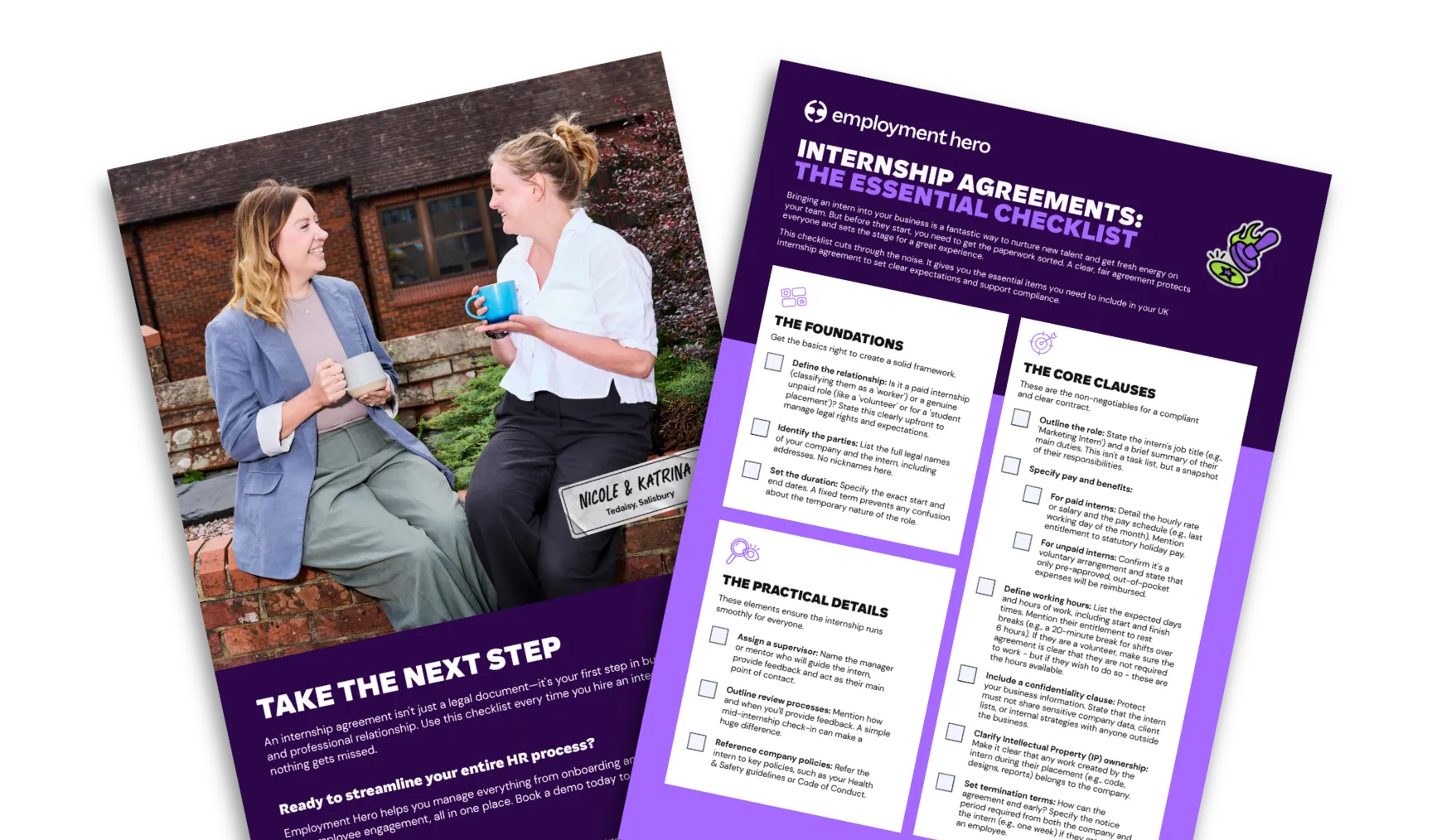 Read more: Internship agreements: What to include
Internship agreements: What to include
Learn what to include in an internship contract agreement in the UK. Define expectations and protect your business with key…
-
 Read more: How to Turn EOFY into a Strategic Advantage
How to Turn EOFY into a Strategic Advantage
Join our expert led EOFY webinar to learn how to use payroll reports, legislative updates, and cost optimisation in 2026.…
