
















Is Your HR System Holding You Back? The HR Digital Transformation Readiness Assessment
Published
Is Your HR System Holding You Back? The HR Digital Transformation Readiness Assessment
Published
Here’s an uncomfortable truth; your HR system probably hasn’t kept up with your business. And while having outdated tech isn’t exactly ideal, the fact that your business has evolved to keep pace with updated employment law and employee needs is a great thing. In today’s world of work, employees have different expectations to before. They now want things like self-service, instant payslips and a digital experience that doesn’t feel like it was built in 2009. But for many SMEs the HR tech stack is still a patchwork of spreadsheets, email chains and legacy software that was never designed to scale. This is something many business owners and HR professionals are going to want to fix.
Enter: HR digital transformation. But before you roll your eyes thinking this is just another buzzword reserved for large organisations with huge tech budgets, hear us out. A HR digital transformation considers what every growing UK business needs to ask themselves:
Are your tools actually working for your business now or are they just what you’ve always used?
We’ve created a HR digital transformation readiness assessment to help you find out. Across five key areas:
- Admin efficiency.
- Compliance.
- Hiring.
- Employee experience.
- Scalability.
We’ll walk you through the questions that reveal where your HR system is doing its job, and where it’s quietly costing you time, money and talent.
What is HR tech readiness
HR tech readiness is a measure of whether your current HR systems can meet your business’s operational, compliance and strategic needs. It assesses three things:
- System capability: Can your tools handle current workload and complexity?
- Integration readiness: Do your HR, payroll and recruitment systems share data automatically?
- Scalability: Will your systems support growth without manual workarounds?
This isn’t just about whether you have software in place. It’s about whether that software is actually keeping up with your business right now.
What HR tech readiness measures
HR tech readiness considers whether your platforms align with:
- Your headcount: Does the system handle your current team size efficiently?
- Your compliance obligations: Can it manage UK employment law requirements automatically?
- Your hiring demands: Does it support your recruitment volume and speed needs?
- Your team’s expectations: Does it deliver the digital experience employees expect?
When HR tech is ready vs. not ready
| When your HR tech is fit for purpose | When your HR tech is no longer working |
| Manual admin is minimized. | Processes become slower. |
| Data is accurate and connected across systems. | Compliance becomes harder to manage. |
| Leaders have real-time visibility of the business. | HR teams spend more time managing systems than supporting people. |
| HR can focus on proactive, strategic work. | HR is stuck in reactive firefighting mode. |
We know which scenario we’d prefer.
So before you invest in anything new, or assume what you have is fine, it’s worth asking an honest question: is your system genuinely fit for where your business is heading?
That’s what this assessment is here to help you work out.
Why HR digital transformation is no longer optional
For a long time, a digital transformation felt like a nice-to-have. Something business owners and HR leaders would get to eventually, you know, once things settled down, once the budget freed up, once there was a quieter moment to deal with it.
That moment never comes. And the cost of waiting keeps going up. But with Employment Hero’s research showing that 9 in 10 leaders agree that there is potential for innovation within the HR function of their company, it’s clear that now is the time to start taking digital transformation seriously. Here’s why:
Compliance is getting harder, not easier
Compliance is always daunting for businesses and with the Employment Rights Bill, Right to Work checks, GDPR, HMRC reporting obligations, the regulatory environment for UK employers has never been more demanding. Manual processes and disconnected systems create inefficiencies and risk. And we all know these are the last things you want to be dealing with.
Hiring is faster and more competitive than ever
Employment Hero’s Work That Works report shows that 3 in 4 business leaders say recruitment is a challenge. The best candidates are off the market quickly, so if your recruitment process relies on email threads, manual CV screening and chasing interview slots through a shared calendar, you’re already at a disadvantage. Slower businesses lose good people to faster ones, it really is that simple.
Employee expectations have changed
The workforce has changed and employee expectations have changed with it. In today’s environment, your team wants the ability to check their payslip on their phone, request leave without sending an email and access their benefits in one place. A clunky or outdated HR experience doesn’t just frustrate people ,it tells them something about how much you value their time.
Signs your system is holding you back
Not all HR problems announce themselves loudly. Most show up as small frustrations, minor inefficiencies or things that just take longer than they should. The trouble is, those small things compound and before long, your system isn’t just underperforming, it’s actively slowing your business down.
Here are the warning signs worth paying attention to.
Processes are manual and time-consuming
Employment Hero’s Work that Works report shows that over half of SMEs are spending one whole day a week on administrative tasks related to employment, HR or payroll. This is proof that while spreadsheets and manual data entry may feel manageable in the early days, they don’t scale. And they can slow everything down as well as increase the risk of mistakes across HR and payroll.
On top of this, if your HR function is permanently buried in data entry, chasing approvals and fixing payroll errors, there is less time for HR professionals to be focusing on more strategic activities. The reality is if your tools aren’t handling routine processes automatically, your team can’t focus on the work that actually drives value; supporting people, building culture and enabling growth.
Systems don’t talk to each other
Having tools to support your business is a good thing… but this doesn’t mean you need every piece of software on the market. Employment Hero’s research shows that the average SME is using 3-4 systems to manage employment and only 11% have a consolidated system and are using just one platform.
The problem with this is that disconnected HR, payroll and recruitment tools create data silos, inconsistencies and reporting challenges. Without a single source of truth, it’s difficult to trust your data or make informed decisions.
Compliance feels reactive rather than controlled
Compliance is complex, but it doesn’t have to be manual. When assessing your tech readiness, ask yourself:
- Could you produce a complete employment record in minutes?
- Do you have a clear audit trail for Right to Work checks?
- Are payroll calculations for holiday pay and statutory sick pay consistently accurate?
If you’re relying on manual tracking or workarounds, you’re increasing your exposure to compliance risk.
Hiring feels reactive rather than planned
In the modern job market, hiring isn’t easy. But what if we told you that your system could be making it harder than it needs to be?
If your hiring process involves posting a job, manually screening CVs, scheduling interviews over email and starting from scratch every time, you could be missing opportunities to streamline and improve hiring outcomes. Without visibility of your pipeline or automation to support the process, you risk losing top candidates to faster-moving competitors.
The employee experience is outdated
If your employees are still emailing HR to ask for their payslip, check their leave balance or update their address, something’s not quite right.
Every request is time your HR team shouldn’t be spending. Every delay is frustration your employees shouldn’t be feeling. Multiply that by your headcount and it adds up fast.
This isn’t about being cutting-edge. It’s baseline expectation: if someone can check their bank balance on their phone at 11pm, they should be able to check their holiday allowance without sending an email and waiting for a reply.
When the employee experience feels clunky or outdated, people notice. And in a market where replacing someone is time consuming and costly, those frustrations matter more than you think.
It’s a struggle to access meaningful workforce insights
If answering basic questions like “what’s our turnover rate?” or “how long does hiring actually take?” means pulling data from three different places and building a spreadsheet, you don’t have insights. You have noise.
Real workforce data should be available in minutes, not cobbled together over an afternoon. When leadership can’t make decisions based on what’s actually happening in the business, HR is being run reactively, not strategically.
And that’s expensive. You can’t fix problems you can’t see.
Teams rely on workarounds to get things done
This is usually the clearest sign of all. When your team starts building processes around a system rather than through it, the system has stopped working.
Workarounds feel pragmatic in the moment. Over time, they become the problem. They add complexity, create risk and ensure that the next person who joins has to learn a process that doesn’t make sense, because it was never designed, just patched together.
If someone leaving your business means a process falls apart because “only they knew how to do it,” that’s not a people problem. That’s a system problem.
What good looks like: The role of HR automation
A modern HR system doesn’t just store data. It does the work. That’s the difference between a system you have to manage and one that runs itself. The benefit of having a system that can do this? It means HR professionals don’t have to handle the admin, instead your platform will flag what’s important, freeing up your team to focus on tasks that need a bit more human touch.
Here’s what that looks like in practice.
- Payroll that runs itself. Not payroll you process manually and hope is right . We’re talking about payroll that pulls directly from time and attendance, calculates deductions, applies the correct tax codes and submits RTI to HMRC automatically. Your compliance obligation is met without anyone needing to remember to do it.
- Onboarding that starts before day one. When a new hire accepts an offer, the system kicks off the sequence: contract sent, documents collected digitally, right to work verified, access granted, welcome information shared. By the time they walk in on day one, the admin is done. Their manager can focus on making them feel welcome.
- Hiring with AI doing the shortlisting. Instead of reading through 80 applications on a Friday afternoon, hiring with AI matches candidates to your requirements and surfaces the strongest fits first. Screening happens faster, bias is reduced and time-to-hire drops — which matters when the candidates you want have options.
- Compliance that doesn’t rely on someone remembering. Automated alerts for document expiries, right to work renewals, probation reviews and policy updates mean nothing falls through the cracks. Audit trails are built automatically. When something needs checking, the system tells you — not the other way around.
- Employees who can manage their own work life. Leave requests, payslips, personal details, benefits, learning — all accessible from one place, on any device, without contacting HR. Self-service doesn’t just reduce admin. It gives employees the autonomy they expect from a modern employer.
- Data you can actually make decisions with. Headcount trends, turnover, absenteeism, hiring funnel performance — a good system puts this in front of you without you needing to build it. That’s what it means to run HR strategically, not reactively.
Ready to future-proof your employment processes?
The reality for most growing UK businesses is that their HR system made sense at a certain size, at a certain moment. But businesses evolve faster than tools do. Headcount grows, compliance requirements shift and employee expectations change. At some point, the systems that once felt manageable start creating friction instead.
HR digital transformation isn’t about ripping everything out and starting again. It’s about making deliberate choices about what your business needs from its HR function and choosing tools that can actually deliver it.
Employment Hero was built for exactly this. Our intelligent platform puts the traditional, isolated elements of employment all into one place. Find and hire top talent, onboard, manage complex payroll and benefits, support compliance and more.
But before you make any decisions, it’s worth understanding where you are today. We’ve created a simple assessment that helps you identify which areas of your HR setup are working well and which ones could be working harder for you.
FAQ’s
HR digital transformation is the process of modernising how businesses manage employment using connected, automated technology. It replaces manual, disconnected processes with a single platform that handles HR, payroll, recruitment and employee experience, enabling HR teams to move from reactive admin work to strategic, data-driven decision making.
For UK SMEs, this typically means consolidating spreadsheets, legacy software and email-based workflows into one system that automates routine tasks, ensures compliance and scales with business growth.
If any of these sound familiar, your business is ready:
- Your HR team spends most of their time on admin rather than people.
- You’re using 3+ different systems that don’t share data automatically.
- Onboarding a new employee takes multiple days of manual work.
- You can’t quickly answer questions like “what’s our turnover rate?” or “how long does hiring take?”.
- Employees email HR for payslips, leave balances or personal detail updates.
- You’ve built workarounds because your system can’t do what you need.
The HR tech readiness assessment helps you identify exactly where the gaps are.
With the right platform, initial implementation typically takes 2–4 weeks for UK SMEs — not months.
Employment Hero’s system is designed for businesses to go live quickly with core functions like payroll and HR management, then add recruitment, employee experience tools and advanced features gradually as your team adopts the platform. Most businesses see measurable time savings within the first month.
The key is choosing a platform built for UK SMEs rather than trying to customize enterprise software that wasn’t designed for your size or needs.
No. Most UK businesses take a phased approach:
- Phase 1: Consolidate HR and payroll, this is where the biggest compliance risk and time waste typically lives.
- Phase 2: Add recruitment and applicant tracking to speed up hiring.
- Phase 3: Roll out employee self-service and engagement tools.
- Phase 4: Layer in advanced features like learning management and workforce analytics.
A connected platform like Employment Hero lets you adopt features based on priority and budget, without needing to implement everything on day one.
Costs vary based on headcount and features, but modern HR platforms are priced for SMEs, typically starting from £3–8 per employee per month for core HR and payroll, with additional modules available as add-ons.
The ROI calculation is straightforward: if your HR team is spending one day per week on admin (the UK SME average), that’s 52 days per year. At an average cost of £250–350 per day in staff time, automation pays for itself in 2–4 months and that’s before factoring in compliance protection, faster hiring or reduced employee attrition.
See Employment Hero UK pricing for specific plans.
Compliance exposure is the most immediate risk. Manual Right to Work tracking, payroll calculations and document management create genuine legal and financial risk — especially with the Employment Rights Bill introducing stricter obligations for UK employers.
Beyond compliance, the cost of delay compounds:
- Time waste: Admin burden grows with every new employee.
- Hiring disadvantage: Slower processes mean you lose candidates to faster competitors.
- Employee attrition: Poor self-service experiences drive turnover, and replacing someone costs 6–9 months of their salary.
- Data blindness: Without real-time reporting, you’re making decisions based on guesswork.
The cost of waiting typically exceeds the cost of upgrading within 6–12 months.
Absolutely not. In fact, SMEs often benefit more than large enterprises because the relative time and cost savings are greater.
A business with 50 employees spending one day per week on HR admin is losing 2,600 hours per year across the organization. For a 10-person HR and leadership team, that’s half a full-time role consumed by admin that could be automated.
Employment Hero was specifically built for UK SMEs (1–300 employees). The platform handles the complexity of UK employment law, payroll and compliance without requiring an IT team or enterprise budget.
Yes. Employment Hero offers a free demo where you can see the platform in action with real use cases from your industry, and most implementations include a trial or onboarding period to ensure the system fits your needs before full rollout.
You can also download the HR tech readiness assessment to identify your gaps first, then discuss those specific areas with an Employment Hero specialist.
Book a free demo or start for free to explore the platform at your own pace.
Employment Hero is the only platform that combines HR, payroll, recruitment and employee experience in a single system with AI-powered automation built in from the ground up.
Key differences for UK businesses:
- Built for UK compliance: Right to Work tracking, HMRC RTI submissions, Employment Rights Bill readiness, auto-enrolment support.
- AI-powered hiring: SmartMatch technology and access to 1.5 million active UK job seekers — built in, not bolted on.
- Employee superapp: Self-service portal with payslips, leave, benefits, earned wage access and learning — all on mobile.
- One platform, not integrations: Everything connects automatically because it’s designed as one system, not pieced together.
Over 25,000 UK businesses trust Employment Hero to run their employment operations — from 5-person startups to 300+ employee scale-ups.
To download the assessment, we just need a few quick details.
Related Resources
-
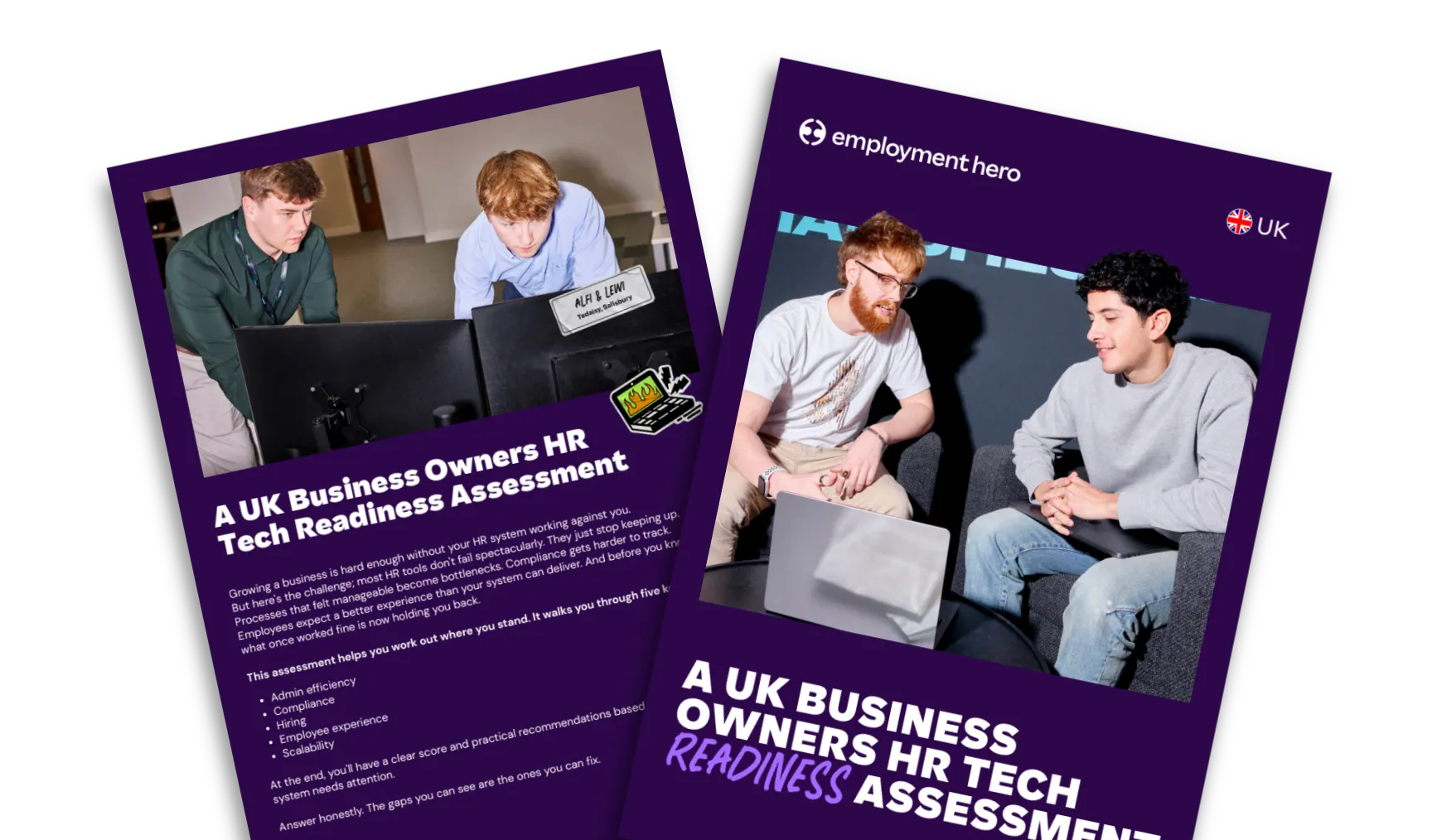 Read more: Is Your HR System Holding You Back? The HR Digital Transformation Readiness Assessment
Is Your HR System Holding You Back? The HR Digital Transformation Readiness Assessment
Most HR systems haven’t kept up with business growth. Find out if yours is holding you back with our free…
-
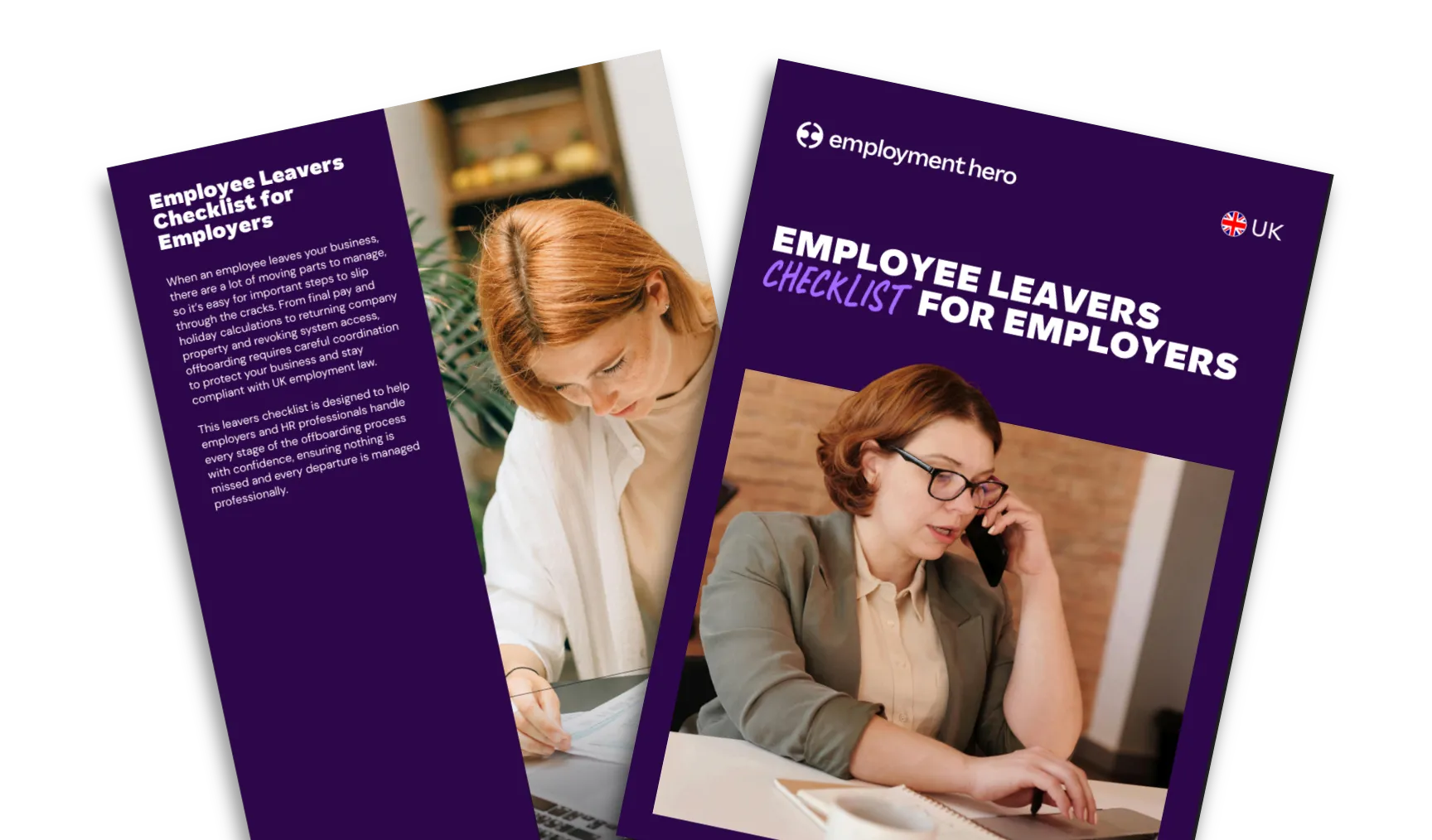 Read more: Employee Leavers Checklist for Employers
Employee Leavers Checklist for Employers
Ensure a seamless transition for departing employees with our leavers checklist.
-
 Read more: Staff Engagement Plan Template
Staff Engagement Plan Template
Discover effective strategies for creating a staff engagement plan that drives results. Download our template and guide.
