














EOFY HR Audit: What to Review in March
Published
EOFY HR Audit: What to Review in March
Last Updated
Spring cleaning isn’t just for the office fridge. As we approach the end of the financial year (EOFY) and the new financial year draws closer, March is a business owners or HR leaders cue to hit pause and give HR processes a once over. This is a task that gives business owners and HR professionals a chance to spot gaps, work smarter and set their business up for a new financial year that actually runs smoother.
Human resources audits are all about strengthening compliance, streamlining processes and improving the employee experience across your business. Get this right and you’ll cut risk, drive better decisions, and turn the “same old” into something so much better, before the new financial year even starts on 6th April.
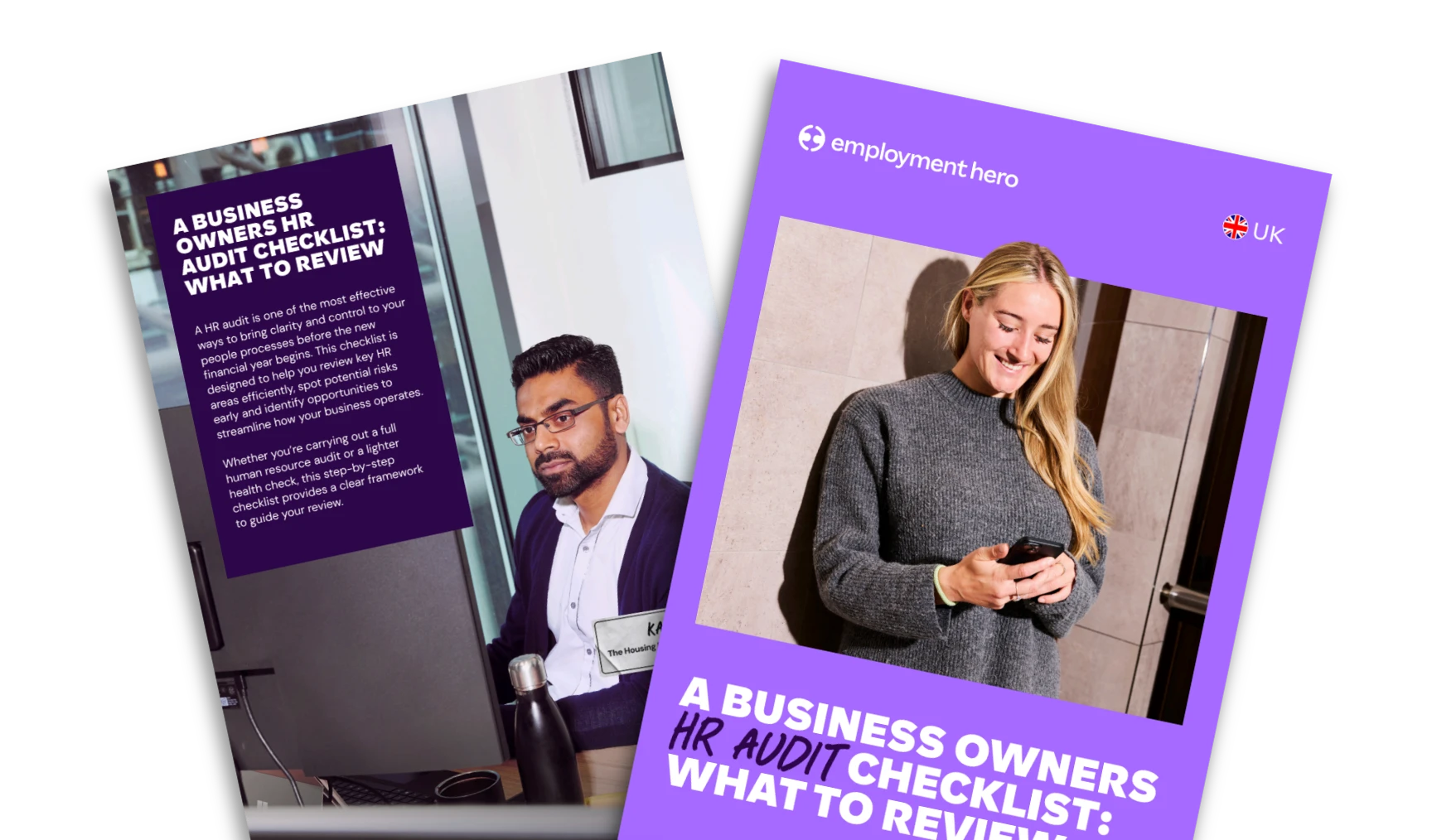
But we’ve gone one step further than just giving you the run-down on what human resource management audits are, our downloadable checklist outlines everything.
Download the checklist.
What is a human resource audit?
A human resource management audit is a structured review of how your HR practices operate across the business. It looks beyond individual documents or tasks to assess whether your people processes are compliant, consistent and aligned with your wider business goals.
Rather than focusing on one isolated area, a human resource management audit looks across the full employee lifecycle, including:
- Hiring.
- Onboarding.
- Performance management.
- Employee engagement and wellbeing.
- Offboarding.
This broader view helps ensure your HR processes are not only compliant, but also consistent and aligned with your wider business goals.
Internal vs external human resource management audit
Human resource audits fall into one of two categories; internal or external. Here’s a breakdown of what they are.
|
Type of audit |
Description |
When to use |
|---|---|---|
|
Internal |
Self-assessment carried out by your own HR team. |
Ideal for regular reviews, spotting quick wins, and keeping HR processes running smoothly throughout the year. |
|
External |
Conducted by an independent third party for an objective, in-depth review. |
Useful for complex issues, validating processes, or benchmarking HR practices against industry standards. |
The strategic purpose of a human resource management audit
The word “audit” can easily sound intimidating, so we like to think of it more as a spring clean of your processes. With 9 in 10 leaders agreeing that there is potential for innovation within the HR function of their company*, a human resource management audit can help find ways to achieve this, by looking at:
- Identifying gaps in policies, processes and documentation.
- Reducing legal, financial and people-related risk.
- Improving HR efficiency and reducing unnecessary admin.
- Strengthening consistency across the employee experience.
- Ensuring HR practices support business objectives and future growth.
For HR leaders and business owners, a human resource management audit provides clarity and confidence, turning HR from a reactive function into a more strategic part of the organisation.
Benefits of conducting an EOFY HR audit
We know that business owners and HR professionals are busy, so adding something else to the to-do list can feel counterintuitive. But we promise it’s worth it. Taking the time to review your processes in March isn’t just another task; it’s about setting your business up for success moving forward.
Here’s why a spring audit is one of the smartest moves you can make right now.
Stronger compliance ahead of the new financial year
The new financial year often brings employment law updates, such as regulatory and wage changes. An end of financial year HR audit helps you spot gaps early (especially regarding the April National Living Wage uplift) so you can manage compliance risks proactively. Instead of panic-fixing issues later on in the year, you’ll have everything organised.
Clearer people data for workforce planning
You can’t build a workforce plan on messy data. Cleaning up your records gives you a clear, accurate picture of your team. Understanding data such as headcounts, costs and skills is invaluable as it leads to better budgeting and smarter hiring decisions when you’re ready to grow.
Reduced HR admin and duplicated processes
If you feel like you’re doing the same admin task three times over, you probably are. An HR management audit highlights clunky workflows, duplicated processes and outdated systems. Identify the bottlenecks, cut the admin burden so you can do what you do best, running the business.
A more consistent employee experience
Your team notices when things slip through the cracks. Reviewing your processes ensures that everyone, from your newest hire to your longest-serving manager, is treated fairly and consistently. Clear expectations and reliable systems build trust and boost engagement.
Better preparedness for inspections, disputes or growth
Whether it’s a surprise inspection, a workplace dispute or a sudden growth spurt, you don’t want to be caught on the back foot. An HR audit ensures your documentation is organized and accessible, turning potential headaches into manageable moments.
Key areas to review in an end of financial year HR audit
We get it, a human resources management audit feels like a lot to take on. But before you panic, it’s important to recognise that you don’t need to overhaul all of your processes overnight. Instead, a smart EOFY HR audit focuses on the key elements that keep your business running. By breaking your review into these core areas, you can spot the friction points that are slowing you down and address them before the new financial year ramps up.
Compliance
Compliance is huge for UK businesses, especially with the introduction of the Employment Rights Act and staying on top of it all can feel overwhelming. But staying on top of legislative changes is essential.
This part of your end of financial year HR audit isn’t just about avoiding fines; it’s about reducing risk and gaining peace of mind. Therefore, you should be focusing on tasks such as:
- Reviewing employment contracts.
- Reviewing wage rates.
- Reviewing employee classifications, including contractors and fixed-term staff.
Identifying compliance gaps early allows you to take action proactively rather than reacting when issues arise.
Employee documentation
Strong record-keeping underpins every effective human resource audit. Disorganised or incomplete files create unnecessary risk and admin. Review employee records to ensure key documents are complete,securely stored, and up to date. Sensitive information, such as medical data, should be stored separately and confidentially. Getting your documentation in order now saves time and stress later.
Compensation and benefits
Attracting and retaining top talent in a competitive market is challenging for many SMEs. This is why offering fair compensation and benefits is so essential. A spring review is the ideal time to assess whether your pay and benefits still stack up. Benchmark salaries where possible, review benefits offerings, check pension auto-enrolment compliance, and check for any unexplained pay gaps. This ensures employees are rewarded consistently and helps position your business as an employer of choice.
Performance management
If performance reviews feel like a tick-box exercise, they’re unlikely to drive real improvement. But revamping your performance management can sometimes be a task that is pushed back to make way for “more time sensitive” tasks. A spring review is the perfect opportunity to make this a priority. Assess whether feedback processes are meaningful, regular and focused on development.
Effective performance management supports productivity, engagement and growth, while ensuring managers are equipped to help their teams succeed, not just complete paperwork.
Hiring and onboarding
First impressions matter. And your hiring and onboarding processes won’t magically keep themselves updated. Now is the perfect time to review your processes, this includes everything from job adverts through to a new hire’s first few weeks in the role.
Consider:
- Are candidates dropping off due to slow or unclear communication?
- Do new starters feel welcomed, supported and ready to perform?
- Are Right to Work checks being conducted before the first day?
Streamlining these processes helps you secure the right talent faster and sets employees up for long-term success.
Policies and procedures
HR policies are ever-evolving, so making sure that your policies and procedures evolve at the same rate is essential. Make sure you take a look at key policies, such as “Day 1” flexible working, leave, and conduct, to ensure they remain relevant, compliant and clearly communicated. Well-maintained policies reduce confusion, support consistency and reinforce your company culture.
Safety and wellbeing
A safe workplace is non-negotiable, but wellbeing goes beyond physical safety. Review health and safety procedures, risk assessments and emergency plans, as well as how you support mental health and overall wellbeing. A holistic approach to safety helps create a resilient, engaged workforce ready for the year ahead.
The do’s and don’ts of conducting an EOFY HR audit
A EOFY HR audit doesn’t need to be a minefield. Knowing what to focus on (and what to avoid) can make the process far more effective. These do’s and don’ts highlight the key practices that help turn your HR audit into a practical, high-impact review.
|
Do |
Don’t |
Why it matters |
|---|---|---|
|
Involve HR, managers, payroll and leadership in your human resource management audit. |
Treat the audit as an HR-only exercise. |
Ensures findings reflect real processes and supports better decision-making. |
|
Gather up-to-date contracts, policies, payroll data and employee feedback. |
Rely on assumptions or outdated documentation. |
Reduces compliance risk and improves audit accuracy. |
|
Prioritise findings based on legal risk and business impact. |
Attempt to fix everything at once. |
Keeps the audit focused and actionable. |
|
Turn audit insights into a clear action plan with owners and timelines. |
File findings away without follow-up. |
Ensures the audit delivers measurable improvements. |
|
Review processes ahead of the new financial year. |
Treat the audit as a one-off annual task. |
Supports long-term HR efficiency and readiness. |
Turn HR audits into a strategic reset for HR with Employment Hero
An end of financial year HR audit is more than a compliance exercise, it’s an opportunity to reset, refocus and strengthen the foundations of your people operations. Reviewing key HR areas in March gives you clearer visibility of what’s working, where risks may be emerging and how effectively your processes support both your people and your business goals.
When approached proactively, a human resource audit builds confidence. It replaces uncertainty with accurate data, clear priorities and a practical plan for the months ahead.
Not sure where to start?
This is where having a checklist comes in handy. Using a clear, step-by-step spring HR audit checklist helps turn insight into action, ensuring nothing is missed and making the review easier to complete, not harder.
*Employment Hero commissioned research with One Poll, UK, May 2025, n=1000 (business leaders/owners in companies of 5-249 employees)
To download the checklist, we just need a few quick details.
Related Resources
-
 Read more: EOFY HR Audit: What to Review in March
EOFY HR Audit: What to Review in March
Complete a EOFY HR audit with our practical checklist. Review compliance, people processes and compliance to reduce risk before the…
-
 Read more: How to Choose an HR System: A 2026 Buyer’s Checklist
How to Choose an HR System: A 2026 Buyer’s Checklist
HR software is more than features. Discover how the right system can streamline operations, boost efficiency and future-proof workforce management.
-
 Read more: How to Create an Employee Training Plan: Template & Guide
How to Create an Employee Training Plan: Template & Guide
Ready to build a training program that drives results? Learn how to create an effective employee training outline that aligns…
