


















Ask the Experts: How the Employment Rights Act 2025 Will Change Employer Compliance
Published
Ask the Experts: How the Employment Rights Act 2025 Will Change Employer Compliance
-

Simon Obee
Last Updated
Author Bio: Simon Obee has been an employment lawyer for over 20 years and has worked in law firms of all shapes and sizes, as well as an inhouse employment law for the UK government. He has a passion for helping small businesses with employment law compliance and HR best practice.
Simon Obee, Head of HR Advisory – Employment Hero

UK employment law is undergoing its biggest shift in years. With the Employment Rights Act 2025 now receiving Royal Assent, employers are facing a wave of new obligations that will significantly change how they manage people, risk and compliance.
While many of these changes won’t take effect immediately, the direction of travel is clear. From unfair dismissal rights after just six months’ service to stricter rules around fire and rehire, statutory sick pay (SSP) and zero-hours contracts, the cost of getting compliance wrong is about to rise.
Our Head of HR Advisory Simon Obee, is here to provide guidance to businesses navigating complex legislation every day. In our first edition of ‘Ask the Experts’, Simon will break down what the Employment Rights Act 2025 means in practice and how employers can start preparing now.
Compliance landscape overview
The Employment Rights Bill has now been approved by both Houses of Parliament and achieved Royal Assent on the 18th of December 2025. Going forward it will be known as the Employment Rights Act 2025. The changes set out don’t take effect immediately, but some will come into force on various dates throughout 2026 while others not until 2027.
The Employment Rights Act 2025 represents a fundamental shift in UK employment compliance. Rather than introducing one or two targeted reforms, the legislation reshapes employer obligations across the entire employee lifecycle; from hiring and contracts, to dismissal, pay and workplace conduct.
Key things employers should understand upfront:
- The Act doesn’t take effect all at once. Changes will be phased in, with the first main tranche taking effect in April 2026, although some changes won’t be made until 2027.
- Many details will be set out in future regulations, meaning further clarity is still to come.
- Enforcement will increase, with the creation of a new Fair Work Agency and longer tribunal claim time limits.
For employers, this means preparation matters just as much as compliance on day one. Let’s take a deeper look at the key compliance changes to watch for.
Contents
Important Employment Rights Act 2025 changes for employers
Fire and rehire restrictions (From 2027)
Fire and rehire i.e, dismissing or threatening to dismiss an employee so they can be re-engaged to do the same job but on different terms and conditions, will not be banned outright. However, changes to the law will severely limit the ability for employers to follow this process. This change is planned to be introduced in 2027, although initially it was expected sooner.
What this means for employers:
- Contract variation strategies must be handled carefully.
- Threatening dismissal to force agreement will carry high risk.
- Replacing staff with agency workers on different terms will be restricted.
Day one statutory sick pay (From April 2026)
Statutory sick pay will become a day-one right under the Employment Rights Act, meaning employees will be able to access sick pay from the employer from the first day of absence, rather than having to wait until the fourth day. The lower earnings limit to access SSP will also be removed. These changes are planned to come into effect from April 2026.
What this means for employers:
- Increased payroll costs.
- Greater importance of absence management and wellbeing strategies.
- SSP policies will need updating.
Family friendly rights (April 2026)
The Employment Rights Act also brings in several new family friendly rights for employees. From new protections from dismissal for pregnant employees and those returning from maternity leave, to day-one rights for (unpaid) paternity leave, parental leave and bereavement leave for a wider category of family members. These changes will be implemented across various dates from April 2026 onwards.
What this means for employers:
- Review and update family leave policies (paternity, parental, maternity and bereavement).
- Train managers on heightened dismissal risks involving pregnancy and family leave.
- Ensure HR processes clearly flag protected periods.
- Prepare for increased take-up of leave by new starters.
- Communicate entitlements clearly to avoid misunderstandings.
Enforcement and remedies (April 2026)
A new ‘Fair Work Agency’ will be established to enforce workplace rights on behalf of employees from April 2026. This, as well as the time limit being extended for bringing tribunal claims from 3 months to 6 months in 2027, will mean employers will need to take more care than ever before to ensure they are compliant.
What this means for employers:
- Audit HR and payroll processes for compliance gaps.
- Ensure policies are up to date and consistently applied.
- Improve record-keeping (disciplinary notes, consultations, warnings, payroll data etc).
- Train managers on compliance-critical decisions.
- Use systems that can easily produce evidence if inspected.
Harassment, NDAs and third-party liability (2026-2027)
The duty to prevent sexual harassment will be strengthened and there will be a new obligation to prevent harassment of staff by third-parties (such as members of the public, customers, clients, etc) which will apply to sexual harassment as well as harassment on other protected grounds (race, age, disability, etc).
In addition, non-disclosure agreements that cover harassment or discrimination will be banned, except in limited circumstances. These changes are planned to be implemented at various dates in 2026 and 2027.
What this means for employers:
- A stronger duty to take all reasonable steps to prevent sexual harassment.
- New liability for harassment by third parties such as customers.
- A ban on NDAs that silence harassment or discrimination claims (with limited expectations).
Collectively redundancies (2026-2027)
The Employment Rights Act will give the government the power to make regulations to widen the circumstances when the duty to collectively consult with trade unions or employee representatives in the cases of redundancies will apply.
Currently, the obligation applies where there are 20 or more redundancies planned “at one establishment” within the employer’s business (e.g. at one office or other physical workplace). These changes are planned to be introduced from 2027, but an increase in the penalty for non-compliance is planned to be introduced in April 2026.
What this means for employers:
- Plan redundancies cautiously, especially where multiple sites are involved.
- Get advice early if headcount reductions are being considered.
- Assume higher risk, even if numbers are currently below 20 at any one location.
- Train managers on when collective consultation may be triggered.
- Document decisions carefully, including how thresholds were assessed.
Unfair dismissal after six months (From 2027)
Employees will gain unfair dismissal rights after six months of service, down from the current two-year qualifying period. At the same time the cap on compensation for unfair dismissal claims will be removed. These changes are currently planned for January 2027.
What this means for employers:
- Robust dismissal processes will be required much earlier.
- Probation periods should be reviewed and aligned.
- The financial risk of poor processes will increase significantly.
Zero-hours and low-hours worker protections (From 2027)
Employers will have a new duty to provide guaranteed work hours to workers and employees on zero-hours contracts or contracts where they are only guaranteed a low number of hours, this will be based on the number of hours they work over a particular “reference period”.
There will also be duties to provide these workers with reasonable notice of the request or requirement to work a shift and where a shift is changed or cancelled. This is one area where much of the details of how this will work (and the circumstances in which the new obligations will and won’t apply) will be set out in future regulations. The changes will be particularly significant for those in the hospitality, retail and seasonal businesses and are planned to be implemented in 2027.
What this means for employers:
- You’ll need to offer guaranteed hours based on hours worked over a reference period.
- Provide reasonable notice of shifts and shift changes.
- Pay compensation where notice obligations aren’t met.
Equality action plans (2027)
Employers with 250 or more employees will be required to publish equality action plans setting out the details of the steps they are taking to address gender pay gaps and the support they provide to employees going through the menopause. These changes are planned for 2027.
What this means for employers:
- Review gender pay gap data to understand root causes.
- Assessing whether existing initiatives are meaningful and measurable.
- Developing or formalising menopause policies and support frameworks.
- Ensuring HR teams can evidence actions, not just intentions.
- Engaging senior leadership as these plans will require visible ownership.
Flexible working (2027)
The grounds for lawfully refusing a flexible working request will become stricter by introducing a requirement that a refusal must be “reasonable” and a new obligation for employers to explain the reasonableness of the refusal to employees. The government will also have powers to set out how employees must be consulted about their flexible working requests in regulations. These changes will be made in 2027.
What this means for employers:
- Review flexible working policies and refusal templates.
- Training managers on how to assess and evidence ‘reasonableness’.
- Stress-testing current working arrangements–can you explain why they are needed?
- Improving documentation of consultation discussions.
- Ensuring decisions are consistent across the business.
Get ahead of the Employment Rights Act 2025 compliance
The Employment Rights Act 2025 marks a fundamental shift in UK employment compliance. With stronger enforcement, expanded employee rights and higher penalties for getting it wrong, this is not legislation employers can afford to react to at the last minute.
While many of the changes won’t take effect until 2026 and 2027, the preparation work needs to start now. Reviewing policies, training managers and stress-testing existing processes early will put your business in a far stronger position when the new rules come into force.
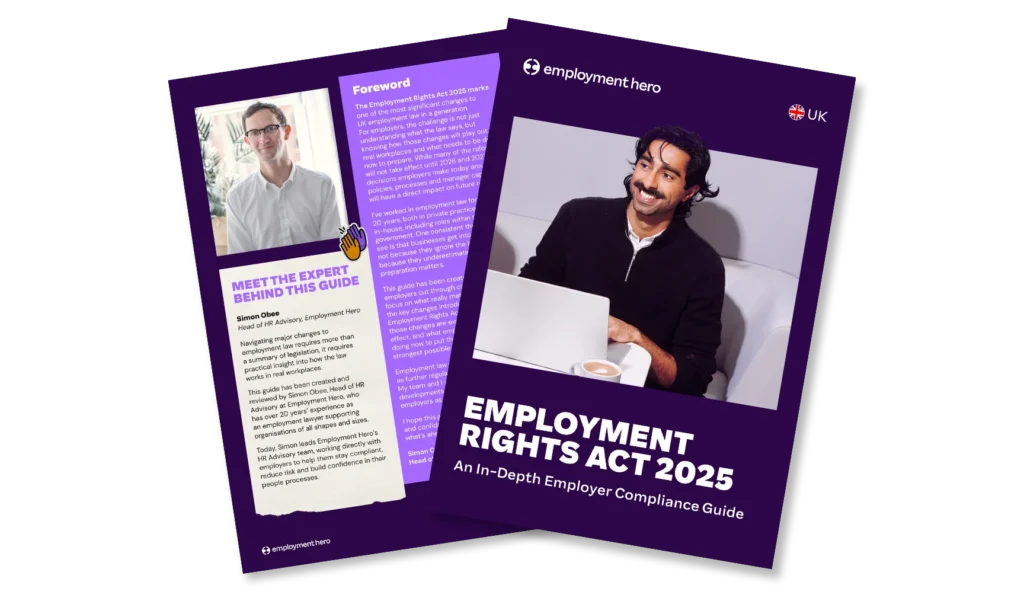
To help employers navigate what’s changing and when, we’ve created a practical Employment Rights Act 2025 Guide that explains the reforms in plain English and sets out what employers need to do next.
Need more guidance?
If you need tailored support, Employment Hero’s HR Advisory team works directly with employers to interpret new legislation, update policies and manage risk with confidence.
We’re also running a dedicated webinar; Employment Rights Act 2025: Critical Changes Before April 2026, where our experts, Simon Obee and Jhecie de Chavez, walk through the most urgent reforms and what employers should prioritise now.
Frequently Asked Questions
The Employment Rights Act 2025 is a significant piece of UK legislation that reforms employment law across the entire employee lifecycle. The Act introduces stronger worker protections, new employer obligations and increased enforcement powers, affecting areas such as unfair dismissal, sick pay, flexible working, harassment, zero-hours contracts and redundancy consultation.
The Employment Rights Act 2025 does not take effect all at once. Changes will be phased in from April 2026 through to 2027, with different provisions coming into force at different times. Some details will also be set out in future regulations, meaning employers should monitor developments closely.
The Act applies to UK employers of all sizes, although some obligations will only apply to employers meeting specific thresholds (for example, equality action plans for employers with 250 or more employees). Certain protections will apply to employees, while others extend to workers, including those on zero-hours or low-hours contracts.
Under the Employment Rights Act 2025, employees will gain the right to claim unfair dismissal after six months’ service, rather than the current two-year qualifying period. The cap on compensation for unfair dismissal claims will also be removed. These changes are currently planned to take effect in January 2027.
Fire and rehire will not be banned outright, but the Employment Rights Act 2025 will significantly restrict when and how employers can use this practice. Threatening dismissal to force contract changes will carry higher legal risk and employers’ ability to replace staff on inferior terms will be limited from April 2026.
Yes. Statutory sick pay (SSP) will become a day-one right under the Employment Rights Act 2025. Employees will be entitled to SSP from the first day of sickness absence and the lower earnings limit for eligibility will be removed. These changes are planned to come into force in April 2026.
The Employment Rights Act 2025 introduces new duties for employers to offer guaranteed hours to zero-hours and low-hours workers, based on hours worked over a reference period. Employers will also be required to give reasonable notice of shifts and compensate workers where shifts are cancelled or changed at short notice. These changes are planned for 2027.
Employers should begin preparing by reviewing HR policies, auditing current compliance practices, training managers on higher-risk decisions and planning for increased enforcement. Although many changes take effect in 2026 and 2027, early preparation will help reduce legal risk and avoid rushed policy changes later.
Legal accuracy checked on [28/01/2026]. Last updated [04/02/2026].
Related Resources
-
 Read more: Employee Termination Process & Checklist
Employee Termination Process & Checklist
Published Setting up an employee termination process, while unpleasant, is a critical part of risk management and safeguarding in business.…
-
 Read more: Internship agreements: What to include
Internship agreements: What to include
Learn what to include in an internship contract agreement in the UK. Define expectations and protect your business with key…
-
 Read more: How to Turn EOFY into a Strategic Advantage
How to Turn EOFY into a Strategic Advantage
Join our expert led EOFY webinar to learn how to use payroll reports, legislative updates, and cost optimisation in 2026.…
