

















Diversity and Inclusion Checklist for UK Employers
Published
Diversity and Inclusion Checklist for UK Employers
Last Updated
Building a diverse and inclusive workplace is important for UK businesses, but the reality is, very few companies nail it. Turning good intentions into meaningful action can be challenging. This is why having a diversity and inclusion checklist is so helpful.
From understanding unconscious bias and fostering psychological safety, to implementing a practical diversity and inclusion checklist and measuring the impact of your efforts, we’ll walk you through the key steps to build a workplace where everyone can thrive.
Whether you’re just starting your D&I journey or looking to strengthen your existing approach, we’ll give you the clarity and tools you need to make a real, measurable difference.
What is diversity and inclusion?
Before diving into the diversity and inclusion checklist, it’s first important to understand what the term means. While it’s easy to use the words interchangeably, they actually represent two different sides of the same coin.
| Diversity | Inclusion |
|---|---|
| The mix of people in your organisation. It’s about representation across different identities, experiences and backgrounds. Think age, gender, ethnicity, sexual orientation, disability and neurodiversity. Diversity is the ‘who’. | About making that mix work. It’s the culture you create to ensure every single person feels valued, respected and heard. Inclusion is the ‘how’. |
Having a diverse team is important, but without an inclusive culture, you won’t keep them. One without the other is a strategy doomed to fail.
The business case for diversity and inclusion
D&I isn’t just a feel-good initiative for UK businesses, it’s a powerful driver for success. Diverse teams often see tangible benefits across every level of the organisation. They bring a wider range of perspectives to the table, which fuels creativity and better problem-solving.
But it runs deeper than that, D&I has an impact on employee engagement and retention. The reality is when employees feel valued for who they are, they’re more likely to stay, perform at their best and contribute fully to the company’s goals. This, in turn, reduces turnover costs and builds a stronger, more resilient workforce.
For growth focussed businesses looking to hire, D&I is also a huge factor. Top candidates actively seek out employers with a proven commitment to D&I. A strong, inclusive culture boosts morale, increases engagement and significantly improves employee retention. When people feel they belong, they do their best work. As we’ve seen, fostering real diversity and inclusion starts in the boardroom.
But to build this culture, you first have to understand the hidden barriers that stand in your way. When doing this a diversity and inclusion checklist can be an invaluable tool to assess current practices, identify gaps and ensure every initiative drives real impact.
What is covered in this diversity inclusion checklist?
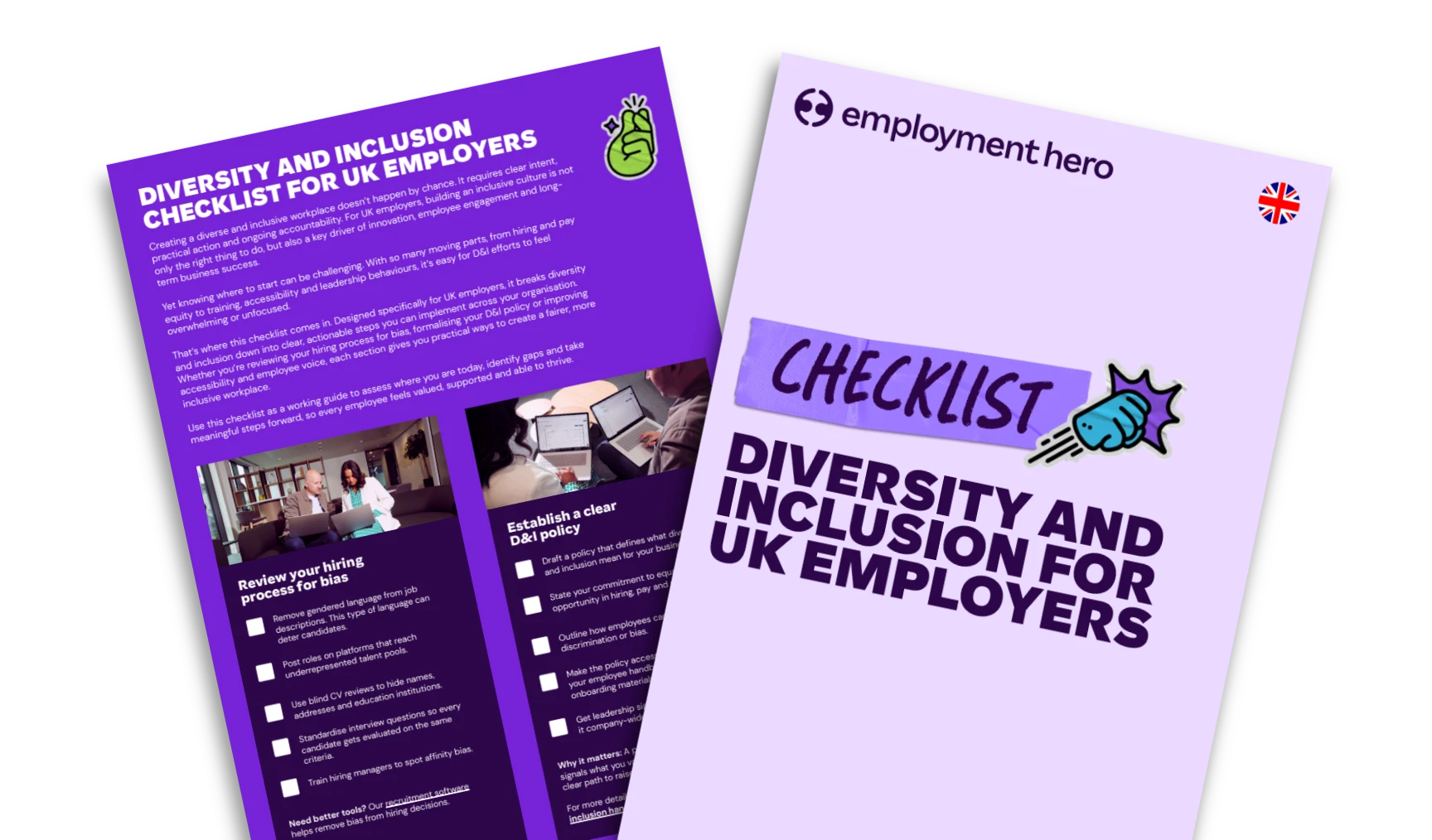
Implementing D&I effectively starts with practical, actionable steps. This diversity and inclusion checklist guides you through the key areas that can make your workplace truly inclusive.
1. Review your hiring process for bias
This step focuses on dismantling barriers that may unintentionally filter out brilliant candidates. From how you write job ads to where you post them, the goal is to ensure you’re reaching the widest possible talent pool. Using the right recruitment software can help standardise processes, reduce bias and create a more consistent and inclusive hiring experience.
2. Establish a clear D&I policy
A strong D&I policy isn’t just corporate jargon. It’s a clear, powerful statement about the kind of inclusive workplace you’re building. This section will help you put your commitment down on paper in a meaningful way.
3. Provide unconscious bias training and ongoing D&I education
Getting everyone on the same page is crucial. This section explores how to roll out training that goes beyond the basics, helping your team understand unconscious bias and their role in creating a respectful culture.
4. Create inclusive meeting practices
Every voice deserves to be heard. Learn simple but effective changes you can make to meetings so that participation isn’t dominated by the loudest voices and everyone has the chance to contribute.
5. Audit your pay and promotion processes
Fairness in pay and progression is non-negotiable. This section covers how to conduct pay equity audits and close any unjustifiable gaps based on gender, race, or other characteristics.
6. Support employee resource groups (ERGs)
ERGs empower employees to build communities and have their voices heard. Discover how supporting these groups can strengthen inclusion and provide underrepresented employees with vital networks of support.
7. Gather feedback on your inclusion efforts
Listening is as important as acting. This section explains how to use anonymous surveys and feedback channels to measure the effectiveness of your inclusion initiatives and identify areas for improvement.
8. Ensure your workplace is physically accessible
Inclusion extends to the physical and digital environment. Explore ways to create a workspace that is welcoming and usable for people with all types of disabilities.
By following this diversity and inclusion checklist, organisations can take concrete steps toward creating a workplace where everyone feels valued, heard and able to thrive.
Understanding unconscious bias
Unconscious bias refers to the hidden thought patterns and assumptions that influence our decisions without us even realising it. These biases are shaped by our experiences, culture and social conditioning and they can subtly affect how we perceive and treat others in the workplace.
In hiring, unconscious bias might lead managers to favour candidates who “fit the mould,” even if another candidate is equally or more qualified. In promotions, it can result in certain groups being overlooked for leadership opportunities. And in day-to-day interactions, it can shape how we communicate, give feedback or collaborate, often without anyone noticing.
The first step in tackling unconscious bias is awareness. By understanding how these hidden biases operate, organisations can implement strategies, such as structured interviews, diverse decision-making panels and training programmes, to ensure fairer, more objective and more inclusive outcomes for all employees.
Measuring D&I metrics
Diversity and inclusion efforts are only as effective as your ability to track and measure their impact. Without real data, it’s easy to assume progress is being made when in reality, gaps may remain.
Key metrics can provide a clear picture of how inclusive your organisation truly is. These include representation across different levels of the company, hiring and promotion rates for underrepresented groups, employee engagement scores, retention rates and participation in D&I initiatives. Collecting feedback through surveys and exit interviews can also reveal how employees experience your workplace culture.
Monitoring these metrics allows you to hold yourself accountable and identify areas where more focus is needed. By using data to inform your decisions, you can ensure your D&I initiatives are not just well-intentioned, but actually driving meaningful, measurable change across your organisation.
Fostering psychological safety
Psychological safety is the foundation of a truly inclusive workplace. It refers to an environment where employees feel safe to speak up, share ideas, ask questions and be themselves without fear of embarrassment, rejection or negative consequences.
When psychological safety is present, people are more willing to contribute openly, challenge ideas constructively and take the kind of risks that lead to innovation and growth. Without it, even the most diverse team can struggle—because if individuals don’t feel safe to participate, their perspectives remain unheard.
Leaders play a crucial role in creating this culture. Simple behaviours, such as actively listening, encouraging different viewpoints, acknowledging mistakes and responding respectfully to feedback, can make a significant difference. It’s also important to ensure that inclusion is embedded in everyday practices, from team meetings to performance conversations.
By fostering psychological safety, organisations create an environment where employees feel valued, respected and empowered to contribute fully—unlocking the true potential of a diverse and inclusive team.
Take the next step
Building a diverse and inclusive business is one of the most powerful things you can do to future-proof your organisation. It drives innovation, attracts the best people and creates a workplace where everyone can thrive.
Ready to turn intention into action?
FAQ’s
A comprehensive diversity and inclusion checklist should cover eight key areas: reviewing hiring processes for bias, establishing a clear D&I policy, providing employee training, creating inclusive meeting practices, auditing pay and promotion processes, supporting employee resource groups (ERGs), gathering feedback on inclusion efforts and ensuring physical accessibility.
Each area should include specific action steps. For example, in hiring, you’d remove gendered language from job ads, use blind CV screening and standardise interview questions. For policies, you’d document your commitment to equality, outline reporting procedures for discrimination and make it accessible to all staff. The checklist should also include measurable metrics so you can track progress and hold your organisation accountable.
Diversity is the mix of different people in your organisation. This includes:
- Age.
- Gender.
- Ethnicity.
- Disability.
- Sexual orientation.
- Religion.
- Socioeconomic background.
- Neurodiversity.
Inclusion is making that mix work. It’s creating a culture where everyone feels valued, respected and able to contribute fully. You can have a diverse team but still have an exclusionary culture if people don’t feel they belong.
Equity is about fairness. It means giving people what they need to succeed, which isn’t always the same for everyone. For example, providing adjustable desks for employees with back conditions or offering flexible hours for carers. Equity recognises that not everyone starts from the same place and adjusts support accordingly.
All three are essential. Diversity brings different perspectives, inclusion makes people feel they belong and equity ensures everyone has a fair chance to succeed.
No, D&I training isn’t legally mandatory for most UK employers. However, employers do have legal obligations under the Equality Act 2010 to prevent discrimination and training is one of the most effective ways to meet these obligations.
The Equality Act requires employers to protect staff from discrimination based on nine protected characteristics: age, disability, gender reassignment, marriage and civil partnership, pregnancy and maternity, race, religion or belief, sex and sexual orientation. If an employee successfully brings a discrimination claim, tribunals often consider whether the employer provided adequate training.
Some sectors have specific requirements. For example, NHS trusts must provide equality and diversity training for all staff. Public sector organisations subject to the Public Sector Equality Duty also have stronger obligations to promote equality.
Even where it’s not mandatory, D&I training is considered best practice. It helps prevent costly discrimination claims, improves workplace culture and demonstrates your commitment to building an inclusive environment.
Review your D&I policy at least once a year, but you should also update it whenever there are significant changes to legislation, your workforce or your business structure.
Annual reviews should cover:
- Whether the policy still reflects your organisation’s values and goals.
- If objectives from the previous year were met.
- Whether employee feedback suggests the policy needs updating.
- Changes to UK employment law or best practice guidance.
- New D&I challenges or opportunities identified in the past year.
Review immediately if:
- There are changes to the Equality Act 2010 or related regulations.
- Your organisation undergoes restructuring, mergers or acquisitions.
- You receive feedback from employees highlighting gaps in the policy.
- There’s a discrimination complaint or tribunal case.
- You’re expanding into new locations or significantly growing headcount.
Make sure your review process includes input from employees at all levels, particularly those from underrepresented groups. Employee resource groups can provide valuable insights into whether your policy is working in practice.
Under the Equality Act 2010, it’s illegal to discriminate against someone because of nine protected characteristics:
- Age: Protection from discrimination based on age (applies to all ages, not just older workers).
- Disability: Physical or mental impairments that have a substantial, long-term negative effect on ability to do normal daily activities.
- Gender reassignment: Protection for people who are transitioning or have transitioned from one gender to another.
- Marriage and civil partnership: Protection from discrimination for being married or in a civil partnership.
- Pregnancy and maternity: Protection during pregnancy and maternity leave
- Race: Includes colour, nationality, ethnic or national origins.
- Religion or belief: Protection for religious beliefs and philosophical beliefs (including lack of belief).
- Sex: Protection from discrimination based on being male, female or intersex
- Sexual orientation: Protection regardless of whether someone is heterosexual, gay, lesbian or bisexual.
Employers must not discriminate in recruitment, terms and conditions, pay and benefits, promotion and transfer opportunities, training or dismissal. You also have a duty to make reasonable adjustments for disabled employees and to prevent harassment related to any protected characteristic.
Start by tracking quantitative metrics that show representation, fairness and movement. Key metrics include:
Representation metrics:
- Demographic breakdown at each level of the organisation.
- Diversity of new hires compared to the applicant pool.
- Composition of leadership and board positions.
Pay equity metrics:
- Gender pay gap analysis.
- Pay gap analysis by ethnicity, age and other characteristics.
- Bonus pay gap data.
Career progression metrics:
- Promotion rates for different demographic groups.
- Time to promote by group.
- Representation in succession planning.
Retention metrics:
- Turnover rates by demographic group.
- Exit interview data highlighting inclusion concerns.
- Length of service analysis.
Qualitative metrics:
- Employee engagement survey scores on inclusion questions.
- Participation rates in D&I training and ERGs.
- Number and nature of discrimination complaints.
- Employee Net Promoter Score (eNPS) by demographic.
Survey employees regularly using anonymous tools to ask: “Do you feel you can be yourself at work?” “Have you witnessed or experienced discrimination?” “Do you feel your contributions are valued?” These sentiment measures often reveal issues that numbers alone won’t show.
The most important part is acting on what you find. Metrics are worthless if they don’t drive change.
Yes. While there’s no legal requirement to have a written D&I policy regardless of company size, having one is considered best practice and provides important protections for both you and your employees.
Benefits for small businesses:
- Legal protection: A clear policy shows you take equality seriously, which can be a defence if you face a discrimination claim. Employment tribunals consider whether employers have taken reasonable steps to prevent discrimination.
- Clarity for staff: It sets expectations for behaviour and shows employees how to raise concerns. This is especially important in smaller teams where there may not be a dedicated HR function.
- Recruitment advantage: Top talent increasingly looks for employers with clear D&I commitments. A policy demonstrates you’re serious about creating an inclusive workplace.
- Culture building: As you grow, your policy sets the foundation for the culture you want to build. It’s easier to establish good practices early than to change a problematic culture later.
Even a simple one-page policy is better than nothing. It should cover:
- Your commitment to equality and inclusion.
- The protected characteristics under UK law.
- How employees can report discrimination or harassment.
- Your process for handling complaints.
- How you’ll promote diversity in hiring and development.
Employment Hero’s HR software makes it easy to create, store and share policies with your team, even if you don’t have a dedicated HR person.
To download the checklist, we just need a few quick details.
Related Resources
-
 Read more: Diversity and Inclusion Checklist for UK Employers
Diversity and Inclusion Checklist for UK Employers
Create a truly inclusive environment with our diversity and inclusion checklist.
-
 Read more: Workplace Bullying Checklist for UK Businesses
Workplace Bullying Checklist for UK Businesses
Are your employees protected from workplace bullying? Review your processes and learn how to handle arising issues with this checklist.
-
 Read more: Monthly Payroll Checklist for UK Businesses
Monthly Payroll Checklist for UK Businesses
Manage your payroll processing with our monthly checklist. Streamline your tasks and improve efficiency.
