


















Employment Hero November data reveals small businesses are hiring again – but recovery is fractured across the UK
– Employment Hero’s latest Jobs Report reveals that employment in UK small businesses grew 1.7% month-on-month in November.
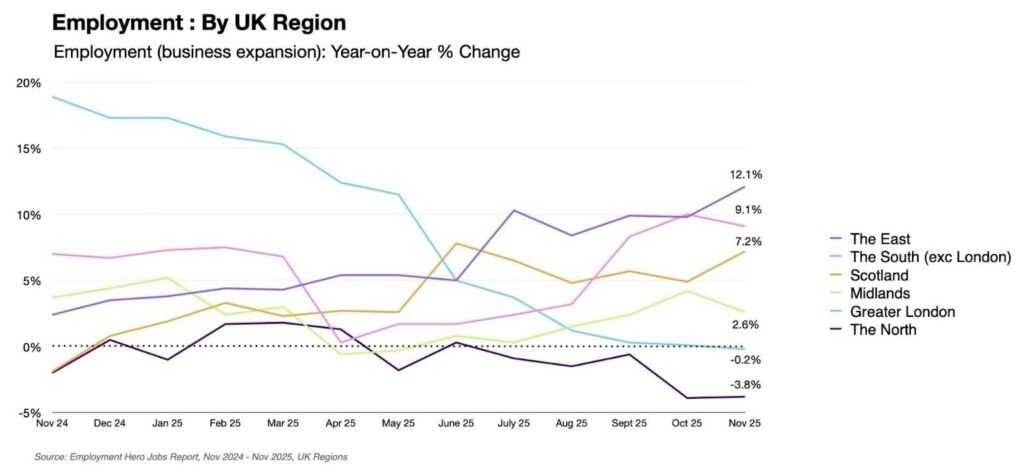
– But the longer term picture shows a fractured nation: The East leads the way with a substantial 12.1% annual rise in employment growth – the strongest performance of any region – while employment in The North is retracting at -3.8%.
– As the economic landscape worsens, workers are reassessing their options: four in ten (42%) UK workers searched for a new job in 2025 and over a third (36%) considered quitting.
London, 12th December 2025 – Employment Hero, the global leader in HR, hiring and payroll software, has today released its November UK Jobs Report, based on real-time data from over 110,000 employee records. The findings reveal that while small businesses are driving a modest rebound in employment, with employment up 1.7% in November, the recovery is fractured across the country. This uncertainty is impacting workers, many of whom have been looking for new job opportunities in 2025.
SMEs are leading the rebound, but growth is slow
Small businesses continue to push the labour market forward, despite the pace of growth slowing and remaining below pre-2025 levels. UK employment among SMEs rose again in November and is now 4% higher than in August. But the year-on-year picture is weaker: employment is up 2.0% compared with last year, well below the 7-8% annual increases typically seen before April’s employment law changes.
This slowdown is occurring as larger firms ease off on hiring, according to recent KPMG and Recruitment and Employment Confederation (REC) data. Against this backdrop, SMEs are still expanding – a sign of resilience in a difficult economic climate.
Fractured national recovery
While the national picture is that of slow recovery, a regional imbalance persists. The East leads the nation with a substantial 12.1% annual rise in employment – the strongest performance of any region – followed closely by the South at 9.1%. Elsewhere, hiring momentum is far weaker: the Midlands saw a modest 2.6% annual gain but London remains flat at -0.2% and the North is declining at -3.8%.
Wage growth tells a similarly uneven story. The East has seen a buoyant 9.7% annual rise, while the North has risen to 3.6%, outpacing London, the South and the Midlands.
Nationally, wages rose 0.8% month-on-month, but with inflation at 2.3%, workers are still losing out in real terms. The data shows that job creation and pay growth are being driven by different forces, making traditional trends increasingly unpredictable.
Workers are reassessing their options
The slow, fractured job market is impacting how workers are thinking about their futures. Employment Hero’s recent ‘Employment Uncovered’ research shows that 42% of UK workers actively searched for a new job in 2025 and over a third (36%) thought about quitting altogether.
Half of UK workers at SMEs (50%) said they would sacrifice higher pay for more flexible hours, and 42% said they would accept lower pay for a job which felt more meaningful. With a significant share of workers weighing up new opportunities, purpose and flexibility are becoming just as important as pay, adding another layer of complexity for SMEs planning their 2026 workforce strategies.
Commenting on the findings, Kevin Fitzgerald, UK Managing Director at Employment Hero said:
“We continue to see small businesses showing real resilience and leading the employment growth rebound in the UK. However, the recovery is fragmented, and this unevenness is creating uncertainty for both employers and staff. SMEs face the difficult task of keeping wages moving, supporting flexibility, and offering meaningful work – all at a time when costs are rising and local challenges vary dramatically. Yet despite this, they continue to grow, which is remarkable.”
Related Resources
-
 Read more: South West named UK’s most locally loyal business region as Employment Hero deepens commitment to Bristol
South West named UK’s most locally loyal business region as Employment Hero deepens commitment to Bristol
18 March 2026 – New data from Employment Hero reveals strong regional confidence in the South West, with 84% of…
-
 Read more: Yorkshire businesses show local loyalty as Employment Hero back region with Leeds United partnership
Yorkshire businesses show local loyalty as Employment Hero back region with Leeds United partnership
5 March 2026 – New data from Employment Hero reveals strong regional confidence across Yorkshire & the Humber amid rising…
-
 Read more: Government red tape risks blocking youth jobs as SMEs look to access apprenticeship scheme
Government red tape risks blocking youth jobs as SMEs look to access apprenticeship scheme
February 9, 2026: New Employment Hero research finds 73% of SME leaders intend to leverage new Government apprenticeship schemes following…
