


















How Apprenticeships Help SMEs Hire Responsibly and Build Skills
Traditional hiring isn’t working. Discover how apprenticeships can bridge skill gaps, boost retention and transform your recruitment strategy.

Contents
For too long, hiring has been treated like a numbers game. Post a role. Sort through hundreds of CVs. And hope the right person stands out.
But for many UK employers, especially small and medium-sized businesses, the reality looks very different.
Traditional recruitment is slow, expensive and biased towards outdated credentials. We found that 3 in 4 businesses say recruitment is a challenge, and 45% of businesses now spend more on recruitment. Worse still, it often fails to deliver people with the practical skills businesses actually need.
When every hire matters, the traditional hiring approach can become a real barrier to growth. That’s why many employers are rethinking how they attract, develop and retain people; not by replacing hiring altogether, but by complementing it with more structured, skills-focused pathways.1
Apprenticeships offer a practical, proven way to develop talent from the ground up, helping employers build the skills they need while creating meaningful, long-term opportunities for people.
Why employers are rethinking traditional hiring
Hiring is becoming more complex for UK employers. Skills shortages are increasing, competition for talent is intensifying and recruitment budgets are under pressure.
At the same time, heavy reliance on CVs and formal qualifications can narrow the talent pool too early. This approach often prioritises academic pathways over practical capability, meaning employers may overlook candidates with the right mindset, adaptability and potential to grow into the role.
As businesses focus on building resilient, future-ready teams, many are starting to explore new ways of finding and developing talent that better reflect how work actually happens today.
Once viewed as a less traditional career route, apprenticeships are now helping SMEs bridge the gap between on-paper qualifications and day-to-day job requirements. Training remains essential regardless of experience level, and apprenticeships allow employers to build those skills in a structured, supported way.
Perceptions are shifting. Employment Hero research shows that 78% of business leaders now hold a positive view of apprenticeships, pointing to the rise of a blended talent model. Nearly half of SMEs (46%) now place greater value on vocational routes, while just 11% still see apprenticeships as less valuable.
This momentum is set to continue. Our research found that 73% of SME leaders plan to make use of new government apprenticeship schemes following the 2025 Autumn Budget, with 78% of employers already report productivity gains from apprenticeship programmes.
The impact goes beyond individual businesses. By creating accessible pathways into work, apprenticeships also play an important role in tackling youth unemployment across the UK.
What is an apprenticeship?
Apprenticeships are structured training programmes that combine paid, hands-on work with formal off-the-job learning.
They are available across a wide range of industries, including technology, HR, finance, marketing and professional services.2
Unlike traditional recruitment, apprenticeships are designed around development. Apprentices join your business to learn, supported by a clear training plan that focuses on the skills your organisation actually needs.
Instead of searching for the finished product, you build it.
How apprenticeships solve hiring challenges
Apprenticeships do more than fill vacancies. They address the root causes of many modern recruitment problems. Let’s take a look.
Reducing bias in recruitment
CV-led hiring favours candidates who know how to present themselves on paper. Apprenticeships shift the focus to potential.
By recruiting for attitude, motivation and willingness to learn, employers open their doors to a wider and more diverse talent pool. This creates fairer access to opportunities while helping businesses benefit from new perspectives and ideas.
Building job-ready skills
Apprentices learn in the context of your business. Training is aligned to real responsibilities, processes and systems. This closes the gap between theory and practice and produces employees who are genuinely job-ready, not just qualified.
Over time, apprentices develop into highly capable team members who understand how your organisation operates because they have grown within it.
Creating a long-term talent pipeline
Constantly recruiting for the same roles is costly and unsustainable. Apprenticeships allow employers to grow talent internally, creating a reliable pipeline of skilled employees who can progress as the business evolves. This reduces reliance on external recruitment and protects against future skills shortages.
A structured onboarding process plays a critical role here, helping apprentices settle quickly and feel supported from day one.
Attracting overlooked talent
Apprenticeships appeal to candidates who may be excluded by traditional hiring routes. Career changers. Parents returning to work. School leavers choosing an alternative to university.
By offering paid, supported entry into your industry, you make your business accessible to people with valuable life experience and transferable skills. These candidates are often highly motivated and deeply committed to their employers.
Improving retention and engagement
Employees who are developed internally tend to stay longer. Apprenticeships build loyalty by showing people there is a future for them within your organisation. Clear progression pathways, structured learning and ongoing support all contribute to higher engagement and lower staff turnover.
How to get started with apprenticeships
Employment Hero data shows that 43% of employers find navigating the apprenticeship system complex, highlighting a key barrier to wider adoption. Understanding funding rules, training requirements and compliance can feel overwhelming, particularly for time-poor SMEs.
The good news is that getting started does not have to be complicated.
Start with a clear skills need
Begin by identifying roles where practical skills gaps already exist or where future demand is likely to grow. Starting with one or two well-defined positions makes it easier to design meaningful training and see results quickly.
Partner with the right training providers
Registered training providers and colleges manage the formal learning and assessment elements of apprenticeships. Working with experienced providers helps ensure programmes meet national standards while reducing the administrative burden on your business.
Understand the funding available
Government funding covers a significant portion of apprenticeship training costs, but navigating eligibility and claims can be challenging. Taking the time to understand what support is available, or working with partners who can guide you, makes apprenticeships far more accessible and cost-effective.
- Apprenticeship Levy funding – Large employers with an annual payroll over £3 million pay into the Apprenticeship Levy and can use those funds to cover training and assessment costs. Importantly for SMEs, levy-paying organisations3 can transfer unused levy funds to other businesses, helping smaller employers access fully funded apprenticeships without paying the levy themselves.
- Government co-investment for SMEs – Most small and medium-sized businesses do not pay the Apprenticeship Levy. Instead, they benefit from government co-investment, where the state covers the majority of training costs and the employer pays a small contribution. This makes apprenticeships a far more affordable option than traditional recruitment or external training.
- Employer inventive payments – From time to time, the government offers employer incentive payments, particularly for hiring younger apprentices, new starters or individuals with additional support needs. These payments are designed to offset onboarding and training costs during the early stages of employment.
- Fully funded apprenticeships for young learners – In many cases, apprentices aged 16–18 are fully funded, meaning employers do not contribute towards training costs at all. This makes apprenticeships an accessible entry point for businesses looking to develop early-career talent.
Simplify the experience with technology
Managing apprenticeships becomes far easier when processes are centralised. HR software can support onboarding, track training progress, manage performance reviews and keep records organised, helping employers stay compliant while giving apprentices a smooth, supported experience.
With the right structure and support in place, apprenticeships become a practical, scalable way to build skills rather than an administrative burden.
Ready to strengthen your hiring and development strategy?
Traditional hiring alone is no longer enough to meet today’s skills challenges. Apprenticeships don’t replace recruitment entirely, but they do offer a powerful way to complement it, helping businesses grow talent internally, build capability over time and create more resilient teams.
At Employment Hero, we help employers manage and support their people at every stage of the employee lifecycle. From onboarding and training to payroll and performance management, our all-in-one platform gives you the foundations you need to build successful apprenticeship programmes with confidence.
References
- Work That Works, Employment Hero commissioned research with QuestionPro, UK, March 2025, n=1200 (employees in companies of 5-999 people)
- Employment Hero commissioned survey with Focaldata, UK, January 2026, n=1,047 business owners/leaders in SMEs. Data based on a bespoke survey of 1,047 UK business owners/leaders at SMEs, commissioned by Employment Hero and conducted by Focaldata in January 2026.
- Employment Hero commissioned survey with Focaldata, UK, January 2026, n=1,047 business owners/leaders in SMEs. Data based on a bespoke survey of 1,047 UK business owners/leaders at SMEs, commissioned by Employment Hero and conducted by Focaldata in January 2026.
Related Resources
-
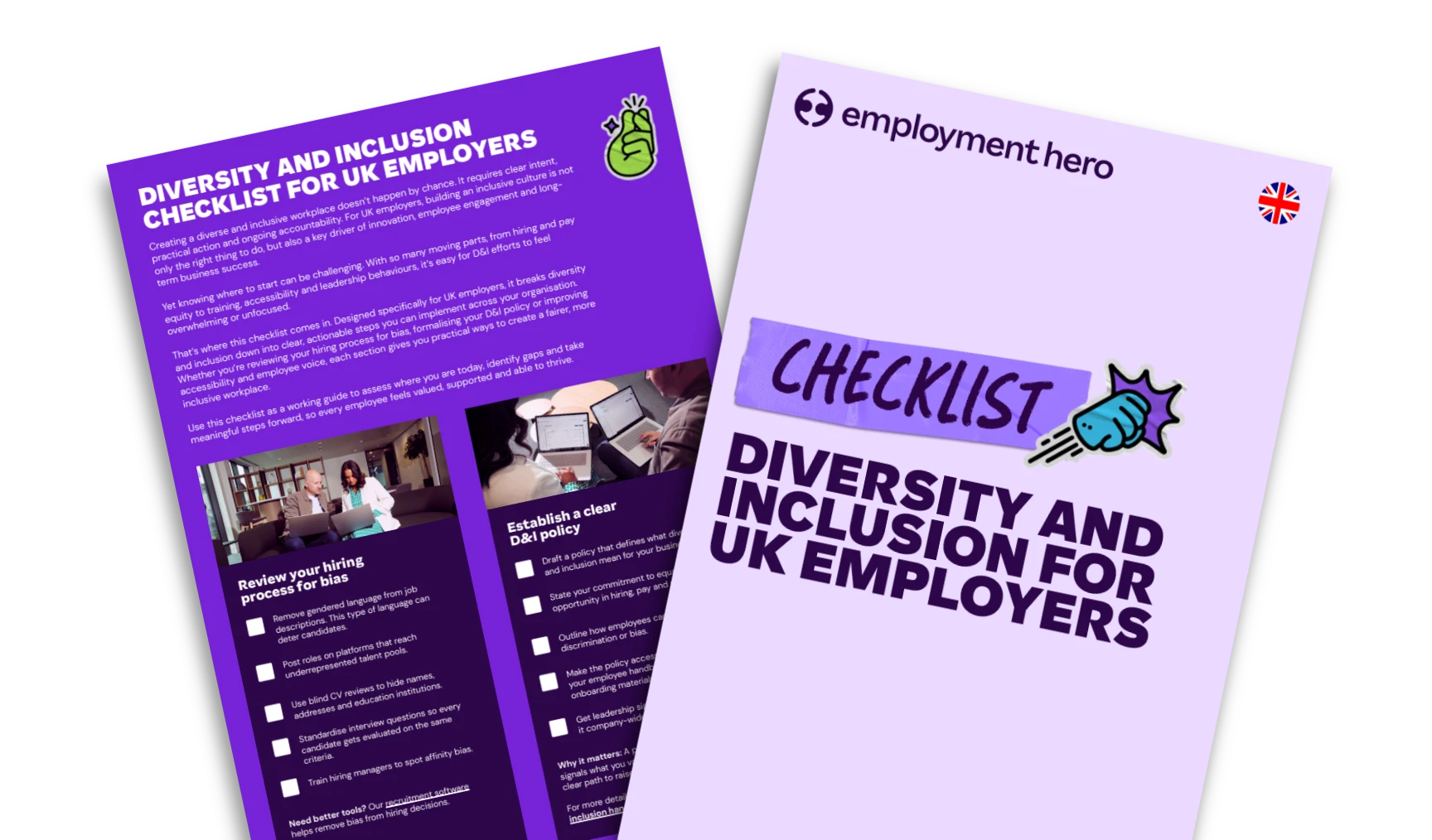 Read more: Diversity and Inclusion Checklist for UK Employers
Diversity and Inclusion Checklist for UK Employers
Create a truly inclusive environment with our diversity and inclusion checklist.
-
 Read more: Workplace Bullying Checklist for UK Businesses
Workplace Bullying Checklist for UK Businesses
Are your employees protected from workplace bullying? Review your processes and learn how to handle arising issues with this checklist.
-
 Read more: Monthly Payroll Checklist for UK Businesses
Monthly Payroll Checklist for UK Businesses
Manage your payroll processing with our monthly checklist. Streamline your tasks and improve efficiency.

