 Australia
  United Kingdom
  Singapore
  Malaysia
  Canada (Français)
 New Zealand



How to calculate final pay in New Zealand
Last Updated
How to calculate final pay in New Zealand
Last Updated
When an employee moves on, their final pay is your chance to close the chapter on a high note. Getting it right isn’t just a legal requirement under New Zealand employment law. It’s also a reflection of your professional relationship. Whether someone is heading to a new opportunity, stepping into retirement or leaving through redundancy, knowing exactly what they’re owed and when to pay it makes for a confident, clean farewell.
Our guide walks you through everything you need to know about calculating final pay in New Zealand, including:
- What to include in final pay
- How to make final calculations for annual leave
- Considerations around public holidays
- How notice periods affect final pay
- Common challenges faced by New Zealand employers
What is final pay?
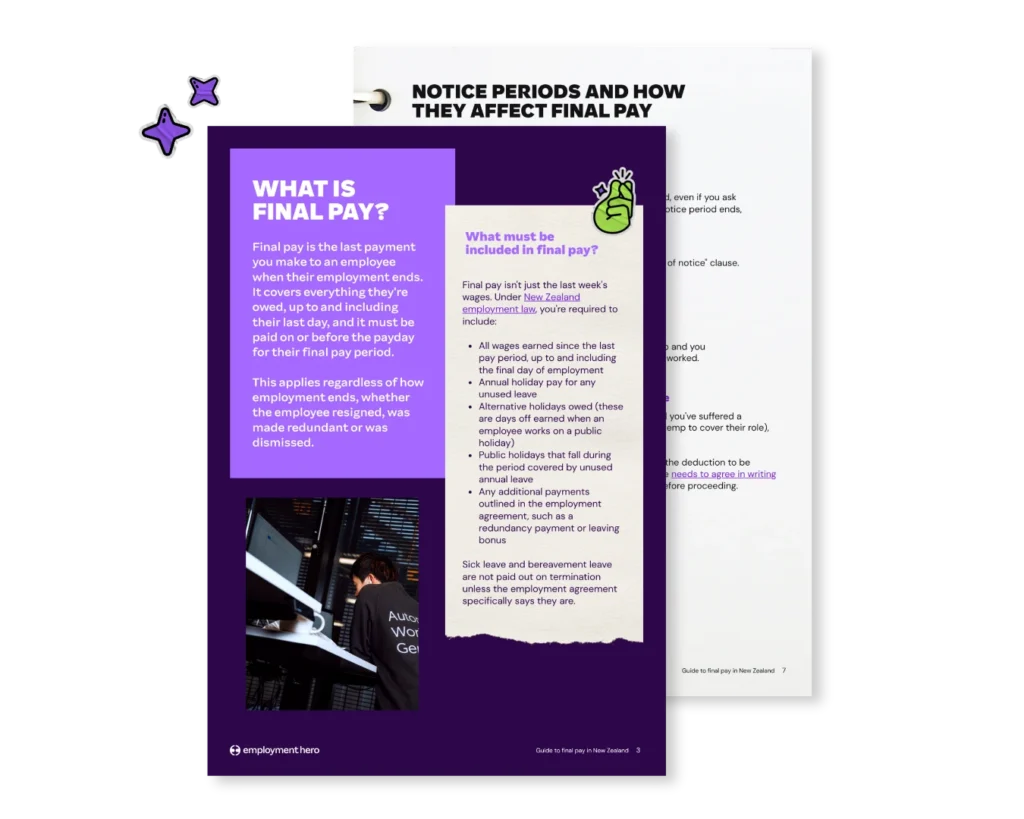
Final pay is the last payment an employee receives from their employer. It covers more than just their last week of wages. Under New Zealand law, final pay must include all outstanding entitlements, meaning you need to account for wages, holiday pay, leave balances and any other payments owed under the employment agreement.
The rules around final pay are primarily governed by the Holidays Act 2003 and the Employment Relations Act 2000. Getting it wrong can expose your business to claims, so it’s worth taking the time to understand everything before you process that final pay run.
What must be included in final pay in New Zealand?
Every final pay should cover the following:
- Wages for hours worked since the last pay period, up to and including the final day of employment.
- Payment through the notice period, if the employee gave the correct amount of notice.
- Annual holidays owed and calculated in accordance with the Holidays Act.
- Public holidays that fall within the period covered by any unused annual leave.
- Alternative holidays owed, if the employee worked on a public holiday and hasn’t yet taken their day off in lieu.
- Any additional lump sum payments outlined in the employment agreement, such as a redundancy payment or retirement allowance.
Unused sick leave and bereavement leave don’t have to be paid out unless the employment agreement specifically requires it. Some employers choose to include these payments as a goodwill gesture but there’s no legal obligation to do so.
How to calculate holiday pay in final pay
Annual holiday pay is where most employers run into difficulty. The calculation method depends on how long the employee has been with you.
If employment ends before the 12-month anniversary
Employees who haven’t yet reached their 12-month anniversary aren’t entitled to annual holidays in the traditional sense. Instead, they receive a payment of 8% of their gross earnings for the entire period of employment, minus any amounts already paid for, such as:
- Annual holidays taken in advance
- Annual holidays paid on a pay-as-you-go basis
Gross earnings includes everything the employee earned during their time with you, including other payments made in their final pay.
If employment ends after the 12-month anniversary
Once an employee has completed 12 months of service, they become entitled to four weeks of annual holidays each year. When they leave, you must pay out any remaining unused annual holiday entitlement. This is calculated at whichever is the higher of:
- Ordinary weekly pay, or
- Average weekly earnings (calculated over the 52 weeks prior to the end date)
On top of this, you also need to pay 8% of gross earnings since their last anniversary date, minus any amounts already paid for holidays taken in advance or on a pay-as-you-go basis. This covers the portion of leave they’ve accrued since their last entitlement date.
Calculating unused annual leave
To work out how much unused annual leave an employee is owed, start by checking their leave balance on their last day. If they have, say, three weeks of unused leave, you pay that out at the higher of ordinary weekly pay or average weekly earnings.
Ordinary weekly pay (OWP) is typically what the employee earns in a standard working week. If it’s not clearly defined in their employment agreement, you’ll need to look at their regular pattern of work and pay.
Average weekly earnings (AWE) is calculated by dividing the employee’s total gross earnings over the past 52 weeks by 52.
If the employee has been off work on ACC for an extended period, the calculation gets more complex. You should use their ordinary weekly pay as the base, rather than their average weekly earnings, since a period of ACC leave could bring that average down significantly.
For a deeper dive into how leave accrues and is calculated, our guide to accrued leave in New Zealand covers the detail.
What happens to other leave entitlements?
Public holidays in final pay
This is one area that catches many employers off guard. When an employee leaves, you need to treat their unused annual leave entitlement as if it’s being taken immediately after their last day. If a public holiday falls within that period and it would have been an otherwise working day for the employee, they have to be paid for it.
Here’s a practical example: an employee’s last day is Friday 22 December and they have five days of annual leave remaining. Those five days are added to their end date, extending it to Friday 29 December. Christmas Day and Boxing Day both fall within this window, so both must be paid as public holidays. The two days of annual leave that would have covered those public holidays are then pushed out further as well.
Each time a public holiday is paid out, the annual leave period extends by one day, which may then capture more public holidays. Work through this carefully before processing the final pay.
Alternative holidays
If an employee worked on a public holiday and earned an alternative holiday (a day off in lieu) that they haven’t yet taken, this must also be paid out in their final pay. The rate is relevant daily pay or average daily pay, whichever applies. Note that alternative holidays don’t affect the end date calculation for public holidays.
Sick and bereavement leave
As mentioned, there’s no legal requirement to pay out unused sick leave or bereavement leave. If your employment agreements are silent on this, you’re not obligated to include it. However, if your agreement does include a payout clause, you must honour it.
Notice periods and final pay timing
When the employee gives the correct notice
If an employee gives the notice required under their employment agreement, you must pay them through to the end of that notice period, even if you ask them to stop working early. The only exception is if the employee themselves requests to be released from working out their notice, in which case you only need to pay for the days they actually worked.
You can ask an employee not to work their notice period but you still need to pay them for it unless they’ve agreed to waive it.
When the employee doesn’t give enough notice
If an employee resigns without giving the required notice, you only have to pay them for the days they actually worked. You’re not required to pay out the remainder of the notice period.
When does final pay need to be processed?
Final pay must be paid on the employee’s last day of work or, at the latest, by the next scheduled payday. The safest approach is to process it as quickly as possible, ideally on the last day. Late payment can lead to disputes and complaints to Employment New Zealand.
Employer obligations under the Holidays Act 2003
The Holidays Act 2003 sets out the minimum entitlements for annual holidays, public holidays, sick leave, bereavement leave and alternative holidays. When it comes to final pay, the Act requires you to calculate and pay out all entitlements correctly, regardless of the reason for termination.
Key obligations in the Act include:
- Keeping accurate records of wages, hours worked and leave balances for at least six years, even after an employee has left
- Retaining payroll tax records, including PAYE information, for at least seven years
- Calculating annual holiday pay using the correct method based on length of service
- Accounting for public holidays that fall within the unused leave period after employment ends
- Processing final pay on time, no later than the next scheduled payday
Non-compliance with the Holidays Act can result in significant financial penalties and personal grievance claims.
Common challenges and how to avoid them
Miscalculating the annual leave rate
Always check whether ordinary weekly pay or average weekly earnings is higher. Using the wrong rate is a common error that can lead to underpaying employees.
Missing public holidays in the leave extension period
Work through the calendar carefully after the employee’s last day. Many employers forget to check whether public holidays fall within the unused leave window.
Confusing gross earnings
When calculating the 8% component, remember to include the value of annual leave, alternative holidays and public holidays being paid out in the final pay. These all count as gross earnings for the purposes of the 8% calculation.
Getting the notice period wrong
Read the employment agreement carefully. The notice period affects both the timing and the amount of the final pay.
Delaying payment
Final pay must be processed by the next scheduled payday at the latest. Build this into your offboarding process so nothing falls through the cracks.
A practical checklist for processing final pay
Use this as a guide when an employee leaves:
- Confirm the employee’s last day and notice period from the employment agreement
- Calculate wages owed for all hours worked since the last pay period
- Determine whether the employee has reached their 12-month anniversary
- Calculate unused annual leave entitlement and the applicable rate (ordinary weekly pay vs average weekly earnings)
- Work out the 8% gross earnings component for the relevant period
- Check the calendar for public holidays that fall within the unused leave extension period
- Identify any outstanding alternative holidays and calculate the payout
- Review the employment agreement for any additional lump sum payments owed
- Apply the correct tax treatment to each component (note: lump sum payments like redundancy may have different tax rules)
- Process the payment on or before the next scheduled payday
- Update your payroll records and archive the employee file
Final pay calculations can be complex, particularly when public holidays, alternative holidays and different leave rates are all in play at the same time. If you’re managing payroll manually, the risk of errors is real.
Employment Hero automates Holidays Act calculations and keeps leave records, saving significant time and reducing the risk of underpayment disputes.
To find out more, book a call with one of our team today.
The information in this article is current as at 5 April 2026, and has been prepared by Employment Hero Pty Ltd (ABN 11 160 047 709) and its related bodies corporate (Employment Hero). The views expressed in this article are general information only, are provided in good faith to assist employers and their employees, and should not be relied on as professional advice. Some information is based on data supplied by third parties. While such data is believed to be accurate, it has not been independently verified and no warranties are given that it is complete, accurate, up to date or fit for the purpose for which it is required. Employment Hero does not accept responsibility for any inaccuracy in such data and is not liable for any loss or damages arising directly or indirectly as a result of reliance on, use of or inability to use any information provided in this article. You should undertake your own research and seek professional advice before making any decisions or relying on the information in this article.
Register to download guide
Related Resources
-
 Read more: MFA policy: what it is, why you need one and how to write it
MFA policy: what it is, why you need one and how to write it
Learn how to create an MFA policy that protects your business from unauthorised access. Includes a template, implementation steps and…
-
 Read more: Your strategic guide to winning leadership buy-in for HR and payroll system change
Your strategic guide to winning leadership buy-in for HR and payroll system change
Struggling to get sign-off on a new HR or payroll system? This guide walks you through everything you need to…
-
 Read more: The AI Adoption Blueprint
The AI Adoption Blueprint
What does it take to embed AI across an entire team? We’re sharing our training, our policies, and the lessons…
