 Australia
  United Kingdom
  Singapore
  Malaysia
  Canada (Français)
 New Zealand





Employee Share Scheme rules and compliance guide in New Zealand
Last Updated
Employee Share Scheme rules and compliance guide in New Zealand
Last Updated
Attracting top talent and keeping your best people is a priority for any growing business in New Zealand. One highly effective way to build loyalty, boost morale and align your team with your company goals is through an employee share scheme. By offering your staff a stake in the business, you turn employees into owners who share in the success they help create.
Navigating the rules around these schemes can feel daunting for business owners and HR managers. With specific tax implications, corporate laws and employment obligations to manage, understanding the landscape is crucial.
That’s why we’ve created a comprehensive guide to help you understand the mechanics of share schemes so you can confidently offer these benefits to your team.
Download the guide by filling in the form on the right.
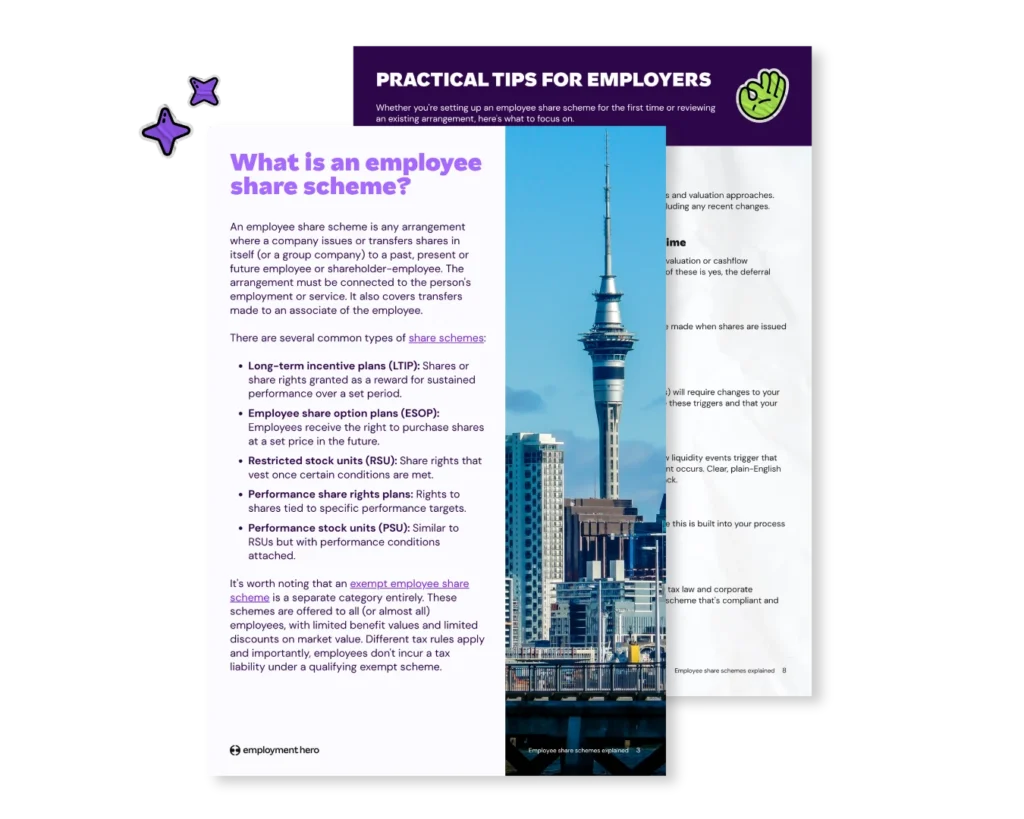
An employee share scheme is a structured program that allows companies to offer their employees shares or options to buy shares in the business. Instead of receiving only a standard salary, employees get the opportunity to own a piece of the company they work for. This creates a direct financial incentive for staff to contribute to the long-term growth and profitability of the business.
Share schemes are particularly popular among scaling businesses and startups in New Zealand. They provide a practical way to offer competitive compensation packages without draining cash reserves. When your business thrives, the value of the shares increases, rewarding employees for their dedication and hard work.
How share schemes work in New Zealand
In New Zealand, an employee share scheme operates as an agreement between the employer and the employee. The company grants shares or share options to the employee, often subject to specific conditions known as vesting criteria. Vesting criteria typically require the employee to remain with the company for a set period or achieve specific performance milestones before they fully own the shares.
Once the shares vest, the employee can exercise their options to buy the shares at a predetermined price or receive them outright depending on the scheme structure. The New Zealand government regulates these schemes to protect both the business and the employee. Regulatory oversight ensures transparency, fair valuation and appropriate tax treatment for any financial benefits gained through the scheme.
Types of employee share schemes
Businesses can choose from several different structures when setting up a share scheme. The right choice depends on your company size, growth stage and ultimate business goals.
Share option plans are the most common type. Under this structure, employees receive the right to purchase shares at a fixed price at a future date. If the company value increases, the employee can buy the shares at the lower original price and benefit from the financial gain.
Another popular option is an employee share purchase plan. This arrangement allows employees to buy shares directly, often at a discounted rate or through salary deductions over time. Sometimes employers will match the shares purchased by the employee, effectively doubling their investment.
Phantom share schemes offer an alternative for private companies that want to provide equity-like benefits without issuing actual shares. Instead of receiving real equity, employees receive cash bonuses tied to the increase in the company valuation over time. This provides the financial incentive of ownership while keeping the company cap table simple.
Legal requirements for employee share schemes
Setting up a share scheme requires careful attention to New Zealand corporate and employment laws. Employers must meet specific obligations to protect their business and provide fair transparent terms to their team members. Meeting these legal obligations prevents future disputes and builds trust with your workforce.
As always, this isn’t legal advice, so we’d highly recommend you seek independent legal counsel if you’re considering starting a share scheme in your business.
Companies Act obligations
The primary legislation governing corporate structures in New Zealand is the Companies Act 1993. Under this act, company directors must follow strict rules when issuing new shares. Directors must formally resolve that the issue of shares is fair and reasonable to the company and all existing shareholders.
Private companies must also consider their constitution and any existing shareholders agreements. These documents often contain pre-emptive rights, which means new shares must be offered to existing shareholders before they can be issued to employees. You will typically need to obtain a waiver of these pre-emptive rights from your current investors before launching an employee share scheme.
Financial Markets Authority guidelines provide additional frameworks around disclosing financial information to employees participating in the scheme, although standard employee schemes often qualify for specific disclosure exemptions.
Employment agreement considerations
An employee share scheme is fundamentally tied to the employment relationship. Any participation in a share scheme must be clearly documented. You should keep the share scheme rules separate from the core employment agreement but you must still reference the scheme within broader employment documentation.
According to Employment New Zealand guidelines on good faith, employers must communicate the terms of the scheme clearly and give employees sufficient time to seek independent financial or legal advice before signing. The documentation must explicitly state what happens to the shares if the employee resigns, is terminated or faces redundancy.
Tax rules for employee share schemes in New Zealand
Tax is often the most complex aspect of managing an employee share scheme. The Inland Revenue Department (IRD) has specific rules regarding how and when financial benefits from these schemes are taxed. Understanding these rules helps you avoid unexpected tax bills and allows you to communicate the true value of the scheme to your employees.
How the IRD taxes ESS benefits
The IRD treats the financial benefit gained from an employee share scheme as a form of employment income. This means the benefit is subject to standard income tax. The taxable benefit is generally calculated as the difference between the market value of the shares at the time they become taxable and the amount the employee paid for them.
For example, if an employee pays $5 per share and the market value is $15 when the tax point occurs, the $10 difference is treated as taxable income. The employee must pay tax on this amount at their standard marginal tax rate.
When is tax triggered?
The timing of the tax obligation is a critical factor for both employers and employees. Under New Zealand tax law, the tax trigger point usually occurs at the “share scheme taxing date”. This date is generally when the employee actually owns the shares and is no longer subject to a real risk of losing them.
For share option plans, the taxing date is typically the day the employee exercises their options and acquires the shares. At this point, the shares are theirs to keep, and the taxable benefit is crystallized. For shares that are subject to a vesting period where the employee could forfeit the shares if they leave the company, the taxing date is delayed until the vesting period ends and the forfeiture risk passes.
Employer reporting obligations
Employers play a central role in reporting employee share scheme benefits to the IRD. You must accurately calculate the value of the benefit and report it through your standard payroll processes.
Employers have the choice to tax the benefit through the PAYE system or leave it to the employee to declare in their personal tax return. If you choose to process it through PAYE, you must deduct the appropriate tax from the employee pay in the pay period the benefit is received. If you do not process it through PAYE, you are still legally required to report the value of the benefit to the IRD via the Employer Monthly Schedule (IR348). Reporting these details accurately keeps your business running smoothly and helps your team manage their personal tax obligations without stress.
Setting up a compliant employee share scheme
Creating a successful share scheme involves strategic planning and expert guidance. You want to build a structure that aligns with your business goals, fits your budget and excites your team.
The first step is determining the size of the option pool. This is the percentage of your company equity reserved specifically for employee shares. A common standard for growing businesses is an option pool of between 10-20% of total equity. Once you determine the size of the pool, you need to establish the vesting schedule. A standard schedule might span four years, with a one-year “cliff”. This means no shares vest until the employee completes their first year of service, at which point 25% of their options vest immediately. The remaining options vest monthly or annually over the next three years.
Valuing the shares is another crucial step. Private companies do not have a public stock price, so you must determine a fair market value for the shares. Engaging an independent valuer is highly recommended to establish a credible share price. This protects your business from IRD scrutiny and reassures employees that their equity is valued fairly.
Finally, you must draft clear scheme rules and offer letters. Working with legal professionals who understand New Zealand corporate and employment law is the safest way to draft these documents.
Employee rights and eligibility
Not every employee needs to be included in a share scheme. Employers have the flexibility to determine eligibility criteria based on their specific business needs.
You might choose to offer shares only to senior management, key technical staff or employees who have been with the company for a certain number of years. Alternatively, you might implement a company-wide scheme to foster a broad culture of ownership. Whatever approach you take, the eligibility criteria must be applied fairly and transparently to avoid claims of discrimination under the Human Rights Act 1993.
Participating employees have the right to receive regular updates regarding the value of their shares and the overall financial health of the business. Transparent communication builds trust and reinforces the value of the share scheme. While employees holding minority shares do not usually have significant voting power or control over company decisions, they are entitled to receive dividend payments if the company chooses to distribute profits.
Offering an employee share scheme is a powerful way to unite your team around a shared vision for the future. By understanding the legal frameworks, managing the tax implications and clearly communicating the benefits to your staff, you can create a rewarding environment where everyone thrives together.
For more information, download our guide by filling the form on the right.
The information in this guide is current as at 5 April 2026, and has been prepared by Employment Hero Pty Ltd (ABN 11 160 047 709) and its related bodies corporate (Employment Hero). The views expressed in this guide are general information only, are provided in good faith to assist employers and their employees, and should not be relied on as professional advice. Some information is based on data supplied by third parties. While such data is believed to be accurate, it has not been independently verified and no warranties are given that it is complete, accurate, up to date or fit for the purpose for which it is required. Employment Hero does not accept responsibility for any inaccuracy in such data and is not liable for any loss or damages arising directly or indirectly as a result of reliance on, use of or inability to use any information provided in this guide. You should undertake your own research and seek professional advice before making any decisions or relying on the information in this guide.
Download our guide to Employee Share Scheme rules and compliance
Related Resources
-
 Read more: MFA policy: what it is, why you need one and how to write it
MFA policy: what it is, why you need one and how to write it
Learn how to create an MFA policy that protects your business from unauthorised access. Includes a template, implementation steps and…
-
 Read more: Your strategic guide to winning leadership buy-in for HR and payroll system change
Your strategic guide to winning leadership buy-in for HR and payroll system change
Struggling to get sign-off on a new HR or payroll system? This guide walks you through everything you need to…
-
 Read more: The AI Adoption Blueprint
The AI Adoption Blueprint
What does it take to embed AI across an entire team? We’re sharing our training, our policies, and the lessons…
