 Australia
  United Kingdom
  Singapore
  Malaysia
  Canada (Français)
 New Zealand





Performance Improvement Plan (PIP) template & guide [free download]
Published
Performance Improvement Plan (PIP) template & guide [free download]
Last Updated
Developing an employee handbook is one of the most valuable steps you can take as an employer in New Zealand’s current business climate. As employment law and employee expectations evolve year on year, the need for a central reference point is stronger than ever. Businesses face not only legal obligations but also shifting expectations relating to flexible work, wellbeing and transparency.
A well-prepared handbook demonstrates your commitment to fairness and consistency. It shows staff that you are invested in creating a safe and welcoming environment and that you are prepared to handle workplace situations constructively.
That’s why we’ve created a template version of an employee handbook, so you have a foundation to customise and make your own. Whether your team is growing quickly or you want to update existing processes, this resource will make it easy to create a comprehensive handbook for your business.
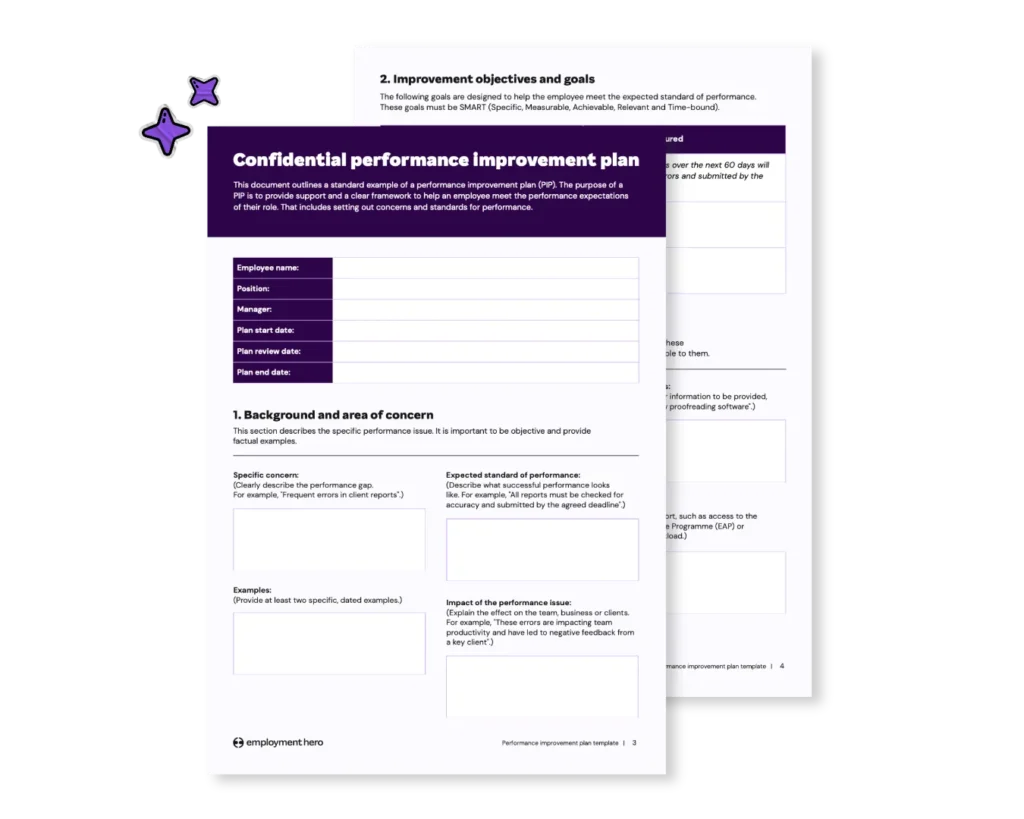
How can this performance improvement plan template help?
A robust template provides a consistent and fair framework for addressing performance issues. It makes sure you cover all the necessary components, from defining the problem to setting clear goals and outlining support.
Using a performance improvement plan template helps you:
- Maintain objectivity: It removes emotion from the process, focusing on facts and observable behaviours.
- Be consistent: Every employee facing similar challenges goes through the same documented process.
- Set clear expectations: It clearly documents expectations, timelines and potential outcomes for both the employee and the manager.
- Save time: It eliminates the need to create a new document from scratch for every situation.
- Support compliance: A documented process demonstrates that you have taken fair and reasonable steps to manage poor performance.
What is a performance improvement plan (PIP)?
A performance improvement plan, often called a PIP, is a formal document that outlines specific performance issues and the steps an employee must take to improve. It’s a structured action plan designed to help a struggling employee get back on track and succeed in their role.
A PIP is typically used when informal feedback and coaching haven’t resolved an ongoing issue with an employee’s performance. The plan details the gap between their current performance and the company’s expectations, sets measurable goals for improvement and establishes a clear timeline for achieving them.
The ultimate goal of a performance improvement plan is to see the employee’s performance improve to a satisfactory level. It’s a formal opportunity for them to understand the issues, access support and show they can meet the requirements of their role.
Legal obligations and good faith requirements in New Zealand
When managing performance in New Zealand, it is not just about getting the process right — the law requires that you do it fairly and in good faith. This means that employers and employees should be active, constructive and responsive in their dealings. Getting this wrong can expose your business to personal grievance claims, so understanding your obligations is key.
Fair and reasonable process
In New Zealand, any action you take that could affect an employee’s job must be fair and reasonable. For a PIP, this means you cannot just spring it on someone. You should have valid reasons for the performance concerns, investigate them properly and give the employee a real chance to improve. A fair process is your best defence against legal disputes.
Documentation and record-keeping
Clear, accurate records are non-negotiable. Document every step of the PIP process, from the initial performance concerns to the goals set, meeting notes and support provided. This documentation creates a transparent record that shows you have acted fairly and followed a structured process, which is critical if you need to justify your decisions later.
Consultation with employees
Good faith means you must genuinely consult with your employee. A PIP should not be a one-way street. You are legally required to share your concerns, provide all relevant information and give the employee a real opportunity to comment and have their say before any final decisions are made. This includes allowing them to bring a support person to meetings. True consultation shows you are committed to finding a solution together.
Key components of a performance improvement plan
A comprehensive PIP should include several key elements to be effective. These components ensure clarity, fairness and a clear path forward for everyone involved.
- Details of performance issues: Clearly and objectively describe the specific areas of poor performance. Use concrete examples, data and dates where possible, avoiding vague statements.
- Clear objectives and goals: Outline what successful performance looks like. These performance goals should be SMART (Specific, Measurable, Achievable, Relevant and Time-bound).
- Defined timeline: Specify the duration of the PIP, which is often 30, 60 or 90 days. Include dates for regular check-in meetings to discuss progress.
- Support and resources: Detail the support you will provide. This could include additional training, coaching from a manager, access to tools or regular mentoring sessions.
- Consequences of failure: The plan must clearly state what will happen if the employee achieves the goals and what the consequences are if performance does not improve by the end of the period.
When to implement a performance improvement plan
A PIP should be considered when other, less formal methods of addressing performance have not been successful. It is a significant step, so it’s important to use it in the right situations.
Consider implementing a performance improvement plan when:
- An employee consistently fails to meet the core requirements of their job.
- Informal coaching, feedback and regular one-on-ones have not led to improved performance.
- An employee’s work quality has noticeably declined over a period and is impacting the team or business outcomes.
- There are documented instances of behavioural issues, such as a persistent negative attitude or poor communication, that affect team morale and productivity.
- The performance issue is specific and measurable, making it possible to create a clear action plan for improvement.
Advantages and disadvantages of performance improvement plans (PIPs)
PIPs are a powerful tool, but they have both pros and cons. Understanding these can help you decide when and how to use them effectively.
| Advantages | Disadvantages |
| Structure: A PIP provides a clear, documented path for improvement. It removes ambiguity about what needs to change and by when. | Can cause stress and anxiety: Being placed on a PIP can be incredibly stressful for an employee, potentially leading to disengagement or a drop in morale. |
| Opportunity for success: It gives the employee a genuine, structured opportunity to improve and get their career back on track. It shows the company is invested in helping them succeed. | Perceived as a formality before firing: Many employees view a PIP as the first step toward termination, which can make them defensive and less receptive to feedback. |
| Legal protection: A well-executed PIP process provides clear documentation of the performance issues and the steps taken to address them. This is crucial if termination becomes necessary. | Time-consuming: Creating and managing a PIP requires a significant time investment from managers for drafting the plan, conducting check-ins and providing support. |
| Improved communication: The process forces a direct and honest conversation about job performance, which can strengthen the manager-employee relationship if handled correctly. | Risk of demotivating the employee: If not handled with empathy, the PIP process may damage the employee’s confidence and job satisfaction. |
How to write a performance improvement plan (step-by-step)
Writing an effective performance improvement plan involves thought, clear communication and a genuine commitment to helping the employee succeed.
Step 1 – Assess whether a PIP is necessary
Before jumping to a PIP, review the situation. Have you provided clear, informal feedback? Have you conducted regular performance reviews? A PIP is for persistent or significant performance issues that haven’t been resolved through regular management and coaching. Make sure the decision to start a PIP is proportional to the issue at hand, aligning with your good faith obligations.
Step 2 – Involve the employee in planning
A PIP should be a collaborative process, not a top-down directive. Sit down with the employee to discuss the performance concerns and listen to their perspective. As required by New Zealand law, you must genuinely consult with them. This fosters a sense of ownership and makes it more likely they will engage with the process. Remind them they can have a support person present during these meetings.
Step 3 – Set measurable goals and draft the plan
The core of the PIP is the set of goals for improvement. These must be specific and measurable. Instead of “improve communication”, use “provide a written weekly project update to the team every Friday by 4 PM”. Use the information gathered to draft the plan, clearly documenting the performance issues, the expected standards, the specific goals and the timeline.
Step 4 – Identify support and resources
A PIP is about improvement and improvement requires support. Clearly outline what resources the company will provide. This could be additional training, weekly coaching sessions with a manager, access to the Employee Assistance Programme (EAP) or changes to their workflow. This shows you are invested in helping the employee succeed.
Step 5 – Schedule regular check-ins
The PIP is not a set and forget document. Schedule weekly or bi-weekly check-in meetings to track progress and discuss any challenges. These documented meetings are crucial for providing ongoing feedback, adjusting the plan if needed and keeping the employee motivated.
Step 6 – Clarify expectations and consequences
Be transparent. The employee needs to know exactly what success looks like and what happens if they meet the goals of the performance improvement plan. Equally, they must understand the consequences if the performance issues are not resolved by the end of the PIP period. This clarity ensures there are no surprises for anyone involved.
How long should performance improvement plans go for?
The length of a performance improvement plan can vary depending on the complexity of the issues, but most fall within a 30, 60 or 90-day timeframe. The key is to choose a realistic and fair timeframe that gives the employee a reasonable chance to demonstrate improved performance.
- 30-day PIP: Suitable for straightforward issues that can be corrected quickly, such as punctuality or meeting deadlines on smaller tasks.
- 60-day PIP: A common length that provides enough time for an employee to learn new skills or make significant changes to their work habits.
- 90-day PIP: Often used for more complex performance issues, such as improving strategic thinking, client relationship management or mastering a difficult new aspect of a role.
Halfway point evaluation
A midway review is a critical checkpoint in the PIP process. It’s an opportunity to formally assess how things are going. During this meeting, you should review the employee’s progress against the goals, discuss what’s working and what isn’t and make any necessary adjustments to the plan or the support being provided. This evaluation helps keep the process on track.
Performance improvement plan examples
The nature of the PIP will depend on the specific performance issue. Here are some common scenarios and what a PIP might look like.
Often misses deadlines
- Issue: “Employee regularly submits reports and project deliverables after the agreed-upon deadlines, impacting team workflow.”
- Goal: “For the next 60 days, all assigned projects must be completed and submitted by the specified deadline. If a delay is unavoidable, it must be communicated to the manager at least 24 hours in advance with a new proposed deadline.”
- Support: Weekly check-ins to review project timelines and workload management coaching.
Has received negative feedback from clients or customers
- Issue: “Received formal complaints from three separate clients in the last quarter regarding communication style and unmet customer expectations.”
- Goal: “Complete the company’s customer service training module by [Date]. Achieve a minimum average score of 8/10 on customer feedback surveys for the next 90 days.”
- Support: Role-playing difficult customer scenarios with a manager and weekly reviews of client communications.
Delivering a low quality of work
- Issue: “Reports submitted over the past two months have contained frequent errors and required significant rework from a supervisor.”
- Goal: “For the next 30 days, all submitted reports must be free of factual errors and have a maximum of two grammatical/spelling mistakes per page. A quality checklist must be used before submission.”
- Support: Access to a proofreading tool and a 30-minute review session with the manager before final submission of major reports.
Demonstrates persistent behavioural or attitude issues
- Issue: “Employee has shown a pattern of negative commentary in team meetings and has been unresponsive to constructive feedback, affecting team morale.”
- Goal: “For the next 60 days, actively participate in team discussions by contributing constructive ideas and refraining from negative or dismissive comments. Acknowledge feedback from colleagues and managers in a professional manner.”
- Support: Bi-weekly coaching sessions focused on communication skills and a support person can be present if requested.
Attendance or punctuality concerns
- Issue: “Employee has been late to work more than five times in the last month and has had two unapproved absences without prior notification.”
- Goal: “For the next 30 days, arrive on time for all scheduled shifts. Any planned absence must be requested according to company policy and any unplanned absence must be reported to the manager before the shift starts.”
- Support: A review of the company’s attendance policy and a conversation to understand if any external factors are impacting punctuality.
Identifying the root causes of poor performance
To truly help an employee improve, you need to understand why their performance is suffering. A PIP that only addresses the symptoms without getting to the root cause is unlikely to succeed. Consider these potential underlying factors.
Lack of resources or tools
Does the employee have everything they need to do their job effectively? Outdated software, a slow computer or a lack of access to necessary information can all be significant barriers to good job performance.
Organisational or process obstacles
Sometimes, the problem is not the employee but the system they are working in. Inefficient workflows, bureaucratic red tape or a lack of communication between departments can make it nearly impossible for anyone to succeed in a role.
Skills or knowledge gaps
Has the role evolved? Has new technology been introduced? An employee might be struggling simply because they have not received the proper training to meet the new demands of their job.
Unclear expectations or role confusion
If an employee does not know what success looks like, they cannot achieve it. Vague job descriptions, shifting priorities or a lack of clear key performance indicators (KPIs) can all lead to poor performance because the employee is never sure what they should be focusing on.
Lack of recognition or accountability
People are motivated when they see that their hard work is recognised and that everyone on the team is held to the same standard. A workplace culture where good work goes unnoticed and poor performance is ignored can lead to widespread disengagement.
Personal circumstances and wellbeing factors
Never forget the human element. Issues outside of work can have a huge impact on an employee’s performance. Health problems, family emergencies, financial stress or burnout are all valid personal circumstances that can temporarily affect a person’s ability to perform at their best.
Supporting employees during a PIP
The way you manage the PIP process is just as important as the document itself. A supportive approach can make the difference between a successful outcome and a failed one.
Lead with empathy and respect
Remember that being put on a performance improvement plan is difficult for the employee. Approach every conversation with empathy and treat them with respect. Frame the PIP as a tool to help them, not to punish them. This builds trust and makes them more likely to engage positively.
Give honest, constructive feedback
Sugar-coating the issues will not help. Be direct and honest, but deliver feedback constructively. Focus on specific, observable behaviours and their impact on the business. Use “I” statements (e.g. “I noticed that…”) rather than accusatory “you” statements (e.g. “You always…”).
Provide regular 1:1 meetings and check-ins
Stick to the schedule of check-ins outlined in the improvement plan. These regular meetings are your chance to track employee performance, offer guidance and address any roadblocks. They keep the lines of communication open and show the employee you are committed to the process.
Offer practical support and coaching
Support should not just be a line item in the PIP document. It’s a chance for you to be an active coach. Can you demonstrate a better way to do a task? Can you connect them with a subject matter expert in the company or suggest an EAP? Proactive, hands-on support shows you are genuinely invested.
What happens if a performance improvement plan fails
Sometimes, despite everyone’s best efforts, an employee does not meet the goals of the performance improvement plan. If the PIP fails, you need to follow through with the consequences outlined in the plan.
Escalating to formal process
If termination is being considered, the law says that you should follow a formal disciplinary process that is procedurally fair. This includes formally notifying the employee of the proposal to terminate their employment, providing all relevant supporting information and giving them a reasonable opportunity to respond before you make a final decision.
We’d also highly recommend seeking independent legal advice before taking this step.
Alternatives to termination
Termination is not the only option. Depending on the circumstances, you might consider extending the PIP to give the employee more time or exploring whether another role in the business (redeployment) might be a better fit for their skills.
Addressing attendance and punctuality issues
Attendance and punctuality are common triggers for PIPs in New Zealand and can be legally sensitive. If an employee is frequently late or absent without good reason, a PIP can formalise the expectation for improvement. It is crucial to document the pattern of behaviour, discuss it with the employee to understand any underlying causes and set clear, measurable goals for attendance, all while following a fair process.
Wellbeing and personal circumstances in PIPs
When an employee’s performance drops, it is important to consider if personal issues or burnout are contributing factors. A PIP process should include a conversation about the employee’s wellbeing. Offering support through an EAP, allowing for flexible work arrangements or simply showing empathy can make a significant difference. Managing wellbeing during a PIP is not just good practice, it helps fulfil your good faith obligations.
How to prevent performance issues before they require a PIP
The best way to handle a performance issue is to prevent it from happening in the first place. A proactive approach to performance management can help you avoid the need for a formal PIP.
Foster a culture of continuous feedback
Do not wait for the annual performance review to talk about performance. Create a culture where regular, two-way feedback is the norm. When managers and employees talk openly and often, small issues can be corrected before they become big problems.
Set clear goals and expectations early
From day one, employees should understand what is expected of them. Use frameworks like Objectives and Key Results (OKRs) to set clear, measurable goals. A detailed job description and a thorough onboarding process can also make sure that everyone is aligned on responsibilities from the start.
Use performance management tools and templates
Leverage technology to streamline performance management. Using dedicated tools and templates ensures consistency, helps document conversations and makes it easier to track progress against goals over time. This creates a fair and transparent system for everyone.
Download the free performance improvement plan template
Ready to manage under-performance effectively and confidently in your NZ business? Our template provides a structured path to get your employees back on track.
The information in this article is current as at 30 November 2025, and has been prepared by Employment Hero Pty Ltd (ABN 11 160 047 709) and its related bodies corporate (Employment Hero). The views expressed in this article are general information only, are provided in good faith to assist employers and their employees, and should not be relied on as professional advice. Some information is based on data supplied by third parties. While such data is believed to be accurate, it has not been independently verified and no warranties are given that it is complete, accurate, up to date or fit for the purpose for which it is required. Employment Hero does not accept responsibility for any inaccuracy in such data and is not liable for any loss or damages arising directly or indirectly as a result of reliance on, use of or inability to use any information provided in this article. You should undertake your own research and seek professional advice before making any decisions or relying on the information in this article.
Register for the template
Related Resources
-
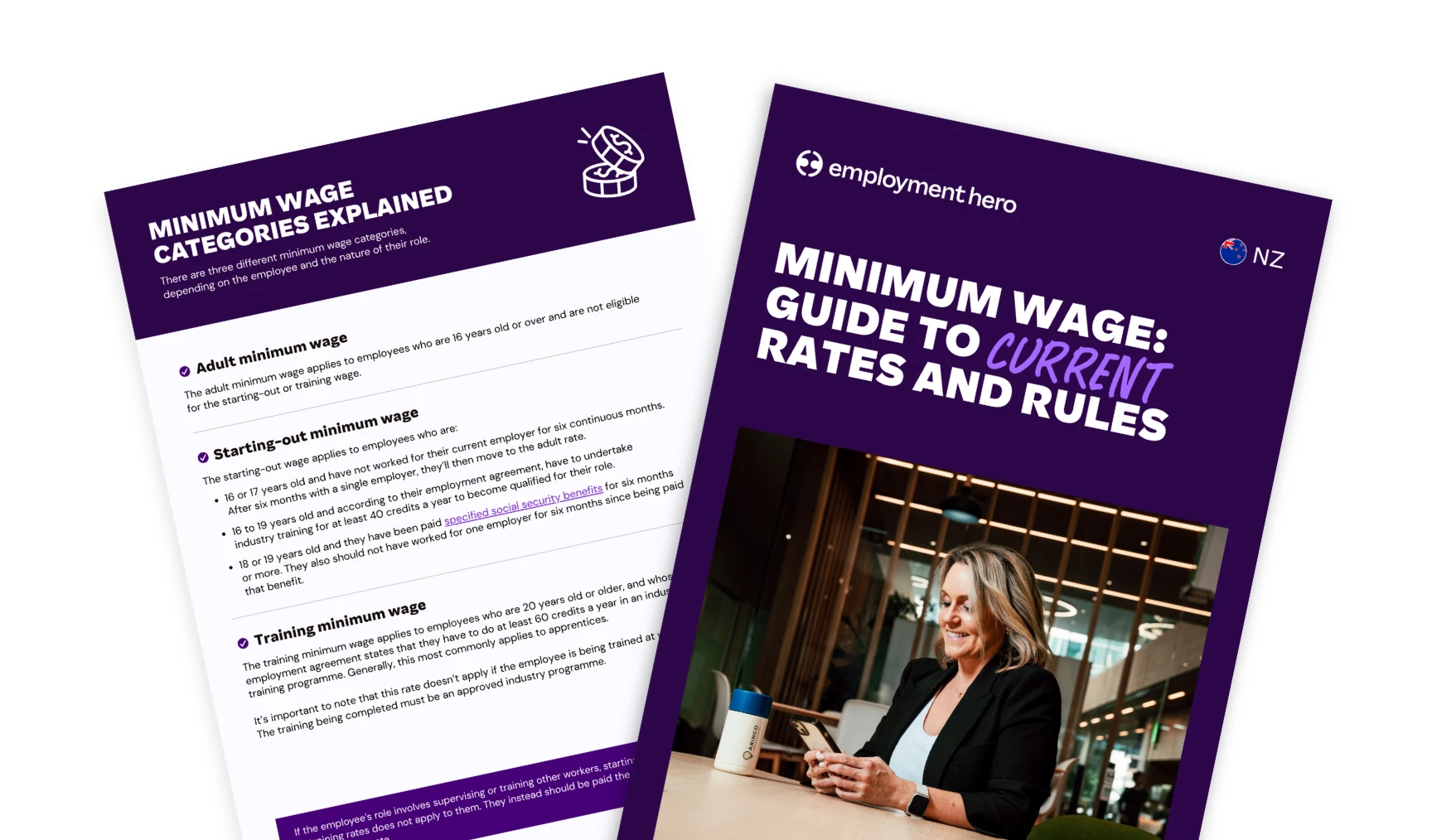 Read more: Minimum wage: Guide for New Zealand employers and payroll teams
Minimum wage: Guide for New Zealand employers and payroll teams
Understand NZ’s minimum wage rates, training wage rules, and 2025 updates. Learn how Employment Hero NZ automates wage compliance.
-
 Read more: Navigating 2025: NZ Employment Law Forecast
Navigating 2025: NZ Employment Law Forecast
Stay ahead of NZ employment law changes in 2025 with insights on grievance laws, wages, and more.
