 Australia
  United Kingdom
  Singapore
  Malaysia
  Canada (Français)
 New Zealand



The complete interview guide for hiring managers
Published
The complete interview guide for hiring managers
Last Updated
| Published
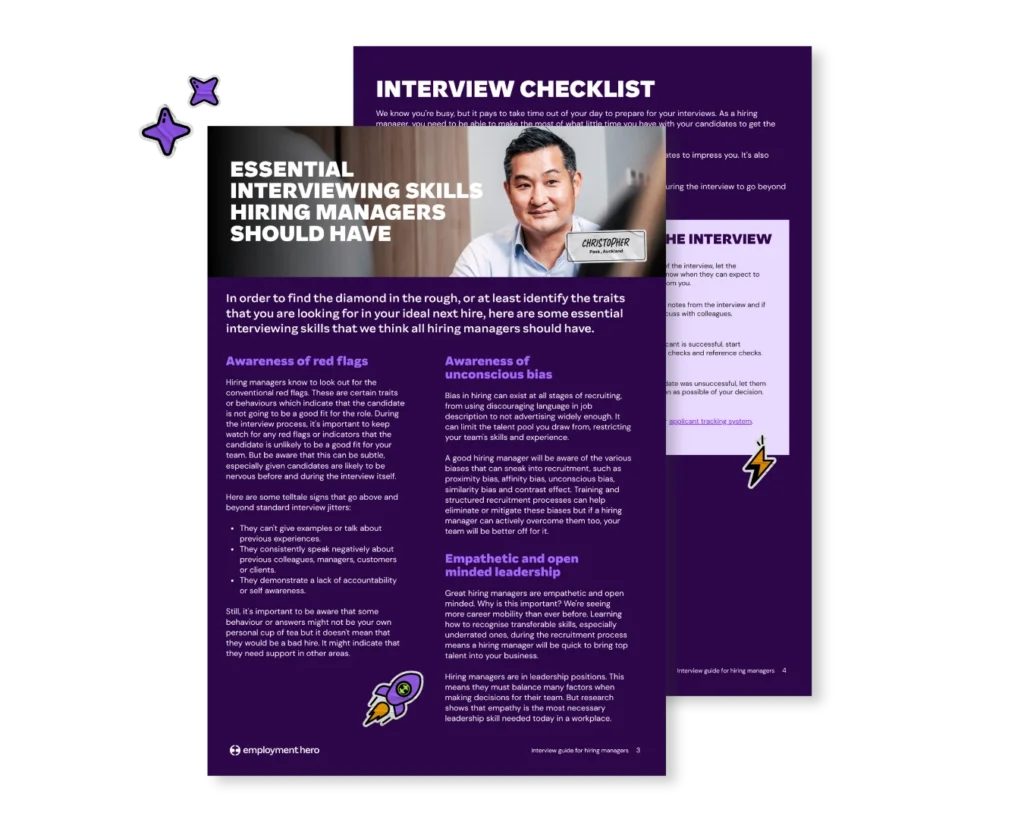
Finding the right talent is one of the most significant challenges facing businesses today. All employers know that without a great team, it’s hard to achieve business success. But within a limited, often high-pressure time frame, how can you tell the difference between a bad hire and your next best hire?
That’s why we’ve created this guide to interviewing, to unpack the art of identifying your next employee.
The guide also covers:
- Essential skills that hiring managers need
- Common interview mistakes to avoid
- A pre-interview checklist
- Tips for getting the most of the interview
- Examples of good interview questions
Download the guide by filling in the form on the right.
Why getting interviews right matters
Interviews are far more than a simple conversation. They’re a critical assessment tool that can heavily influence the future trajectory of your business. A well-executed interview process helps you identify candidates who possess the right technical skills, cultural alignment and long-term potential. Conversely, a poorly structured interview can lead to bad hiring decisions that cost your business time, money and team morale.
Furthermore, the interview is often the first deep interaction a candidate has with your company. It serves as a two-way street. While you evaluate their suitability for the role, they assess whether your organisation is a place where they want to work. Getting the interview right means you present your company as professional, respectful and organised. This positive impression is vital in a job market where word of mouth goes far.
Who is this guide for?
We designed this guide for anyone involved in the hiring process across New Zealand. This includes dedicated HR professionals, department managers, business owners and external recruiters. If you’re responsible for assessing candidates and making employment decisions, the insights provided here will elevate your strategy.
Even if you’ve conducted hundreds of interviews, the hiring landscape is constantly evolving. New technologies, shifting candidate expectations and updated legal frameworks require continuous learning. This guide serves as a refresher for seasoned professionals and a foundational manual for those new to the responsibilities of hiring.
What makes a great hiring manager?
A great hiring manager goes beyond simply reading questions from a piece of paper. They actively listen, adapt to the flow of conversation and create an environment where candidates feel comfortable sharing their true experiences.
Empathy plays a massive role in this process. Recognising that interviews are stressful allows you to put candidates at ease, which ultimately leads to more authentic and revealing conversations.
Preparation is another hallmark of an effective hiring manager. They review the candidate’s resume well in advance, understand the core competencies required for the role and prepare targeted questions. They also maintain an objective mindset, actively working to overcome unconscious biases that might influence their decision-making.
Ultimately, a great hiring manager acts as a brand ambassador who respects the candidate’s time and provides a transparent, fair and engaging interview experience.
Pre-screen applicants
We know that businesses are currently drowning in applications and reviewing every single one takes so much time.
Before jumping to in-person interviews, screen the talent with AI. Employment Hero’s recruitment agent can handle those initial screening interviews for you, ensuring that the main interviews are saved for the best candidates in the running.
Before the interview: Your pre-interview checklist
Preparation sets the foundation for a successful interview. Jumping into a meeting without adequate planning usually results in a disjointed conversation and poor candidate assessment.
First, define the core requirements of the role. You should clearly understand the daily tasks, required technical skills and soft skills necessary for success. Review the job description and create a list of key competencies you need to evaluate. Next, carefully review the candidate’s application materials. Highlight areas where you need more clarification or specific examples of past work.
You must also decide on the interview format and panel. Determine whether the interview will be in person, over a video call or over the phone. If you are involving other team members, assign specific topics or competency areas to each interviewer to avoid overlapping questions.
Finally, prepare your physical or virtual space. Book a quiet room, test your technology and ensure you won’t face interruptions during the scheduled time.
How to structure an interview
A structured interview guarantees consistency and fairness across all candidates. It allows you to compare applicants objectively based on the same criteria.
Start with a warm welcome and a brief introduction of yourself and the company. Outline the agenda for the meeting so the candidate knows what to expect. This initial phase helps settle their nerves. Move into a brief discussion about their background and career journey. Ask them to highlight experiences that directly relate to the role you are filling.
The core of the interview should focus on behavioural and situational questions. Use the STAR method (Situation, Task, Action, Result) to guide candidates in providing specific examples of their past performance.
After assessing their skills, transition to discussing the role in more detail. Explain the team dynamics, company goals and what success looks like in the position. Finally, leave ample time for the candidate to ask their own questions before outlining the next steps in the recruitment process.
Interview questions that actually work
Relying on generic questions often yields rehearsed answers. To truly understand a candidate’s capabilities, you need questions that prompt reflection and specific storytelling.
Behavioural questions are incredibly effective. Asking “Tell me about a time you had to manage a difficult stakeholder” provides far more insight than asking “How are your communication skills”. Focus on scenarios that frequently occur in the role you are hiring for. If the job requires high adaptability, ask about a time they had to pivot a project at the last minute.
You should also include questions that assess problem-solving skills and cultural alignment. Ask candidates how they approach learning new software, resolving conflicts with peers or prioritising multiple urgent deadlines.
The key is to ask open-ended questions that require more than a simple yes or no response, allowing the candidate to showcase their critical thinking and communication style.
What you can and can’t ask under NZ law
Navigating employment law is a critical aspect of the interview process. As a hiring manager, you must operate within legal boundaries to protect candidates from discrimination and safeguard your business from legal action.
Under the Human Rights Act 1993, it’s unlawful to discriminate against applicants based on specific personal characteristics. You cannot ask questions related to a candidate’s age, religious beliefs, sexual orientation or marital status. Questions regarding family planning, such as asking a female candidate if she intends to have children, are strictly prohibited.
You must also adhere to the Privacy Act 2020 when collecting candidate information. Only ask for details directly relevant to their ability to perform the job. For example, you can ask if they hold the legal right to work in New Zealand, but you shouldn’t demand their passport details during the initial interview stages.
Understanding these legal requirements helps you run a fair process and build a trustworthy reputation as an employer.
Inclusive hiring practices for New Zealand employers
Building a diverse and inclusive workforce starts with your hiring practices. Inclusive recruitment means removing barriers that might disadvantage certain groups of people and actively seeking candidates from varied backgrounds.
Start by reviewing your job advertisements to remove gender-coded language or unnecessary academic requirements that might deter capable applicants. During the interview stage, offer accommodations for candidates with disabilities. This might include providing questions in advance, offering a sign language interpreter or conducting the interview in a wheelchair-accessible room.
Standardising your interview questions and using diverse interview panels also helps mitigate unconscious bias and promotes fair assessment for everyone.
Using AI in the hiring process: What to know
Artificial intelligence is rapidly transforming how businesses recruit talent. From automated resume screening to AI-driven video interviews, these tools offer the promise of increased efficiency and reduced administrative workload.
Employment Hero’s recruitment agent can both source and screen candidates. When you use the platform, you can also take advantage of Employment Hero Jobs, which boasts a huge community of 2.3 million candidates. It then matches people from the existing talent pool to roles in your business.
Then, once you’ve got a list of potential candidates, the recruitment agent can conduct screening video interviews. Using your criteria, it can score responses and give you an outside perspective on candidate suitability.
Of course, when incorporating AI into your New Zealand business, transparency is crucial. Inform candidates if automated systems are being used to evaluate their applications. Human oversight remains essential to interpret nuanced responses, provide a personal touch and ensure your hiring process remains equitable.
Common interview mistakes (and how to avoid them)
Even experienced hiring managers can fall into habits that compromise the interview process. Recognising these common pitfalls is the first step toward improving your recruitment outcomes.
One major mistake is doing all the talking. An interview should be a dialogue, but the candidate needs space to showcase their skills. Aim to listen for at least eighty percent of the conversation.
Another frequent error is relying on gut feeling rather than objective evidence. Allowing your initial impression to dictate your final decision often leads to hiring people who are similar to you, rather than the best person for the job. You can combat this by using a standardised scoring rubric for all candidates.
Failing to follow up with unsuccessful candidates is a poor reflection on your employer brand. Taking the time to send a polite rejection email or offer brief constructive feedback leaves a positive impression. Treat every applicant with respect, as they could become a future customer or apply for another role down the line.
After the interview: Making your decision
The interview concludes when the candidate leaves the room but your work as a hiring manager is far from over. The post-interview evaluation phase requires careful analysis and collaboration with your hiring team.
Review your notes immediately while the conversation is still fresh in your mind. Score the candidate against the core competencies you established during your pre-interview preparation. If you conducted a panel interview, gather the team to discuss your observations. Focus the discussion on specific examples the candidate provided, rather than vague impressions.
Once you identify your preferred candidate, conduct thorough reference checks to verify their employment history and performance. When you are ready to make the offer, be prepared to discuss salary, benefits and start dates transparently.
Download the free guide
Ready to transform your interviewing process? We’ve compiled all these insights, templates and legal guidelines into one comprehensive resource.
Download the complete interview guide for hiring managers today and take the guesswork out of your next recruitment drive.
The information in this article is current as at 5 April 2026, and has been prepared by Employment Hero Pty Ltd (ABN 11 160 047 709) and its related bodies corporate (Employment Hero). The views expressed in this article are general information only, are provided in good faith to assist employers and their employees, and should not be relied on as professional advice. Some information is based on data supplied by third parties. While such data is believed to be accurate, it has not been independently verified and no warranties are given that it is complete, accurate, up to date or fit for the purpose for which it is required. Employment Hero does not accept responsibility for any inaccuracy in such data and is not liable for any loss or damages arising directly or indirectly as a result of reliance on, use of or inability to use any information provided in this article. You should undertake your own research and seek professional advice before making any decisions or relying on the information in this article.
Register for the guide
Related Resources
-
 Read more: NZ Employment Law: What Changed in 2026 & What’s Next?
NZ Employment Law: What Changed in 2026 & What’s Next?
Employment law changed in 2026. Join our local Employment Counsel to see what is in effect and what to prepare…
-
 Read more: Psychological safety at work: what it is, why it matters, and how to tell if you have it
Psychological safety at work: what it is, why it matters, and how to tell if you have it
Psychological safety determines whether your team can speak up without fear. Learn what it looks like, how to spot its…
-
 Read more: End-of-year exhaustion is real. Here’s how to actually rest over the holidays.
End-of-year exhaustion is real. Here’s how to actually rest over the holidays.
The summer break doesn’t always feel restorative. Here’s the science of why — and what to do differently to come…

