 Australia
  United Kingdom
  Singapore
  Malaysia
  Canada (Français)
 New Zealand


The complete guide to hiring employees in New Zealand
Published
The complete guide to hiring employees in New Zealand
Published
As a business, hiring employees is often a vital part of your operations. The hiring and onboarding process can often be time-consuming and complicated though, with plenty of elements to consider. Thankfully, we’ve been there, done that and worked with hundreds of growing businesses doing the same thing. That’s why we’ve created this guide to help you.
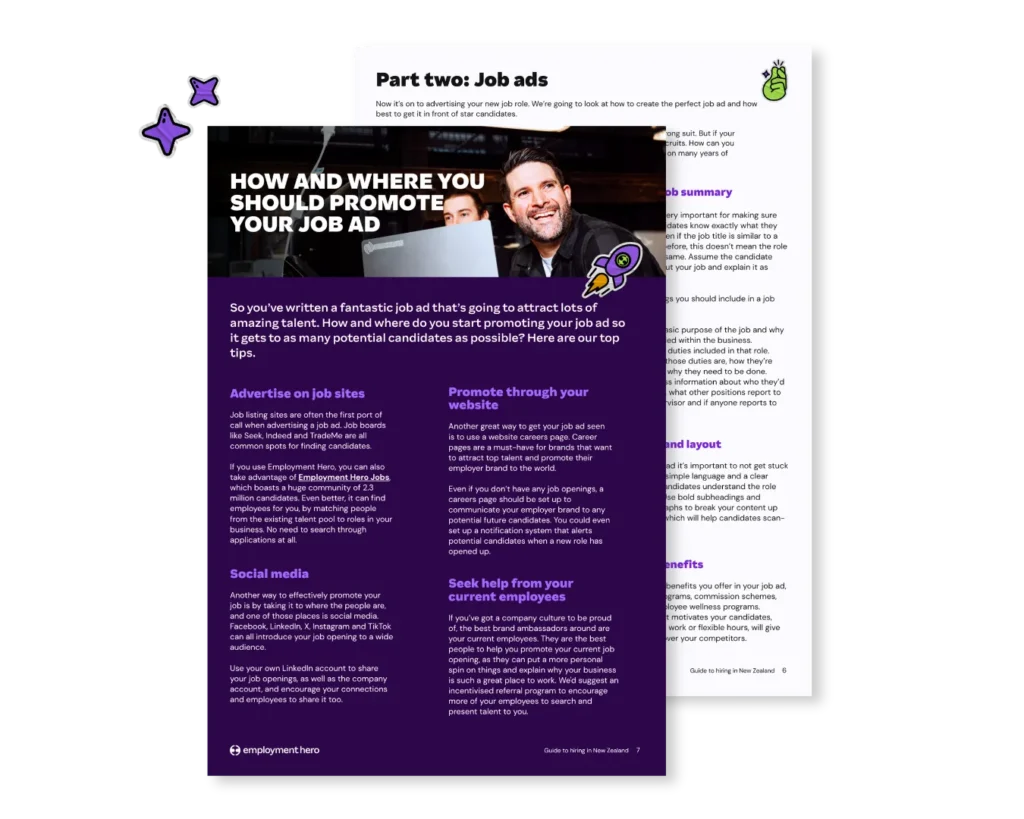
What’s in the hiring guide? This guide to hiring employees in NZ includes:
- How to know when to hire
- The secrets of effective job ads
- The best job interview questions to use
- Onboarding task checklists
Why getting your first hire right matters
Your first employee sets the tone for your future workforce. They will help shape your company culture, establish foundational processes and influence how your business operates daily. Bringing the right person on board can propel your business forward, boost productivity and give you the breathing room you need to focus on big-picture strategy.
A poor hiring decision can be costly. The time spent training, onboarding and managing an unsuitable fit can drain your resources. It also impacts morale if things do not work out. Taking the time to build a structured recruitment process protects your business and creates a positive experience for your future team members.
Is it the right time to hire?
Before you write a job description, you need to be certain that hiring is the right move for your business right now.
Signs you’re ready to bring on your first employee
You might be ready to hire if you are constantly turning away work because you lack capacity. If you spend most of your time on administrative tasks instead of revenue-generating activities, it is a clear indicator that you need support. Another sign is declining customer service quality due to an overwhelming workload. When your business growth has hit a ceiling that only extra hands can break through, it is time to look for help.
How to build a basic business case for headcount
Start by identifying the specific gaps in your business. Are you looking for someone to handle customer service, manage bookkeeping or drive sales? Calculate the cost of the new hire, including their salary, KiwiSaver contributions and equipment. Weigh this against the projected revenue they will help generate or the time they will free up for you to focus on high-value tasks. If the financial return justifies the expense, you have a solid business case.
Understanding your New Zealand employer obligations
When you hire staff in New Zealand, you must meet specific legal standards. Meeting these obligations protects your business and creates a fair environment for your staff.
Employment agreements under the Employment Relations Act
Under the Employment Relations Act 2000, every employee must have a written employment agreement. This document needs to be signed before they start work. It must outline key details like their working hours, wage rate, role description and the nature of their employment. Providing a clear agreement prevents misunderstandings and sets a professional standard from day one.
KiwiSaver, PAYE and IRD registration
You must register as an employer with Inland Revenue (IRD) before your first hire starts. Once registered, you are responsible for deducting Pay As You Earn (PAYE) tax from their wages. You also need to manage KiwiSaver enrolments. Most new employees are automatically enrolled in KiwiSaver, which requires you to deduct their contributions and pay a minimum 3.5% employer contribution.
Minimum wage, leave entitlements and the Holidays Act
You must pay your staff at least the minimum wage if they are 16 or older. Alongside fair pay, employees are entitled to specific leave benefits under the Holidays Act 2003. This includes four weeks of annual holidays after 12 months of continuous employment. They also receive 10 days of sick leave after six months, paid bereavement leave and public holiday entitlements.
Keeping accurate records of hours worked and leave taken is legally required and essential for accurate payroll.
Writing a job ad that attracts the right people
Your job advertisement is often the first interaction a candidate has with your company. It needs to be clear, engaging and honest.
What to include (and what to leave out)
A great job ad focuses on what the candidate will do and how they’ll fit into your company. Include a clear job title, a brief overview of your business, the core responsibilities and the essential skills required. Be transparent about the salary range and highlight any perks or benefits you offer.
Leave out internal jargon and long lists of minor tasks. Focus on the core requirements instead of asking for a laundry list of unrealistic qualifications. Avoid using discriminatory language regarding age, gender or background.
Where to advertise in New Zealand
To reach local talent, post your job ad on popular New Zealand platforms like Seek and Trade Me Jobs. LinkedIn is excellent for professional roles and networking. Do not forget to leverage your own channels. Share the opportunity on your company social media pages and ask your professional network for referrals.
If you use Employment Hero, you can also take advantage of Employment Hero Jobs, which boasts a huge community of 2.3 million candidates. Even better, it can find employees for you, by matching people from the existing talent pool to roles in your business. No need to search through applications at all.
How to run a compliant hiring process
A fair and structured interview process helps you find the best candidate while staying on the right side of the law.
Shortlisting and interviewing
Review applications against the core criteria outlined in your job ad. Create a shortlist of three to five strong candidates to interview. Prepare a consistent set of questions for every interview to keep the process fair. Focus on behavioral questions that ask candidates to provide examples of past experiences, such as how they handled a difficult customer or managed a tight deadline.
What you can and can’t ask under New Zealand law
The Human Rights Act 1993 prohibits discrimination based on specific grounds. You cannot ask candidates about their age, marital status, religious beliefs, sexual orientation or plans to have children. Keep your questions strictly focused on their ability to perform the duties of the role.
Reference checks
Always conduct reference checks before making a final offer. Ask the candidate for permission to contact their previous managers. When speaking with referees, ask about the candidate’s reliability, work ethic and ability to work in a team. This step verifies the information provided during the interview and gives you peace of mind.
Offer letters and employment agreements
Once you find the perfect candidate, it is time to make things official with the right paperwork.
Fixed term vs permanent vs casual
You must choose the correct employment type for your needs:
- Permanent employees have ongoing employment and standard leave entitlements.
- Fixed-term employees are hired for a specific period or project, but you must have a genuine reason for the fixed term.
- Casual employees work as and when required with no guaranteed hours.
Choose the structure that aligns with your business demands.
90-day trial periods: When and how to use them
You can include a 90-day trial period in the employment agreement. This allows you to dismiss the employee within the first 90 days without them being able to bring a personal grievance for unjustified dismissal.
For a trial period to be valid, it must be agreed upon in good faith and signed in the employment agreement before the employee starts work.
Onboarding your new employee
A great onboarding experience makes your new hire feel welcome and sets them up for long-term success.
Day one checklist
Prepare their workspace before they arrive. Make sure their computer, email accounts and software logins are ready to go. Give them a tour of the workplace, point out health and safety procedures and introduce them to key people they will interact with.
Setting up payroll and KiwiSaver
On their first day, collect their IR330 tax code declaration and their KiwiSaver deduction form. Enter their details into your payroll system immediately. Having this information sorted early prevents payment delays and keeps your administrative tasks organised.
Induction and culture
Onboarding is about more than just paperwork. Take the time to explain your company vision, values and goals. Schedule regular check-ins during their first few weeks to answer questions and provide feedback. A supportive induction process builds trust and helps them integrate smoothly into your business.
Using technology to simplify hiring
Managing recruitment manually can involve endless spreadsheets, scattered emails and messy filing cabinets. Technology takes the friction out of building your team.
How Employment Hero automates hiring and onboarding
Employment Hero provides an all-in-one platform that streamlines your HR processes. You can track applicants seamlessly, generate compliant employment agreements with a few clicks and send offer letters digitally. Our paperless onboarding feature allows new hires to enter their own bank, tax and KiwiSaver details directly into the system before their first day. This reduces your administrative burden and creates a professional first impression as you scale your business.
New hire checklist: At a glance
Keep this quick reference guide handy to stay on track as you welcome your first team member.
- Assess your business needs and confirm you have the budget for a new hire
- Register as an employer with Inland Revenue
- Write a clear job description focused on essential skills
- Advertise the role on local job boards and social channels
- Conduct fair interviews focusing on job-related criteria
- Perform thorough reference checks with previous employers
- Draft a compliant employment agreement outlining hours and pay
- Ensure the agreement is signed before the employee’s first day
- Collect tax and KiwiSaver forms immediately upon starting
- Set up their workspace and necessary software accounts
- Provide a comprehensive health and safety induction
- Schedule regular progress catch-ups during their first month
Hiring your first employee is a big step, but with the right preparation, it can transform your business. By understanding your local obligations and leveraging smart HR tools, you can build a strong foundation for your growing team.
The information in this article is current as at 5 March 2026, and has been prepared by Employment Hero Pty Ltd (ABN 11 160 047 709) and its related bodies corporate (Employment Hero). The views expressed in this article are general information only, are provided in good faith to assist employers and their employees, and should not be relied on as professional advice. Some information is based on data supplied by third parties. While such data is believed to be accurate, it has not been independently verified and no warranties are given that it is complete, accurate, up to date or fit for the purpose for which it is required. Employment Hero does not accept responsibility for any inaccuracy in such data and is not liable for any loss or damages arising directly or indirectly as a result of reliance on, use of or inability to use any information provided in this article. You should undertake your own research and seek professional advice before making any decisions or relying on the information in this article.
Register for the guide
Related Resources
-
 Read more: What’s new at Employment Hero: Here’s our 2026 product recap
What’s new at Employment Hero: Here’s our 2026 product recap
Explore Employment Hero’s 2026 product updates for NZ: KiwiSaver at onboarding, Hero Points, Hero AI, Recruitment Agent, HeroForce and Chat.
-
 Read more: The true cost of a bad hire in New Zealand
The true cost of a bad hire in New Zealand
Discover the true financial and cultural cost of a bad hire in New Zealand, and learn practical steps to get…
-
 Read more: How Employment Hero’s AI Recruitment Agent helps New Zealand businesses hire faster
How Employment Hero’s AI Recruitment Agent helps New Zealand businesses hire faster
New Zealand businesses are drowning in applications and losing top candidates to faster competitors. Here’s how Employment Hero’s AI recruitment…
