

















How to build a business growth plan + free template
Published
How to build a business growth plan + free template
Published
Growth is central to any New Zealand business. Whether you’re expanding your reach, exporting your services or strengthening your local presence, a robust plan is essential. Scaling a business rarely follows a straight line. It demands clear strategy, ongoing resource management and an ability to adapt to shifts in the market.
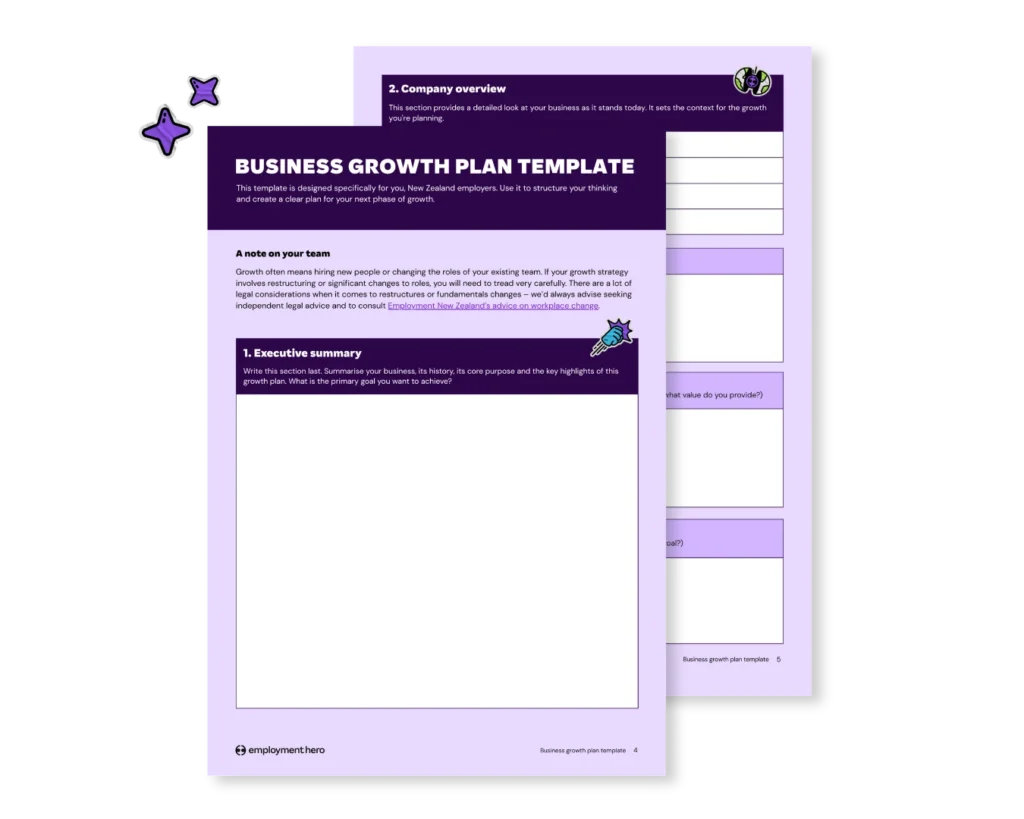
This guide covers the fundamentals of business growth. You’ll learn about the key stages of the business lifecycle, proven strategies for expansion and how to create a growth plan that enables your ambitions. We’ve also created a handy template to help you get started.
Download our business growth plan template by filling in the form on the right.
Why are business growth strategies important?
Running a business without a growth strategy is like sailing the Cook Strait without a compass. You might make progress but external factors dictate the result. Setting a deliberate strategy is critical for long-term success, turning your approach from reactive to proactive.
A clear plan also can potentially grow profitability by focusing your resources on the most promising opportunities. It sharpens your competitive edge, letting you predict market shifts before they threaten your position. Most of all, a strong strategy builds resilience. With a thought-out roadmap, you’re better prepared to handle major changes or disruptions because you have already considered risks and alternatives.
Growth does not happen by luck. It’s driven by reviewing your current position, understanding your market and executing a sequence of focused actions.
The four stages of business growth
Every business moves through predictable stages. Knowing where you sit — startup, growth, maturity or renewal — helps you choose the right strategies for your next move.
Startup business
This first stage brings high energy and risk. Your focus is survival and establishing value. It’s about turning an idea into reality, finding initial customers, refining your offering and stabilising cash flow.
Resources are tight and you probably fill several different roles. The challenge is securing a place in your market without exhausting your funds. Agility and a willingness to listen to feedback are essential. In this stage, you set the principles and culture for your business.
Business growth
With a proven concept, your business now attracts more customers and revenue climbs. This growth phase brings new challenges. The processes that suited a small team can fail quickly as you expand.
Scaling up means formalising your structures, hiring new expertise and investing in technology. You should monitor your cash flow carefully, since growing revenues can be matched by soaring costs if not managed. Balance is key: manage more demand without letting quality slip.
Business maturity
In the mature phase, you enjoy steady profits and established market share. Things are more predictable but there’s risk in becoming complacent. Competitors still want your customers and market demands continue to change.
Innovation should not slow. Continue to optimise your efficiency and keep an eye out for potential threats. Decide how you will keep your offer relevant and appealing while making the most of your reputation.
Business renewal or decline
Every business meets this stage eventually. Sales dip due to market saturation, new technology or changing customer needs. Here you either adapt and evolve or risk fading away.
Renewal will often require bold decisions. You may reinvent your product, step into new markets or acquire other businesses. This stage draws on the drive of the startup phase, but is powered by a more solid foundation.
In all of these stages, a business plan is essential. It’ll help you weather the storms and challenges of running a company.
Crafting a business growth plan
Ambition is only the beginning. Turning it into action requires a structured business growth plan. Having a written plan supports informed, timely decisions and helps engage your leadership team.
Essential elements of a growth plan
A robust business growth plan stands on a few pillars:
- An executive summary that outlines your vision and focus
- A market analysis that details your customers and competitors
- Clear operational plans showing how you’ll cope with higher demand
- A marketing strategy to attract new business
- A financial plan that confirms you can fund your growth
Without these elements, your plan is just an idea.
Setting business growth goals for success
Set objectives that motivate action. Vague goals like “sell more” or “grow bigger” are not enough. Your targets must be clear and measurable so your team knows exactly what to work towards.
Use the SMART method: objectives are Specific, Measurable, Achievable, Relevant and Time-bound. For example, rather than saying “improve customer service,” you might set “reduce response time to under two hours by 1 September.” Concrete targets allow for easier tracking and accountability.
Aligning growth objectives with financial forecasting
Growth goals must line up with your financial realities. Before deciding on large investments or hiring, test your plans with accurate forecasting. This lets you see whether your resources can cover planned growth and if your targets are genuinely sustainable.
An example: if hiring ten new people in October, your plan should show revenue to support these salaries. Forecasting helps prevent overextension and keeps your ambitions financially safe.
Goal setting for long-term business success
Think beyond the next quarter. Long-term vision drives your business in the right direction, even as markets shift. Breaking this vision into short-term milestones creates momentum and regular points to measure progress.
If your long-term aim is national leadership, set interim targets, such as becoming the leading supplier in the South Island within three years. These serve as both motivation and checkpoints.
9 business growth strategies
Here are 9 techniques you can use to expand your business and outperform the competition in New Zealand.
1. Use digital marketing effectively
Digital channels are cost-effective ways to reach new customers. The goal is more than simply having a website. Use search engine optimisation, content creation and social media to connect with the right audience.
Responding to customer questions through articles or video builds credibility. Local search optimisation is particularly valuable for Kiwi businesses wanting to attract nearby customers.
2. Optimise internal systems and processes
Smooth daily operations support profitability and make scaling possible. If your workflows are slow or manual, rapid growth will cause problems.
Map out your typical processes. Are approvals slow? Is data being re-entered? Refine these steps to free up your team’s energy and lay foundations for expansion.
3. Adopt more efficient processes by using software
Technology streamlines work. Software and automation reduce repetitive tasks and cut down the chance for mistakes, letting your team focus on bigger priorities.
For example, an Employment Operating System like Employment Hero can simplify HR and payroll, offer clarity into your workforce, help you hire fast and give you a huge amount of time back in your day. Connected systems also offer leaders better, more current information for decision-making.
4. Focus on customer satisfaction
Satisfied customers come back and refer others. Service that exceeds expectations creates advocates for your business, which is powerful in a close-knit New Zealand market.
Monitor feedback and address issues quickly. Retaining happy clients is not only cost-effective, but often delivers higher lifetime value.
5. Become an expert in your industry
Market leadership starts with expertise. Sharing knowledge at industry events, publishing insights or mentoring peers builds your reputation as a leader.
Trust grows when customers see your understanding of the industry. It attracts both clients and top talent who value a strong, visible employer.
6. Become an expert on your products and services
Possessing deep knowledge of your offer is just as important. Your team should confidently educate clients about products, demonstrating value and helping identify better solutions.
The more your staff know, the more credibility and trust they build. This turns interactions into growth opportunities.
7. Continuously research your market
Stay alert to change by researching your market regularly. This ensures you spot new trends, shifts in customer behaviour and emerging challenges early.
Keep your business responsive by collecting feedback and reviewing industry updates often. Reacting in time means adapting on your terms, not under pressure.
8. Perform competitor research
Competitor analysis helps you learn from both their strengths and weaknesses. Watching rivals closely uncovers areas where you can improve or claim market share.
Have they overlooked a segment? Is there customer dissatisfaction? Use these gaps to your advantage.
9. Competitive positioning
Distinctiveness is crucial. Clearly define what makes your business unique so that customers have an obvious reason to choose you.
Focus on your unique value proposition, whether that is quality, speed, price or experience. Consistency of message matters across every touchpoint.
Managing cash flow for sustainable growth
Growth consumes resources quickly, making strong cash flow management critical. Costs like stock, wages and marketing often come before you receive payment. Poor cash flow can halt even the most promising business.
Stay close to your finances. Follow up overdue invoices quickly and aim to negotiate good terms with suppliers. Accurate cash flow forecasting signals tight periods so you can arrange finance early, not at the last moment.
Common business growth strategy questions
Below are practical answers to frequent concerns about growing a business in New Zealand.
What are the best ways to attract new customers?
Reputation and brand remains powerful. Encourage referrals from satisfied clients. Strategic partnerships introduce your company to new audiences and can create win-win opportunities.
Offer promotions that deliver real value but always mind the cost of acquisition versus customer lifetime value. Not every new customer justifies the spend.
What are the challenges of explosive business growth?
Rapid gains come with their own set of strains. Staff risk burnout and space can become limiting. Protect quality as you scale by monitoring workloads and maintaining clear expectations.
Operational complexity requires greater oversight. Prepare your systems and focus on communication before issues arise.
What are the best cost-free methods of growing a business?
You don’t need a large budget for growth. Invest in your workplace culture. Engaged staff champion your brand and help attract both clients and future hires.
Use social media to connect widely at low cost. Engage in networking and community groups, especially in regional areas, where regular presence can translate into new leads.
And of course, having a plan makes a huge difference. Download our business growth plan template to get started today.
The information in this article is current as at 13 February 2026, and has been prepared by Employment Hero Pty Ltd (ABN 11 160 047 709) and its related bodies corporate (Employment Hero). The views expressed in this article are general information only, are provided in good faith to assist employers and their employees, and should not be relied on as professional advice. Some information is based on data supplied by third parties. While such data is believed to be accurate, it has not been independently verified and no warranties are given that it is complete, accurate, up to date or fit for the purpose for which it is required. Employment Hero does not accept responsibility for any inaccuracy in such data and is not liable for any loss or damages arising directly or indirectly as a result of reliance on, use of or inability to use any information provided in this article. You should undertake your own research and seek professional advice before making any decisions or relying on the information in this article.
Register for the template
Related Resources
-
 Read more: Remote work compliance: Checklist & best practices
Remote work compliance: Checklist & best practices
Support your team with our NZ remote work compliance checklist. Understand legal obligations and create a safe, productive workplace.
-
 Read more: Employer’s guide to tax-deductible expenses
Employer’s guide to tax-deductible expenses
Tax deductions may include expenses like office rent, business insurance, equipment and even business travel.
-
 Read more: Your HR risk assessment checklist
Your HR risk assessment checklist
Use our straightforward checklist to identify and manage potential issues, so you can focus on growing your business.

