 Australia
  United Kingdom
  Singapore
  Malaysia
  Canada (Français)
 New Zealand




What are 1:1s? One-on-one meetings explained
Contents
We often hear that internal communication is a pain point for businesses, so what if we told you that you could improve it with one simple yet effective management technique? One-on-one meetings (or 1:1s) might be the very thing to take your company’s communication and alignment to the next level of performance.
Why? Ongoing communication and feedback between team members is essential for employee development. It also allows employees to reach their full potential and climb the career ladder. Whether you’re a manager or early on in your career, regular communication is an important part of managing a team effectively.
Ready to dive in and get up to speed with 1:1s? Keep reading as we explain the concept of 1:1s and how you and your team can get the most out of them.
What is a one-on-one meeting (1:1s)?
1:1s are a scheduled weekly or fortnightly catch-up that an employee has with their direct manager. This is time dedicated for the employee to talk through how their past week or fortnight has gone, as well as commit to things for the future.
Although there’s still structure to 1:1s, it’s an informal way to catch up on the week that was. These meetings are designed to empower accountability and are a great way to discuss goals, engagement, career development and roadblocks.
Did you know? 1:1s have many different names. They can be referred to as:
- 1:1s
- 1-1’s
- 1 on 1’s
- 1:2:1s
- One-on-ones
- One-to-one meetings
- One-on-one meetings
For the sake of clarity, we will be using ‘1:1s’ and ‘one-on-one meetings’ within this article.
Why are one-on-one meetings important?
1:1s can strengthen the relationship between managers and employees, reduce turnover and facilitate more productive conversations at work.
For 1:1s to be as effective as possible, they should be three things: scheduled, recurring and structured. Regularity and a set approach will make it easier to track employee progress and handle any issues.
Not only do 1:1s serve as a way to strengthen bonds, but they can also contribute to improved communication and trust within the business, a great benefit for any workplace.
By having a transparent relationship with your direct reports, you’ll be able to understand how they’re feeling. This could be whether they’re feeling frustrated or anxious about an upcoming project and need some assistance. Alternatively, feeling happy, inspired and extremely engaged in their work. This is very important for you to know as a manager.
Put yourself in the shoes of your direct report
Imagine this – your direct report is completing great work, so you assume they’re loving their role. However, one month later they resign from their role, and you feel blindsided and confused. You assumed that they were working long hours because they loved what they were doing. However, this was not the case.
In the exit interview, they revealed that they were feeling extremely burnt out and underappreciated in their role, so when the opportunity came about to jump ship, they did.
We’ve all seen this scenario time and time again, and it’s something that we believe can be avoided with better communication. If you knew that your direct report was feeling underappreciated, you could have taken the appropriate action to discuss challenges, as well as reward and recognise their efforts. If you know that they were feeling burnt out, you could have reduced their workload, expanded the team or encouraged them to take leave.
At the end of the day, poor communication can be detrimental to business success. To decrease your risk of losing top talent, we suggest that you implement 1:1s across your team.
What are the benefits of one-on-one meetings?
Do you remember the last time you caught up with your direct report to discuss how they’re going? If it was more than a fortnight ago, you’re missing out on all the benefits associated with having regular 1:1s.
Here are some benefits of setting regular meetings with your team members.
1. Improves communication
We all know that frequent communication is the key to building a high-performing team. When your team is open and honest about their work, engagement and output naturally improve tenfold.
There’s no denying that these days, we’re busier than ever. Sometimes it can be easy to get caught up in work and deadlines, and that means that regular meetings and communication slip off the agenda.
One of the benefits of having 1:1s is that you have dedicated time each week to go through how your direct reports are feeling. It’s also a great opportunity to discuss any challenges they’re facing professionally.
2. Boost employee engagement
If you’re finding your team isn’t as engaged as they once were, 1:1s could be just the thing you need to ignite their excitement for work again. When you schedule regular 1:1s, your team is more likely to feel engaged with the work they’re doing and the company as a whole. They also ensure that your direct reports feel heard and valued in their role.
By having discussion points and questions for your direct report to answer, you can identify their roadblocks and provide practical solutions to help them meet their targets and goals.
The result? High-performing, motivated and engaged teams that are always willing to go above and beyond.
3. Improves productivity
When you look at 1:1s from a holistic perspective, they’re designed to help your team members be their best. Whether you use 1:1s to talk through how your direct reports week has been or simply set goals for the week ahead, the ball is in your court when it comes to deciding what works best for your management style.
At the end of the day, 1:1’s, allow you to reflect on the past week and discuss what did and didn’t work well. Having this session of constructive feedback allows you to set expectations and get the team on the same page.
Remember, your role as a manager is to provide guidance and act as a source of inspiration to your direct report so they will feel empowered to be productive.
4. Builds trust and improves professional relationships
When you regularly catch up with your direct report, they should feel a stronger sense of trust with you. This allows for transparent conversations to be had and realistic steps put in place to overcome challenges.
Without regular 1:1s in place, your direct report might feel as though they can’t talk to you about issues they’re facing and this is the last thing you want. You may never understand the challenges or roadblocks they’re experiencing because they feel as though they’ll be judged.
In the workplace, trust is everything. Low trust can be detrimental to company culture and ultimately lead to high staff turnover, and no one wants that.
5. Allows for career development discussion
Career growth and development are critical for keeping your employee engagement high. Traditionally, career development and progression opportunities were only brought up once a year at annual review time. This can be incredibly frustrating for a direct report — especially if they’re waiting an entire year to have career conversations and discuss their next steps.
The result of not talking about career development? They’ll walk out the door and straight to a competitor who values professional development opportunities. Small things like discussing where they’d like to be in six months can make all of the difference.
You can start this discussion by asking questions about skills they’d like to improve on and what their dream position would be. From here, you can put a clear action plan in place so they can actively work towards their career goals.
Remember, by encouraging your direct report to regularly think about their career goals, they’ll be more motivated to achieve them.
6. Allows for goals to be proactively set and monitored
Having professional goals in place can help guide your direct report through their career. Remember, one of the benefits of 1:1s is the ability to check on progress regularly.
Time and time again you’ll see employees swimming through their roles with no clear direction or career drive. This can often come down to a lack of direction or having goals that aren’t clearly defined.
This can lead to disengaged employees who are left feeling uninspired in their roles. This is not a great place to be as it can often do more damage to the company than good.
How do you run an effective 1:1?
To run an effective 1:1, it requires preparation. If you prepare a few questions prior to the meeting, it can help guide your discussion and result in an effective outcome. Plus, you can follow this structure over future 1:1s too, to give you an easy way to compare progress.
To help you get the most out of your 1:1s, we’ve rounded up our top tips.
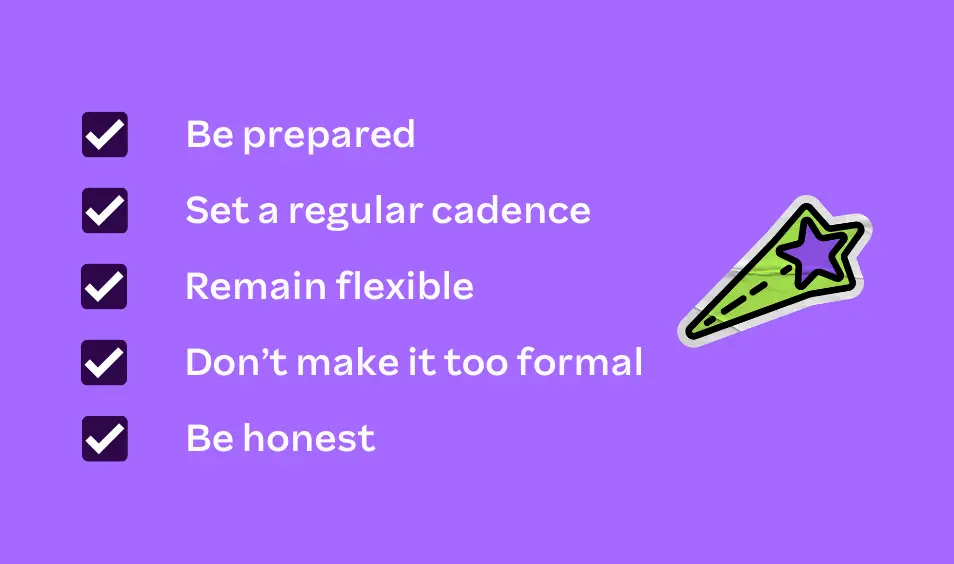
Be prepared
Preparation is key when it comes to an effective and productive 1:1. Start by thinking about a few questions your direct report will find useful so you can help them achieve their goals.
Are you looking for status reports? Looking to share feedback? Or simply want to have a free-form meeting to catch up? By setting a meeting agenda, you’ll be able to support your employee and ultimately be more collaborative.
Set a regular cadence
Whether you choose weekly or bi-weekly meetings, having your 1:1s on as a recurring calendar event means they won’t suddenly disappear from your agenda.
Even when times are busy and you have to reschedule your 1:1s, make sure you move them to a different time or day. You don’t want to fall into the routine of continually saying “Sorry, can we reschedule our 1:1?” and they never actually happen. However, if things are going well and you’re both happy to miss the occasional 1:1, that’s ok, too. Just make sure to reschedule!
Remain flexible
Although you should have a meeting structure set with talking points planned for each week, it’s important to remain flexible on the meeting structure. If the 1:1 focuses specifically on one roadblock someone is facing in their day-to-day work, and you find a solution, that’s still a great outcome.
Sometimes your 1:1s will be 10 minutes (especially if you set regular meetings with your direct report), sometimes they’ll be an hour. There’s no right or wrong way when it comes to 1:1s — it can be a process of trial and error and finding out what works best for both of you.
Don’t make it too formal
The last thing you want to do is make your 1:1s a formal, robust process where your team member feels like they can’t have a personal conversation about how they’re feeling.
If some weeks you only focus on one issue, that’s still considered a productive 1:1. They’re designed to increase trust and communication within teams so you can help them both in achieving their professional goals as well as in personal development.
Remember: 1:1s are a casual way to share feedback, progress and discuss challenges with your direct reports — they aren’t annual performance reviews.
Be honest
At the end of the day, honesty is key. When you are open, transparent and honest with your team members, you create psychological safety within the team and instil confidence for your team members to openly discuss challenges. You’ll be happier and in a better position to achieve your best work.
Did you know? Employment Hero has a built-in 1:1 feature that can help you manage your team effectively? 1:1s in Employment Hero will guide managers and employees through structured and regular meetings with the goal of providing an environment for coaching and constructive feedback.
What questions should you ask in a 1:1?
It’s important to have a list of questions ready for your 1:1. If possible, ask your team members to fill them out prior to your next meeting so that you can both come prepared. This will ensure that you stay on track and get the most out of your 1:1.
Some examples of questions you could ask in your 1:1 include:
- Rate your happiness on a scale of 1 to 10
- What are you proud of in the last week?
- What are your roadblocks right now?
- How are you progressing with your long-term goals? Have you made any progress this week?
- Are there any skills you would like to improve?
- How can I help you achieve your goals better?
- What are you committing to next week to progress your goals?
Check-in with direct reports regularly
Sometimes it can be easy to underestimate the importance of regular catch-ups with your team.
At the end of the day, 1:1s is an important ingredient of every high-performing team. By being prepared, setting a regular cadence, remaining flexible and being honest, you’ll be on your way to getting the most out of your team. Not only this, but you’ll also begin to reap the benefits associated with regularly communicating with your team.
Ultimately, 1:1’s can improve communication, build trust, improve productivity and allow for career development conversations. By introducing 1:1’s into your workplace, you’ll be able to experience all the benefits associated with them.
Empower your team with Employment Hero
Employment Hero’s Employment Operating System is designed to support New Zealand businesses in everything HR, people and payroll. From effective digital surveys and company-wide shout-outs, to 1:1 meeting frameworks and unique rewards, our software can facilitate a culture where everyone feels empowered to perform at their best.
Through its extensive suite of features, the Employment Operating System also makes it easier for you to manage your team and streamline everyday processes.
Find out how our platform can transform your organisation and build a thriving workplace culture by booking a demo with one of our team today.
The information in this article is current as at 5 March 2026, and has been prepared by Employment Hero Pty Ltd (ABN 11 160 047 709) and its related bodies corporate (Employment Hero). The views expressed in this article are general information only, are provided in good faith to assist employers and their employees, and should not be relied on as professional advice. Some information is based on data supplied by third parties. While such data is believed to be accurate, it has not been independently verified and no warranties are given that it is complete, accurate, up to date or fit for the purpose for which it is required. Employment Hero does not accept responsibility for any inaccuracy in such data and is not liable for any loss or damages arising directly or indirectly as a result of reliance on, use of or inability to use any information provided in this article. You should undertake your own research and seek professional advice before making any decisions or relying on the information in this article.
Related Resources
-
 Read more: Employment Essentials: AI Best Practices
Employment Essentials: AI Best Practices
Learn how to use AI in HR without creating privacy, compliance or employment risks in our latest webinar.
-
 Read more: The High Performance Series: The Power of Recovery
The High Performance Series: The Power of Recovery
Learn how elite teams manage recovery and prevent burnout. Join Employment Hero and The Blues for practical HR mental health…
-
 Read more: 6 ways that Employment Hero helps manage health and safety in the workplace
6 ways that Employment Hero helps manage health and safety in the workplace
Learn how our suite of workforce management tools can help you maintain a safe workplace.


