

















Workplace health and safety guide
Published
Workplace health and safety guide
Last Updated
Running a business in New Zealand involves balancing many priorities. You have customers to serve, staff to manage and growth targets to hit. Amidst the daily hustle of keeping the lights on and the books balanced, there is one responsibility that stands above the rest: keeping your people safe.
Health and safety is often viewed through the lens of paperwork and red tape, so it’s easy to see it as a hurdle to jump over, rather than a value to embrace. However, a robust approach to safety is the foundation of a sustainable business. It protects your most valuable asset-your team-and safeguards your business reputation.
Our guide provides a comprehensive overview of workplace health and safety. It includes:
- Your obligations as an employer
- Practical steps for managing risk
- Strategies to build a positive safety culture
- A checklist to evaluate your business’s health and safety management
After all, whether you run a construction site in Christchurch or a design agency in Auckland, the principles remain the same.
Download the guide by filling in the form on the right.
Understanding workplace health and safety
Workplace health and safety (WHS) is the discipline concerned with protecting the safety, health and welfare of people engaged in work or employment. In New Zealand, this goes beyond simply preventing slips, trips and falls. It encompasses a holistic view of the working environment, considering how every aspect of the job affects the person doing it.
For employers, understanding WHS is critical. It’s not just about avoiding fines or meeting legal requirements. It’s about creating an environment where people can do their best work without fear of harm. A safe workplace is a productive workplace. When your team knows you value their wellbeing, morale improves, turnover decreases and engagement rises. Conversely, a poor safety record can lead to devastating personal consequences for workers, significant financial penalties for the business and irreparable damage to your brand.
In New Zealand, workplace health and safety is governed by the Health and Safety at Work Act 2015, which set out standards for all businesses to follow.
Definition and core principles of workplace safety
At its core, workplace safety is about managing the interaction between people and their work environment to prevent harm. This involves identifying what could go wrong and taking reasonable steps to stop it from happening.
The core principles of safety management rely on the idea that accidents are caused, they don’t just happen. This means they can be prevented. Effective safety management moves away from blaming individuals for mistakes and looks at the systems and processes that allowed those mistakes to occur.
Key principles include:
- Leadership commitment: Safety starts at the top. If business owners and directors do not take it seriously, no one else will.
- Worker engagement: The people doing the work are often the best placed to identify the risks, so they need to be involved in prevention.
- Continuous improvement: Safety is not a one-off task. It requires ongoing monitoring and review.
This systematic approach shifts the focus from reacting to accidents after they happen, to proactively managing risks before harm occurs.
Physical and mental health considerations
Historically, health and safety focused almost exclusively on physical harm, for example machinery accidents, chemical spills or heavy lifting injuries. While these remain critical, the modern understanding of “health” in the workplace has expanded significantly.
Under current New Zealand law, health includes both physical and mental health. This means you have the same duty to manage risks to mental health as you do to physical safety. Work-related stress, fatigue, bullying and harassment are now recognised as significant workplace hazards.
Mental health risks, often called psychosocial risks, can be harder to spot than a trailing cable or a guarded saw blade. They often build up over time. A culture of excessive work hours, unrealistic deadlines or poor communication can slowly erode a worker’s mental wellbeing. This can lead to burnout, anxiety and depression. Interestingly, mental fatigue often increases the risk of physical accidents, creating a dangerous cycle.
Managing mental health requires a different toolkit. It involves looking at work design, organisational culture and management practices. It means fostering an open environment where staff feel safe to speak up if they are struggling.
Prevention-first approach to risk management
The old adage that prevention is better than cure is the cornerstone of modern health and safety practice. A prevention-first approach requires you to look ahead. Instead of waiting for an incident to trigger an investigation, you proactively seek out potential issues.
This could involve regular workplace inspections, analysing near-miss data to spot trends and maintaining machinery before it breaks. It also could mean considering safety at the design stage. When you buy a new piece of equipment or design a new workflow, asking “how could this hurt someone?” at the start is far more effective than trying to retrofit safety measures later.
Compliance in New Zealand
New Zealand has a robust legal framework designed to protect workers. The primary legislation is the Health and Safety at Work Act 2015 (HSWA). This Act replaced the old Health and Safety in Employment Act 1992 and introduced significant changes to how safety is managed, particularly regarding accountability.
Understanding this framework is essential for every business owner. Ignorance of the law is not a defence. The legislation is designed to be flexible and workable for businesses of all sizes, from sole traders to large corporations.
Health and Safety at Work Act 2015 requirements
The HSWA sets out the principles, duties and rights in relation to workplace health and safety. The key concept introduced by the Act is the Person Conducting a Business or Undertaking (PCBU). In most cases, the PCBU is the business entity itself (e.g. the company).
The Act focuses on duties rather than prescriptive rules. It requires PCBUs to do what is “reasonably practicable” to eliminate or minimise risks. This acknowledges that you cannot eliminate every single risk, but you must do what is reasonable given the likelihood of the risk, the potential degree of harm and the cost and availability of controls.
Key requirements include:
- Identifying hazards and assessing risks.
- Providing appropriate training and supervision.
- Engaging with workers on health and safety matters.
- Reporting notifiable events to the regulator.
WorkSafe New Zealand’s role and authority
WorkSafe New Zealand is the primary work health and safety regulator. Their goal is to lift New Zealand’s health and safety performance and reduce the number of people killed or seriously injured at work.
WorkSafe has a dual role: education and enforcement. They provide guidance, tools and resources to help businesses understand their obligations. They also monitor workplaces and enforce the law.
Their authority is extensive. WorkSafe inspectors can enter workplaces, inspect equipment, interview staff and issue notices. For many businesses, WorkSafe is a partner in safety, providing clarity on complex issues. However, if a business neglects its duties, WorkSafe acts as the enforcer.
Criminal law implications for non-compliance
The HSWA carries significant penalties for failure to meet obligations. This reflects the seriousness with which New Zealand views workplace safety. Breaches of the Act are criminal offences.
There are three categories of offences, ranging from reckless conduct to simple failure to comply.
- Reckless conduct: Where a person has a duty and engages in conduct that exposes any individual to a risk of death or serious injury, and is reckless as to the risk. This carries the highest penalties, including jail time for individuals and fines in the millions for companies.
- Failure to expose to serious risk: Failure to comply with a duty that exposes an individual to a risk of death or serious injury.
- Failure to comply: Failure to comply with a duty, even if no one is exposed to serious risk.
It is important to note that insurance can’t cover fines imposed under the HSWA. This means a serious breach comes directly off your bottom line. Furthermore, individuals in governance roles (Officers) can be held personally liable if they fail to exercise due diligence, emphasizing that you can’t simply delegate safety responsibility and forget about it.
Employer duty of care and primary responsibilities
Under the HSWA, the primary duty of care lies with the PCBU. As an employer, this means you must look after the health and safety of your workers and any other workers you influence or direct. This includes contractors, sub-contractors and volunteer workers.
Your duty also extends to others who might be affected by your work, such as visitors, customers or the general public. For example, if you are a retailer, you must check that your shop floor is safe for customers. If you are a builder, you must verify that your site does not pose a risk to passersby.
To meet this duty, you must provide:
- A work environment that is without risks to health and safety.
- Safe plant* and structures.
- Safe systems of work.
- Safe use, handling and storage of plant, substances and structures.
- Adequate facilities for the welfare of workers.
- Information, training, instruction or supervision necessary to protect people from risks.
(*’Plant’ refers to any of the following: Machinery, vehicles, vessels, aircraft, equipment, appliances, containers, implements, tools.)
The list above is comprehensive. It means checking the machinery works, the chemicals are stored correctly, the processes are logical and safe and the staff know what they are doing. It also means checking that workers have access to basics like clean water, toilets and a place to eat.
You must also monitor the health of workers and the conditions at the workplace. This might involve hearing tests for workers in noisy environments or monitoring exposure to dust or fumes.
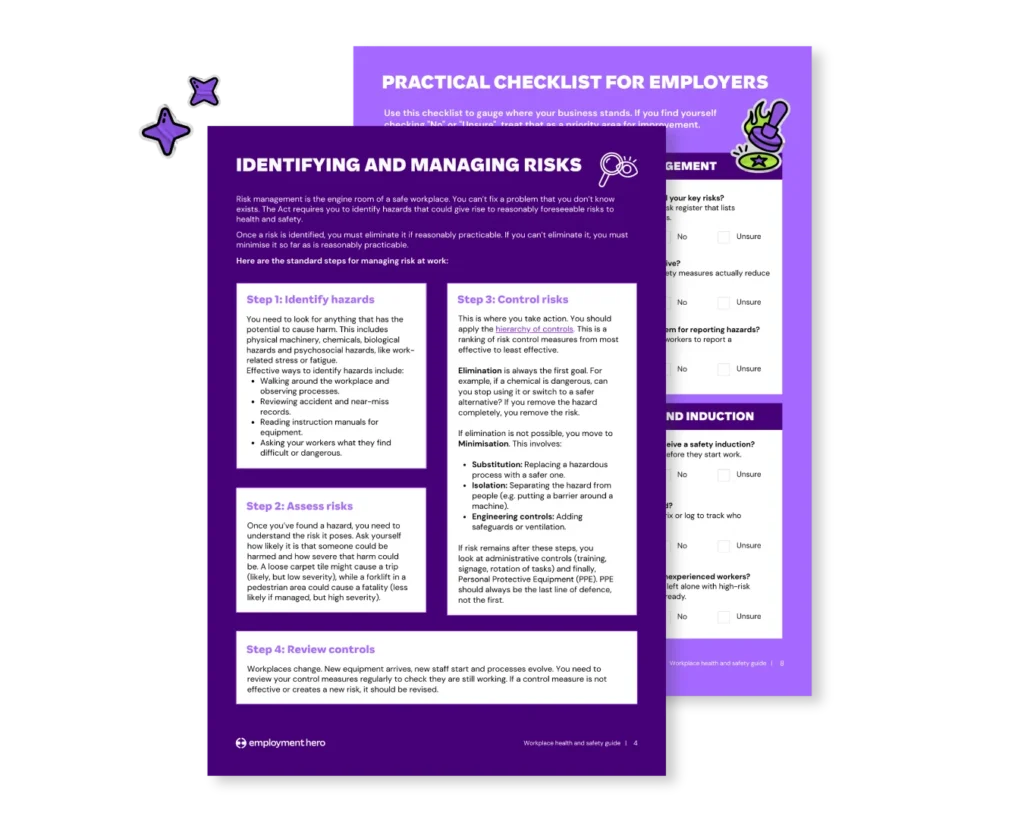
Identifying and assessing workplace hazards
You can’t manage a risk if you don’t know it’s there. Hazard identification is the first step in the risk management process. A hazard is anything that has the potential to cause harm.
Hazards generally fall into a few categories:
- Physical: Machinery, noise, radiation, slips and trips.
- Chemical: Cleaning products, fumes, dust.
- Biological: Bacteria, viruses, mould.
- Ergonomic: Poor workstation setup, heavy lifting, repetitive movements.
- Psychosocial: Stress, fatigue, bullying, violence.
To identify hazards, you should take a systematic approach. Walk around your workplace with a fresh pair of eyes. Ask your workers what tasks they find difficult, dangerous or stressful. Review your accident and near-miss records to see where problems have occurred in the past. Read the instruction manuals for your equipment and safety data sheets for your chemicals.
Once you have identified a hazard, you need to assess the risk. Risk is the likelihood that a hazard will cause harm combined with the severity of that harm.
- How likely is it to happen? (Rare, possible, likely, almost certain)
- What would the consequence be? (Minor cut, broken bone, permanent disability, death)
This assessment helps you prioritise. A hazard that is likely to cause death needs immediate attention. A hazard that is unlikely to cause a minor scratch can be dealt with later.
Hierarchy of controls for risk management
Once you have assessed the risks, you need to control them. The hierarchy of controls is a widely accepted framework for selecting the most effective control measures. You should always start at the top of the hierarchy and work your way down.
1. Elimination
This is the most effective control. It involves physically removing the hazard. For example, if working at height is dangerous, can you use a drone to do the inspection instead? If a chemical is toxic, can you stop using it? If you eliminate the hazard, you eliminate the risk.
2. Minimisation
If you cannot eliminate the hazard, you must minimise the risk. This can be done through:
- Substitution: Replace the hazard with something safer. For example, switch to a water-based paint instead of a solvent-based one.
- Isolation: Separate people from the hazard. This could involve putting a barrier around a noisy machine or using a glove box for handling chemicals.
- Engineering controls: Design the hazard out. This includes machine guards, ventilation systems or lifting aids.
3. Administrative controls
These rely on human behaviour. They are less effective because people make mistakes. Administrative controls include training, warning signs, rotating staff to limit exposure and written procedures.
4. Personal Protective Equipment (PPE)
This is the least effective control and should be the last line of defence. PPE protects the worker only if it is worn correctly and fits properly. Examples include hard hats, ear muffs, safety glasses and high-vis vests. PPE should be used in conjunction with other controls, not as a replacement for them.
Developing health and safety management systems
A health and safety management system is not just a folder on a shelf. It is the coordinated set of policies, processes and procedures you use to manage safety in your business. It serves as the “operating manual” for safety.
A good system provides clarity. It tells everyone what the rules are, who is responsible for what and how things should be done.
Key components of a management system include:
- Policy statement: A commitment from leadership outlining the business’s goals for health and safety.
- Risk register: A document listing all identified hazards and the controls in place to manage them.
- Training records: Proof that staff have been trained and are competent.
- Incident reporting forms: A way to record accidents and near misses.
- Maintenance logs: Records of equipment checks and repairs.
- Emergency plans: Procedures for fire, earthquake, medical emergencies and other threats.
Documentation is important for two reasons. Firstly, it helps you manage safety effectively by providing a structure. Secondly, it provides evidence of your compliance. If WorkSafe investigates an incident, they will ask to see your records. Being able to show that you have identified risks, trained staff and maintained equipment is your best defence.
Did you know? Employment Hero can facilitate a lot of this management system, with a built-in incident reporting feature, digital policy acknowledgement and centralised document storage. Find out more about our health and safety features here.
Training, supervision, and information provision
You can’t expect your staff to work safely if they don’t know how. Under the HSWA, you must provide the information, training, instruction and supervision necessary to protect workers from health and safety risks.
Training
Training should be specific to the job and the risks involved. It starts with induction. Every new worker, contractor or visitor should receive an induction that covers emergency procedures, site rules and hazard reporting.
Beyond induction, workers need training on the specific equipment they will use and the tasks they will perform. This is not just a one-off event. Refresher training is vital to prevent bad habits from creeping in. You should also verify competency. Just because someone sat through a course does not mean they can do the job safely. Observe them doing the task to verify they have understood the training.
Supervision
Supervision is critical, especially for new, young or inexperienced workers. The level of supervision required depends on the risk of the task and the competence of the worker. A high-risk task or a novice worker will likely require direct, constant supervision. As competence grows, supervision may become less intense, but it should never disappear completely. Managers need to check that standard operating procedures are being followed.
Information
Workers need access to safety information. This includes equipment manuals, safety data sheets for chemicals and risk assessments. This information must be easy to understand. If you have workers with English as a second language, you may need to provide information in their native language or use visual aids.
Employee participation
Your workers are your eyes and ears on the ground. They know the reality of the job better than anyone. Engaging them in health and safety is not just a legal requirement; it’s smart business.
The HSWA requires PCBUs to have practices that provide workers with reasonable opportunities to participate effectively in improving work health and safety. This means you must consult with them on matters that affect their safety.
Engagement involves sharing information and giving workers a say in decisions. Participation involves workers taking an active role.
Practical ways to foster engagement include:
- Health and Safety Representatives (HSRs): Workers can elect an HSR to represent their views. HSRs have specific powers and training rights under the Act.
- Health and Safety Committees (HSCs): A committee brings together workers and management to discuss safety issues and develop solutions.
- Toolbox talks: Short, regular team meetings to discuss specific safety topics or recent incidents.
- Safety as a standing agenda item: Make safety the first item on every team meeting agenda.
When workers feel their voice is heard, they’re more likely to take ownership of safety, follow the rules and suggest practical improvements.
Investigating incidents and near misses
Despite your best efforts, things can go wrong. When an incident occurs, your response is critical.
First, you must look after the injured person and make the site safe. If it is a notifiable event (a death, serious injury or serious illness), you must preserve the scene and notify WorkSafe immediately.
Once the immediate dust has settled, you must document the event and investigate why it happened. The purpose of an investigation is not to assign blame. Blaming individuals rarely fixes the problem and drives reporting underground. Instead, the goal is to find the root cause.
Why did the accident happen? Was it a lack of training? Was the machine faulty? Was the worker fatigued? Was there pressure to cut corners to meet a deadline?
You should also investigate near misses. A near miss is an incident where no one was hurt, but they could have been. These are free lessons. They highlight a weakness in your system before someone gets injured. Encouraging the reporting of near misses gives you a chance to fix the problem proactively.
Once you have identified the root cause, you must put corrective actions in place to stop it from happening again. This closes the loop and demonstrates a commitment to continuous improvement. By learning from every incident, you make your workplace safer for everyone.
Learn more about your health and safety responsibilities
Download our guide today on workplace health and safety by filling in the form on the right. It’s easy to reference and understand, and designed exactly for New Zealand employers.
The information in this article is current as at 30 December 2025, and has been prepared by Employment Hero Pty Ltd (ABN 11 160 047 709) and its related bodies corporate (Employment Hero). The views expressed in this article are general information only, are provided in good faith to assist employers and their employees, and should not be relied on as professional advice. Some information is based on data supplied by third parties. While such data is believed to be accurate, it has not been independently verified and no warranties are given that it is complete, accurate, up to date or fit for the purpose for which it is required. Employment Hero does not accept responsibility for any inaccuracy in such data and is not liable for any loss or damages arising directly or indirectly as a result of reliance on, use of or inability to use any information provided in this article. You should undertake your own research and seek professional advice before making any decisions or relying on the information in this article.
Register for the guide
Related Resources
-
 Read more: Minimum wage: Guide for New Zealand employers and payroll teams
Minimum wage: Guide for New Zealand employers and payroll teams
Understand NZ’s minimum wage rates, training wage rules, and 2025 updates. Learn how Employment Hero NZ automates wage compliance.
-
 Read more: Navigating 2025: NZ Employment Law Forecast
Navigating 2025: NZ Employment Law Forecast
Stay ahead of NZ employment law changes in 2025 with insights on grievance laws, wages, and more.

