
















A guide to staff training records (template included)
Published
A guide to staff training records (template included)
Published
Keeping track of your team’s skills and qualifications is more than just good housekeeping. It’s the foundation of a capable, safe and future-ready workplace.
For many New Zealand businesses, managing training records can feel like just another item on an endless to-do list. But with the right approach and tools, it becomes a straightforward process that protects your people and helps your business grow.
This guide explores why training records matter, your legal obligations under New Zealand law, and how to manage them effectively.
Plus, we’ve included a free practical training record template to help you get started today. Download the template by filling in the form on the right.
Why staff training records are important
Maintaining accurate records is a high-impact business practice. It helps you build a motivated team, while supporting critical compliance obligations.
1. Proof of compliance
In New Zealand, “I didn’t know” isn’t a legal defence. Detailed records go a long way towards showing that you’ve provided necessary instruction. If a workplace accident occurs, WorkSafe NZ inspectors will ask for training documents first. They prove you took reasonable steps to ensure your employees were competent to work safely.
2. Strategic workforce planning
Beyond safety, these records highlight your team’s strengths and reveal where gaps might be holding you back. This allows you to make informed decisions about the future of your team.
By looking at your records, you can instantly see:
- Succession planning: Who is ready to step up into a leadership role?
- Gap analysis: Are we over-reliant on one person for a specific technical skill?
- Recruitment: Do we need to hire a new person, or can we upskill an existing high-performer?
3. Boost employee engagement and retention
The modern workforce is changing. Many employees, especially Gen Z and Millennials, prioritise career development. When you track training and certifications, it shows your team that you’re invested in their professional journey.
A clear record of their progress makes performance reviews more meaningful. Instead of vague feedback, you can say: “I see you’ve mastered X and Y this year; let’s look at getting you certified in Z for next year.” This sense of progression is a powerful tool for keeping your best talent from jumping ship.
Compliance and training requirements in New Zealand
As a Kiwi employer, you have a primary duty of care under the Health and Safety at Work Act 2015. This includes providing the information, training, or supervision necessary to protect people from risks.
While all businesses must keep wage and time records, high-risk sectors (like construction, manufacturing, or forestry) have even stricter mandates. For example, operating a forklift or working at heights requires formal certification and regular refreshers. Documenting this isn’t optional. It’s a legal requirement to keep your “PCBU” (Person Conducting a Business or Undertaking) status in good standing.
What to include in a staff training record
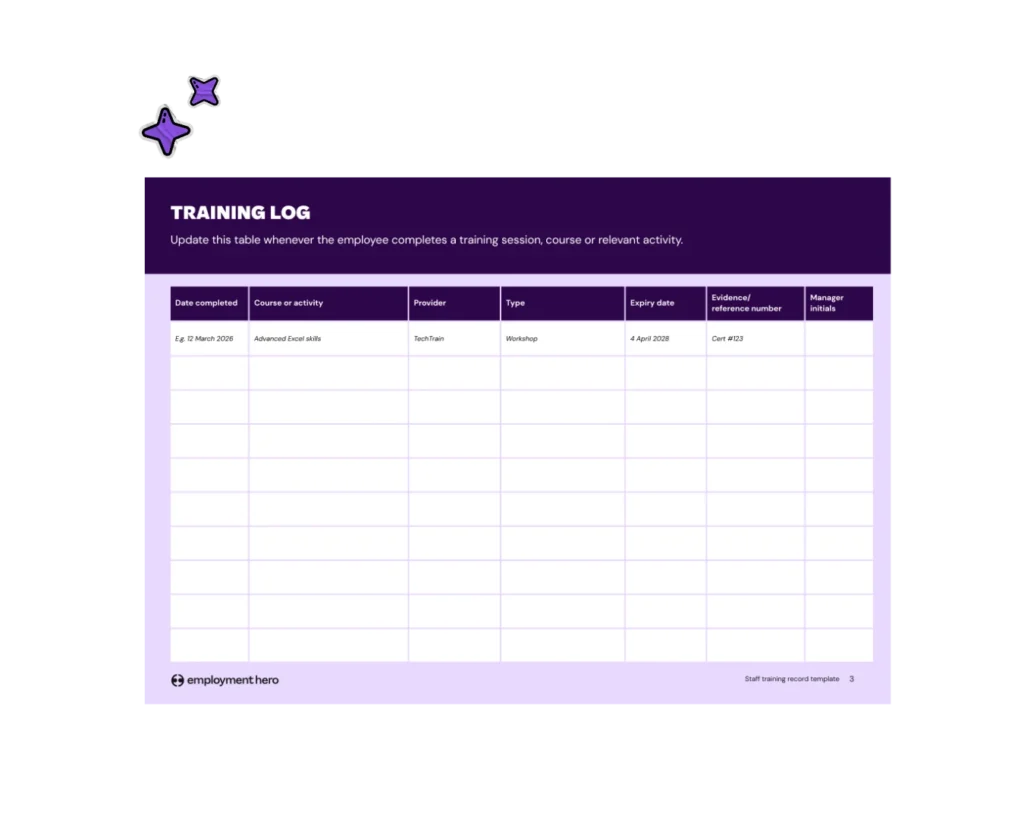
A great record should tell the full story of an employee’s development. To stay organized, ensure every entry includes:
- Employee basics: Full name, job title, and department.
- Course details: Name of the training, date completed and the provider.
- Training type: Categorise it (e.g, health & safety, technical or soft skills).
- Expiry dates: Essential for first aid, site safe passports or driver’s licenses.
- Evidence: A certificate of completion or a signed attendance sheet.
- Sign-off: Confirmation from both the manager and employee.
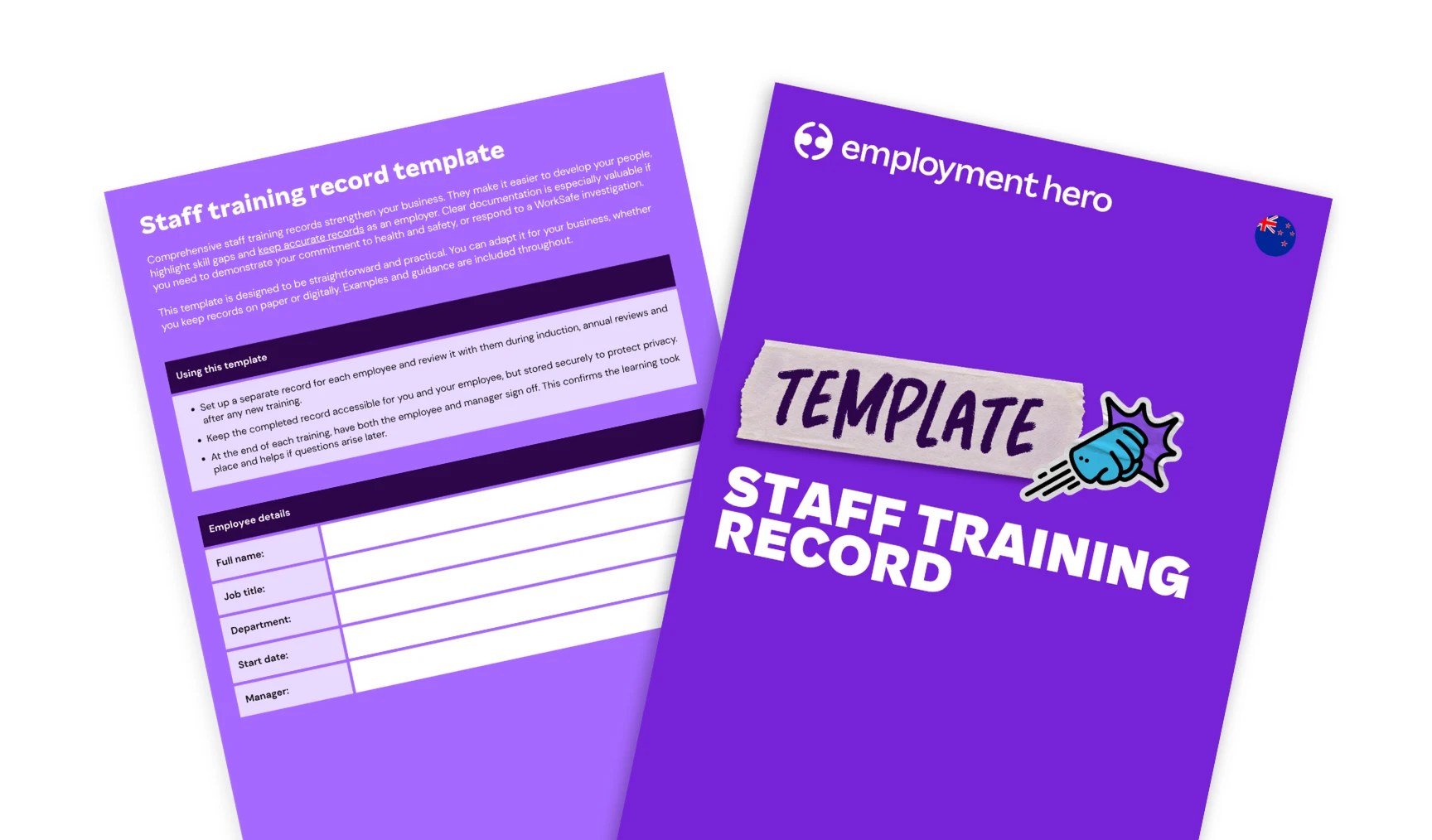
Download your free staff training record template
Take the guesswork out of tracking. Our easy-to-use training record template helps you manage everything from induction to advanced certifications in one place.
Download the template by filling in the form on the right.
The training process: Assessment to action
A successful training programme doesn’t happen by chance. It follows a structured process that begins with understanding your needs and ends with evaluating the results. This lifecycle ensures your training investments are targeted, effective and deliver a real return for your business. It involves assessing what skills are needed, creating a plan to develop them and supporting employees through the learning process.
Training needs assessment
Before you can build a training plan, you need to know your team’s capabilities. A training needs assessment is a systematic process for identifying the gap between the skills your business needs and the skills your employees currently have. This ensures you invest your time and money where it will have the biggest impact.
You can gather this information through various methods. Performance reviews are a great source of insight into individual development areas. You can also talk to managers about the challenges their teams are facing or survey employees directly to ask what training they feel would help them perform better. Analysing business data like productivity metrics or safety incident reports can also highlight areas where additional training is needed.
Annual training plans
Once you’ve identified your training needs, the next step is to plan the next year’s training for each employee. This plan acts as a roadmap for their professional development over the coming year. It should outline the what, when and why of their training activities, linking them to both individual career goals and broader business objectives.
A good plan includes a mix of training types. It could include formal courses, online modules, mentoring from a senior colleague or attendance at industry conferences. The key is to make it specific and achievable. For example, instead of a vague goal like “improve communication skills,” the plan might specify “complete a two-day presentation skills workshop by 30 June.” This clarity helps both the employee and their manager track progress effectively.
Supervising employees under training
Supporting team members while they learn new skills is crucial for success. Simply sending someone on a course isn’t enough. Effective supervision ensures they feel confident applying their new knowledge and are supported appropriately until they are fully competent.
For practical skills, this often means providing on-the-job supervision. An employee learning to use new machinery should be monitored by an experienced colleague until they can operate it safely and independently. This period of supervision should be documented as part of their training record.
For other skills, support might involve regular check-ins, providing opportunities to practice and offering constructive feedback. This creates a safe learning environment where employees feel comfortable asking questions and developing their abilities.
Simplify your training management
Stop juggling spreadsheets. Employment Hero’s comprehensive learning management system makes it easy to manage training records, assign courses from a pre-populated library and track employee development.
Book a call with our team today to find out more.
Monitoring and reviewing training outcomes
The final step in the training cycle is to check if it actually worked. Monitoring and reviewing training outcomes helps you understand the effectiveness of your programmes and measure their impact on the business. It answers the question: are the new skills being applied on the job and delivering real results?
You can measure this in several ways. You could observe employees performing tasks that utilise their new skills or review performance data to see if there have been improvements in areas like productivity or quality. Gathering feedback from both the employee and their manager can provide qualitative insights into the training’s value. This review process allows you to refine your training strategy, celebrate successes and ensure you’re getting the best return on your investment.
Recording qualifications and experience
Formal training courses are just one piece of the puzzle. To get a full picture of your team’s capabilities, it’s important to document their existing qualifications and relevant on-the-job experience as well. Many employees come to your business with valuable skills and certifications from previous roles or education.
During the onboarding process, take the time to capture this information. This might include university degrees, trade certifications, driver’s license classes or industry-specific licenses. Recording this existing knowledge helps you understand the full depth of talent within your organisation. It prevents you from investing in training for skills your team already possesses and helps identify internal experts who could mentor others.
Best practices for maintaining training records
Keeping your training records organised, up-to-date and secure doesn’t have to be complicated. By following a few practical tips, you can create a system that is efficient and easy to manage.
First, decide on a central location for your records. If you are still using paper, this might be a dedicated filing cabinet. However, a digital system is often more effective. Storing information in an HR software platform like Employment Hero makes information easier to access, update and back up.
Make updating records part of your regular workflow. When a new employee starts, create their training record as part of their induction process. After an employee completes a course, update their file immediately. Set calendar reminders for expiring qualifications so you can schedule refresher training well in advance. By making record-keeping a consistent habit, you ensure your data is always accurate and reliable.
Ready to build a more skilled team?
If you’d like to supercharge team performance and management, Employment Hero is here to help. Employment Hero can help simplify your processes, supporting your business as it grows. An all-in-one solution that supports everything employment, our Employment Operating System puts HR, payroll, hiring and more, all in one place.
Plus, we’ve got a comprehensive learning management system, packed with expertly curated training content from over 250 global providers. Make it easy for your team to build their skills and stay up to date.
Find out more about Employment Hero – talk to one of our business specialists today.
The information in this article is current as at 30 December 2025, and has been prepared by Employment Hero Pty Ltd (ABN 11 160 047 709) and its related bodies corporate (Employment Hero). The views expressed in this article are general information only, are provided in good faith to assist employers and their employees, and should not be relied on as professional advice. Some information is based on data supplied by third parties. While such data is believed to be accurate, it has not been independently verified and no warranties are given that it is complete, accurate, up to date or fit for the purpose for which it is required. Employment Hero does not accept responsibility for any inaccuracy in such data and is not liable for any loss or damages arising directly or indirectly as a result of reliance on, use of or inability to use any information provided in this article. You should undertake your own research and seek professional advice before making any decisions or relying on the information in this article.
Register for the template
Related Resources
-
 Read more: A guide to staff training records (template included)
A guide to staff training records (template included)
Discover a practical staff training record template for NZ businesses that ensures effective compliance and simplifies your training process.
-
 Read more: AI in retail: What every employer needs to know
AI in retail: What every employer needs to know
AI in retail is transforming how employers hire, schedule and operate. Discover how retail businesses worldwide are using AI to…
-
 Read more: AI in manufacturing: What every employer needs to know
AI in manufacturing: What every employer needs to know
AI in manufacturing is transforming how employers hire, schedule and operate. Discover how manufacturing businesses worldwide are using AI to…

