

















Recruitment screening template and best practices guide
Published
Recruitment screening template and best practices guide
Last Updated
Hiring is one of the biggest investments a business can make. Getting it right means finding someone with the right skills who also fits your team and culture. Getting it wrong can be costly.
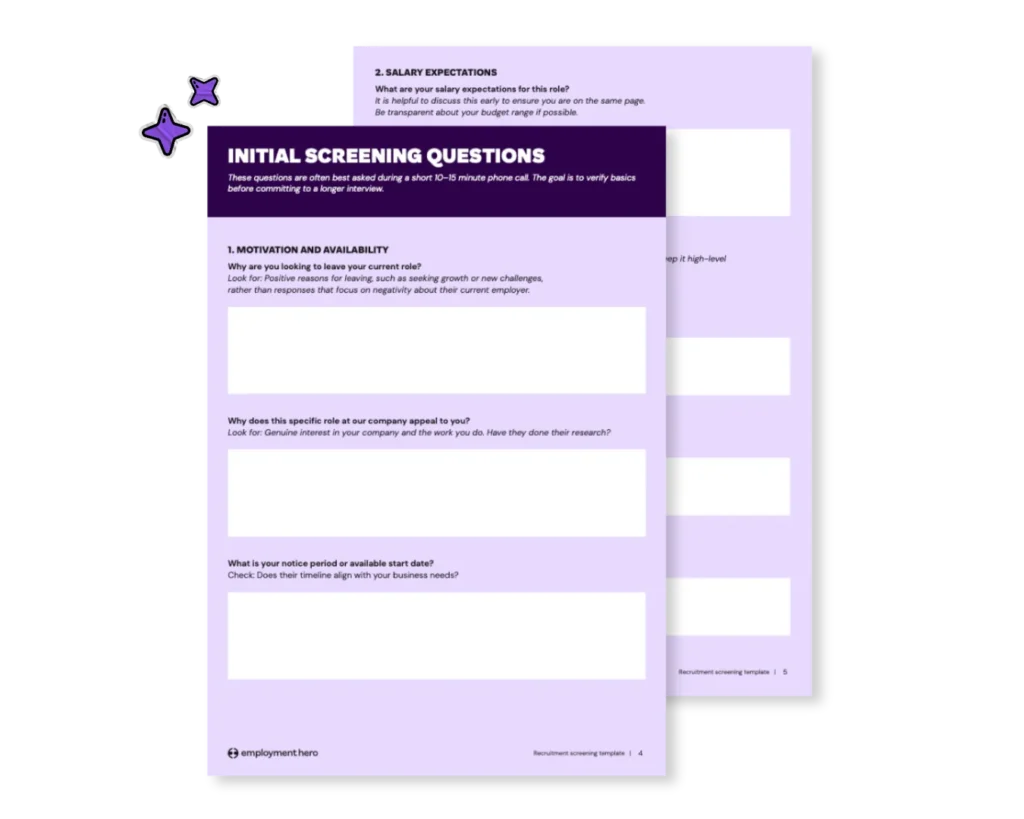
That’s where candidate screening is so crucial – it allows you to get a quick first impression of a candidate so you can decide whether to proceed with a formal interview. Having a set routine for this can make the whole screening process quicker and easier. To help, we’ve created a recruitment screening template, which you can use to capture key notes from a screening call. That includes a candidate’s potential suitability and their readiness for the role.
What is screening in recruitment?
Applicant screening is the first major step in the hiring process. It’s where you review the pool of people who have applied for a job and decide which ones meet the basic requirements to move forward. The goal is to create a shortlist of qualified candidates for a more in-depth evaluation.
This stage often involves reviewing CVs, cover letters and application forms against the key criteria outlined in your job description. It’s a filtering process designed to save time by quickly identifying those who are clearly not a fit.
Candidate screening is the next step. It usually involves more direct interaction like a brief phone call or video chat. While applicant screening is about filtering based on written information, candidate screening is about verifying that information and getting an initial feel for the person. In New Zealand both stages are crucial for making consistent and fair hiring decisions.
Why candidate screening is critical for hiring in New Zealand
A structured screening process is more than just a box-ticking exercise. For many New Zealand businesses facing skills shortages and a competitive talent market, a robust screening process can be a significant advantage. It helps you move quickly when you find the right person and ensures every candidate gets a fair assessment.
Ensuring fair and consistent hiring
Structured screening also helps you make decisions based on objective criteria, rather than gut feelings alone. By using a consistent template and set of questions for every applicant, you create a level playing field. This approach helps you uphold your responsibilities under the Human Rights Act 1993, which prohibits discrimination on various grounds during the hiring process. A documented process provides a clear record of your decision-making should a candidate ever raise a question about fairness.
Reducing time-to-hire and bias
When you don’t have a clear screening process, hiring can become a bottleneck. Applications pile up and decision-making slows down. A systematic approach helps you quickly identify the most promising candidates, saving valuable time. It also helps minimise unconscious bias. By focusing on skills, experience and predefined criteria you are less likely to be swayed by irrelevant factors. This not only improves fairness but also widens your talent pool, leading to a more diverse and capable team.
Key applicant and candidate screening methods
Generally a few key methods are used to evaluate applicants before they reach the formal interview stage. These steps are designed to efficiently filter your pool of candidates, ensuring you only invest significant time in those who are a genuine fit for the role. Understanding these candidate screening steps is key to building an effective process.
Resume and application screening
So the applications have arrived. Now it’s time to review every CV and application against the ‘must-have’ criteria for the job. Look for the specific skills, qualifications and experience you outlined in your job description. The goal is to quickly sort applications into three piles: yes, no and maybe. This initial filter is essential for managing a large volume of applicants without getting overwhelmed. Be methodical and stick to your criteria to maintain fairness.
Phone and video screening
Once you have a shortlist, a brief phone or video call is the next step. A 15-minute chat is often enough to validate the information on their CV and get a sense of their communication skills and professionalism. Use this opportunity to ask high-level questions about their motivation, salary expectations and availability. A structured call where you ask each candidate the same core questions will give you a consistent baseline for comparison.
This stage is where our template can be used. Download it today by filling in the form on the right and try it out in your next candidate screening call.
Skills assessments and tests
For some roles a practical assessment can be very revealing. This could be a short coding challenge for a developer, a writing task for a content creator or a problem-solving exercise for a manager. The key is to make the test relevant to the day-to-day tasks of the job, so that you get a true reflection of their potential performance.
Reference and background checks
Reference and background checks are typically done at the end of the process but it’s important to think about them from the start. Under the Privacy Act 2020 you must have a candidate’s permission before contacting their referees or conducting a background check. It’s good practice to let candidates know early on that these checks will be part of your process. This includes verifying their right to work in New Zealand.
How to design a recruitment screening template
A strong recruitment screening template brings structure and consistency to your hiring. It acts as a guide, ensuring you evaluate every candidate against the same criteria. Instead of relying on memory or scattered notes, a template captures all the essential information in one place. It makes decision-making more objective and transparent.
Candidate information and role criteria
The first part of your template should capture the basics. This includes the candidate’s name, contact details and the role they have applied for. It’s also the place to note key role criteria. List the top three to five ‘must-have’ skills or qualifications for the position. This keeps the most important requirements front and centre during your review.
Screening questions and scoring system
To make your evaluation objective you need a consistent set of questions. Your template should include predefined screening questions that cover motivation, salary expectations and key experience.
Notes and comments section
A dedicated section for notes is essential. This is where you can jot down impressions that don’t fit neatly into a checkbox. Did the candidate communicate clearly? Did they show genuine enthusiasm for the role? These qualitative notes add colour to the quantitative scores providing a more holistic view of each candidate. Documenting your thoughts also helps you provide constructive feedback if a candidate asks for it.
Step-by-step guide to using the screening template
Having the template is one thing. Using it effectively is another. Take this approach when using the template to ensure your screening is as efficient as it can be.
Step 1: Define job requirements clearly
Before you even look at a single application, get crystal clear on what you need. Sit down with the hiring manager and define the essential skills, experience and qualifications for the role. Also consider the softer skills and cultural fit. What kind of person will thrive in your team? Document these criteria. They will become the foundation of your screening template.
Step 2: Pre-screen the CVs
Go through each CV and compare it against the essential criteria you defined in step one. This systematic approach ensures you apply the same logic to every single applicant.
Step 3: Conduct screening calls
For the candidates who pass the initial screen, schedule a brief phone call. Use the screening questions from your template to guide the conversation. Ask about their motivation for applying, their salary expectations and their notice period. Fill in their answers and your notes directly into the template as you talk. This keeps all the information organised and ready for review.
Step 4: Score and shortlist candidates
After the screening calls it’s time to review your templates. Tally up the scores and read through your notes for each candidate. This objective data will make it much easier to compare them. Rank the candidates based on how well they meet the criteria and align with the role. This process will give you a clear data-driven shortlist for the first round of formal interviews.
Step 5: Start the formal interview process
For your top candidates it’s time to meet formally. Schedule an interview with each candidate to get to know them in person. Thanks to your screening process, these candidates should be fairly suitable for the role already – now it’s just time to find the perfect fit for your business.
Common applicant screening questions and examples
Good screening questions are open-ended and designed to get more than a simple ‘yes’ or ‘no’ answer. They help you dig a little deeper into a candidate’s experience, motivation and suitability. Here are some examples you can adapt for your own screening process.
Qualification and experience questions
- Can you walk me through your experience with [specific software or skill]?
- This role requires [X qualification]. Can you confirm you have this and tell me a bit about it?
- Your CV mentions you have experience in [Y industry]. What did you enjoy most about working in that sector?
Availability and commitment questions
- What is your notice period at your current job?
- What are your salary expectations for this role?
- Are you looking for a full-time or part-time position?
- This role is based in [City]. Are you able to work from this location?
Cultural fit and motivation questions
- What prompted you to start looking for a new role?
- What do you know about our company and what made you want to apply here?
- What kind of work environment do you thrive in?
- Can you describe your ideal manager?
Candidate screening best practices for recruiters
Running a fair and effective screening process comes down to a few core principles. By embedding these best practices into your recruitment, you’ll not only hire better people but also build a stronger reputation as an employer.
Maintain consistency and fairness
The single most important practice is to treat every candidate consistently. Use the same screening template, the same questions and the same scoring criteria for everyone who applies for a particular role. This ensures that your decisions are based on merit and not on unconscious bias or random factors.
Minimise unconscious bias
Everyone has unconscious biases. The key is to recognise them and put systems in place to mitigate them. A structured screening process is your best tool for this. By focusing on objective criteria you force yourself to look past irrelevant details. Some businesses also practice ‘blind’ CV screening where names and other identifying details are removed to focus purely on skills and experience.
Document and store records securely
Keep your completed screening templates for all applicants, not just the ones you hire. These records provide a clear audit trail of your decision-making process. This documentation can be invaluable if a decision is ever challenged. Under the Privacy Act 2020, you have an obligation to store this personal information securely and dispose of it properly when it’s no longer needed.
Download the free recruitment screening template
Ready to make your hiring process more efficient, fair and effective? Our free Recruitment Screening Template is designed specifically for New Zealand businesses. It provides a clear structure for you to follow from the initial CV review to the screening call.
This template will help you:
- Standardise your evaluation process
- Make objective data-driven decisions
- Reduce unconscious bias
- Keep a clear record of your hiring activities
Download your free template today and take the first step towards a smarter recruitment process.
The information in this article is current as at 30 December 2025, and has been prepared by Employment Hero Pty Ltd (ABN 11 160 047 709) and its related bodies corporate (Employment Hero). The views expressed in this article are general information only, are provided in good faith to assist employers and their employees, and should not be relied on as professional advice. Some information is based on data supplied by third parties. While such data is believed to be accurate, it has not been independently verified and no warranties are given that it is complete, accurate, up to date or fit for the purpose for which it is required. Employment Hero does not accept responsibility for any inaccuracy in such data and is not liable for any loss or damages arising directly or indirectly as a result of reliance on, use of or inability to use any information provided in this article. You should undertake your own research and seek professional advice before making any decisions or relying on the information in this article.
Register for the template
Related Resources
-
 Read more: Minimum wage: Guide for New Zealand employers and payroll teams
Minimum wage: Guide for New Zealand employers and payroll teams
Understand NZ’s minimum wage rates, training wage rules, and 2025 updates. Learn how Employment Hero NZ automates wage compliance.
-
 Read more: Navigating 2025: NZ Employment Law Forecast
Navigating 2025: NZ Employment Law Forecast
Stay ahead of NZ employment law changes in 2025 with insights on grievance laws, wages, and more.


