

















Creating a recruitment policy: template and guide
Published
Creating a recruitment policy: template and guide
Published
Recruitment is a constant for any growing business. Finding the right people is essential for success but navigating the hiring process can be a significant challenge for employers. A formal recruitment policy provides a clear roadmap, helping you attract and secure top talent with consistency.
This guide breaks down what a recruitment policy is, why it’s crucial for your business and how to build one that works. We’ll cover everything from writing job descriptions to making an offer, all tailored for New Zealand businesses.
We’ve also created a policy template that you can easily customise for your business. Download the template by filling in the form on the right.

A recruitment policy is a document that outlines your company’s approach to hiring new employees. It sets out the steps and principles you follow to attract, assess and select candidates. Think of it as your company’s rulebook for recruitment.
The policy provides a consistent framework for everyone involved in hiring, from managers to HR teams. It helps to standardise your process, making it fair for all applicants and easier for you to manage. It’s about creating a structured approach that moves away from ad-hoc decisions and towards a professional, repeatable system.
This clarity not only helps internally but also presents a professional image to potential employees, showing that you take hiring seriously.
Why your business needs a recruitment policy
Having a formal recruitment policy isn’t just about bureaucracy. It offers real benefits that can strengthen your business and protect it from risk. For many business owners, managing recruitment on top of everything else is a major source of stress. A policy can lighten that load.
Consistency
A key advantage is consistency. When everyone follows the same process, you create a fair playing field for all candidates. This reduces the risk of bias and discrimination, which is a major legal consideration. Under the Human Rights Act 1993, employers cannot discriminate against candidates based on factors like age, gender, ethnicity or family status. A good policy can help you ask the right questions and make unbiased choices.
Quality of hires
A formal recruitment policy can improve the quality of your hires. A structured process forces you to clearly define what you’re looking for in a candidate. This focus helps you assess applicants against objective criteria, leading to better hiring decisions. You end up with employees who are not only skilled but also a great fit for your company culture. Over time, this improves team performance and reduces staff turnover.
Employer brand and candidate experience
Finally, a managed approach to recruitment can help your employer brand. Our recent study revealed that 62% of New Zealand workers say they’ve been discouraged from looking for new roles because the hiring process feels too draining. When candidates have a positive experience, even if they don’t get the job, they are more likely to speak highly of your company. A transparent and professional process leaves a lasting good impression.
What is the recruitment and selection process?
The recruitment and selection process is the journey you take to fill a vacant role. It starts the moment you identify a need for a new team member and ends when a candidate formally accepts your job offer. A well-defined process makes recruitment more efficient and effective.
It typically involves these key stages:
- Identifying the need: Recognising a gap in your team that requires a new hire.
- Job description: Defining the role’s responsibilities, required skills and experience.
- Sourcing candidates: Advertising the role internally and externally to attract applicants.
- Screening and shortlisting: Reviewing applications to create a shortlist of qualified candidates.
- Interviewing and assessment: Conducting interviews and other assessments to evaluate shortlisted candidates.
- Reference checking: Contacting referees to verify a candidate’s experience and character.
- Making an offer: Extending a formal offer of employment to the chosen candidate.
- Onboarding: Integrating the new hire into your company.
Each step is a chance to gather more information and make an informed decision. By following a structured path, you reduce the chances of making a hasty choice you might later regret.
How to get the recruitment process right
There are several essential steps of the recruitment process that your team should follow for hiring success.
Create clear job descriptions
The job description is often the first point of contact a candidate has with your company. A well-written one can make the difference between attracting top talent and getting applications that miss the mark. It needs to be more than just a list of tasks. It should sell the role and your company to the right person.
Start by clearly defining the purpose of the role. What is its main contribution to the business? Then, detail the key responsibilities and duties. Use clear, direct language and avoid internal jargon that an external candidate wouldn’t understand.
It’s just as important to specify the required skills, qualifications and experience. Be realistic here. Distinguish between ‘must-have’ and ‘nice-to-have’ attributes. An impossibly long list of requirements can discourage great candidates from applying.
Finally, include information about the company culture and what it’s like to work for you. This helps candidates decide if they will be a good fit for your team.
Post jobs internally
Before looking outside the company, consider the talent you already have. An internal-first approach to recruitment can be a powerful way to boost employee morale and retention. It shows your team that there are opportunities for growth and career progression within the business.
Your recruitment policy should outline how internal vacancies are communicated. This could be through a dedicated section on your company intranet, a regular email newsletter or announcements in team meetings. Make the application process straightforward for internal candidates.
Giving your current employees the first opportunity to apply for new roles fosters a culture of loyalty and development. It can also save you time and money on external advertising and lengthy onboarding processes.
Understand the selection stages
Once applications start coming in, you need a structured way to sort through them. The selection process involves several stages designed to narrow down the pool of candidates to the one best suited for the role.
The first step is resume screening. This involves reviewing CVs and cover letters against the key criteria in your job description. This helps you create a manageable shortlist of candidates to move to the next stage.
Next comes the interview. This is your chance to dig deeper into a candidate’s experience, skills and personality. You might conduct an initial phone or video screening followed by a more in-depth, in-person interview. Using structured interviews, where you ask all candidates the same set of questions, helps to keep the process fair and objective.
For some roles, you might also include a practical assessment or assignment. This could be a technical test for a developer, a writing task for a marketing role or a presentation for a sales position. These tasks give you a real-world look at a candidate’s capabilities.
Provide feedback
Providing feedback to candidates after an interview is a crucial part of a positive recruitment experience. Many businesses fail to do this, leaving candidates in the dark. This can damage your employer brand. People talk, and a reputation for ghosting applicants can make it harder to attract good people in the future.
Your policy should state that all interviewed candidates will receive a response. For unsuccessful candidates, constructive feedback can be valuable, though you need to be careful with your wording. Keep it brief, objective and focused on the requirements of the role. For example, you might say, “We decided to move forward with a candidate whose experience was more closely aligned with the specific technical skills required for this position.”
Timely and professional communication shows respect for the time and effort candidates have put into their application.
Use technology to track your progress
There are so many moving parts when recruiting – each candidate is likely at a slightly different stage at any one time. For consistency and to ensure that nothing gets missed, using an applicant tracking system (ATS) is essential. For example, our ATS at Employment Hero provides one central safe space for candidate documentations, can automate emails and reminders, and directly onboard successful candidates into the wider HR platform.
Find out more about Employment Hero’s applicant tracking system here.
How employment agreements and recruitment policies work together
Your recruitment policy and the employment agreement are two distinct but connected documents. The recruitment policy guides how you select a candidate, while the employment agreement formalises the relationship once you’ve made your choice.
Your policy should state that all job offers are made in writing and are conditional on the candidate signing an Individual Employment Agreement (IEA). According to Employment New Zealand, the IEA is a legal requirement and must be provided to the employee before they start work. It sets out the terms and conditions of their employment, including their duties, hours of work and pay. The job description, which is a core part of the recruitment process, often forms a key part of the employment agreement.
Integrating other workplace policies into recruitment
Your recruitment process doesn’t exist in a vacuum. It should reflect your company’s broader values and policies. This integration ensures that your principles are applied consistently from the moment a candidate first interacts with your business.
For example, your Diversity and Inclusion Policy should be clearly reflected in your recruitment practices. This means writing inclusive job ads, using diverse interview panels and actively working to remove bias from your selection process. Similarly, your Code of Conduct should inform how your hiring team interacts with candidates, ensuring everyone is treated with professionalism and respect.
Mentioning these related policies within your recruitment policy reinforces your company’s commitment to a fair, ethical and positive workplace culture.
Download your recruitment policy template today
Creating a recruitment policy from scratch can feel daunting. Using a template can simplify the process and give you a solid foundation to build on. That’s why our policy template includes all the essential sections and prompts to help you tailor the content to your specific needs.
Download the template by filling in the form on the right.
The information in this article is current as at 30 December 2025, and has been prepared by Employment Hero Pty Ltd (ABN 11 160 047 709) and its related bodies corporate (Employment Hero). The views expressed in this article are general information only, are provided in good faith to assist employers and their employees, and should not be relied on as professional advice. Some information is based on data supplied by third parties. While such data is believed to be accurate, it has not been independently verified and no warranties are given that it is complete, accurate, up to date or fit for the purpose for which it is required. Employment Hero does not accept responsibility for any inaccuracy in such data and is not liable for any loss or damages arising directly or indirectly as a result of reliance on, use of or inability to use any information provided in this article. You should undertake your own research and seek professional advice before making any decisions or relying on the information in this article.
Register for downloadable
Related Resources
-
 Read more: Employment Relations Act: Key changes explained
Employment Relations Act: Key changes explained
Stay up to date with the latest changes to New Zealand’s Employment Relations Act. Understand what’s new and how it…
-
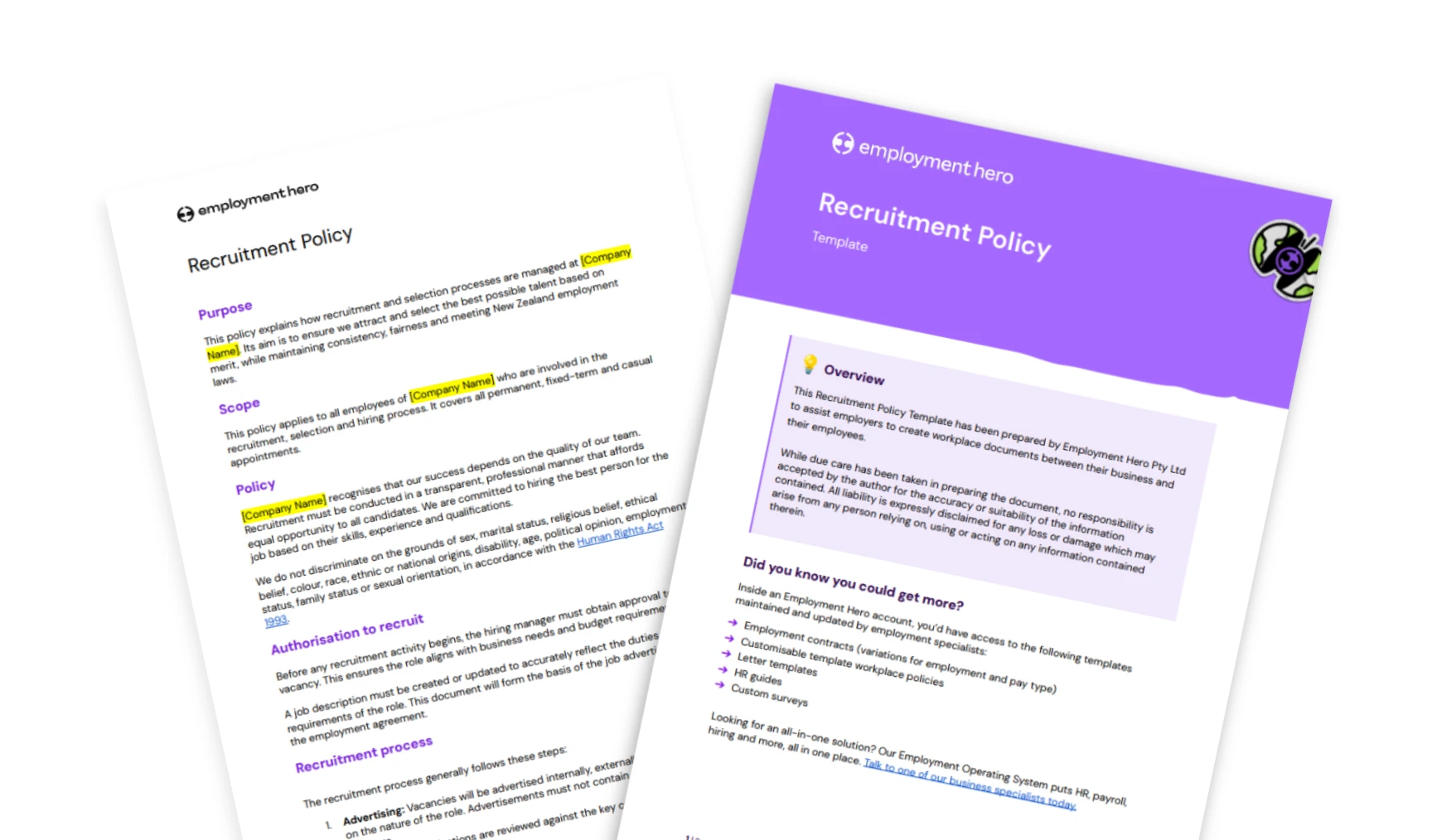 Read more: Creating a recruitment policy: template and guide
Creating a recruitment policy: template and guide
Discover how to create a comprehensive recruitment policy, or download the template tailored for NZ businesses.
-
 Read more: Hero Hour: Auckland
Hero Hour: Auckland
Join Auckland’s HR and business leaders at Saint Alice on March 26. Network with the Employment Hero team and shape…

