

















Payroll reporting guide for NZ employers
Published
Payroll reporting guide for NZ employers
Published
Payroll is such a fundamental part of your business, ensuring that your employees are compensated correctly for their work. There’s also the accompanying legal obligations – leave calculations, correct deductions and of course, reporting. Ensuring you’re filing the correct information at the right time is a critical part of payroll compliance.
Our guide explains your obligations around payroll reporting, from payday filing with Inland Revenue to keeping accurate records under the Employment Relations Act.
Download the guide by filling in the form on the right.
Understanding payroll reporting requirements in New Zealand
Getting payroll reporting right is crucial for every New Zealand employer. There are a few important requirements that you need to meet to stay compliant.
Legal and compliance obligations
Your responsibilities are guided by two main bodies. Inland Revenue (IRD) manages tax and deductions, while Employment New Zealand oversees employee entitlements and record-keeping. Meeting the requirements of both is essential for lawful operation and avoiding penalties.
IRD registration and employer responsibilities
Before you hire your first employee, you must register as an employer with Inland Revenue. This is a critical first step that sets up your PAYE account to manage tax obligations from day one. You are then responsible for deducting and paying PAYE, KiwiSaver and other contributions for your team.
Employment Relations Act record-keeping requirements
The Employment Relations Act 2000 requires you to keep detailed wage, time and leave records for every employee. These records must be accurate and kept for at least seven years. Proper record-keeping is the foundation of compliant NZ payroll reporting.
Essential payroll reports
Employers must produce several key reports to meet their obligations. These documents provide a transparent record of earnings deductions and entitlements for your employees and the government.
Wages and time records
For each employee, you must maintain records showing hours worked each day and the pay for those hours. This is a specific requirement under the Employment Relations Act 2000 and is vital for calculating correct pay and leave.
PAYE deduction reports and filings
Each pay cycle, you must report all PAYE (Pay As You Earn) tax deductions to IRD. This is done through payday filing and ensures that employees’ income tax obligations are met correctly throughout the year.
KiwiSaver contribution reports
Tracking and reporting KiwiSaver contributions is another core task. Your reports must accurately show both employee deductions and your mandatory employer contributions, ensuring all funds are correctly allocated to your team’s retirement savings.
IRD payroll requirements and deadlines
Inland Revenue has strict deadlines for filing payroll information and making payments. Missing these dates can lead to penalties and interest, so it’s important to have them locked in your calendar.
Payday filing timeline (2 working days rule)
If you use payroll software, you must send your employment information to IRD within two working days of each payday. This system provides near real-time reporting of employee earnings and deductions.
Monthly tax payment due dates (20th of following month)
For most employers, payments for all deductions, including PAYE and KiwiSaver are due by the 20th of the month, following the paydays they relate to. For example, all deductions made in May must be paid to IRD by 20 June.
End of financial year reporting (31 March 2025)
At the end of the financial year on 31 March you need to ensure all your payroll information for the year is correct and reconciled with IRD’s records. This annual check helps finalise tax positions for you and your employees.
Mandatory employee data in payroll reports
Your payroll reports must contain specific employee data to be compliant. This information ensures each employee is identified correctly and their pay is processed accurately.
Personal information and tax code details
You must include each employee’s full name, address and IRD number in your payroll records. Their tax code is also essential, as it determines the rate of PAYE tax deducted from their earnings.
Hours worked and leave entitlements
Accurately tracking hours worked is fundamental, especially for waged employees. You also need to maintain a clear record of accrued and taken leave, ensuring you meet your obligations under the Holidays Act 2003.
Gross pay, deductions and net pay breakdowns
Every payslip and report must clearly show the breakdown of an employee’s pay. This includes their total gross earnings, a list of all deductions like PAYE and KiwiSaver and their final net pay.
KiwiSaver and retirement scheme reporting
KiwiSaver is a key part of payroll. Employers play a vital role in managing contributions and ensuring compliance with scheme rules.
Employee contribution rates (3%, 4%, 6%, 8%, 10%)
Employees can choose to contribute 3%, 4%, 6%, 8% or 10% of their gross pay to KiwiSaver. You must deduct their chosen rate correctly from their pay each cycle.
Employer contribution requirements (3% minimum)
For eligible employees who contribute to KiwiSaver, you are required to make a minimum employer contribution of 3% of their gross earnings. This is a mandatory part of your payroll obligations.
Opt-out procedures and documentation
When a new employee is automatically enrolled in KiwiSaver, they have a set window to opt out. You must follow the correct IRD-approved process and maintain records of any opt-out notices.
Leave and entitlement reporting
Under the Holidays Act 2003, you must keep precise records of all leave. This includes annual holidays, sick leave, bereavement leave and public holidays, ensuring employees receive their full entitlements.
Payroll compliance for different employee types
Payroll rules can differ for casual, part-time and full-time staff. It is also critical to correctly classify workers as employees or contractors, as their payment and tax obligations are very different.
Digital payroll reporting systems and tools
Modern payroll software simplifies compliance and reporting. These digital tools automate calculations, manage payday filing directly with IRD and integrate with your accounting systems, saving you time and reducing the risk of errors.
Find out how Employment Hero’s payroll software does all those steps and more.
Download the full guide
Learn how to manage your obligations with confidence. Our detailed guide covers everything you need to know about payroll reporting in New Zealand.
Download the payroll reporting guide by filling in the form on the right.
The information in this article is current as at 30 October 2025, and has been prepared by Employment Hero Pty Ltd (ABN 11 160 047 709) and its related bodies corporate (Employment Hero). The views expressed in this article are general information only, are provided in good faith to assist employers and their employees, and should not be relied on as professional advice. Some information is based on data supplied by third parties. While such data is believed to be accurate, it has not been independently verified and no warranties are given that it is complete, accurate, up to date or fit for the purpose for which it is required. Employment Hero does not accept responsibility for any inaccuracy in such data and is not liable for any loss or damages arising directly or indirectly as a result of reliance on, use of or inability to use any information provided in this article. You should undertake your own research and seek professional advice before making any decisions or relying on the information in this article.
Register for the guide
Related Resources
-
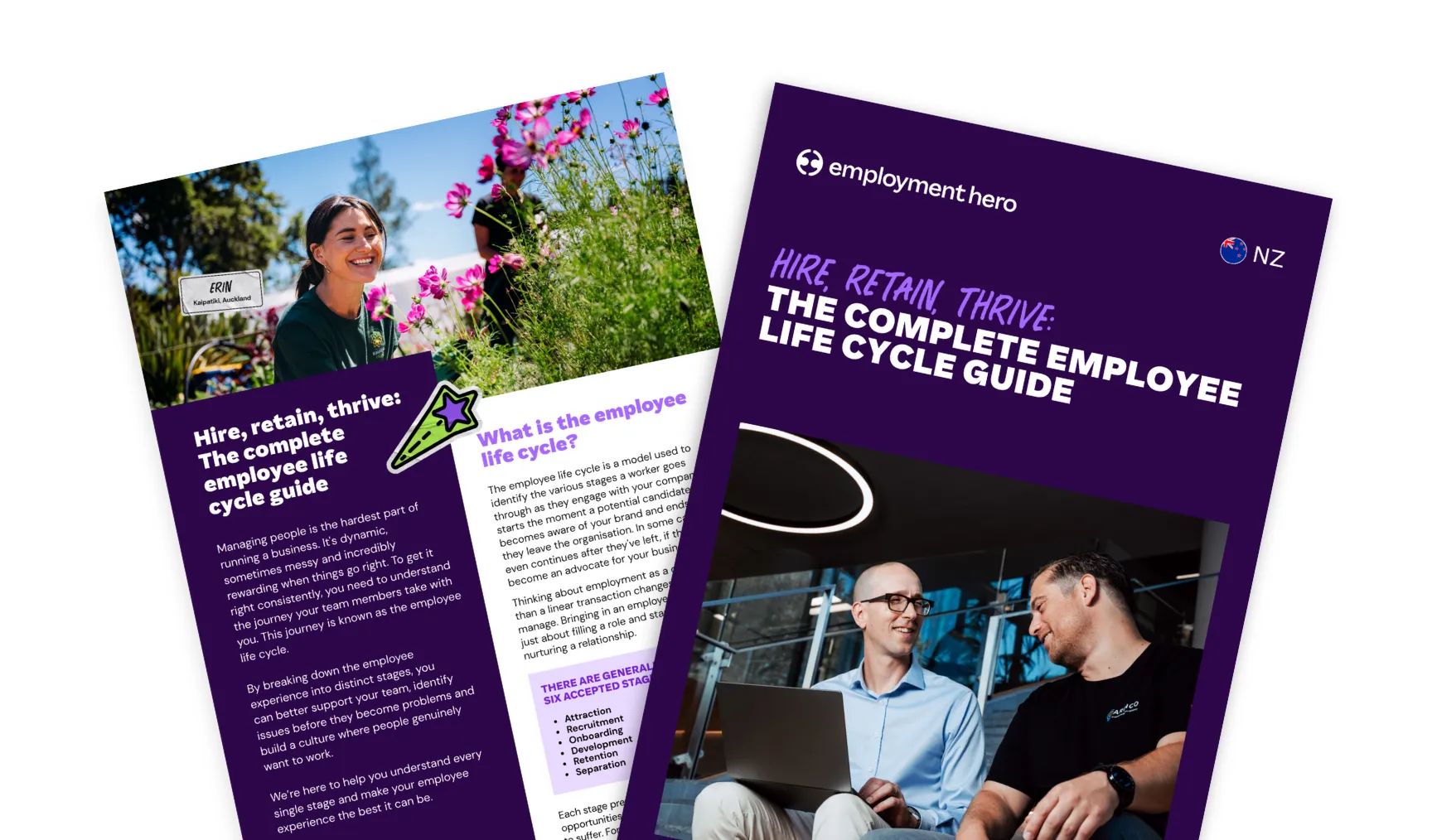 Read more: Hire, retain, thrive: The complete employee life cycle guide
Hire, retain, thrive: The complete employee life cycle guide
Learn the full scope of the employee life cycle and how it impacts recruitment, onboarding and retention.
-
 Read more: The Invisible Duty: Navigating NZ’s Psychosocial Safety Landscape
The Invisible Duty: Navigating NZ’s Psychosocial Safety Landscape
Join Employment Hero’s Employment Counsel, Sanam Ahmadzadeh Salmani, for a practical webinar on NZ health and safety duties.
-
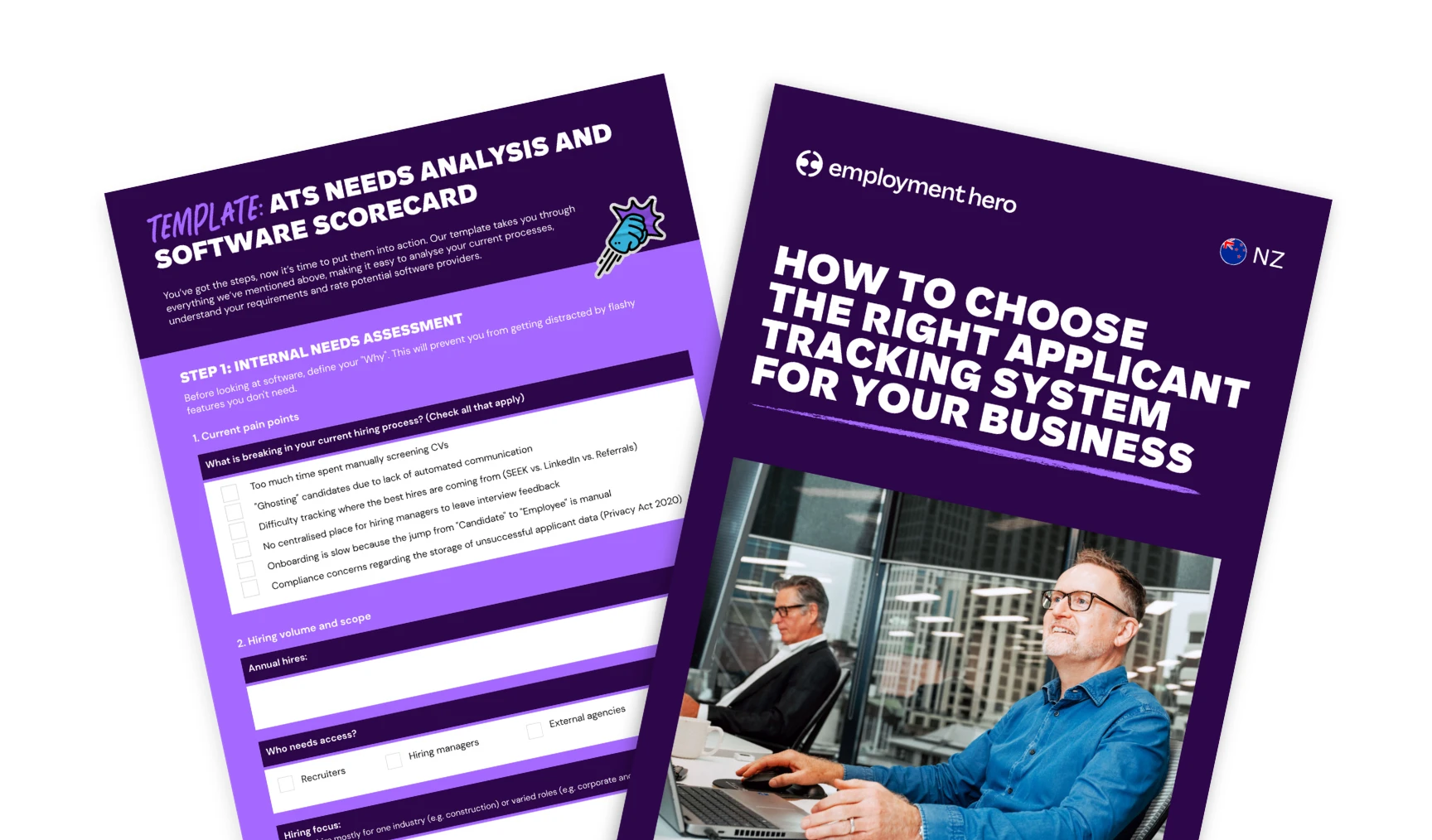 Read more: How to choose the right ATS for your business
How to choose the right ATS for your business
Learn how to choose the right applicant tracking system. Explore features, vendor questions, red flags, and comparison tips in this…

