 Australia
  United Kingdom
  Singapore
  Malaysia
  Canada (Français)
 New Zealand


Introduction to HR management: Beginner’s guide for New Zealand businesses
Published
Introduction to HR management: Beginner’s guide for New Zealand businesses
Published
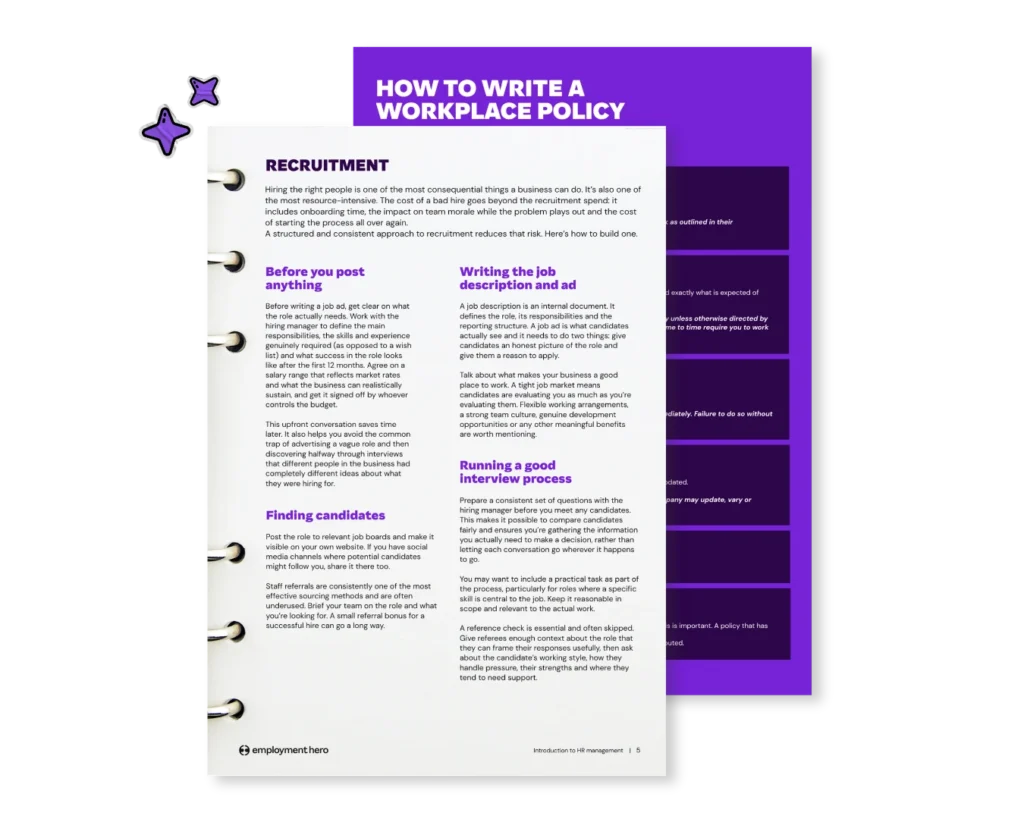
Has your business grown significantly over the last 12 months? Are you looking to expand your team with great talent? Are you concerned about running your business compliantly? Congratulations! It’s time to start thinking about HR.
What is in this human resource management guide?
In this guide, we go back to basics and talk through everything HR beginners need to know. You’ll learn about:
- The importance of HR in growing companies
- The basics of recruitment, onboarding, policies, performance and more
- The digital tools that can help you easily get started
Download the guide by filling in the form on the right.
The information in this guide is current as at 5 April 2026, and has been prepared by Employment Hero Pty Ltd (ABN 11 160 047 709) and its related bodies corporate (Employment Hero). The views expressed in this guide are general information only, are provided in good faith to assist employers and their employees, and should not be relied on as professional advice. Some information is based on data supplied by third parties. While such data is believed to be accurate, it has not been independently verified and no warranties are given that it is complete, accurate, up to date or fit for the purpose for which it is required. Employment Hero does not accept responsibility for any inaccuracy in such data and is not liable for any loss or damages arising directly or indirectly as a result of reliance on, use of or inability to use any information provided in this guide. You should undertake your own research and seek professional advice before making any decisions or relying on the information in this guide.
What is HR management?
Human resources (HR) management is the practice of overseeing the people who make up your organisation, from the moment they’re hired to the moment they leave. It covers everything from setting employment terms and building workplace policies, to supporting employee performance and ensuring your business stays compliant with employment law.
At its core, HR exists to create the conditions in which both people and businesses can thrive. It connects the goals of the organisation with the needs of the workforce, acting as the bridge between leadership decisions and day-to-day employee experience.
While some people use “HR management” and “personnel management” interchangeably, there’s a meaningful distinction. Personnel management focuses on employee-facing activities like talent management, learning and development, and engagement. HR management is the broader discipline: it encompasses all of that, plus administration, compliance, strategic workforce planning and more. In practice, the two overlap significantly and the most effective HR professionals are skilled in both.
Why HR matter for small businesses
It’s a common misconception that HR is only for large organisations with dedicated departments. In reality, wherever you have people, you have HR, and getting it right matters just as much (if not more) in a small business setting.
The case comes down to three things: keeping your people, staying on the right side of the law and getting the most out of your team.
High turnover is expensive. Replacing an employee can cost anywhere from a few months’ to over a year’s salary when you factor in recruitment, onboarding and lost productivity. Good HR practices help people feel valued and give them reasons to stay. On the compliance side, employment law is complex and constantly evolving. A missing contract, an outdated policy or a miscalculated leave entitlement can quickly turn into a dispute or a regulatory problem. And when it comes to productivity, employees who know what’s expected of them, have the right tools and feel genuinely supported simply perform better.
Core HR functions
HR is a broad function that spans the full employee lifecycle. While every business will have its own priorities, these are the six areas that form the foundation of any solid HR operation.
Recruitment is where it all begins. Finding and hiring the right people is one of the most impactful things a business can do, and good recruitment goes well beyond posting a job ad. It involves defining role requirements clearly, running a consistent and fair selection process and making offers that reflect both market rates and what the business can sustainably support.
Onboarding sets the tone for everything that follows. The first few weeks in a new role shape an employee’s long-term engagement and a well-structured process ensures new starters have the equipment, access, information and support they need from day one. Poor onboarding leads to confusion and fast turnover, often before the business has had a chance to see the person perform.
Payroll is non-negotiable. Accurate, on-time pay is a basic expectation, and errors here can seriously damage employee trust. Payroll also intersects with leave, hours and compliance obligations, making it one of the more complex HR responsibilities to manage well.
Performance management is an ongoing process, not an annual event. It involves setting clear expectations, providing regular feedback, supporting development and addressing issues before they escalate. Regular one-on-one meetings between managers and their direct reports are one of the most effective tools for keeping this on track.
Compliance means staying current with employment legislation and making sure your business practices reflect those requirements, covering everything from contracts and leave entitlements to health and safety obligations.
Policies provide the framework that ties it all together. They set clear standards for conduct and give everyone in the organisation a consistent reference point when questions or issues arise.
HR responsibilities by business size
HR doesn’t look the same at every stage of growth. The right approach depends heavily on how many people you’re managing and how quickly things are changing.
At 1 to 10 employees, the business owner usually handles HR directly. The priority is getting the foundations right: proper employment contracts for everyone, a small set of essential policies covering conduct, leave and health and safety, and a basic onboarding process. Even without a dedicated HR role, simple tools and templates can save significant time and reduce risk.
The 10 to 50 employee stage is where informal approaches start to break down. Businesses at this size typically need to formalise their HR processes, introduce consistent performance management, expand their policy library and think more deliberately about culture and retention. Many will bring in a part-time HR coordinator or outsource to a specialist.
At 50 or more employees, HR becomes a strategic function. Dedicated roles are usually necessary, and the focus shifts toward workforce planning, compliance management at scale, structured learning and development programs and data-driven decision making. HR technology becomes essential rather than optional.
Common HR challenges
Even businesses with the best intentions run into HR problems. Most of them are avoidable with the right processes in place.
No written employment contracts
Agreeing employment terms verbally might feel easy at the time, but without a written contract there’s nothing to refer to if a dispute arises over hours, responsibilities, pay or termination. It’s one of the most common HR risks and one of the most avoidable. Always document employment terms in writing and make sure both parties have a signed copy.
Poor onboarding
A new employee who isn’t properly set up, given clear guidance or introduced to the role in a structured way is likely to disengage quickly. The effects tend to have a longer tail than employers realise. In a small team, one person checking out early can have an outsized impact on morale and productivity well beyond that individual.
Outdated or absent policies
Some businesses never establish policies. Others wrote them years ago and haven’t revisited them since. Both situations leave the business exposed in ways that often only become apparent when something goes wrong. Policies need to reflect current legislation, current team size and current ways of working, and they should be reviewed whenever the business changes significantly.
Over-reliance on manual processes
Spreadsheets, paper forms and email chains might hold things together when a team is tiny, but they don’t scale. Manual HR processes are time-consuming, error-prone and keep HR managers tied up in administration rather than the higher-value work that actually improves the employee experience.
Avoiding performance conversations
Many managers delay difficult conversations until a situation has escalated, at which point options are limited and relationships can already be strained. It’s a pattern that tends to compound. Building a culture of regular, honest feedback makes these conversations easier over time and prevents small issues from becoming serious ones.
HR tools and software
As HR becomes more complex, technology plays an increasingly important role in helping businesses manage it well. HR software, sometimes called a Human Resource Information System or HRIS, brings together the different functions of HR into a single integrated platform.
Rather than managing leave in a spreadsheet, distributing policies over email, and storing contracts in a filing cabinet, an HRIS gives you one place to handle all of it. The best platforms are cloud-based, which means your team can access what they need from anywhere, data stays secure, and updates happen automatically.
What should you look for? The core capabilities that make the biggest difference day to day include:
- Leave management, so employees can request leave and managers can approve it without manual tracking.
- Policy distribution with acknowledgement tracking and automated reminders.
- Digital contracts that new starters can sign and access without paperwork.
- Compliance reporting to track outstanding certifications and documents across your team.
- Payroll integration so leave, hours, and pay data are always aligned.
An HRIS doesn’t replace good HR judgement. What it does is remove the administrative load that so often prevents HR from being done well in the first place.
When to consider HR software
There’s no single right moment to invest in HR software, but there are clear signals that the time has come.
The most obvious is when the HR admin is crowding out everything else. If processing leave requests, chasing policy acknowledgements and filing documents is eating into time that should go toward hiring, strategy or actually managing people, automation will give that time back.
Rapid growth is another trigger. Adding headcount is exciting, but it multiplies HR complexity quickly. Onboarding, compliance tracking and leave management all become significantly harder to manage manually once a team reaches a certain size.
A compliance scare is a strong signal that the current approach isn’t reliable enough. If you’ve had to scramble to find a signed contract, discovered a policy was never acknowledged or found a leave entitlement was miscalculated, those are exactly the kinds of errors a good HRIS should help with.
Managing a distributed or remote team is a situation where manual HR processes simply don’t work. Paper forms, in-person sign-offs and word-of-mouth policies fall apart the moment your team is working across different locations or time zones.
Finally, if you want better visibility into what’s happening across your workforce, whether that’s turnover trends, engagement, leave patterns or performance data, you need a system that can surface that information. Spreadsheets can’t do that at scale.
The right time to invest in HR software is before you need it urgently. Building solid HR infrastructure during a growth phase is far easier than retrofitting it after problems have already emerged.
For more detailed information on HR management, download our guide today.
Download the Human Resource Management Guide
Related Resources
-
 Read more: The AI Adoption Blueprint
The AI Adoption Blueprint
What does it take to embed AI across an entire team? We’re sharing our training, our policies, and the lessons…
-
 Read more: Employment Essentials: AI Best Practices
Employment Essentials: AI Best Practices
Learn how to use AI in HR without creating privacy, compliance or employment risks in our latest webinar.
-
 Read more: The High Performance Series: The Power of Recovery
The High Performance Series: The Power of Recovery
Learn how elite teams manage recovery and prevent burnout. Join Employment Hero and The Blues for practical HR mental health…

