

















Restructuring checklist for HR teams
Published
Restructuring checklist for HR teams
Published
Restructuring is one of the toughest responsibilities a HR leader can face. It’s a process filled with complexity and, whether the business is adapting to market shifts or aiming for greater efficiency, changing a business structure impacts the people most of all.
Done poorly, it can lead to personal grievance claims, damaged morale and real harm to the business reputation. But when handled with care, empathy and a fair process, a restructure can set the business up for a stronger, more sustainable future.
Our checklist breaks down Employment New Zealand’s key guidelines for restructuring, turning them into actionable steps that your HR team can take through the process.
Download the checklist by filling in the form on the right.
Note: this isn’t legal advice, so we’d highly recommend you seek independent legal counsel before beginning the restructuring process.
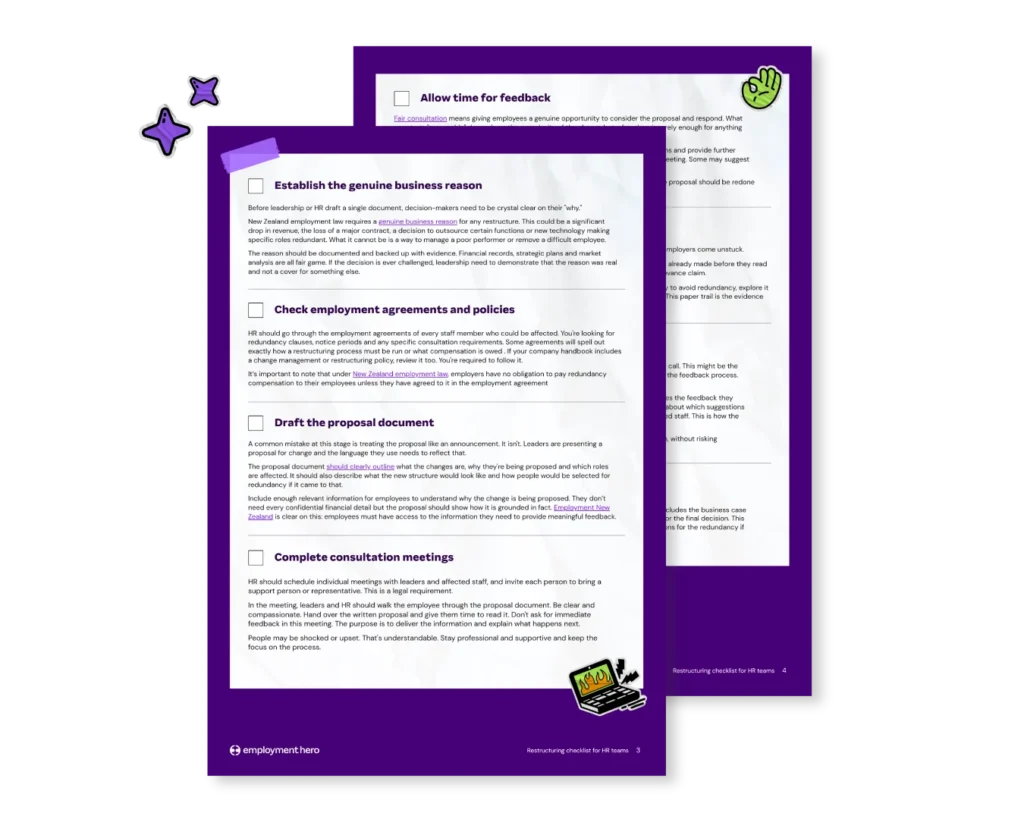
Preparing for the restructure
The success of any restructure hinges on the preparation. Rushing this step (or failing to document the reasoning) can undermine the entire process.
First, the decision-makers must establish a genuine business reason for the proposed changes. Under Employment New Zealand guidance, this is a legal requirement, not a formality. It must be grounded in real commercial circumstances: a significant drop in revenue, the loss of a major contract, new technology making certain roles obsolete or a strategic shift in direction. It cannot be used to manage an underperforming employee or resolve a personality clash.
They’ll need to gather evidence to support the reasoning. Financial statements, market analysis reports, board meeting minutes and new strategic plans all help build a case they could potentially defend if challenged.
Next, HR should review the employment agreements for every affected employee. Look for clauses related to restructuring, redundancy and notice periods. These are legally binding and must be followed precisely. Check the employee handbook too. If a change management or restructuring policy exists, the business is required to follow it.
With the business case clear, define what success looks like on the other side of the change. Specific, measurable goals will guide the team’s decision-making and help you communicate the purpose of the restructure to the team.
Presenting the proposal
How company leadership communicates the proposed changes is just as important as the changes themselves. This is where the process becomes real for employees, and the approach needs to be clear, honest and empathetic. Critically, leaders or HR are presenting a proposal for consultation, not announcing a final decision. The language they use should reflect this.
The proposal document needs to cover:
- The why — the genuine business reason, explained clearly.
- What’s changing — which roles are affected and what the new structure looks like.
- Selection criteria — if redundancies are possible, how leaders would decide who is affected.
Employees must be given enough relevant information to understand the proposal and provide meaningful feedback. Leaders don’t need to share every sensitive commercial detail, but they do need to share what has informed the thinking. Failing to do so can render the consultation process unfair.
Once the proposal is ready, HR and team leaders should schedule meetings with affected staff. Employment New Zealand requires that they are invited to bring a support person or representative. Walk them through the proposal, hand them a written copy and explain the next steps. This is not the time to debate or seek immediate feedback, it’s about giving people the information they need. Leaders should be prepared for a range of emotional reactions and stay professional, supportive and focused on the process.
Getting feedback
The consultation phase is a cornerstone of a fair and legally sound restructuring process. It is not a tick-box exercise, but a genuine opportunity for employees to influence the outcome.
Employment New Zealand requires that employees are given a reasonable amount of time to consider the proposal and respond. What’s reasonable depends on the complexity of the changes, but a few days is almost never sufficient for a significant restructure. A week or more is often necessary.
Leaders and HR should make themselves available to answer questions throughout this period. Feedback can come in different forms. Some employees may prefer to respond in writing while others may request a meeting. It’s wise to accommodate these preferences where possible.
Some employees may suggest alternatives to redundancy, such as reduced hours, job sharing, unpaid leave or other cost savings. Leaders have a legal duty to genuinely consider every suggestion with an open mind. If they enter this phase with their mind already made up, the process is not compliant and they risk a personal grievance claim. Document all feedback received and the consideration of it.
Making a decision
After consultation closes and all feedback has been thoroughly reviewed, leaders can move towards a final decision. This is where they weigh the original proposal against the suggestions and counter-proposals from the team. The final decision may look identical to the initial proposal or it may be significantly different. Both are valid outcomes.
Evaluate each piece of feedback on its merits. If an employee suggested an alternative way to achieve cost savings, assess whether it is genuinely viable. If leaders decide not to adopt a suggestion, they must have a clear, documented business reason for that choice.
Once a final decision is made, leaders should communicate it in a formal document that:
- Summarises the consultation process
- Acknowledges the feedback received and how it was considered
- Responds to the key themes and suggestions
- States the final decision and new structure clearly
Send this to all affected staff. Even when people don’t get the outcome they hoped for, being shown that their input was genuinely considered matters.
Implementation
Once the final decision is confirmed, the new structure becomes a reality. If redundancies are involved, there are several important steps to manage carefully.
Redeployment must be considered first. Before confirming any redundancy, Employment New Zealand requires that employers look for suitable vacant positions elsewhere in the business. A role is considered suitable if the employee has the skills and experience to perform it, or could do so with reasonable training. If a suitable position exists, it must be offered. Redeployment always takes priority over redundancy.
If no redeployment options are available, leaders and HR should confirm the redundancy formally and provide written notice, in line with the employee’s agreement. They may require them to work through the notice period or agree to pay in lieu of notice.
HR and payroll teams should calculate and pay the final entitlements correctly. This includes outstanding wages, notice pay, accrued holiday pay and any redundancy compensation specified in the employment agreement.
Beyond the legal obligations, offering practical support to departing employees makes a real difference. Paid time off to attend job interviews, a written reference or access to outplacement services all help with the transition.
Organisational restructuring examples
Restructures come in many shapes and sizes. A small retail business might close a physical store to focus on e-commerce, making a handful of roles redundant. A larger manufacturer might bring a previously outsourced logistics function in-house, creating new roles while disestablishing others. A technology firm might merge two development teams into a single unit to improve collaboration, resulting in a flatter structure with fewer management positions.
Each scenario requires the same fair process, regardless of the scale.
Mitigating risks during restructuring
The most obvious legal risk in any restructure is a personal grievance claim for unjustified disadvantage or unjustified dismissal. The best way to mitigate this is to follow a fair and documented process at every step and seek professional advice when unsure.
Cultural risks are just as serious. A poorly handled restructure can destroy morale, erode trust and create “survivor syndrome”, where remaining employees feel anxious and disengaged. Communicating openly throughout the process, being visible and acknowledging the difficulty of the situation all help protect the culture. Supporting both departing and remaining staff is key.
For a suggested list of HR actions during a restructure, download our checklist today.
The information in this article is current as at 13 February 2026, and has been prepared by Employment Hero Pty Ltd (ABN 11 160 047 709) and its related bodies corporate (Employment Hero). The views expressed in this article are general information only, are provided in good faith to assist employers and their employees, and should not be relied on as professional advice. Some information is based on data supplied by third parties. While such data is believed to be accurate, it has not been independently verified and no warranties are given that it is complete, accurate, up to date or fit for the purpose for which it is required. Employment Hero does not accept responsibility for any inaccuracy in such data and is not liable for any loss or damages arising directly or indirectly as a result of reliance on, use of or inability to use any information provided in this article. You should undertake your own research and seek professional advice before making any decisions or relying on the information in this article.
Register for the checklist
Related Resources
-
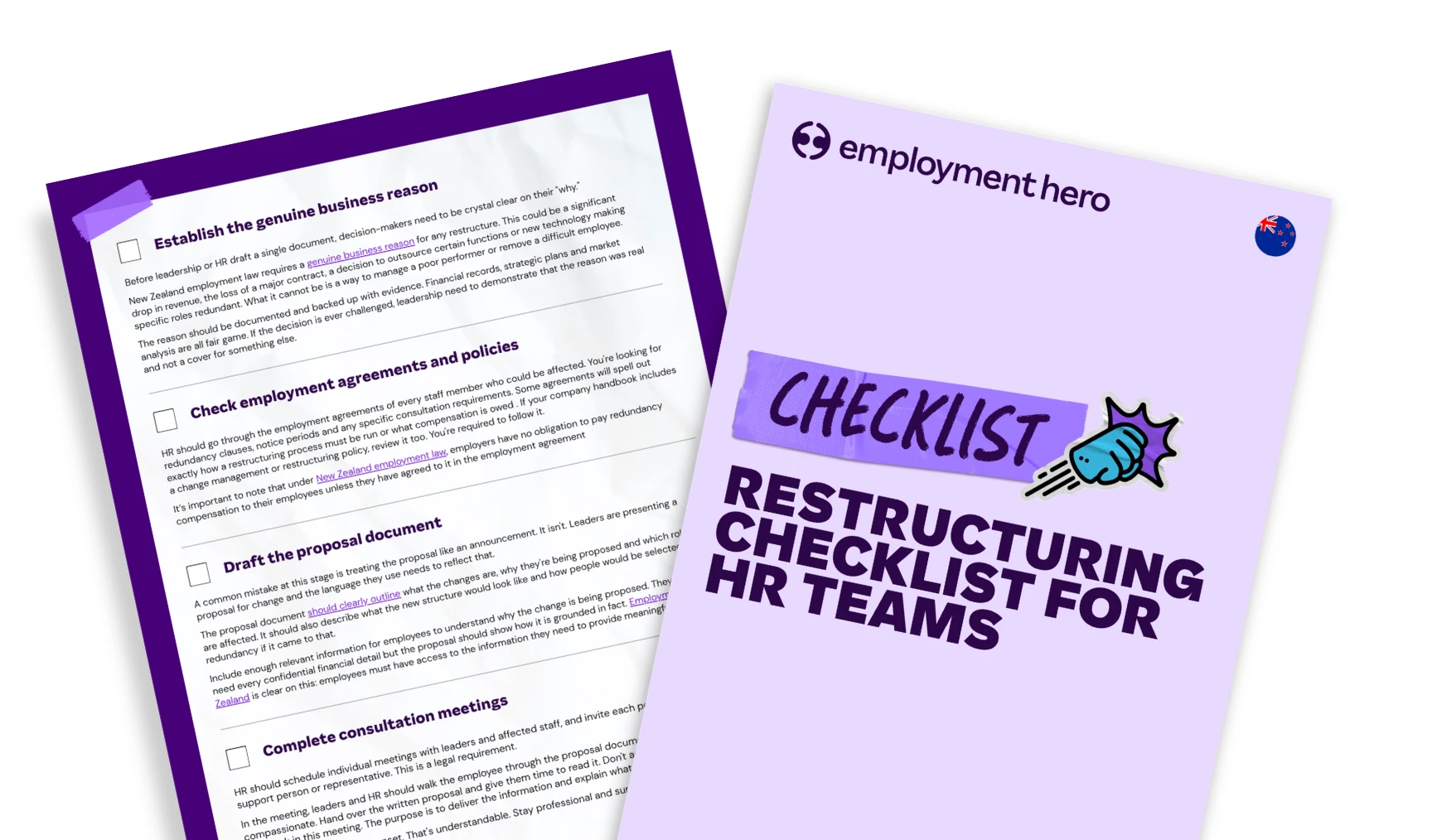 Read more: Restructuring checklist for HR teams
Restructuring checklist for HR teams
Streamline your HR restructuring process with our essential checklist. Navigate changes confidently and ensure a smooth transition.
-
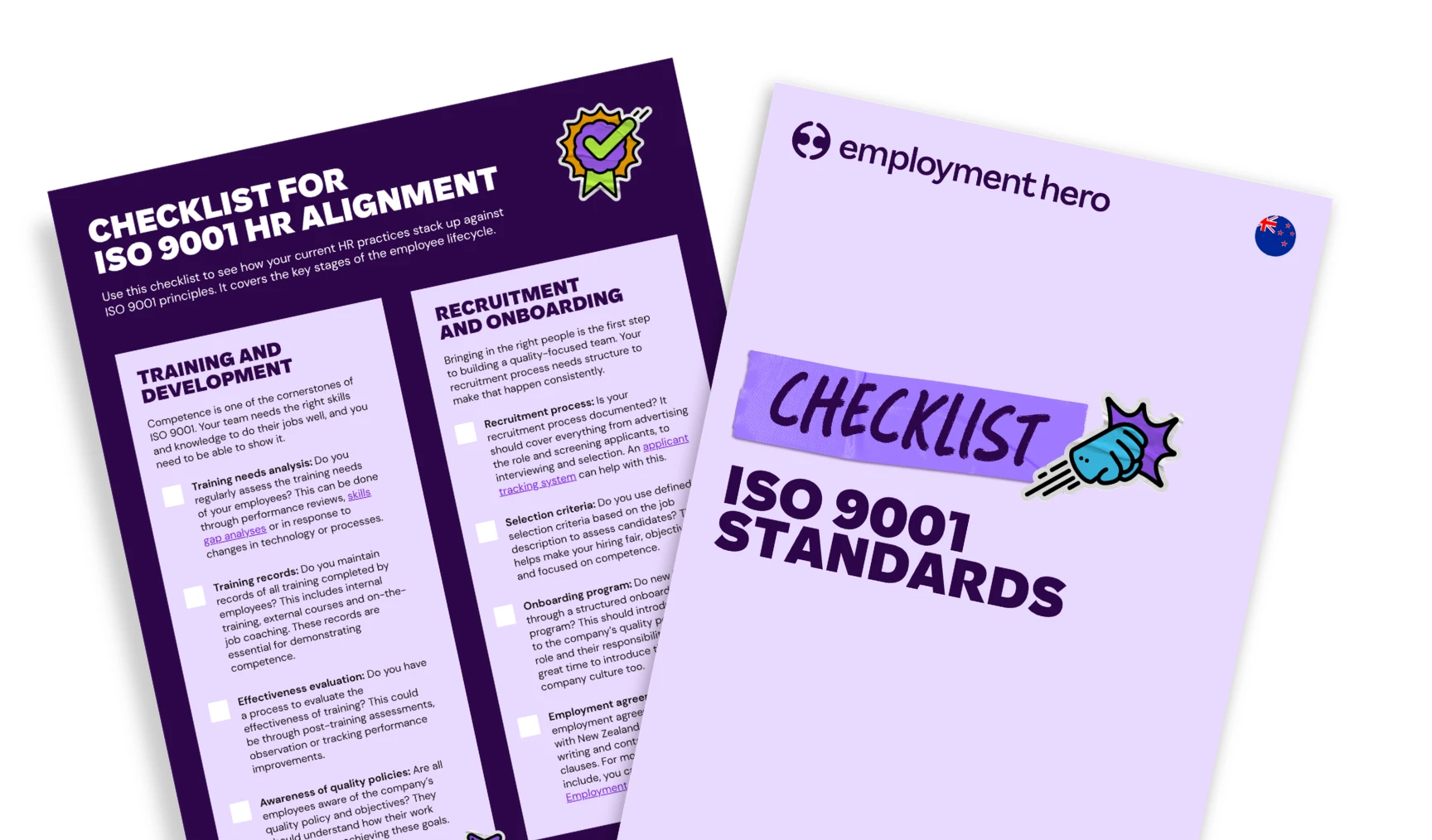 Read more: ISO 9001 standards: HR audit checklist
ISO 9001 standards: HR audit checklist
Review your compliance with ISO 9001 using our essential HR audit checklist.
-
 Read more: AI in construction: what every employer needs to know
AI in construction: what every employer needs to know
Contents The construction industry has always been about more than just steel and concrete; it’s about the coordination of labour,…

