

















ISO 9001 standards: HR audit checklist
Published
ISO 9001 standards: HR audit checklist
Published
Going for ISO 9001 certification is a big deal. It tells your customers and partners that you take quality seriously, and in many industries it’s what gets you through the door in the first place. Government tenders, supplier approvals, international partnerships and quality-sensitive sectors like construction, IT, pharmaceuticals and aerospace all commonly require it.
While it may seem like a specific industry concern, HR can benefit from following this standard too. Your people are your biggest asset and how you manage them has a direct impact on quality, consistency and customer satisfaction. In fact, research shows that 73% of businesses report improved employee productivity after ISO 9001 certification, and 56% see improvement in employee satisfaction.
How do your HR processes stack up against the ISO 9001 standard? We’ve created a checklist to help you assess your current setup.
Download the checklist today by filling the form on the right.
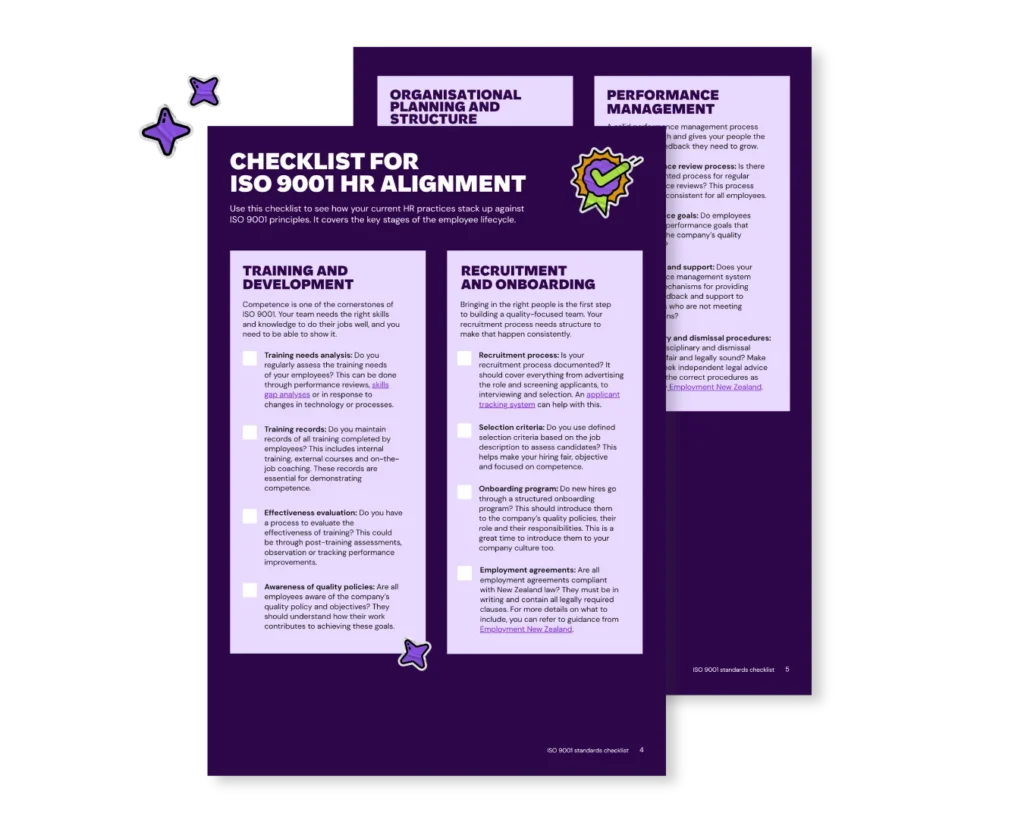
What is ISO 9001?
ISO 9001 is the international standard for quality management systems (QMS). A QMS is the set of policies, processes and procedures that shape how your business plans and delivers its core work. In plain terms, it’s a framework that helps businesses consistently deliver products and services that meet customer and regulatory expectations.
ISO 9001 certification is voluntary, but it’s the independent proof that your quality management system actually works. Think supplier approvals, government tenders, international partnerships and quality-critical industries like construction, IT, pharmaceuticals and aerospace.
Even if you’re not interested in certification, it provides a good list of principles to follow for successful business management.
Here’s how the ISO 9001 standard look in practice, across all elements of your people management:
HR policies and procedures
Good policies aren’t just a compliance tick, they’re what keeps your whole team on the same page. For ISO 9001, your HR policies need to be written down, easy to find and applied the same way every time. Take a look at what you’ve got now: are they current with New Zealand employment law? Does everyone actually know they exist? Getting this right cuts down on confusion and gives people a fair, clear framework to work within.
Recruitment and hiring
ISO 9001 wants to see a structured approach to hiring, not guesswork. That means clear job descriptions, defined selection criteria and fair, consistent assessments for every candidate. It’s not about making the process harder; it’s about making sure you’re bringing in people who can genuinely do the job well and help you hit your goals.
Employment agreements
Your employment agreements do a lot of heavy lifting. They’re legal documents that protect both your business and your people. For ISO 9001, every agreement needs to be in writing, including all legally required clauses. You can find guidance on what to include from Employment New Zealand.
Onboarding
A solid onboarding experience does two things at once: it sets your new hire up for success and it builds your culture from day one. Your onboarding program should cover company policies, role-specific training and how their work connects to your objectives. And don’t skimp on the documentation, because auditors will want to see it.
Employee records
Keeping employee records accurate and secure isn’t optional under ISO 9001; it’s a core requirement. Whether it’s agreements, performance reviews or training logs, your records need to be confidential, correct and ready to show an auditor at any time. Getting the basics of record-keeping right can help you meet your responsibilities under the Privacy Act 2020.
Compliance
Compliance isn’t a one-and-done job, it’s ongoing. You’ll need a clear picture of your obligations under New Zealand employment law, ISO 9001 requirements and any rules specific to your industry. The good news? Staying on top of it proactively is a lot easier (and cheaper) than scrambling to fix gaps when an auditor shows up.
Employee benefits
Your benefits program should be competitive, compliant and clearly laid out. For ISO 9001, it’s not enough to just offer great perks. You need to show they’re managed consistently, with proper records and processes behind them. That’s what demonstrates genuine care for your team and gives auditors a clean, transparent system to review.
Performance management
Continuous improvement is at the heart of ISO 9001, and your performance management system is where that comes to life. Appraisals and feedback need to be structured, happen regularly and connect directly to your quality objectives. The goal is real, meaningful improvement, not just going through the motions to satisfy a checkbox.
Training and development
ISO 9001 puts a lot of weight on competence. Your people need the right skills and knowledge to do their jobs well and support your quality goals. That means actively identifying training gaps, providing the right development opportunities and keeping detailed records to back it all up. It’s not just about ticking a box; it’s about making sure your team can genuinely deliver.
HR technology
A good HRIS makes ISO 9001 compliance a whole lot easier. It gives you one place to store, secure and manage all your HR data, with built-in privacy controls, access management and the kind of audit-ready record-keeping that ISO 9001 expects. Think of it as your single source of truth for everything HR.
Termination and exit procedures
When someone leaves your business, the process needs to be handled with care and thorough documentation. From final pay calculations to exit interviews, every step should be clearly defined and recorded. ISO 9001 expects you to manage this as carefully as any other process.
Workplace safety
Keeping your team safe isn’t negotiable, and under ISO 9001, you need to show you’re serious about it. That means documented safety policies, clear hazard controls and up-to-date training records. It protects your people and gives auditors the evidence they need to see that you’re managing risk responsibly.
Documentation and reporting
In the world of ISO 9001, if it isn’t documented, it didn’t happen. Every HR activity, from a hiring decision to an exit interview, needs a paper trail. That documentation is your evidence, your audit trail and your way of showing leadership and auditors alike that your processes actually work.
Human resources audit checklist for ISO 9001
When it comes to ISO 9001 HR audits, evidence is everything. It’s not enough to say you have great processes. Auditors need to see that they’re actually being followed consistently. Expect them to dig into your job descriptions, training records, performance reviews and policy documents to check that your system is working as intended.
A succinct checklist helps you quickly spot gaps in your legal and ISO compliance. Consider questions like:
- Are all employment agreements current and legally sound?
- Do you have up-to-date job descriptions for every role?
- Are training records complete and easily accessible?
- Is your performance review process documented and followed consistently?
- Are employee records stored securely and confidentially?
Streamlining HR processes for ISO standards
ISO 9001-ready HR doesn’t have to mean mountains of admin. The best approach is to design lean processes that support your team, without creating unnecessary busywork. Lean on automation and clear documentation to do the heavy lifting, because your team’s time is better spent on the work that actually moves the needle.
For a helpful checklist of key ISO 9001 requirements, download our checklist today.
The information in this article is current as at 13 February 2026, and has been prepared by Employment Hero Pty Ltd (ABN 11 160 047 709) and its related bodies corporate (Employment Hero). The views expressed in this article are general information only, are provided in good faith to assist employers and their employees, and should not be relied on as professional advice. Some information is based on data supplied by third parties. While such data is believed to be accurate, it has not been independently verified and no warranties are given that it is complete, accurate, up to date or fit for the purpose for which it is required. Employment Hero does not accept responsibility for any inaccuracy in such data and is not liable for any loss or damages arising directly or indirectly as a result of reliance on, use of or inability to use any information provided in this article. You should undertake your own research and seek professional advice before making any decisions or relying on the information in this article.
Register for the checklist
Related Resources
-
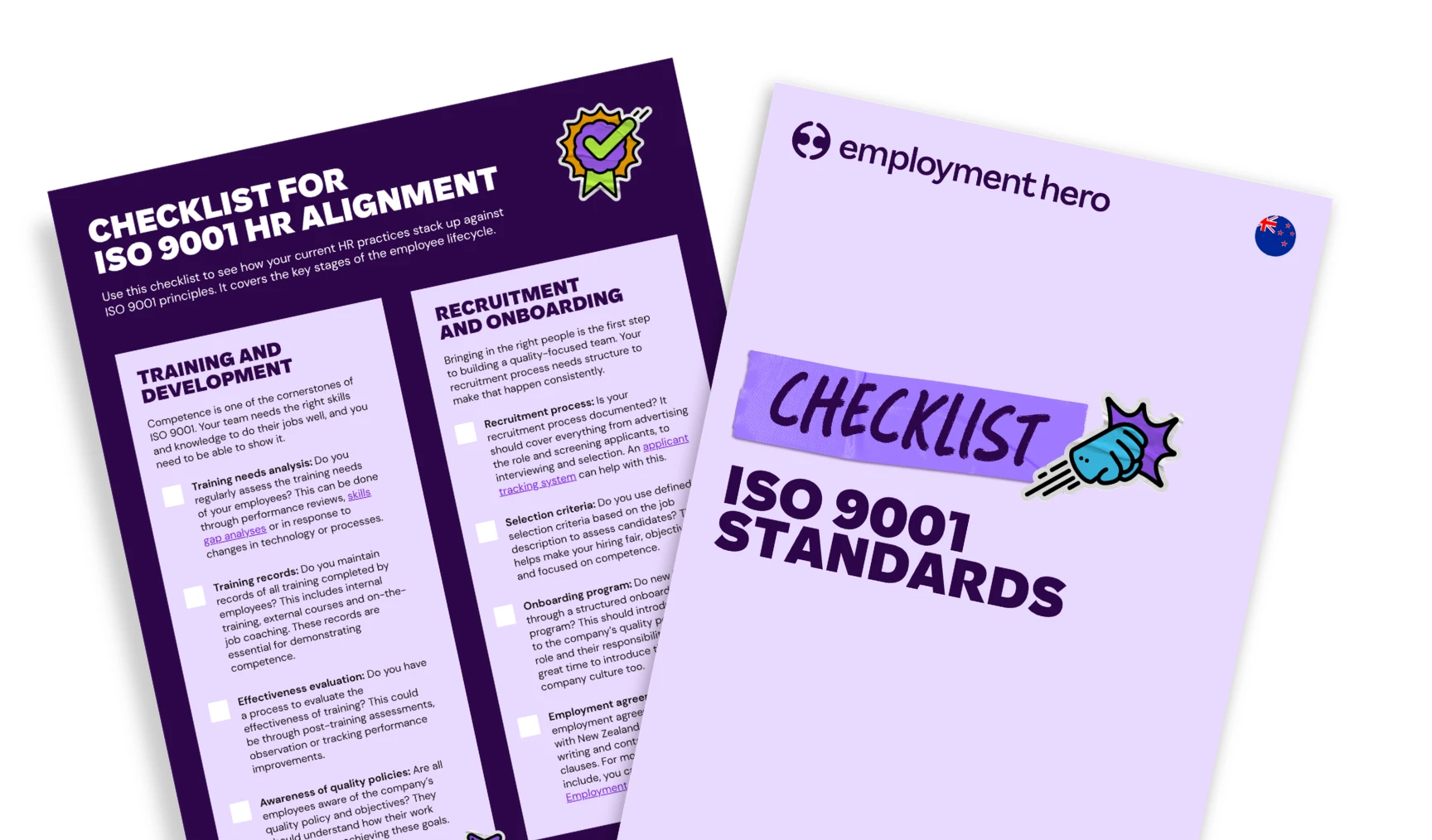 Read more: ISO 9001 standards: HR audit checklist
ISO 9001 standards: HR audit checklist
Review your compliance with ISO 9001 using our essential HR audit checklist.
-
 Read more: AI in construction: what every employer needs to know
AI in construction: what every employer needs to know
Contents The construction industry has always been about more than just steel and concrete; it’s about the coordination of labour,…
-
 Read more: Your team’s growing. Is your communication keeping up?
Your team’s growing. Is your communication keeping up?
As teams grow, communication breaks down. Learn how the right technology can keep your growing team connected, recognised and heard.

