

















Employee handbook template and guide
Published
Employee handbook template and guide
Last Updated
Developing an employee handbook is one of the most valuable steps you can take as an employer in New Zealand’s current business climate. As employment law and employee expectations evolve year on year, the need for a central reference point is stronger than ever. Businesses face not only legal obligations but also shifting expectations relating to flexible work, wellbeing and transparency.
A well-prepared handbook demonstrates your commitment to fairness and consistency. It shows staff that you are invested in creating a safe and welcoming environment and that you are prepared to handle workplace situations constructively.
That’s why we’ve created a template version of an employee handbook, so you have a foundation to customise and make your own. Whether your team is growing quickly or you want to update existing processes, this resource will make it easy to create a comprehensive handbook for your business.
What’s inside the template
Our template includes all the essential sections to help you get started. We have set it out to match the most common handbook structures, ensuring you cover key business areas from the outset.
In the template, you’ll find outlines for:
In the template, you’ll find outlines for:
- Company mission, values and culture
- Employment terms and conditions
- Workplace policies (including health and safety)
- Leave, holidays and hours of work
- Performance management processes
- Discipline, grievance and exit procedures
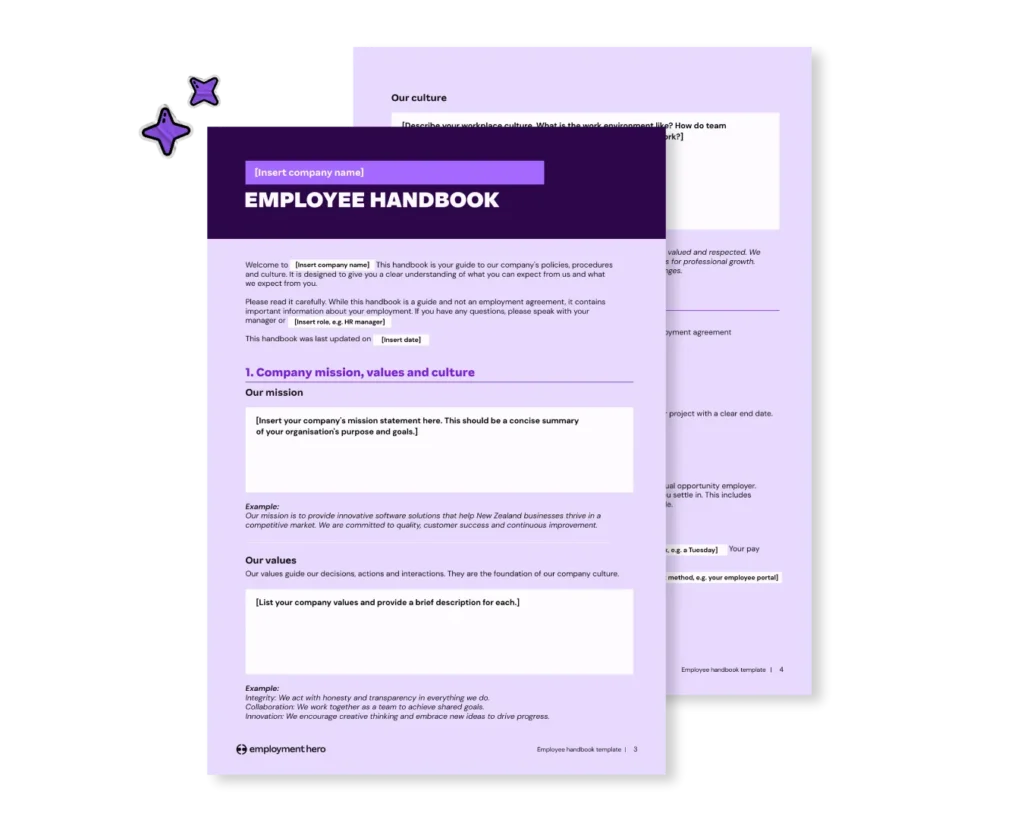
How NZ employers can customise our employee handbook template
To make this handbook accurate for your business, you’ll need to customise it. Start by reviewing each section and tailoring the language to match your company’s tone. It is important to add specific details about your internal policies, procedures and cultural values. Involve key stakeholders in your business to ensure the final document is accurate and reflects how your organisation operates.
You may wish to gather feedback from leaders or team members before finalising your handbook. Consider the unique requirements of your sector, such as shift work, overtime or workplace-specific risks. Ensure every statement reflects actual practice and is workable for your size of business.
Once completed, your handbook should serve as a reliable, go-to resource that covers both day-to-day situations and the unexpected.
Digital versus printed handbooks
As workplaces become more digital, consider how your handbook will be delivered and maintained. Printed handbooks work well for on-site staff but updating them can be time-consuming. Digital versions, which can be shared via secure platforms, make updates fast and distribution easy.
Many organisations are now opting for online handbooks. This ensures all staff, including those who work remotely or in different locations, can access the latest information. It also supports rapid response to legal changes, with instant updates available for everyone.
What an employee handbook is – and isn’t
An employee handbook serves as a central guide to your company’s policies, procedures and culture. It is a vital tool for communicating expectations and ensuring everyone in the team understands how the business operates.
It is important to understand that an employee handbook is not an employment agreement. An employment agreement is a legally binding contract between an employer and an employee. The handbook, on the other hand, is a guide to the workplace environment and can be updated as your business evolves.
Why every organisation needs an employee handbook
Having a clear and current employee handbook is a cornerstone of good employment practice in New Zealand. It helps manage legal risk by clearly documenting policies and procedures, which can be critical in the event of a dispute. Between 2023 and 2024, the Employment Relations Authority saw a 22% increase in the number of formal disputes at work – which is why clarity around expectations and workplace policies is so important.
For new hires, the handbook accelerates onboarding by providing all the essential information in one place. For existing staff, it acts as a reliable reference point, promoting fairness and consistency.
Without a handbook, businesses risk inconsistent decision-making and confusion. A well-written document can support disciplinary processes, grievance management and performance issues. It can also demonstrate to auditors or investigators that you are serious about meeting your employment obligations.
Essential sections to include in your handbook
A strong employee handbook is well-structured and easy to navigate. While you can tailor it to your business, there are several essential sections that every handbook should contain.
Company mission, values and culture
This section introduces employees to your organisation’s purpose and what it stands for. Outline your company’s mission, the core values that guide your decisions and the kind of workplace culture you aim to foster. Clear statements about what you stand for will help embed values into everyday practice and set a positive tone from day one.
Employment terms and conditions
Detail the basics of employment at your company. This can include information about types of employment (full-time, part-time, fixed-term), the recruitment process, payroll information like pay frequency and how to read a payslip. You might also cover trial periods if these are relevant to your workplace.
Workplace policies (harassment, discrimination, health and safety)
This is a critical section for compliance and employee wellbeing. Clearly define your policies on harassment, bullying and discrimination. You must also outline your commitment to health and safety, including procedures for reporting hazards and incidents, as required by law. Consider outlining how you support mental health in the workplace. Providing real examples of unacceptable behaviour can help make these policies clear to all staff.
Leave, holidays and hours
Provide clear information on leave entitlements, including annual leave, sick leave, bereavement leave and parental leave, in line with Employment New Zealand standards. Also specify standard hours of work, break entitlements and any policies on flexible working arrangements. Outline the process for requesting and managing leave, as well as how public holidays are handled.
Performance management and feedback
Explain how performance is managed in your organisation. This section should cover performance reviews, how feedback is given and received and opportunities for professional development and training. Setting clear expectations for both managers and staff helps embed a culture of growth and improvement.
IT, privacy and social media use
Set expectations for the use of company technology, including computers and phones. Outline your policy on internet and email use. It is also important to include guidelines on social media, both for professional and personal use, as it relates to the company.
Discipline, grievance and exit procedures
Detail the process for managing disciplinary issues and for employees to raise a personal grievance. This ensures fairness and transparency. Also, outline the exit procedure for when an employee leaves the company, covering things like final pay and the return of company property. Ensure this section aligns with Employment New Zealand’s guidance to support robust and compliant processes.
How to launch your handbook and ensure buy-in
Rolling out a new or updated handbook is a key step. Once you have finalised the document, share it with all staff either digitally or as a printed version, making sure it is readily accessible. Consider holding a short session to walk through key sections and answer any questions.
Encourage staff feedback so you can address any gaps or make the handbook more practical for your workplace. Make it clear where employees can find support if they are uncertain about a policy or process. Taking these steps ensures your handbook becomes an active tool, not just a document gathering dust.
Training leaders on the handbook
It is important that your managers and team leads are familiar with the handbook and comfortable referencing it when situations arise. Running a short, practical training session covering the major sections and key policies helps ensure the document is used consistently and effectively. Leaders who model good use of the handbook can support positive workplace culture and reduce uncertainty for the team.
Download your employee handbook template
Ready to create a clear and compliant employee handbook? Download our handbook template, customise it for your business and give your team the clarity they need.
The information in this article is current as at 30 November 2025, and has been prepared by Employment Hero Pty Ltd (ABN 11 160 047 709) and its related bodies corporate (Employment Hero). The views expressed in this article are general information only, are provided in good faith to assist employers and their employees, and should not be relied on as professional advice. Some information is based on data supplied by third parties. While such data is believed to be accurate, it has not been independently verified and no warranties are given that it is complete, accurate, up to date or fit for the purpose for which it is required. Employment Hero does not accept responsibility for any inaccuracy in such data and is not liable for any loss or damages arising directly or indirectly as a result of reliance on, use of or inability to use any information provided in this article. You should undertake your own research and seek professional advice before making any decisions or relying on the information in this article.
Register for the template
Related Resources
-
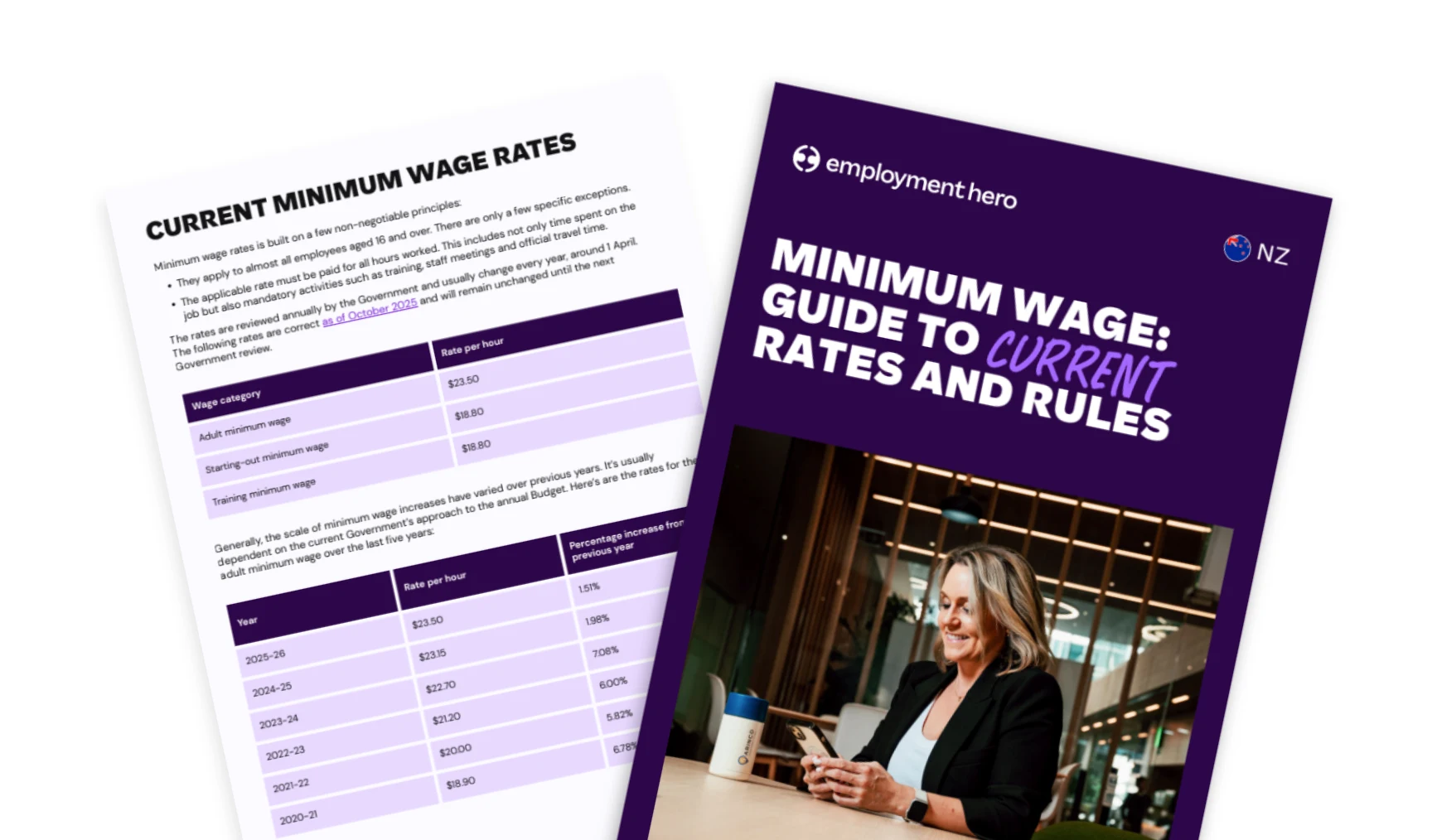 Read more: Minimum wage: Guide for New Zealand employers and payroll teams
Minimum wage: Guide for New Zealand employers and payroll teams
Understand NZ’s minimum wage rates, training wage rules, and 2025 updates. Learn how Employment Hero NZ automates wage compliance.
-
 Read more: Navigating 2025: NZ Employment Law Forecast
Navigating 2025: NZ Employment Law Forecast
Stay ahead of NZ employment law changes in 2025 with insights on grievance laws, wages, and more.


