
















Top 6 skills for recruiters in New Zealand (2026)
Contents
If you have been hiring in New Zealand over the last few years, you know that the landscape shifts quickly. One minute, candidates are flooding your inbox; the next, you’re fighting tooth and nail for a single qualified applicant. As we look ahead to 2026, the recruitment game is changing again. It is no longer just about posting a job ad and hoping for the best but leveraging broader skills and solutions that actively drive results.
Recruitment has evolved into a strategic function that sits at the very heart of business growth. Whether you are an internal recruiter, an HR manager wearing multiple hats or a business owner doing it all yourself, the skills you need to succeed are becoming more sophisticated.
The best recruiters in 2026 will be part data analyst, part marketer and part empathetic listener. They need to understand the nuances of the Kiwi market, navigate employment law with confidence and leverage technology without losing the human touch.
This blog explores the six essential skills that will define successful recruitment in New Zealand over the coming years.
1. Data-driven decision making
Gone are the days when gut feeling was the primary tool for hiring. While intuition still plays a role, the most effective recruiters in 2026 will back their decisions with hard data.
Data literacy is not just for the finance team anymore. In recruitment, it means being able to look at your hiring funnel and understand exactly where the bottlenecks are. It involves analysing sources of hire to see which channels bring you the best long-term employees, not just the most applicants.
For a New Zealand business with 50 employees looking to scale, a bad hire is expensive. After all, should you have to rehire for that same role, it costs on average $6,429. When you use data to inform your decisions, you reduce that risk significantly. You can look at retention rates, time-to-hire and cost-per-hire metrics to refine your process continuously.
Moving beyond vanity metrics
It is easy to get caught up in “vanity metrics” like the number of views on a job ad. A skilled recruiter looks deeper. They ask questions like:
- What is the conversion rate from application to interview?
- How long do successful candidates stay in the role?
- Which specific skills assessment correlates most strongly with high performance in this team?
Being data-driven also helps when you need to justify budget for new tools or higher salaries. Instead of saying “I think we need to pay more,” you can present data on current market rates and competitor offerings.
How software helps: You don’t need to be a spreadsheet wizard to do this. Applicant tracking software like Employment Hero automatically tracks your recruitment metrics for you. It can show you at a glance how many applicants are at each stage of your pipeline and where people are dropping off, giving you the insights you need to tweak your strategy in real time.
2. Advanced proficiency in recruitment technology
The tech stack for recruiters is growing. By 2026, basic familiarity with email and job boards won’t cut it. The top recruiters will be power users of integrated HR and recruitment platforms.
This doesn’t mean you need to learn to code. It means understanding how different tools talk to each other. It means knowing how to set up automated workflows that save you hours of admin time every week.
Consider the candidate experience. In a competitive market, speed is everything. If you are manually emailing candidates to schedule interviews, you are already behind. Tech-savvy recruiters use automated scheduling tools that sync with calendars, allowing candidates to book their own slots. This reduces the back-and-forth friction that often causes candidates to lose interest.
The rise of AI in hiring
Artificial intelligence is already here, and by 2026 it will be standard. We aren’t talking about robots conducting meetings, but rather AI tools that assist with writing unbiased job descriptions, screening resumes for key criteria and even automatically matching candidates to existing roles in your business.
A skilled recruiter knows how to use these tools to augment and enhance human capabilities, not replace them. They understand the limitations of AI and know how and when to use it to ensure the most fair and personal process.
3. Deep understanding of employment law and compliance
New Zealand employment law is specific and it changes. Ignorance is not a defence, and slip-ups can lead to personal grievances or penalties from the Employment Relations Authority.
For recruiters, compliance starts before the employee is even hired. It begins with the job advertisement. You need to know what you can and cannot ask candidates. For example, asking about age, religion or family status can be deemed discriminatory under the Human Rights Act 1993.
Navigating visa complexities
With the global talent shortage, many Kiwi businesses are looking offshore. This brings immigration law into the mix. A top recruiter in 2026 needs a working knowledge of the Accredited Employer Work Visa (AEWV) scheme.
You need to understand the obligations of being an accredited employer, including the requirement to provide settlement support information to migrant workers. Knowing the difference between a resident visa and a work visa, and checking entitlement to work in New Zealand, is fundamental. You can find detailed guidance on these checks through Employment New Zealand.
4. Employer branding and marketing
Recruitment is sales. You are selling your company, your culture and the opportunity. In 2026, the most successful recruiters will think like marketers.
Candidates research you just as much as you research them. They look at your website, your social media and reviews on platforms like Glassdoor. If your digital presence is silent or negative, you will struggle to attract top talent.
Building a strong employer brand requires storytelling. It is about articulating your Employee Value Proposition (EVP) clearly. What makes working for your company unique? Is it the flexibility? The career progression? The commitment to sustainability?
Content creation skills
You don’t need to be a professional copywriter, but you do need to be able to write compelling copy. Job descriptions in 2026 need to be engaging advertisements, not dry lists of requirements. They should speak directly to the candidate, focusing on what they will achieve and learn, rather than just what they need to have.
Visual content is also becoming increasingly important. Being able to snap a good photo of the team for LinkedIn or create a quick video showing the office environment can significantly boost engagement with your job posts.
5. Radical adaptability and resilience
If the last few years have taught us anything, it is that the only constant is change. Economic conditions fluctuate, skill shortages emerge and business priorities pivot.
Resilience is a soft skill, but it is a critical one. Recruiters deal with rejection constantly. Candidates ghost interviews, hiring managers change their minds at the last minute and offers get turned down. The ability to bounce back, re-group and keep moving forward is what separates average recruiters from great ones.
Adaptability goes hand-in-hand with resilience. In 2026, the way we work will continue to evolve. Hybrid working models are now standard for many roles, but the nuances of managing remote teams are still being refined. Recruiters need to be adaptable in how they assess candidates for these new ways of working.
Assessing for soft skills
As technical skills become obsolete faster, hiring for potential and soft skills becomes more important than hiring for experience. A recruiter needs the adaptability to look past a CV that doesn’t tick every box and identify a candidate with the right attitude and learning agility.
This requires moving away from rigid “tick-box” recruitment and towards a more holistic view of talent. It means being open to candidates from non-traditional backgrounds who have transferable skills.
6. Empathetic communication and relationship building
Despite all the talk of data and technology, recruitment remains a deeply human process. Changing jobs is one of the most stressful life events a person can go through.
Empathy is the superpower of the modern recruiter. It is the ability to understand the candidate’s anxieties and motivations. It is about treating every applicant with dignity, regardless of whether they are successful or not.
‘Ghosting’ candidates is a cardinal sin in recruitment. It damages your brand and ruins relationships. The best recruiters communicate clearly and promptly at every stage of the process. Even a rejection email can be a positive touchpoint if it is written with empathy and provides constructive feedback.
For a top candidate experience, check out our comprehensive checklist.
Managing internal relationships
Relationship building isn’t just external. It is also about how you work with your internal stakeholders. Hiring managers are busy people. They want their open roles filled yesterday.
A skilled recruiter knows how to manage expectations. They act as a consultant to the hiring manager, challenging unrealistic requirements and guiding them on market conditions. They build trust by delivering on promises and communicating proactively when things aren’t going to plan.
Streamlining communication: Good communication relies on good systems. Using a platform like Employment Hero allows you to keep all candidate communication in one place. You can leave notes for hiring managers, tag colleagues for feedback and send bulk updates to candidates, ensuring no one falls through the cracks.
Why these skills matter for New Zealand businesses
New Zealand is a village. Everyone knows everyone. In a small market, your reputation as an employer is fragile. If you treat candidates poorly, word spreads fast. Conversely, if you have a reputation for a fair, professional and engaging recruitment process, you will find that talent starts coming to you.
Developing these six skills within your recruitment function, whether that is a dedicated team or just you as the business owner, is an investment in your company’s future.
The businesses that win in 2026 will be the ones that view recruitment not as an administrative burden, but as a strategic advantage. They will use data to find the best people, technology to secure them quickly and empathy to keep them engaged.
Practical steps to upskill your recruitment
So, how do you actually build these skills? You don’t need to go back to university. Much of this can be learned on the job with the right mindset and tools.
Audit your current process
Start by looking at how you hire right now. Is it reactive? Do you wait for someone to resign before you start looking? Are you still using spreadsheets to track applicants? Identify the manual tasks that are eating up your time.
Invest in the right tech
If you are still managing recruitment via email folders, it is time for a change. Look for an Applicant Tracking System (ATS) that can streamline the whole process. This isn’t just about efficiency; it’s about compliance and data security too.
Stay educated on employment law
Subscribe to updates from Employment New Zealand. Make it a habit to check for changes in legislation, especially regarding wages, holidays and visa requirements. When in doubt, seek professional advice.
Listen to your candidates
Ask for feedback from people who have been through your recruitment process. What did they like? What frustrated them? This feedback is gold dust for improving your candidate experience.
The role of integrated software
We have mentioned technology throughout this guide because it is the enabler for almost every other skill. You can’t be data-driven without data. You can’t focus on empathetic communication if you are drowning in admin. You can’t ensure compliance if your documents are scattered across different drives.
Employment Hero is designed to solve exactly these problems for New Zealand SMEs. It brings recruitment, onboarding, payroll and HR management into a single platform.
For recruitment specifically, it allows you to:
- Use our revolutionary hiring tool, SmartMatch.
- Post to multiple job boards with one click.
- Move candidates through custom hiring stages with drag-and-drop simplicity.
- Collaborate with your team on hiring decisions without endless email chains.
- Transition a successful candidate to an employee in seconds, with digital contracts and paperless onboarding.
By automating the heavy lifting, you free up mental space to focus on the human side of hiring—the judgment, the relationship building and the strategic thinking.
Looking ahead to 2026
The recruitment landscape in New Zealand is becoming more complex, but also more exciting. The tools available to us are better than ever. The opportunity to build diverse, high-performing teams is huge.
By focusing on these six core skills named above, you can position your business to attract the talent you need to grow.
It is a journey of continuous improvement. You won’t master all these skills overnight. But by acknowledging their importance and starting to integrate them into your daily practice, you are already ahead of the curve.
Recruitment is the front door to your business. Make sure the person standing there has the skills to welcome the right people inside.
The information in this article is current as at 30 December 2025, and has been prepared by Employment Hero Pty Ltd (ABN 11 160 047 709) and its related bodies corporate (Employment Hero). The views expressed in this article are general information only, are provided in good faith to assist employers and their employees, and should not be relied on as professional advice. Some information is based on data supplied by third parties. While such data is believed to be accurate, it has not been independently verified and no warranties are given that it is complete, accurate, up to date or fit for the purpose for which it is required. Employment Hero does not accept responsibility for any inaccuracy in such data and is not liable for any loss or damages arising directly or indirectly as a result of reliance on, use of or inability to use any information provided in this article. You should undertake your own research and seek professional advice before making any decisions or relying on the information in this article.
Related Resources
-
 Read more: A guide to staff training records (template included)
A guide to staff training records (template included)
Discover a practical staff training record template for NZ businesses that ensures effective compliance and simplifies your training process.
-
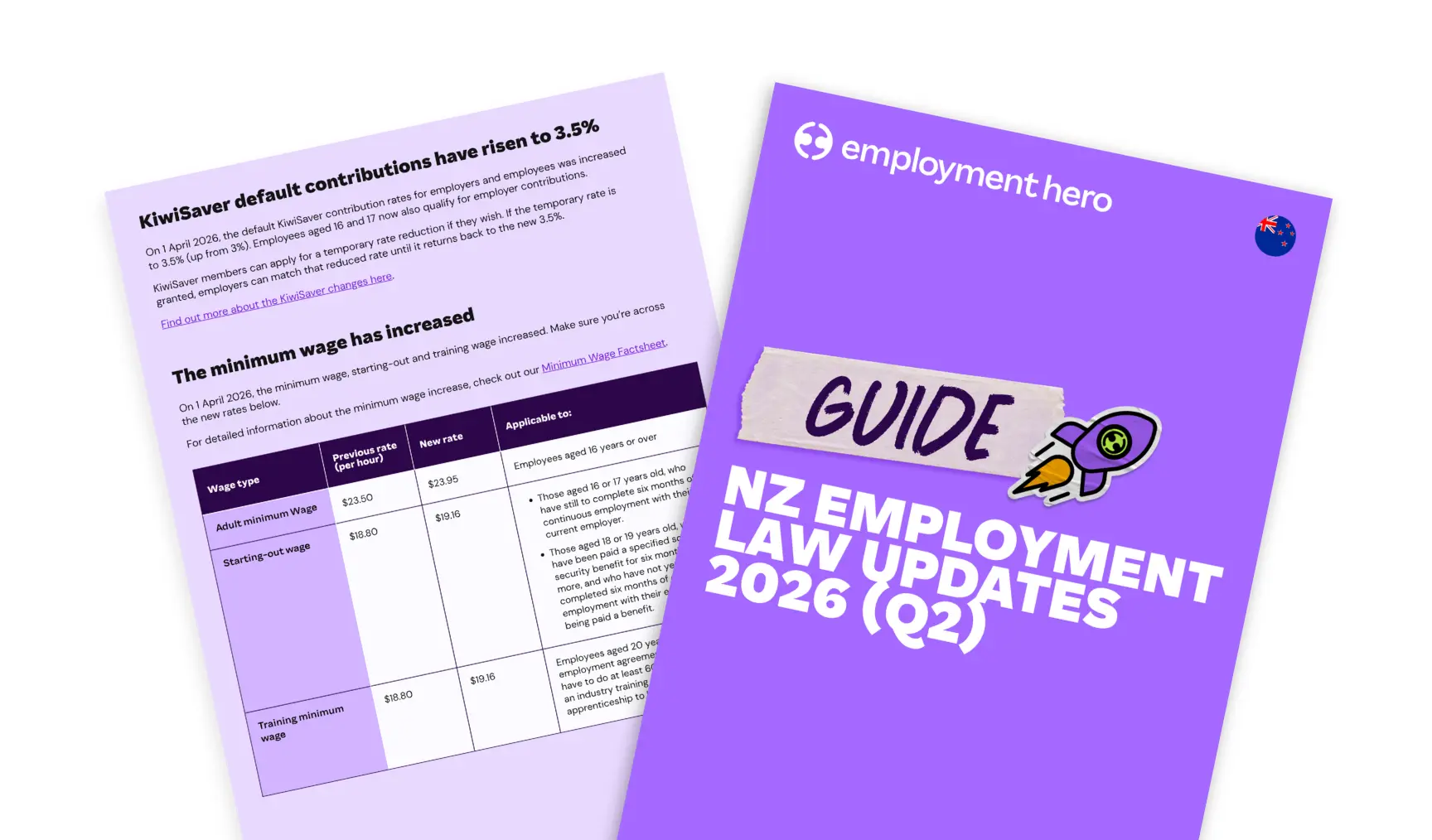 Read more: Employment law updates 2026
Employment law updates 2026
Keep your business up-to-date with the latest changes in NZ employment law. Here’s what you need to know about the…
-
 Read more: Designing an employee work schedule: template and guide
Designing an employee work schedule: template and guide
Learn how to create a flexible work schedule that can boost productivity among your employees.

