 Australia
  New Zealand
  United Kingdom
  Singapore
  Malaysia
  Canada (Français)















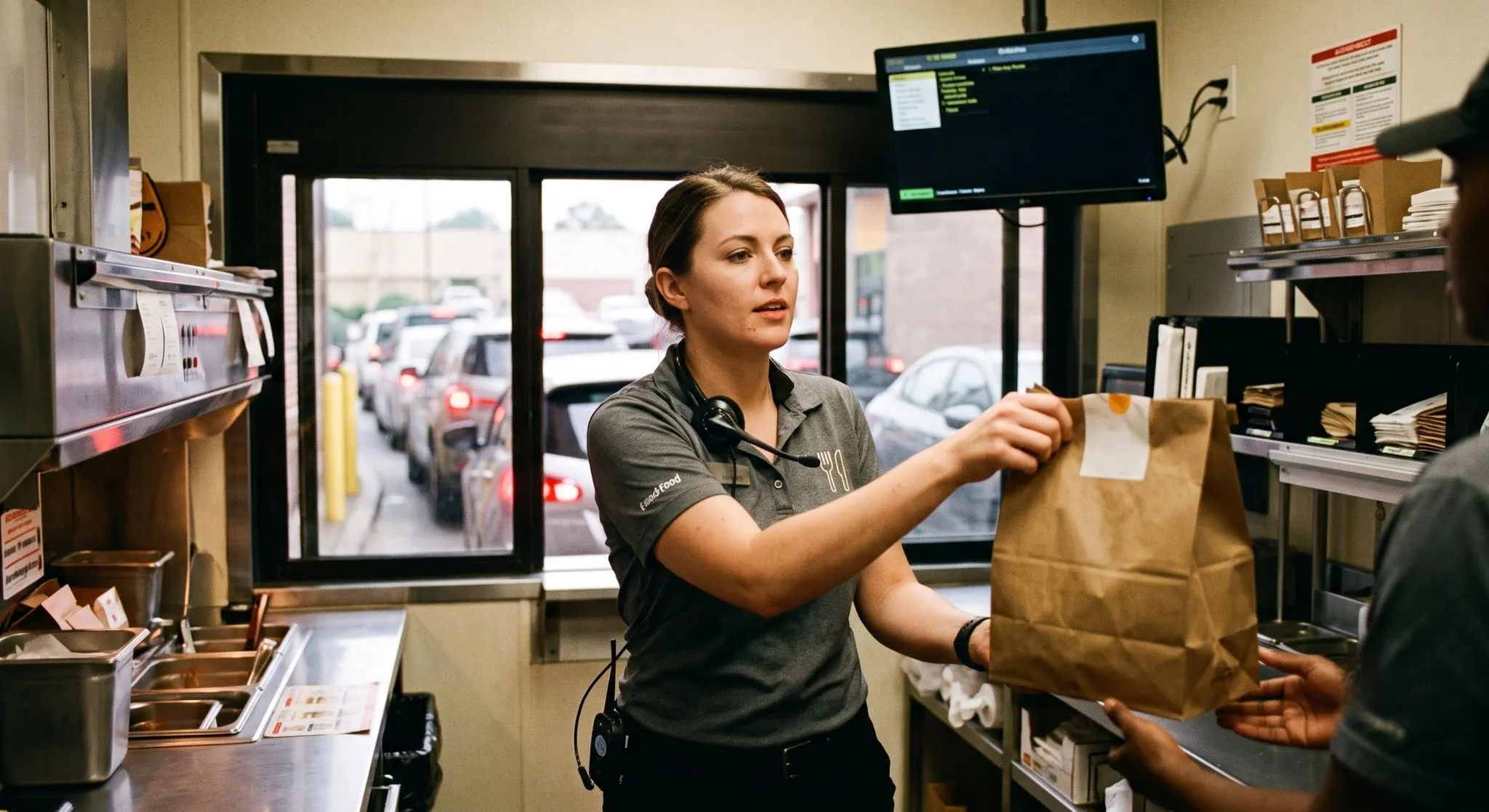
“This image was created using AI. It does not depict a real person or event.”
Major quick-service restaurant chains are rapidly deploying artificial intelligence to manage drive-thru counters across North America. Technology developers indicate that automated voice agents could arrive at Canadian drive-thrus within months, according to a recent CBC News article, shifting how hospitality businesses manage operational workflows.
This technological transition comes as food service operators struggle with persistent recruitment challenges and rising overhead costs. By replacing traditional ordering touchpoints with digital interfaces, businesses are attempting to stabilize daily service delivery and reduce reliance on a highly volatile seasonal labour pool. Understanding the balance between automation and human oversight is becoming essential for small and medium-sized employers across the country.
Technological advancements drive operational efficiency at the counter
Early experiments with automated voice systems frequently encountered operational hurdles, with customers deliberately confusing the software or experiencing frustrating order errors. Recent developments in generative technology have drastically improved performance metrics across the board. Current automated platforms complete a standard drive-thru transaction in an average of three minutes and 53 seconds, compared to four minutes and 15 seconds for human employees. While human order accuracy still outperforms automated platforms at 87% compared to 83%, the performance gap is narrowing rapidly.
Major international brands are investing heavily in infrastructure upgrades to capitalize on these speed gains. McDonald’s is currently testing a Google-powered ordering interface, while Taco Bell has partnered with Nvidia to implement specialized voice agents. Similarly, White Castle has deployed automated voice assistants at approximately 40 locations to manage customer orders seamlessly, allowing kitchen staff to focus entirely on food preparation and order fulfillment.
High worker turnover pushes food service operators toward digital solutions
The shift toward automated order management is largely driven by severe structural challenges within the hospitality sector. Quick-service establishments face an average annual employee turnover rate of 79.6%, creating a constant cycle of recruitment and training costs. Automated voice systems provide consistent operational availability without the risk of scheduling conflicts or unexpected staff absences. Industry analysts project that these automated systems will save global food businesses approximately $8 billion annually by 2026.
Rather than causing sudden mass layoffs, the integration of automated agents typically results in a gradual adjustment of workforce structures. Positions that become vacant through natural attrition are often left unfilled, allowing businesses to downsize their front-of-house headcount without disrupting current staff. This approach helps companies lower long-term labour costs while redirecting human resource budgets toward specialized roles.
Strategic workforce transition remains vital for long-term retention
For business owners considering automated solutions, the primary objective should be enhancing the overall customer experience rather than completely eliminating human interaction. While digital platforms excel at processing routine transactions and executing automated upselling strategies, human workers remain indispensable for resolving complex customer service issues and maintaining brand loyalty.
SME employers must focus on upskilling their remaining teams to handle higher-value operational tasks. Training staff to manage automated systems, supervise food quality and coordinate complex digital logistics ensures that businesses retain their top talent while maximizing the return on technology investments. Embracing automated assistance can give local businesses a distinct competitive edge in a challenging economic market.