

















How to create a team charter: Template and guide
Published
How to create a team charter: Template and guide
Last Updated
Leading a team is rewarding, but it comes with challenges. You bring together talented individuals with different working styles, expectations and ideas about how things should be done. Without a clear framework, even the best teams can end up pulling in different directions.
Misalignment affects productivity when assumptions go unspoken. What feels “urgent” to one person may not to another, and differences in communication or conflict styles can quickly create tension. Over time, these small gaps can impact morale and your bottom line.
A team charter helps prevent this. It’s a shared, living agreement that clarifies how your team works together, so everyone can stay focused on achieving their goals.
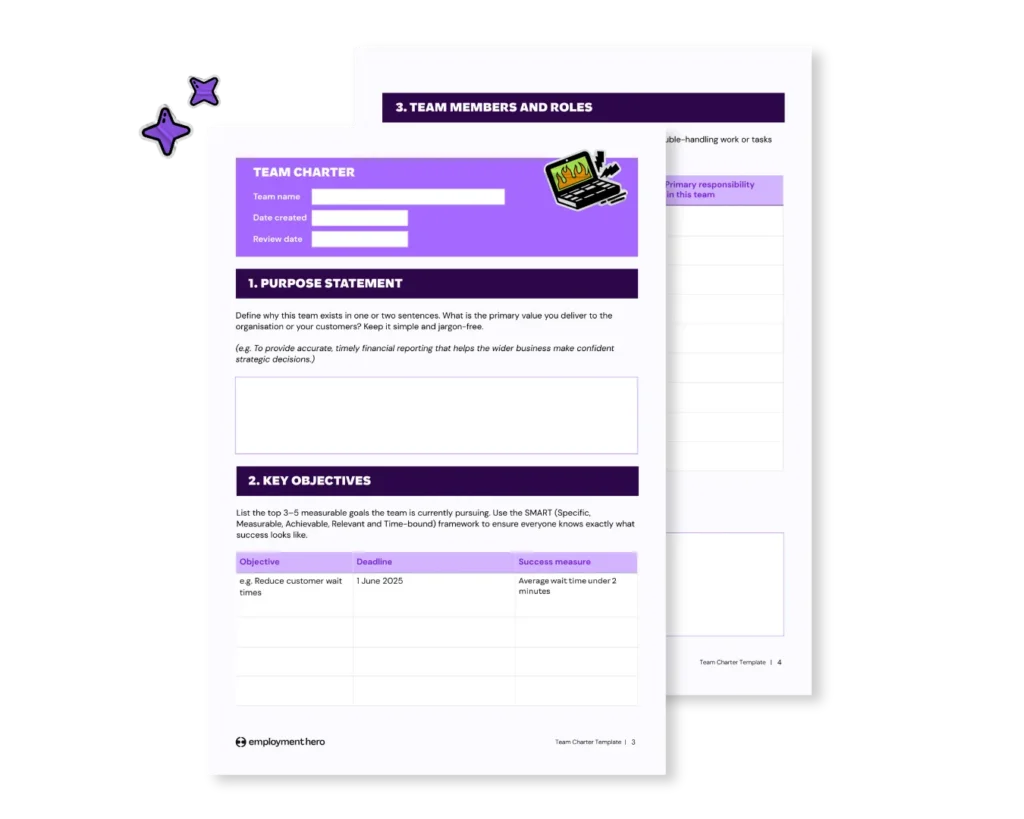
This guide explains what a team charter is, why it matters and how to create one that works. We’ve also included a customisable template for your own team charter — download it by completing the form on the right.
What is a team charter?
A team charter is a foundational document that outlines why a team exists, what it aims to achieve and the rules of engagement for how members will work together. Think of it as a roadmap for your group.
While an individual employment agreement covers the legal relationship between a business and an employee, a team charter covers the social and operational relationship between team members. It bridges the gap between high-level company strategy and day-to-day execution.
It typically defines the team’s purpose, delineates roles and responsibilities, and sets clear expectations for behaviour and communication. It also should remove ambiguity. When you have a charter in place, you stop relying on unwritten rules that new hires have to guess and start operating from a shared playbook.
This document is particularly vital for cross-functional project teams, new departments or businesses that are scaling rapidly. When you are growing from 15 to 50 employees, the informal approach stops working. A charter formalises your culture so it can scale with you.
Using a team charter template
Starting from a blank page is daunting. That is why using our structured template is the smartest way to get this done. A good template acts as a forcing function and it prompts you to have conversations that you might otherwise avoid.
There are several distinct advantages to using our set template for your charter:
It unifies the team around a shared vision
When you fill out a template together, you are forced to articulate your goals in plain English. You might discover that the sales lead thinks the priority is customer acquisition, while the product lead thinks it is retention. Our template highlights these disconnects early so you can resolve them before they become expensive problems.
It boosts productivity
Ambiguity slows people down. When a team member knows exactly who is responsible for a decision or which communication channel to use for an urgent request, they can act immediately. Our template is designed to remove the friction of second-guessing.
It reduces workplace conflict
Most workplace conflict stems from mismatched expectations rather than malice. Our template helps you agree on conflict resolution steps and behavioural norms upfront, giving the team a safe language to address issues. Instead of making it personal, they can refer back to the charter.
[Free Download] Get the team charter template
Stop the guesswork and start aligning your team today. Download our team charter template to streamline your planning process.
How the template works
You should not view the template as a form to be filled out by management and handed down. It works best as a workshop tool. Gather your team, go through each section of the template and debate the answers until you reach a consensus. The value is in the discussion as much as the final document.
The key elements of an effective team charter
A powerful team charter is more than a list of goals. It needs to cover the hard mechanics of work and the soft skills of collaboration. To set your team up for success, your charter must be comprehensive.
You need to move beyond generic statements. A charter that says “we will respect each other” is nice but not useful. A charter that says “we will arrive at meetings on time and read compulsory materials beforehand” is actionable.
The sections below outline the non-negotiable components you need to include. These elements provide a clear roadmap for your operation, leaving no room for confusion about how success is achieved in your business.
Mission and objectives
This is the anchor of your document. You need to define and articulate your team’s core purpose. Why does this team exist? If this team disappeared tomorrow, what value would the organisation lose?
Your mission statement should be short, memorable and free of corporate jargon. It needs to resonate with the people doing the work. For example, rather than saying “We leverage synergies to optimise output,” a customer support team might say “We solve customer problems quickly to build trust in our brand.”
Once the mission is clear, you must layer in your objectives. These are the specific, measurable goals you are working together to achieve.
We recommend using the SMART framework here — Specific, Measurable, Achievable, Relevant and Time-bound. For example:
- Vague objective: Increase sales.
- Precise objective: Achieve $50,000 in new recurring revenue by the end of Q3.
Connecting daily tasks to these broader objectives gives work meaning. It helps team members understand how their individual contribution fits into the bigger picture.
Roles and responsibilities
Confusion over who owns what task is a classic productivity killer. This section should clearly outline each team member’s specific job and responsibilities so that there is no double-handling or finger-pointing.
You should list every team member and map their core role to their specific responsibilities within the team. This is especially important in cross-functional squads where a person might have a different “day job” to their role in the project.
You might also want to clarify what is not someone’s job. Defining boundaries helps prevent burnout and scope creep. If you have a project manager, specify that they are responsible for the timeline but not for making the final technical decisions.
Clarity here empowers your staff. When people know exactly what they own, they take pride in it. They stop waiting for permission and start driving results.
Budget and resources
Ambition without resources is just wishful thinking. This section should cover the budget your team has to work with and how you will allocate the resources needed to get the job done right.
Be transparent about the financial constraints. If the team has a $10,000 budget for software tools, state that clearly. If they have access to a specific graphic designer for five hours a week, write it down.
This manages expectations. It stops the team from planning a champagne launch on a beer budget. It also empowers the team to make trade-off decisions. If they know the resource cap, they can decide for themselves whether to spend their budget on marketing or product development, rather than constantly asking for approval.
Work process and general expectations
How does work actually move from “to-do” to “done”? This section should cover how to outline your team’s workflow from start to finish.
You need to agree on your methodology. Are you working in agile sprints? Are you using a waterfall project management style? You should also cover the tools of the trade. If you use a specific project management tool, specify that all tasks must be logged there.
This is also the place to define your “definition of done”. Does a task count as finished when the code is written or when it has been tested and deployed?
General expectations also cover the rhythm of the workday. This includes agreements on flexible working hours, availability windows and how you handle time off. In a hybrid world, being explicit about when people need to be online is crucial for preventing resentment.
Performance assessment and KPIs
You can’t manage what you don’t measure. This section covers how you’ll measure success, detailing both the objective Key Performance Indicators (KPIs) and the subjective feedback loops you will use to track progress.
Objective measures
These are the hard numbers. Sales targets, ticket resolution times, code deployment frequency or customer satisfaction scores. They should be binary, so you either hit the number or you don’t.
Subjective measures
These are the qualitative assessments. How well is the team collaborating? Are we innovating? You should outline how you will gather this feedback. Will you do a monthly retrospective? Will you use 360-degree feedback tools?
Regular assessment prevents surprises. It allows you to course-correct early if the team is drifting off track, rather than waiting until the end of a project to realise you missed the mark.
Communication norms and tools
In the modern workplace, we’re often drowning in noise. This section covers how to establish clear guidelines for communication, including which tools to use for different situations and the expected response times.
You need to agree on a hierarchy of communication. For example:
- Email: For formal requests, external communication and non-urgent updates.
- Instant Messaging: For quick questions and social chatter.
- Video/In-person meetings: For deep discussion, brainstorming and sensitive feedback.
- Phone: For urgent communications.
You should also set boundaries around response times. Do you expect a reply to an email within 24 hours? Are team members expected to check messages on weekends? (Hint: For a healthy culture, the answer to the latter should usually be “no”).
Setting these norms reduces anxiety. Staff don’t feel the need to be “always on” if they know that non-urgent messages can wait until morning.
Rules and conflict resolution
Disagreements are inevitable in high-performing teams. In fact, they are necessary for innovation. However, healthy debate can quickly turn toxic if not managed well. This section covers how to set the ground rules for how team members will collaborate and provide a straightforward framework for resolving disagreements constructively.
You need to agree on a code of conduct. This might include rules like “critique the idea, not the person” or “one conversation at a time during meetings”.
When conflict does escalate, you need a pre-agreed path to resolution.
- Direct address: The individuals involved try to resolve it between themselves first.
- Mediation: If unresolved, they bring it to the team lead.
- Escalation: If it remains an issue, it goes to HR or senior leadership.
By agreeing to this process while things are calm, you remove the emotion from the process when things get heated. It gives everyone a safe way to raise issues without being labelled a troublemaker.
Note: It is important to remember that a team charter does not override employment law. If a conflict involves bullying, harassment or discrimination, you must follow your formal workplace policies and New Zealand legislation. Employment New Zealand provides clear guidance on managing relationship problems at work.
Decision-making framework
Analysis paralysis can stall even the most talented teams. This section should cover how your team will make decisions, outlining whether you will use consensus, voting or a designated leader to ensure clarity and forward momentum.
Different decisions require different approaches.
- Autonomy: Small decisions (e.g., formatting a document) can be made by the individual responsible.
- Consultative: Medium decisions (e.g., changing a weekly meeting time) require input from the team, but the leader makes the call.
- Consensus: Large strategic decisions (e.g., pivoting the project direction) might require everyone to agree.
Clarifying this upfront saves time. Team members stop asking for permission for small things and stop debating things that have already been decided by leadership.
Signatures
This might seem formal, but the physical act of signing a document carries weight. This section covers the final step of having all team members sign the charter to confirm their agreement and commitment to the principles outlined within it.
It transforms the charter from a management document into a social contract. It signals that everyone has had their say, everyone has been heard and everyone is now committed to the path forward.
Use a free team charter template for a new team
Speed matters when you are launching a new initiative. A template can greatly accelerate a process, giving you everything you need to get started.
For a new team, a template ensures you cover all your bases from day one. You won’t wake up three months into a project and realise you never discussed how to handle budget overruns. The template prompts you to have that conversation before a single dollar is spent.
Continuous improvement in team dynamics
Teams change. Goals shift. New people join and experienced people leave. A process that worked for a team of five might break when you reach a team of ten. You should schedule a review of your charter at least once a quarter or whenever the team composition changes significantly.
During this review, ask honest questions. Is our communication plan still working? Are our meetings efficient? Are we sticking to our decision-making framework?
Treating the charter as a living document encourages a mindset of continuous improvement. It shows the team that you are always looking for ways to work smarter and that you are open to feedback on how the team operates.
Ready to build a high-performing team?
The information in this article is current as at 30 December 2025, and has been prepared by Employment Hero Pty Ltd (ABN 11 160 047 709) and its related bodies corporate (Employment Hero). The views expressed in this article are general information only, are provided in good faith to assist employers and their employees, and should not be relied on as professional advice. Some information is based on data supplied by third parties. While such data is believed to be accurate, it has not been independently verified and no warranties are given that it is complete, accurate, up to date or fit for the purpose for which it is required. Employment Hero does not accept responsibility for any inaccuracy in such data and is not liable for any loss or damages arising directly or indirectly as a result of reliance on, use of or inability to use any information provided in this article. You should undertake your own research and seek professional advice before making any decisions or relying on the information in this article.
Register for the template
Related Resources
-
 Read more: Minimum wage: Guide for New Zealand employers and payroll teams
Minimum wage: Guide for New Zealand employers and payroll teams
Understand NZ’s minimum wage rates, training wage rules, and 2025 updates. Learn how Employment Hero NZ automates wage compliance.
-
 Read more: Navigating 2025: NZ Employment Law Forecast
Navigating 2025: NZ Employment Law Forecast
Stay ahead of NZ employment law changes in 2025 with insights on grievance laws, wages, and more.


