

















Staff engagement plan template and guide
Published
Staff engagement plan template and guide
Published
A highly engaged team is your greatest asset. When your people are connected to their work and feel valued by the business they are more productive, innovative and loyal. But engagement doesn’t happen by accident. It requires a clear strategy and a commitment to turning feedback into meaningful action.
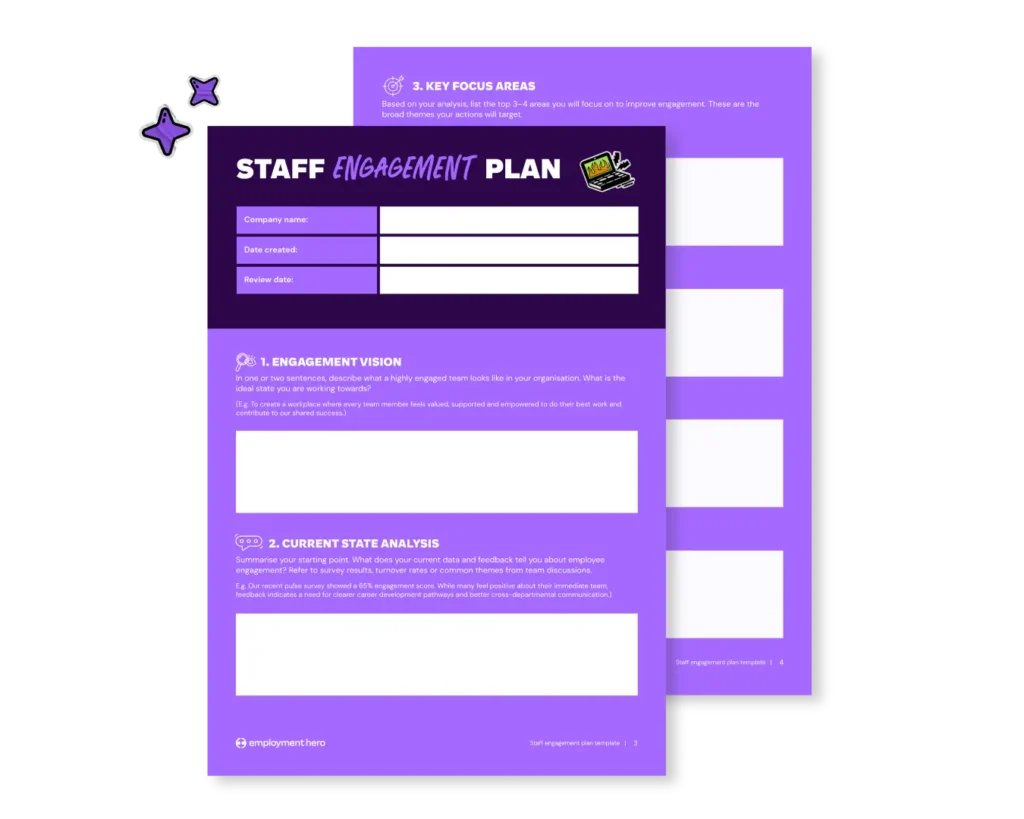
This template will walk you through building a staff engagement plan for your New Zealand business. It’s a practical framework for understanding your team’s needs and creating a workplace where people thrive.
What’s in the template?
We’ve created this template to be a practical tool for any New Zealand business. Use it to build a structured plan that fits your unique team and culture.
In here, you’ll have space to fill out:
- Your engagement vision
- A current state analysis
- Your key focus areas
- An action plan
- Measurement and reporting metrics
Download the template now by filling out the form on the right hand side.
What is an employee engagement plan?
Think of an employee engagement plan as a documented strategy that outlines exactly how you will improve the employee experience based on feedback.
It’s a deliberate set of actions designed to address specific pain points, like communication gaps, lack of recognition or unclear career paths that have been identified by your team. It connects the dots between what your employees need and what your business needs to grow.
How to conduct an employee engagement survey
Before you can fix anything, you need to know what’s broken.
When done right, it moves beyond a complaint box and becomes a strategic roadmap for retention and growth. Here’s some important things to remember when creating and distributing your employee engagement survey.
Guarantee absolute anonymity
True honesty only happens when your team feels psychologically safe. If an employee thinks their feedback can be traced back to them, they’ll give you safe answers instead of the raw truth.
To protect your people and your data, adopt the “rule of five.” This means never viewing specific results for teams with fewer than five respondents. By using a secure HR platform to aggregate results, you encourage the kind of radical candor that helps you improve.
Beat survey fatigue with pulse checks
We’ve all been there: a 50-question annual marathon that people rush through just to get back to their “real” work.
When respondents get bored, data quality nosedives. The modern way to stay connected is through pulse surveys. Instead of one giant survey once a year, send out short, 5-to-10-minute checks every quarter or month.
This agile approach allows you to see the immediate impact of a new policy or a change in leadership in real-time, rather than reacting to a problem that’s already twelve months old.
Ask the questions that actually matter
Surface-level questions about office snacks or Friday drinks don’t drive business results. If you want to master engagement, you need to measure what matters.
Focus on questions that get to the heart of why people stay or leave. Instead of asking if they’re happy, ask: “Do you see a clear future for yourself here in two years?” Instead of asking if they like their manager, ask: “Does your manager provide the resources and recognition you need to succeed?” These are the insights that reveal the structural integrity of your culture.
Close the loop and take action
The fastest way to kill engagement is to ask for feedback and then offer nothing but radio silence. If your team doesn’t feel heard, they’ll stop talking. High-performing leaders share a summary of the findings including the good, the bad and the ugly.
For every major pain point identified, commit to one tangible action. If the team says communication is messy, announce a new monthly All-Hands meeting. By turning feedback into a catalyst for change, you prove that your team’s voice has real power, fostering a culture of mutual respect and continuous improvement.
In summary, to run a successful survey:
- Keep it anonymous: If you want the truth, you have to protect identities.
- Keep it short and frequent: Survey fatigue is real. If it takes more than 10 minutes, you’re losing data quality.
- Ask the hard questions: Don’t just ask “Do you like the coffee?” Ask “Do you see a future here?” and “Do you feel valued by your manager?”
- Take action: Let your team know that you’re taking action based on their feedback.
Using dedicated employee engagement software like Employment Hero can automate this process, allowing you to take the pulse of your organisation regularly without the admin headache.
Why create an employee engagement action plan?
Creating an employee engagement action plan delivers a significant return on your investment of time and resources. It’s the mechanism that stops valuable employee feedback from gathering dust on a shelf. When employees see their suggestions and concerns lead to real change, it builds a powerful sense of trust and psychological safety.
A clear plan shows you’re serious about creating a better workplace. This demonstrates that leadership is listening and committed to the team’s wellbeing which is a powerful way to foster loyalty. Engaged teams are more resilient during challenging times and more likely to go the extra mile. They have lower rates of turnover and absenteeism which directly impacts your bottom line.
Developing an employee engagement strategy
A strategy is the long game, whereas a plan is the immediate action item. Your overall strategy should be embedded in your company DNA.
This involves looking at the entire employee lifecycle. How do you engage candidates before they are hired? How do you engage them during onboarding? How do you keep them engaged as alumni after they leave?
Your strategy should move you from reactive fixing to proactive culture building. It aligns with your brand archetypes; are you the Hero that supports them or the Challenger that pushes them to grow?
Why create an employee engagement action plan?
Creating an employee engagement action plan delivers a significant return on your investment of time and resources. It’s the mechanism that stops valuable employee feedback from gathering dust on a shelf. When employees see their suggestions and concerns lead to real change it builds a powerful sense of trust and psychological safety.
A clear plan shows you’re serious about creating a better workplace. This demonstrates that leadership is listening and committed to the team’s wellbeing which is a powerful way to foster loyalty. Engaged teams are more resilient during challenging times and more likely to go the extra mile. They have lower rates of turnover and absenteeism which directly impacts your bottom line.
Creating an effective employee engagement plan
An effective plan has three key ingredients:
- Leadership buy-in: If leadership doesn’t understand or value engagement, it’s likely neither will anyone else. Engagement is a leadership responsibility.
- Manager empowerment: Your managers are on the front lines. They need the tools and authority to fix issues for their teams.
- Flexibility: Business changes fast. If a pandemic hits or the market shifts, be ready to write a new one that suits the current reality.
Analyse survey results
Finding the gold in your survey data is about looking past the raw numbers. Your task is to identify the real stories and patterns that tell you exactly where to focus your energy. Start by looking at the overall engagement score but don’t stop there.
Drill down into the data. Compare results between departments, locations or tenure groups. Are new hires less engaged than long-term employees? Is one team lagging behind the others? Pay close attention to the comments in open-ended questions. This qualitative feedback often provides the most valuable context and highlights the ‘why’ behind the numbers. Look for recurring themes that point to systemic issues or opportunities.
Decide on your employee engagement initiatives
Once you have your survey insights it’s time to turn them into action. This is where you brainstorm practical high-impact initiatives to tackle the key themes your data has uncovered. Don’t try to fix everything at once. Focus on two or three areas that will have the biggest impact.
If your survey reveals a need for better recognition, you might launch a peer-to-peer awards program. If professional growth is a concern, you could implement individual development budgets or create clearer career pathways. The key is to choose initiatives that directly address the feedback you’ve received. Involve your team in this process to ensure the solutions are relevant and well-received.
Establish milestones to monitor progress
How will you know if your plan is actually working? You need to set simple measurable milestones that help you track progress and demonstrate the impact of your efforts. These milestones act as signposts on your journey to better engagement.
For each initiative define what success looks like in concrete terms. For example if you’re introducing new feedback training for managers a milestone might be “100% of managers complete training by 1 September”. If your goal is to improve communication a success measure could be an increase in attendance at company-wide meetings. These metrics provide accountability and show everyone that your engagement efforts are making a real difference.
Staff engagement plan template
You’ve asked your team for feedback. Now it’s time to show them you’re listening. Use this template to sort your survey insights into a clear, prioritised action plan.
Download the free staff engagement template now by filling out the form on the right.
Measuring employee engagement effectively
Survey scores (eNPS) are the headline, but they aren’t the whole story. To get a true reading, you need to look at:
- Retention rates: Are high performers leaving?
- Absenteeism: Is there an increase in sick days?
- Productivity metrics: Is output dropping despite long hours?
- Glassdoor reviews: What are people saying publicly?
Combining these hard metrics with your sentiment data gives you a well-rounded view of your culture.
The role of HR leaders in engagement plans
HR leaders are often the champions of employee engagement. They play a strategic role in driving the process from initial survey to ongoing improvement. This involves more than just administering the plan.
HR can coach managers on how to have effective engagement conversations with their teams. They can analyse data to identify organisational trends and provide insights to the leadership team. They act as the voice of the employee ensuring that people-related issues are given weight in strategic decisions. HR leaders facilitate the entire process ensuring it stays on track and delivers tangible results.
Aligning engagement plans with business success
A happy team leads to a healthy bottom line. Proving this connection is key to securing ongoing investment in your engagement efforts. The best way to do this is to align your engagement plan directly with key business goals.
If your company’s goal is to increase innovation, your engagement plan might focus on creating more psychological safety for idea-sharing. If the business priority is customer satisfaction, you can show how higher employee engagement correlates with better customer service ratings. By connecting your people’s initiatives to business outcomes, you demonstrate that investing in your team is a direct investment in your success.
Keen to get started boosting employee engagement? Download the staff engagement plan template now by filling out the form on the right.
The information in this article is current as at 19 February 2026, and has been prepared by Employment Hero Pty Ltd (ABN 11 160 047 709) and its related bodies corporate (Employment Hero). The views expressed in this article are general information only, are provided in good faith to assist employers and their employees, and should not be relied on as professional advice. Some information is based on data supplied by third parties. While such data is believed to be accurate, it has not been independently verified and no warranties are given that it is complete, accurate, up to date or fit for the purpose for which it is required. Employment Hero does not accept responsibility for any inaccuracy in such data and is not liable for any loss or damages arising directly or indirectly as a result of reliance on, use of or inability to use any information provided in this article. You should undertake your own research and seek professional advice before making any decisions or relying on the information in this article.
Register for the guide
Related Resources
-
 Read more: Job promotion criteria checklist
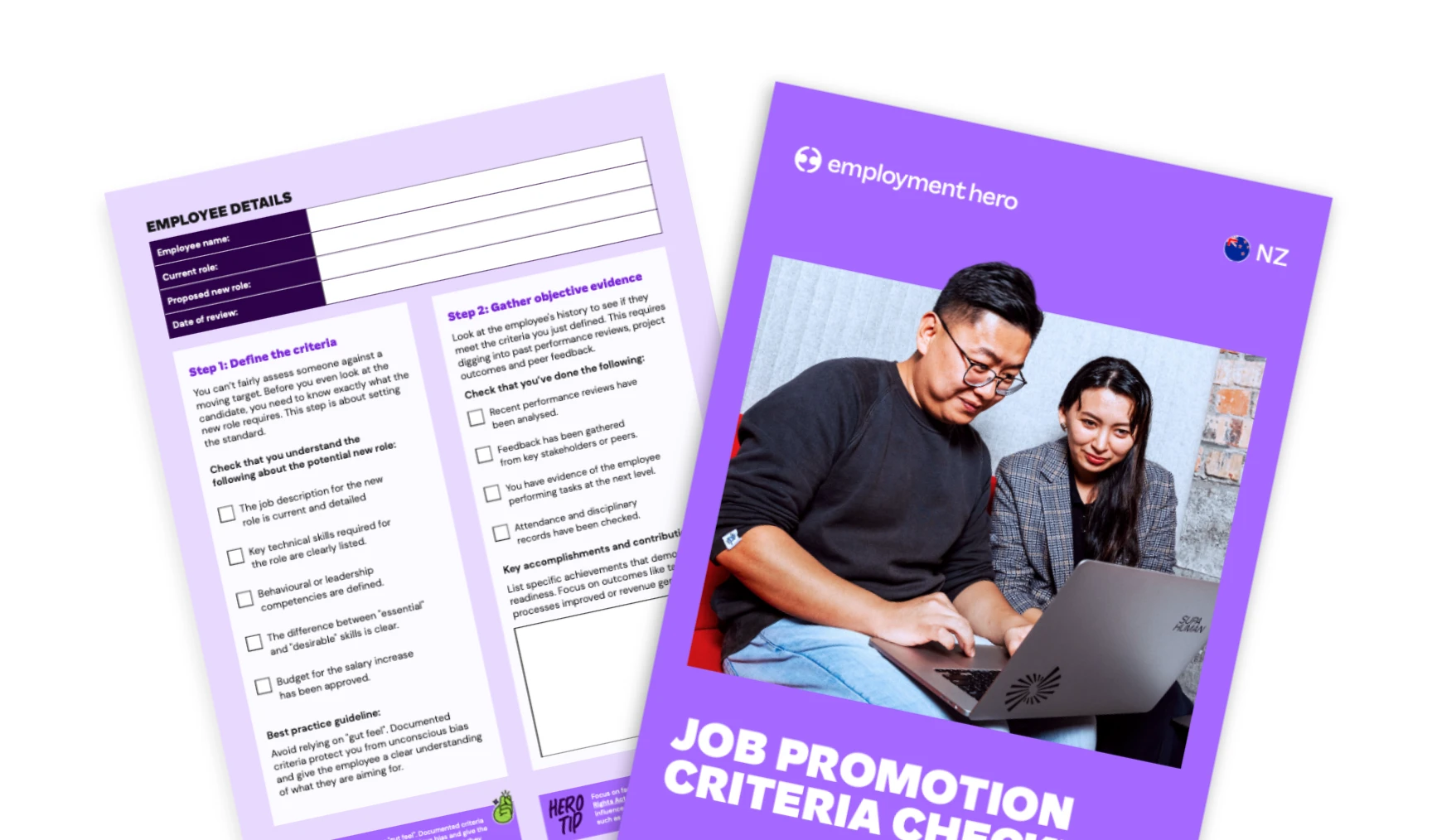
Job promotion criteria checklist
Promoting staff? Use our checklist to make fair, transparent and smart promotion decisions. Download the checklist now.
-
 Read more: Staff engagement plan template and guide
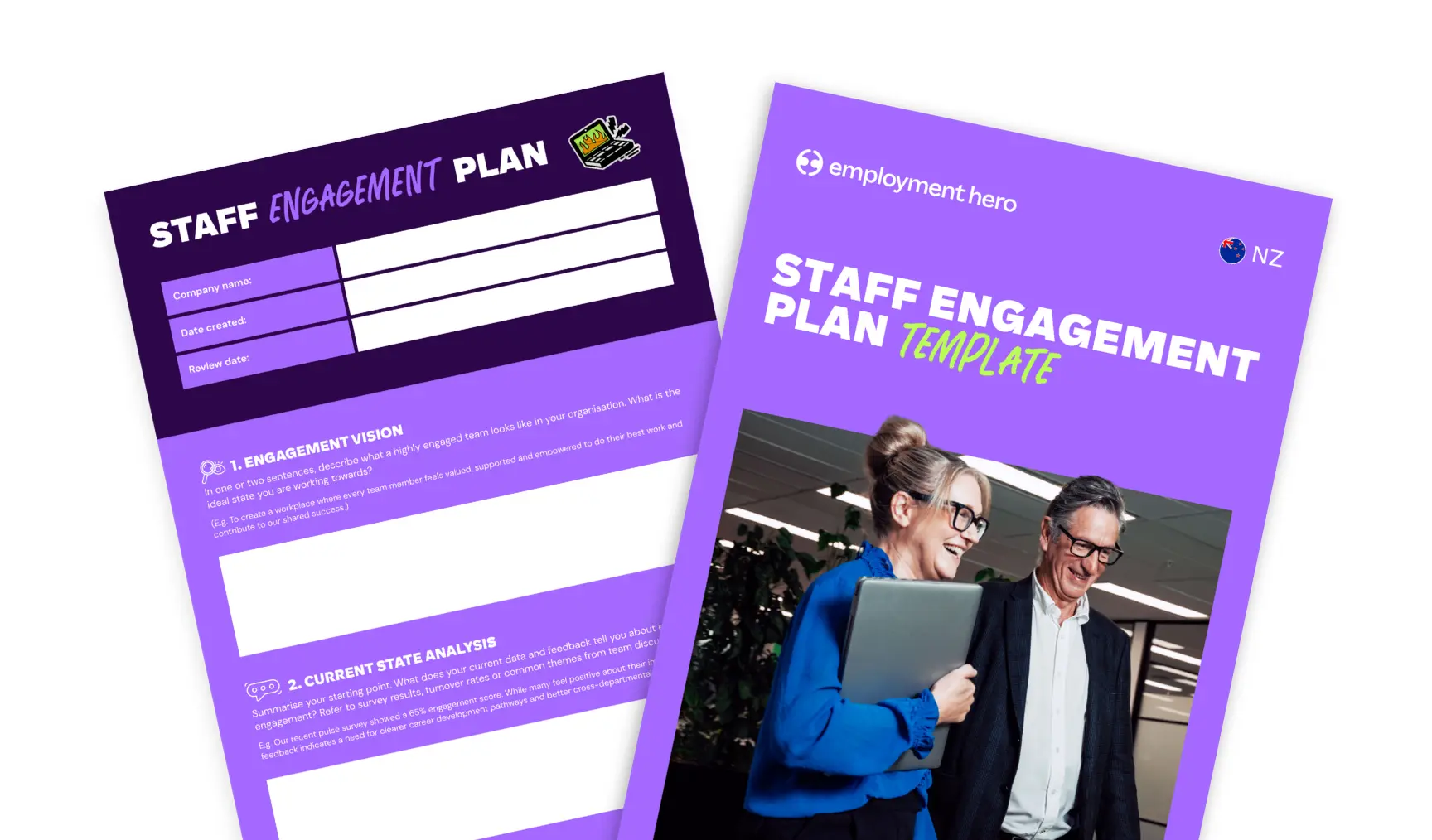
Staff engagement plan template and guide
Discover effective strategies for creating a staff engagement plan that drives results. Download our template and guide.
-
 Read more: Employment Relations Act: Key changes explained
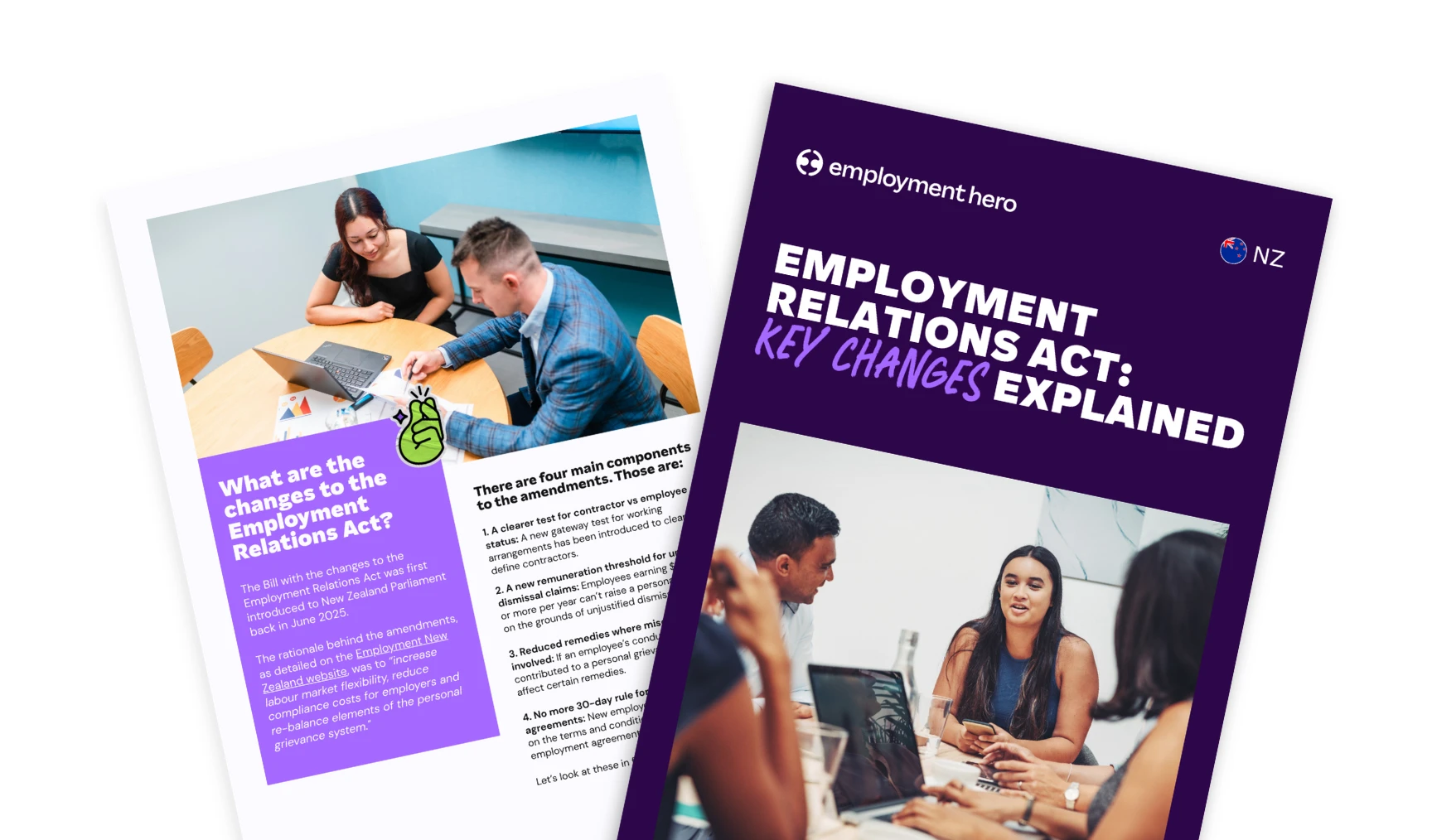
Employment Relations Act: Key changes explained
Stay up to date with the latest changes to New Zealand’s Employment Relations Act. Understand what’s new and how it…

