 Australia
  United Kingdom
  Singapore
  Malaysia
  Canada (Français)
 New Zealand





A guide to seasonal employee rights and agreements
Published
A guide to seasonal employee rights and agreements
Last Updated
Running a seasonal business means knowing your legal obligations before your busy period begins. Not after something goes wrong.
This guide walks New Zealand employers through every aspect of seasonal employment, from drafting agreements to managing fixed-term contracts. We’ll help you understand casual work and obligations to overseas workers under the Recognised Seasonal Employer scheme.
What’s in the guide?
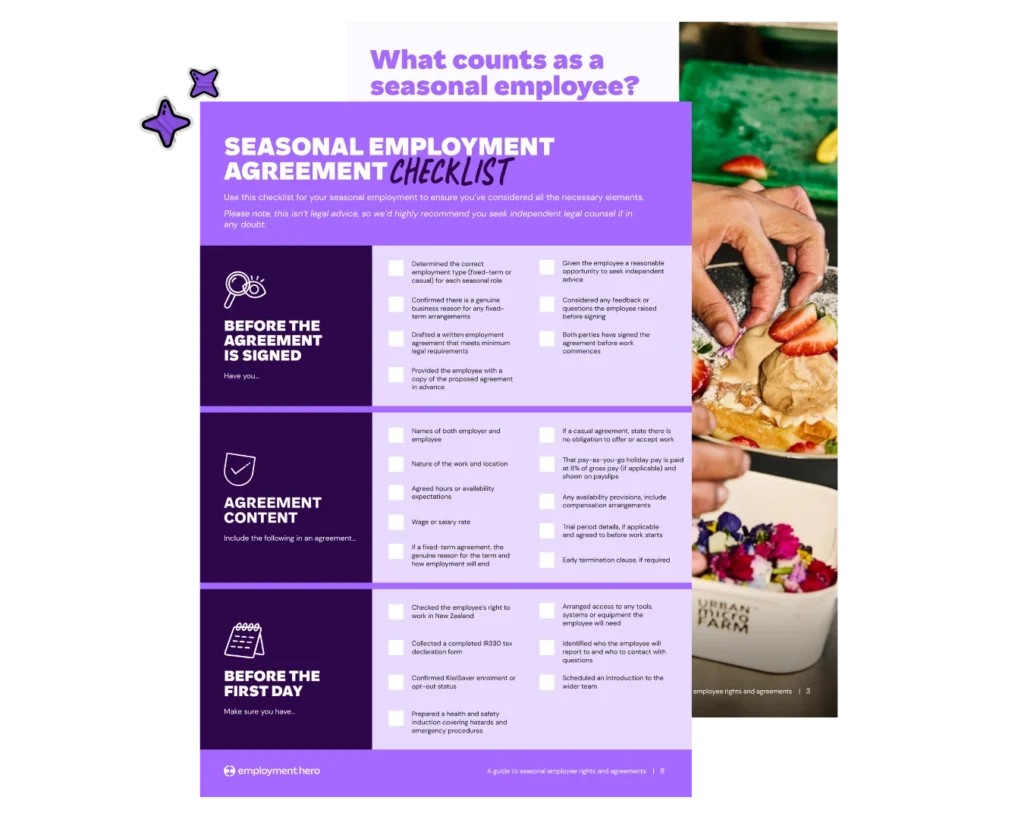
Our guide to seasonal employee rights and agreements includes:
- The different types of seasonal employees in New Zealand
- Legal rights, including annual leave and pay
- What to include in an employment agreement
- Common mistakes to avoid
Download the guide by filling in the form on the right.
The information in this article is current as at 28 May 2026 and has been prepared by Employment Hero Pty Ltd (ABN 11 160 047 709) and its affiliates (Employment Hero). The views expressed in this article are general information only, are provided in good faith to assist employers and their employees, and should not be relied on as professional advice. Some information is based on data supplied by third parties. While such data is believed to be accurate, it has not been independently verified and no warranties are given that it is complete, accurate, up to date or fit for the purpose for which it is required. Employment Hero does not accept responsibility for any inaccuracy in such data and is not liable for any loss or damages arising directly or indirectly as a result of reliance on, use of or inability to use any information provided in this article. You should undertake your own research and seek professional advice before making any decisions or relying on the information in this article.
Overview of seasonal employee rights
Unlike a full-time, part-time or fixed-term employee, a ‘seasonal employee’ isn’t a formal legal work type. Instead, it generally is an umbrella term given to those who work for a business during a specific period of time, such as harvest, summer tourism or the Christmas retail rush. That generally means people on a fixed-term contract, although casual employment may also be used.
What’s important is that if they’re classified as an employee (and not an independent contractor), they’re entitled to the same core protections as any other worker. Whether someone works full time hours across a three-month summer rush or part time shifts during a weekend-heavy peak period, the law applies equally.
These protections include the right to be paid at least the minimum wage, to receive paid rest breaks and unpaid meal breaks, to work in a safe environment and to be treated fairly if a concern or dispute arises. They are legal minimums that apply from the first day of employment.
Employment agreements for seasonal workers
Every seasonal worker, regardless of how short the engagement, must have a written employment agreement in place before they start work. This isn’t optional. A handshake or verbal understanding doesn’t satisfy the requirements of the Employment Relations Act 2000.
A well-drafted agreement for a seasonal role needs to cover more than the basics. It should state the start date and how the employment will end, whether that is a fixed date or the completion of a specific event such as the end of a grape harvest. It should specify the agreed wage or salary rate, the expected hours of work and how rosters will be communicated and managed.
Rest breaks and public holiday pay provisions must also be addressed. Employees are entitled to paid rest breaks and an unpaid meal break based on the length of their shift. Public holidays that fall on what would otherwise be a working day must be paid, even for short-term seasonal roles. These entitlements cannot be excluded by agreement.
Sick leave and annual leave clauses should be drafted to reflect the actual employment type. Fixed-term employees accrue leave in the same way as permanent staff. Casual employees can have their annual leave paid out on a pay-as-you-go basis at 8% of gross earnings, but this arrangement must be written into the agreement and shown clearly on every payslip.
Fixed-term contracts and fixed-term employees
A fixed-term agreement can only be used when there is a genuine business reason for the employment to end at a specific point. Under the Employment Relations Act 2000, that reason must be stated in the agreement itself. Seasonal demand, covering for an employee on parental leave and completing a project with a defined end date are all legitimate grounds. Using a fixed-term agreement because you want to assess a new employee before committing to them permanently is not.
When a fixed-term contract comes to an end, employers sometimes want to renew it or extend it. This is lawful, but there are risks that need to be managed carefully. Each renewal must be supported by a genuine business reason of its own. Renewing the same agreement year after year for the same role without reassessing the basis for doing so increases the likelihood that a court or the Employment Relations Authority will find that the worker has become a permanent employee in practice, regardless of what the paperwork says.
Ending a fixed-term agreement is straightforward when it runs its course. The employment finishes on the agreed date or upon the completion of the agreed event, and no notice is generally required unless the agreement provides otherwise.
Casual employees versus seasonal employees
A genuine casual arrangement involves no regularity and no obligation on either side. Work is offered and accepted on a shift-by-shift basis. The casual employee can decline any offer without consequence, and the employer has no obligation to make offers in the first place.
A seasonal employee, on the other hand, usually works on a fixed-term contract. If you employ someone under a casual agreement for seasonal work, it comes with its own risk. When a worker labelled as casual is actually working regular and predictable hours over a sustained period, their employment status can change, regardless of how the agreement describes them. After six months of regular, consistent hours, that worker may have acquired the rights of a permanent part-time employee.
Employers should review the actual work patterns of anyone on a casual agreement regularly and update the arrangement if the nature of the work has genuinely shifted.
Permanent employees compared to seasonal roles
A permanent employee has no agreed end date to their employment. The relationship continues until it is brought to an end by either party, subject to proper notice and legal process. Seasonal employees, by contrast, usually have a defined endpoint built into their agreement.
That difference is significant, but it does not mean seasonal employees have fewer entitlements. Seasonal workers retain most of the rights that permanent employees enjoy, including minimum wage protections, leave entitlements, rest break rights and access to the personal grievance process. The key difference is the duration of the relationship, not the quality of the protections.
Minimum rights and legal requirements
Certain rights exist for every worker regardless of what an employment agreement says. No employment agreement, however carefully worded, can exclude or reduce these minimum standards.
Accurate wage and time records must also be kept for every worker, including seasonal and casual employees. Records should capture hours worked, pay rates, leave taken and any deductions made.
Leave entitlements must be calculated correctly too. Errors in holiday pay calculations are among the most common compliance issues identified by Labour Inspectors and can result in significant back payments.
Full-time and part-time considerations
Whether a seasonal worker is employed full-time or part-time affects how some entitlements are calculated, but it doesn’t affect whether those entitlements apply. Both full-time and part-time seasonal workers are entitled to minimum wage, rest breaks, sick leave and annual leave.
For part-time workers, entitlements are generally pro-rated based on the hours or days they work. A part-time employee who works three days a week is entitled to sick leave and annual leave calculated proportionally to their hours. Employers who apply full-time entitlement calculations to part-time workers, or who assume that shorter hours reduce their obligations, risk breaching minimum employment standards.
Recognised Seasonal Employer obligations
The Recognised Seasonal Employer scheme allows eligible New Zealand employers to bring in workers from certain Pacific nations to fill seasonal roles that cannot be filled locally. Becoming an RSE employer involves meeting eligibility criteria and submitting an application to Immigration New Zealand demonstrating that genuine attempts have been made to recruit locally first.
Employment agreements for RSE workers must include specific clauses required under the scheme. These cover matters including accommodation arrangements, return airfares and the employer’s obligations in relation to worker welfare. For more information, check out our factsheet.
Hiring overseas seasonal workers
Before any overseas worker begins work, employers must verify that the individual holds the appropriate visa and has the legal right to work in New Zealand in the intended role. Copies of relevant immigration documentation should be retained on file.
For RSE employers, the agreement must address responsibility for return airfares if applicable, and the employer must be able to demonstrate evidence of local recruitment attempts as part of the scheme’s requirements.
Practical steps for employers
Before hiring seasonal staff, confirm the correct employment type for each role based on the actual nature of the work. Draft employment agreements that are tailored to seasonal roles, rather than adapting permanent or generic templates, and make sure every agreement addresses the points covered in this guide.
Make sure to train supervisors and team leaders on your seasonal employment policies so that day-to-day management decisions reflect your legal obligations as well.
Dispute resolution and termination
Every employment agreement should include an internal grievance procedure that sets out how concerns will be raised and addressed. Having a clear process in place is not just a legal best practice. It gives both parties a pathway to resolve issues before they escalate.
When a fixed-term agreement reaches its agreed end, the employment concludes lawfully without the need for a termination process. When an employer needs to end an agreement early, the reasons should be documented clearly and the process set out in the agreement followed precisely. Good documentation can protect both parties if a dispute is later raised.
For more information, download our guide by filling out the form on the right.
Register for the Guide to Seasonal Employee Rights and Agreement
Related Resources
-
 Read more: The AI Adoption Blueprint
The AI Adoption Blueprint
What does it take to embed AI across an entire team? We’re sharing our training, our policies, and the lessons…
-
 Read more: Employment Essentials: AI Best Practices
Employment Essentials: AI Best Practices
Learn how to use AI in HR without creating privacy, compliance or employment risks in our latest webinar.
-
 Read more: The benefits of hiring overseas employees for New Zealand businesses
The benefits of hiring overseas employees for New Zealand businesses
Discover the key benefits of hiring overseas employees for your, from accessing global talent to building round-the-clock teams.

