 Australia
  United Kingdom
  Singapore
  Malaysia
  Canada (Français)
 New Zealand


Running effective 1:1s
Published
Running effective 1:1s
We continually hear that internal communication is a pain point for businesses, so what if we told you that you could improve it with one simple, yet effective management technique?
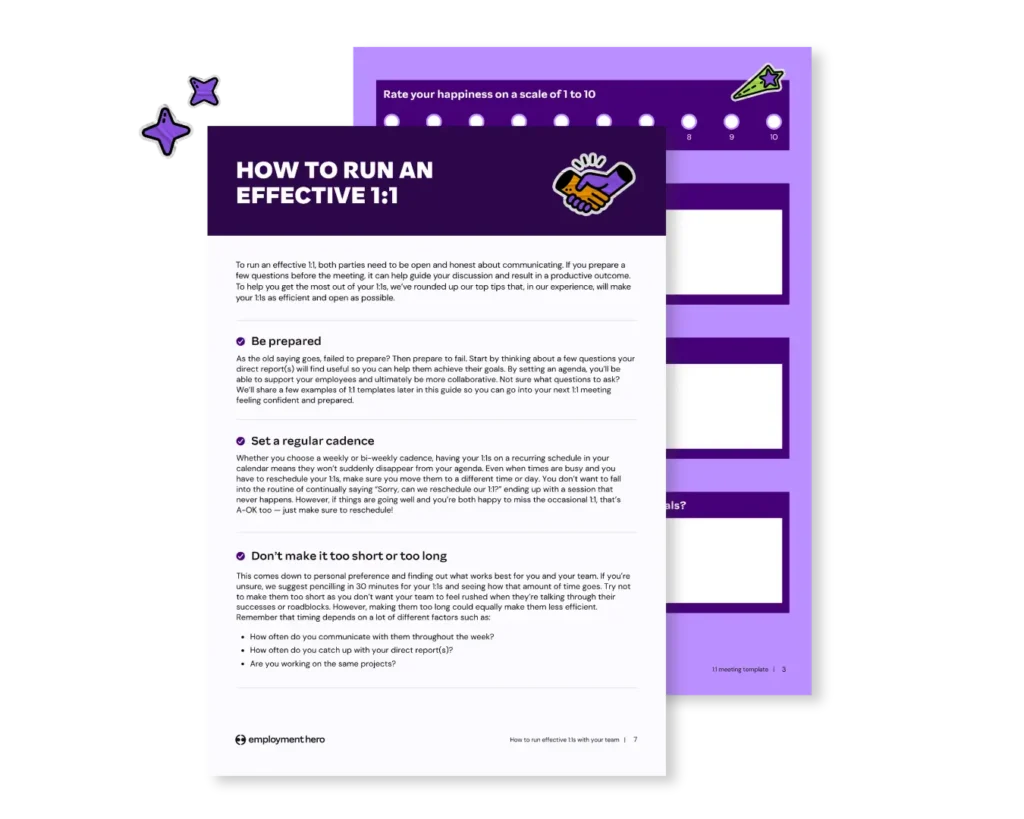
1:1s might be the very thing to take your company communication and alignment to the next level of performance. To help you get the most out of 1:1s, we’ve created this handy bundle.
What’s covered in the Effective 1:1s Bundle?
- A comprehensive guide on running effective 1:1s
- 1:1 template for you to use
- Example questions
What is a one-on-one meeting?
A one-on-one meeting is a dedicated, recurring conversation between a manager and an employee. Unlike team meetings which focus on broader business updates, these catch-ups are entirely about the individual. They offer a private space to discuss workload, wellbeing, career goals and day-to-day challenges.
These check-ins differ significantly from formal performance reviews. While a review looks back at past performance over a long period, a one-on-one is forward-looking and immediate. It is an ongoing dialogue rather than a formal evaluation.
Benefits of one-on-one meetings
Taking the time to sit down with your employees individually delivers strong returns for your business. It improves communication by giving people a safe space to share their thoughts without the pressure of a group setting.
These meetings also boost engagement and performance. When employees feel heard and supported, they are more likely to take ownership of their work. Furthermore, regular check-ins act as an early warning system. You can spot signs of burnout, interpersonal conflict or resource shortages before they escalate into major problems. This proactive approach helps reduce staff turnover, which is crucial given recent labour market statistics from Stats NZ highlighting the ongoing challenges of retaining skilled talent.
Why regular one-on-one meetings matter
Consistency is the secret to making these meetings work. When you hold one-on-ones on a predictable schedule, you build momentum and trust. Your team members know they have a guaranteed window of time to raise issues, which stops them from holding onto frustrations or interrupting you throughout the week.
If you frequently cancel or reschedule these catch-ups, it sends a message that the employee is not a priority. Sticking to a rhythm shows you value their time and their development.
How often should you hold one-on-one meetings?
There is no single rule for how often you should meet. The ideal frequency depends on the role type, the employee’s seniority and the overall needs of your team.
For new hires or junior staff members, weekly meetings provide the close support they need to learn the ropes. For more experienced team members who work autonomously, a fortnightly or monthly meeting might be enough. During busy periods or when managing a remote team, you might want to increase the frequency to keep everyone connected.
Where and how to meet
The environment you choose for your catch-up sets the tone for the conversation. If you work in the same office, finding a private room is essential. Discussing wellbeing or career concerns in a busy open-plan office makes it hard for people to be open.
For remote teams, a video call is usually the best option. Encourage your team to leave their cameras on to help build rapport. Whether you meet in person or online, make sure you minimise distractions. Close your laptop, put your phone on silent and give the person your full attention.
Planning and preparation
Going into a meeting without a plan often leads to a chat about the weekend and a quick status update. While building rapport is great, you need a flexible but structured agenda to keep the conversation productive.
An agenda gives both parties a chance to prepare. It ensures you cover the important topics and prevents the meeting from turning into a simple reporting exercise.
What should be on your one-on-one agenda?
A strong agenda covers more than just a list of tasks. You want to touch on several different areas over time to get a full picture of how the employee is doing. Common categories include workload management, progress on goals, general wellbeing, two-way feedback and career development. You do not need to cover every category in every meeting. You can rotate through them based on what feels most relevant that week.
Preparing for the meeting
Both the manager and the employee share responsibility for making the meeting valuable. As a manager, you should review your notes from the previous session, check progress on any action items and think about any feedback you need to share.
Employees should also prepare by noting down their achievements, current roadblocks and any questions they have. Encouraging your team to drive the agenda empowers them to take control of their own development.
One-on-one questions for employees
Asking the right questions unlocks deeper conversations. Instead of asking closed questions that result in a simple yes or no, use open-ended prompts. Try asking what they found most challenging this week, what they are most proud of or where they feel they need more support. You can also ask for feedback on your own management style by asking what you could do to make their job easier.
Questions to ask in different types of one-on-one meetings
The focus of your conversation will naturally shift depending on the specific purpose of the meeting. Tailoring your approach ensures you get the right outcomes.
Regular check-in
In a standard weekly or fortnightly meeting, focus on immediate updates and wellbeing. Ask about their current capacity, any hurdles blocking their work and how they are feeling generally. This is the time to offer immediate support and adjust workloads if necessary.
First one-on-one with a new team member
Your first meeting sets the foundation for your working relationship. Focus on building rapport and understanding their communication style. Clarify the expectations of their role, discuss how you both prefer to give and receive feedback and explain how your regular check-ins will work.
Skip-level meetings
These occur when a senior leader meets with employees who report to the managers below them. The goal is to gather high-level insights, spot operational risks and strengthen company culture across different layers of the business. Ask about their team dynamics, their understanding of the broader business strategy and any ideas they have for improving company processes.
Goal-setting meetings
When discussing objectives, you need to align their individual goals with the wider goals of the business. Ask what skills they want to develop and how those align with upcoming projects. Outline clear milestones so you can easily track progress over the coming months.
Growth and development conversations
Dedicate specific meetings entirely to career progression. Discuss their long-term career aspirations, identify any skill gaps and explore potential learning opportunities. Whether it involves formal training, mentoring or taking on new responsibilities, these conversations show you are invested in their future.
Performance review debriefs
After a formal review process, schedule a debrief to help the employee reflect on their feedback. Ask what surprised them in the review, what areas they want to focus on improving and how you can support their next steps.
Performance improvement meetings
When an employee is struggling, you need to address the challenges constructively. Focus on specific examples of where expectations are not being met and work together to agree on support actions. If you need to move into a formal performance management process, make sure you act in good faith as outlined by Employment New Zealand.
Taking effective one-on-one meeting notes
Relying on your memory is a risky strategy. Taking brief notes during or immediately after your meeting helps you track progress and spot patterns over time. Document the key decisions made, any feedback given and the specific action items you both agreed on. Following up on these action items in your next meeting is critical for building trust.
Dos and don’ts of effective one-on-one meetings
Running a great meeting takes practice. To help you get the most out of your time, keep these core principles in mind:
- Do let the employee speak first and guide the conversation
- Do actively listen and ask probing questions
- Do follow up on promises and action items
- Don’t cancel at the last minute unless it is an absolute emergency
- Don’t make the meeting entirely about task updates
- Don’t rush the conversation or check your phone
Tools that support better one-on-one meetings
Managing notes and agendas across a growing team can become messy if you rely on spreadsheets or loose paper. HR and performance management software can streamline the entire process. These platforms allow you to set collaborative agendas, record private notes and track action items in one place. Having a digital record makes it much easier to look back on an employee’s progress when it comes time for formal reviews.
The role of HR in supporting one-on-one meetings
While managers run the actual meetings, your HR team or business leaders play a vital role behind the scenes. They provide the framework and structure to make sure these meetings happen consistently across all departments. HR can also train managers on how to have difficult conversations, how to give constructive feedback and how to coach their team members effectively. By monitoring participation and providing the right tools, leaders help embed a culture of continuous support and development.
The information in this article is current as at 5 March 2026, and has been prepared by Employment Hero Pty Ltd (ABN 11 160 047 709) and its related bodies corporate (Employment Hero). The views expressed in this article are general information only, are provided in good faith to assist employers and their employees, and should not be relied on as professional advice. Some information is based on data supplied by third parties. While such data is believed to be accurate, it has not been independently verified and no warranties are given that it is complete, accurate, up to date or fit for the purpose for which it is required. Employment Hero does not accept responsibility for any inaccuracy in such data and is not liable for any loss or damages arising directly or indirectly as a result of reliance on, use of or inability to use any information provided in this article. You should undertake your own research and seek professional advice before making any decisions or relying on the information in this article.
Register for the bundle.
Related Resources
-
 Read more: The AI Adoption Blueprint
The AI Adoption Blueprint
What does it take to embed AI across an entire team? We’re sharing our training, our policies, and the lessons…
-
 Read more: Employment Essentials: AI Best Practices
Employment Essentials: AI Best Practices
Learn how to use AI in HR without creating privacy, compliance or employment risks in our latest webinar.
-
 Read more: The High Performance Series: The Power of Recovery
The High Performance Series: The Power of Recovery
Learn how elite teams manage recovery and prevent burnout. Join Employment Hero and The Blues for practical HR mental health…

