 Australia
  United Kingdom
  Singapore
  Malaysia
  Canada (Français)
 New Zealand

NZ Government Budget 2026: Key takeaways for employers
Published
NZ Government Budget 2026: Key takeaways for employers
Last Updated
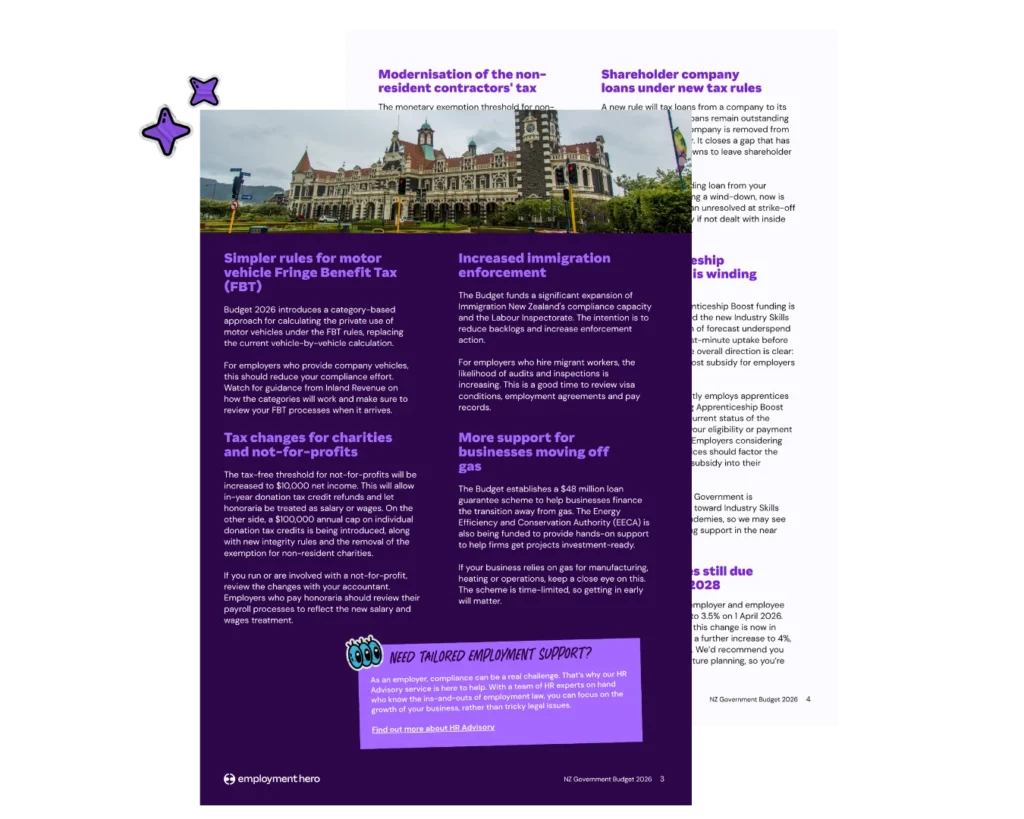
On 28 May 2026, the New Zealand Government announced Budget 2026, outlining key funding decisions that may affect businesses across New Zealand. Announcements include changes to how overseas contractors are taxed and increased immigration enforcement, along with simplified vehicle FBT rules and new loan support for businesses moving off gas.
We’ve created a factsheet which outlines the budget areas that matter most to Kiwi businesses, with clear, practical tips to help you stay ahead.
To download the factsheet, fill in the form on the right.
What are the biggest changes in the New Zealand Budget in 2026?
The Minister of Finance, Hon Nicola Willis, set a net operating allowance of $2.1 billion for Budget 2026, investing in essential services while continuing the government’s programme of fiscal repair.
Businesses weren’t the primary focus in the Budget this year, although there are some tax and investment announcements that will have an impact. Instead, the 2026 Budget focuses primarily on health, education, defence and infrastructure. Additional measures address the ongoing impact of global fuel price pressures, alongside longer-term investment in energy resilience.
Why should businesses be aware of the yearly Budget changes?
New Zealand businesses have faced a lot of challenges as the inflation rates change and everyone’s wallets get a little lighter. The latest Budget announcements will give many business owners an idea of what to expect from the Government in terms of legislation and practical support, as everyone seeks to weather the economic storm. Whether you’re a small or a large business, there’s a chance that these announcements will affect you in some way, even if your industry isn’t under the spotlight.
How is the NZ Budget determined?
The Budget process is one of the cornerstones of New Zealand parliament, as an ongoing examination of the Government’s taxes and spending capacity. At the end of the tax year, the analysis so far is turned into a strategic plan for the year (or sometimes years) ahead, before being presented on Budget day, which usually falls in May. The Budget process exists so that the Government can:
- Set objectives in terms of revenue, debt repayment, expenditure and investment
- Financially plan for the year ahead and beyond
- Allocate available funds and resources to match their current strategic objectives
In terms of who is involved, all Ministers in parliament have a role in the budget process. As well as being involved in the overall strategy, Ministers work on the development of initiatives relevant to their portfolios or focus areas.
What are the sectors affected by NZ budgets?
All sectors of New Zealand can be affected by government budgets, both directly and indirectly. That includes the private sector, as well as any specific industries. The directness of a government budget towards different sectors varies year on year. Often the announcements will single out specific sectors, such as the health sector or the construction industry, if they’re deemed a priority for government initiatives.
Even if they’re not explicitly singled out in budget announcements, certain economic measures can have a knock-on effect on all types of industries. For example, a fuel tax subsidy introduced to mitigate the population’s pain at the pump can also affect any business that relies on fuel for transport. Likewise a change to the Holidays Act or how Kiwisaver is handled will affect everybody’s payroll.
Learn about the key takeaways of this year’s Budget announcement
For a more detailed look, download our factsheet. We’ll break down the key points that will affect you, New Zealand business leaders.
If you’d like to stay up to date with the latest employment law changes in New Zealand, we post quarterly factsheets with everything you need to know. Find out more here.
The information in this article is current as at 28 May 2026, and has been prepared by Employment Hero Pty Ltd (ABN 11 160 047 709) and its related bodies corporate (Employment Hero). The views expressed in this article are general information only, are provided in good faith to assist employers and their employees, and should not be relied on as professional advice. Some information is based on data supplied by third parties. While such data is believed to be accurate, it has not been independently verified and no warranties are given that it is complete, accurate, up to date or fit for the purpose for which it is required. Employment Hero does not accept responsibility for any inaccuracy in such data and is not liable for any loss or damages arising directly or indirectly as a result of reliance on, use of or inability to use any information provided in this article. You should undertake your own research and seek professional advice before making any decisions or relying on the information in this article.
Register for the factsheet
Related Resources
-
 Read more: How Employment Hero’s AI Recruitment Agent helps New Zealand businesses hire faster
How Employment Hero’s AI Recruitment Agent helps New Zealand businesses hire faster
New Zealand businesses are drowning in applications and losing top candidates to faster competitors. Here’s how Employment Hero’s AI recruitment…
-
 Read more: The AI Adoption Blueprint
The AI Adoption Blueprint
What does it take to embed AI across an entire team? We’re sharing our training, our policies, and the lessons…
-
 Read more: Employment Essentials: AI Best Practices
Employment Essentials: AI Best Practices
Learn how to use AI in HR without creating privacy, compliance or employment risks in our latest webinar.


