

















Guide to long service leave in New Zealand
Published
Guide to long service leave in New Zealand
Published
Keeping your best people is one of the toughest parts of running a business in New Zealand. When you’ve invested time training them and watched them grow into key roles, it can be a big loss if they leave for a new opportunity.
Turnover is a cycle that disrupts your business, impacts team morale and costs a lot to fix. While pay rises and flexible work are important, they’re not the only tools you have. Long service leave is a powerful but often misunderstood benefit that can reward loyalty and give your team a compelling reason to stay.
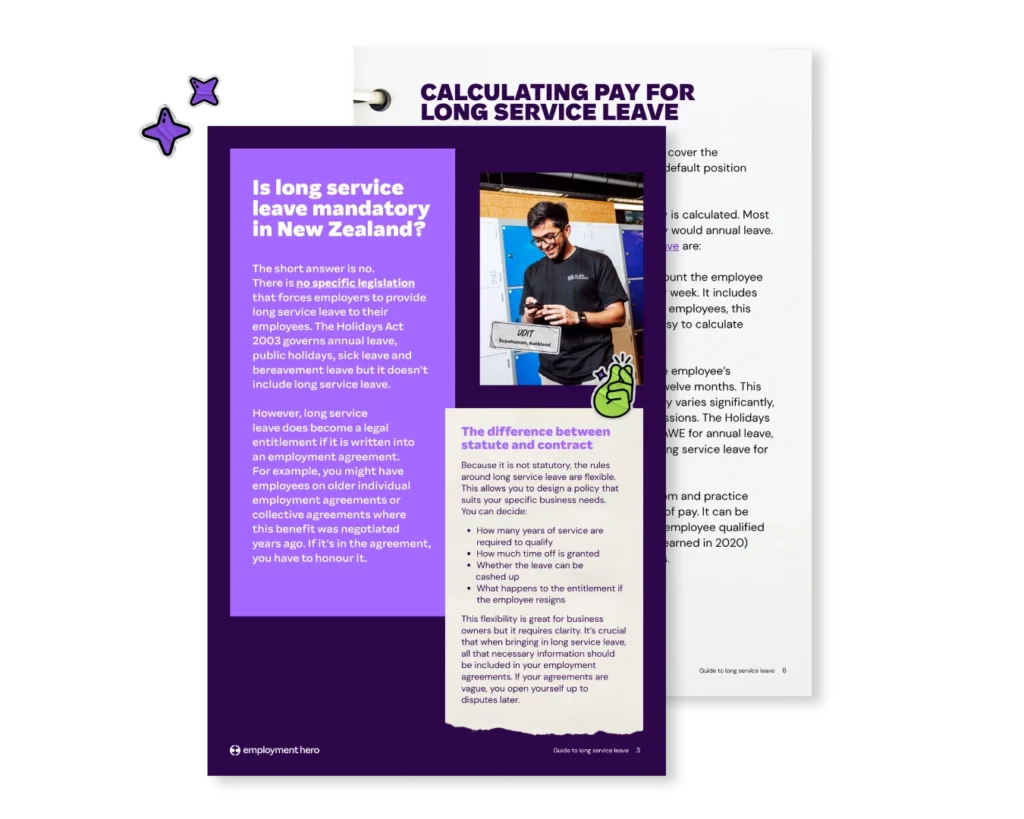
We’ve created a guide for New Zealand employers who want to understand long service leave from the ground up. Our guide covers:
- What long service leave is
- Your legal obligations as an employer
- How to build a policy from scratch
- How to manage it all in your payroll software
We’ve also included a template for a workplace policy, that you can use when rolling out long service leave in your business.
Download your free guide by filling in the form on the right, and turn long service leave into a strategic asset for your business.
What is long service leave in New Zealand?
Long service leave is an additional period of paid leave granted to an employee in recognition of a long period of continuous service with one employer. Think of it as a reward for loyalty. It’s a way for you to acknowledge the significant contribution a long-serving employee has made to your business.
The core idea is to give experienced employees an extended break to rest, travel or pursue personal projects without having to resign. It’s an opportunity for them to recharge their batteries, before returning to work refreshed and re-engaged. For many people, the chance to take a month or more off work without losing their job is a huge incentive.
Long service leave is not a legal requirement but an optional benefit. New Zealand has no universal statutory requirement for long service leave. Instead, employers can choose to offer this type of leave as part of their employee benefits. You decide how long an employee needs to work to qualify, how much leave they receive and the rules around when they can take it.
As an additional expense, many employers don’t offer this type of leave. However, they could be missing an important opportunity. Because it’s not mandated by law, you have the flexibility to design a long service leave policy that gives you a competitive edge. You can create a benefit that truly reflects your company’s values and rewards the long-term commitment of your staff.
Long service leave vs. annual leave
It’s important that both you and your employees understand the difference between long service leave and annual leave. They are separate entitlements that are governed by different rules and serve different purposes. Mixing them up can lead to confusion and incorrect leave management.
Annual leave
Annual leave is a statutory entitlement for all employees in New Zealand under the Holidays Act 2003. Every employee is entitled to at least four weeks of paid annual leave each year after they have completed twelve months of continuous employment.
Key features of annual leave include:
- It’s a legal minimum required by law.
- It accrues every year.
- Employees can request to take it at any time, subject to the employer’s approval.
- Unused annual leave is paid out when an employee leaves the company.
Long service leave
Long service leave, on the other hand, is almost always a contractual benefit. It’s an extra perk offered by an employer, on top of the legal minimums.
Key features of long service leave include:
- It’s not part of an employment relationship unless it is in the relevant employment agreement.
- It is typically a one-off entitlement after a significant period of service, such as ten or fifteen years.
- The rules for eligibility, amount of leave and payment are determined by the employment agreement or company policy.
- Whether it is paid out on termination depends entirely on the terms of the policy.
Think of it this way: annual leave is the standard break everyone gets to rest and recharge each year. Long service leave is a special, larger reward for reaching a major service milestone with the company.
Is long service leave a legal requirement?
This is one of the most common questions employers have and the answer is clear: no, there is no general legal requirement for employers in New Zealand to provide long service leave.
The main legislation governing employee leave, the Holidays Act 2003, covers annual holidays, sick leave, bereavement leave and public holidays. It does not include provisions for long service leave. This means you are not automatically obligated to offer it to your employees.
However, long service leave becomes a binding legal requirement the moment it is included in an employment agreement. If an employee has a clause in their individual employment agreement or is covered by a collective agreement that includes long service leave, you are legally required to provide it.
Many businesses inherit these clauses. For example, you might acquire a business with employees on older contracts that have a long service leave provision. In that case, you must honour the terms of that agreement for those employees. You can’t unilaterally remove an existing contractual entitlement.
Because it’s a contractual matter, the terms are negotiable. For new employees, you can decide whether to offer it at all. If you do, you have the freedom to set the rules. This is a key difference from statutory entitlements like annual leave, where the rules are set by the government and apply to everyone. This distinction gives you the power to use long service leave as a strategic tool, rather than just another administrative task.
Setting up a long service leave policy
If you decide to offer long service leave, creating a clear and comprehensive policy is essential. A well-written policy prevents confusion, manages expectations and protects your business from potential disputes. It ensures everyone understands how the benefit works.
Your policy should be written in plain English and cover all the key details. Here are the crucial elements to include.
Eligibility
This is the most important part of the policy. You need to define who qualifies and when.
- Length of service: Specify the number of years of continuous employment required. Common milestones are ten, fifteen or twenty years. Some modern companies are offering it after seven, or even five years to stay competitive.
- Type of employment: Clarify if it applies to full-time, part-time and fixed-term employees. For part-time staff, you’ll need to decide if the leave is granted on a pro-rata basis.
Entitlement
Be specific about what the employee receives once they qualify.
- Amount of leave: State exactly how much paid leave they are entitled to. For example, “four weeks of paid leave after ten years of continuous service”.
- One-off or recurring: Is it a single grant of leave or does the employee qualify for another period of long service leave if they stay for another ten years?
Taking the leave
Set clear rules about when and how the leave can be taken.
- Timeframe: Can the leave be taken at any time after it’s earned or must it be taken within a certain period – for example, within two years of the entitlement date? This helps you manage leave liabilities.
- The option to split: Can the employee take it all at once or can they split it into smaller chunks? Most employers require it to be taken in one continuous block to maximise the benefit of an extended break.
Cash-up options
Decide whether employees can exchange their leave for a lump sum payment.
- Availability: Is cashing up the leave an option? Some employees will prefer the money, while others will value the time off.
- Approval: Does the employee have the right to cash it up or is it at the discretion of the business?
By thinking through these points and documenting them in a formal policy, you create certainty for both your employees and your payroll team.
How much long service leave do employees get?
The amount of long service leave an employee receives is entirely determined by your company’s policy. Since there’s no law setting a minimum amount, you have complete flexibility to decide what is appropriate for your business.
When determining the amount of leave, consider what you want to achieve. A more generous entitlement will be a stronger incentive for retention. Common entitlements in New Zealand include:
- Two weeks of leave after ten years of service.
- Four weeks of leave after ten or fifteen years of service.
- A sliding scale, such as two weeks after seven years and another four weeks after fifteen years.
The key is to be explicit in your policy. Phrases like “a period of long service leave” are too vague and can lead to disputes. Your policy should state the amount of leave in weeks or days.
For part-time employees, it’s standard practice to grant leave on a pro-rata basis. For example, if a full-time employee gets four weeks of leave, a part-time employee who works half the hours might be entitled to two weeks of leave, paid at their regular part-time rate. Your policy should explain how this is calculated to ensure fairness and clarity.
Ultimately, the amount of leave you offer should balance the desire to reward loyalty with the financial cost to the business. Research what similar companies in your industry are offering to ensure your policy is competitive.
Calculating long service leave pay rates
Once an employee is approved to take their long service leave, you need to know how to pay them correctly. Incorrectly calculated leave pay is a common source of payroll errors and can cause significant frustration for employees.
Because the Holidays Act 2003 does not cover long service leave, it also doesn’t specify how to calculate the payment. This means you need to look to your employment agreement or policy.
Ideally, your long service leave policy should explicitly state how the pay will be calculated. The most common methods for calculating leave are:
- Ordinary Weekly Pay (OWP): This is the amount the employee would normally receive for an ordinary working week. It includes their regular salary or wages. For most salaried employees, this is simply their weekly salary. This method is easy to calculate and understand.
- Average Weekly Earnings (AWE): This is the employee’s average weekly gross earnings over the past twelve months. This method is often used for employees whose pay varies significantly, for example due to regular overtime or commissions. The Holidays Act requires you to pay the higher of OWP or AWE for annual leave, and many employers adopt this practice for long service leave for the sake of consistency and fairness.
If your policy is silent on the calculation method, the accepted practice is to pay the employee at their current rate of pay when they take the leave. It would be risky to pay them based on their pay rate from when they qualified for the leave unless your policy specifically allows for this. For example, paying an employee in 2026 using their 2020 pay rate would likely be seen as unfair and could be challenged.
Clarity is key. Specifying the calculation method in your policy from the outset eliminates any ambiguity and helps your payroll team process the leave correctly every time.
How does an employee apply for long service leave?
Having a formal process for applying for long service leave is just as important as having a clear policy. A simple, well-defined procedure makes it easy for employees to request their leave and for managers to handle those requests consistently.
Your application process should be straightforward and easy to follow. It typically involves these steps:
1. The request
The employee should make a formal request to take their leave. This should be documented to create a clear paper trail – such as facilitating requests through payroll software. The request should include the desired start and end dates of the leave.
2. Notice period
Your policy should specify how much notice an employee needs to give before they intend to take their leave. A longer notice period, such as three months, is reasonable for a long period of absence like long service leave. This gives you enough time to plan for their absence and arrange for cover if needed.
3. Approval
The request should be reviewed by the employee’s manager and the HR department. The approval process should check two things:
- That the employee is eligible for the leave according to the policy.
- That the timing of the leave works for the business.
While you should encourage employees to take their well-earned breaks, there may be business reasons why a particular set of dates doesn’t work. Your policy should state that leave is to be taken at a time that is mutually agreed upon.
Remember, as always, to consider the legal principles of good faith, reason and fair process when handling and responding to leave requests.
4. Confirmation
Once the leave is approved, confirm the dates in writing to the employee. This formal confirmation ensures everyone is on the same page and locks in the arrangement. It should also confirm the employee’s final day of work before the leave starts and their return date.
Making this process clear and accessible means employees know exactly what to do when they want to use their entitlement, and managers can handle requests fairly and efficiently.
Managing long service leave in your payroll
Managing long service leave in your payroll processes requires careful attention to detail. Unlike annual leave which accrues steadily, long service leave is a “lumpy” entitlement that typically appears all at once when an employee hits a service milestone. This can create administrative and financial challenges if you’re not prepared.
Here are the key aspects of managing it in payroll:
Accurate record-keeping
The foundation of good leave management is accurate data. Your payroll or HR system must have the correct start date for every employee. You also need to track any periods of unpaid leave that might affect their continuous service. After all, keeping accurate wage and time records is a legal requirement.
Tracking entitlements
Manually tracking service anniversaries for all your employees is risky. It’s easy to miss a date, which can lead to an employee not being told they have qualified for leave. A modern payroll system can automate this. You should be able to set up the long service leave policy in your system so that it automatically calculates eligibility and notifies your payroll team when an employee’s anniversary is approaching.
Processing payments and tax
When an employee takes long service leave, the payment is usually taxed as normal salary and wages through PAYE. However, if the employee chooses to cash up their leave and is permitted to do so by the long service leave policy, it is treated as a lump sum payment. This is usually taxed as an “extra pay” which has a different tax calculation method. Getting this right is crucial to avoid creating a tax problem for your employee.
Managing liabilities
Long service leave creates a financial liability for your business. For nine years, an employee might have no long service leave liability associated with them. Then, on their ten-year anniversary, your business suddenly owes them several weeks of pay. Your finance team needs to be aware of this. Best practice is to provision for this liability over time, rather than letting it hit your balance sheet as a surprise.
What happens to long service leave when an employee leaves?
The end of an employment relationship can bring up tricky questions about long service leave. How you handle it depends on the specific circumstances and, most importantly, the wording of your policy.
There are two main scenarios to consider:
1. The employee leaves after qualifying
If an employee becomes entitled to long service leave but leaves the company before they have taken it, generally employers will have to pay it out. Once the employee has met the service requirement (e.g, reached their ten-year anniversary), the leave entitlement is “vested”. It becomes a debt owed by the business to the employee, similar to unused annual leave. This amount must be included in their final pay.
The payment would typically be for the full amount of the leave entitlement, calculated according to the method set out in your policy.
2. The employee leaves before qualifying
This is a more common and often contentious scenario. What happens if an employee resigns after nine years and ten months of service when the entitlement is at ten years?
Unless your policy explicitly states otherwise, the employee is generally not entitled to anything. The entitlement only triggers on the specific anniversary date. If they leave before that date, they forfeit the benefit.
However, some employment agreements, particularly older collective agreements, may contain a “pro-rata” clause. A pro-rata clause grants a partial payout if an employee leaves after a certain number of years but before the full entitlement date. For example, a policy might state that employees who leave after seven years of service are entitled to a proportionate payment of the long service leave.
Always check the exact wording of the employment agreement or policy before finalising a payment. A clear policy that covers exit scenarios will save you from potential disputes down the line.
Communicating your long service leave policy
A great benefit is only effective if your team knows it exists and understands how it works. Clear and consistent communication is essential to getting the full value out of your long service leave policy. It transforms it from a line item in a contract to a tangible part of your company culture.
Here’s how you can effectively communicate your policy:
Onboarding
Introduce the long service leave policy to new employees as part of their onboarding process. Include it in your employee handbook and mention it when discussing company benefits. This sets a positive tone from day one, showing that you are a company that values loyalty and plans for the long term.
Easy access
Make the full policy document easily accessible to all employees. Store it on your company intranet or in your HR information system. Employees should be able to find and read the policy whenever they want without having to ask for it.
Regular reminders
Don’t just “set and forget” your policy. Remind employees about it from time to time. You could mention it in company newsletters, at all-staff meetings or as part of a total rewards statement. This keeps the benefit top-of-mind and reinforces its value.
Celebrating milestones
When an employee qualifies for long service leave, celebrate it. Acknowledge their service milestone publicly (with their permission). This not only makes the qualifying employee feel valued but also shows other staff that the company follows through on its promises. It makes the benefit real and aspirational for everyone else.
The benefits of offering long service leave
In a competitive market for talent, offering long service leave can be a powerful move for your business. It goes beyond the standard benefits package and sends a strong message that you value commitment and invest in your people for the long haul. The advantages are significant and can have a lasting impact on your business.
Increased employee retention
This is the most direct and valuable benefit. A significant period of paid leave is a powerful “golden handcuff”. An employee who is approaching a long service leave milestone is less likely to look for a new job. For New Zealand businesses facing skills shortages, keeping experienced and knowledgeable staff is a huge competitive advantage.
Enhanced employee engagement and morale
Offering long service leave shows that you care about your employees’ wellbeing. An extended break allows them to fully disconnect, rest and pursue personal interests. They return to work feeling refreshed, re-energised and more engaged. This positive morale can spread throughout the team.
Attracting top talent
When a candidate is choosing between two similar job offers, a generous long service leave policy can be the deciding factor. It signals that your company has a positive culture that supports its employees’ long-term careers. In a tight labour market, every advantage counts.
Improved productivity and knowledge transfer
The prospect of an employee taking a long break can force you to improve your processes. You will need to document procedures and cross-train other team members to cover their work. This builds resilience in your business and helps with succession planning. When the long-serving employee returns, they often bring back fresh perspectives and new energy that can drive innovation.
While it represents a financial cost, long service leave should be viewed as an investment in your most valuable asset: your people. By rewarding loyalty, you can build a stable, experienced and dedicated team that is committed to the success of your business.
To find out more about long service leave and build your own workplace policy, download our guide.
The information in this article is current as at 30 December 2025, and has been prepared by Employment Hero Pty Ltd (ABN 11 160 047 709) and its related bodies corporate (Employment Hero). The views expressed in this article are general information only, are provided in good faith to assist employers and their employees, and should not be relied on as professional advice. Some information is based on data supplied by third parties. While such data is believed to be accurate, it has not been independently verified and no warranties are given that it is complete, accurate, up to date or fit for the purpose for which it is required. Employment Hero does not accept responsibility for any inaccuracy in such data and is not liable for any loss or damages arising directly or indirectly as a result of reliance on, use of or inability to use any information provided in this article. You should undertake your own research and seek professional advice before making any decisions or relying on the information in this article.
Register for the guide
Related Resources
-
 Read more: Essential guide to contract management
Essential guide to contract management
Understand contract management from creation to renewal, and why the right software is essential for reducing risk and getting your…
-
 Read more: Guide to long service leave in New Zealand
Guide to long service leave in New Zealand
Learn about long service leave entitlements, pay rates and regulations.
-
 Read more: Guide to restraint of trade clauses in New Zealand
Guide to restraint of trade clauses in New Zealand
A straightforward guide to restraint of trade clauses, enforceability and protecting your trade secrets.

