

















Job promotion criteria checklist
Published
Job promotion criteria checklist
Published
Promoting employees is both an opportunity and a responsibility for employers. It’s a chance to reward growth, motivate your team and support business success. But when handled poorly, promotions can create confusion, damage morale and invite claims of unfairness. A transparent approach, guided by structure and clear criteria, helps avoid these risks.
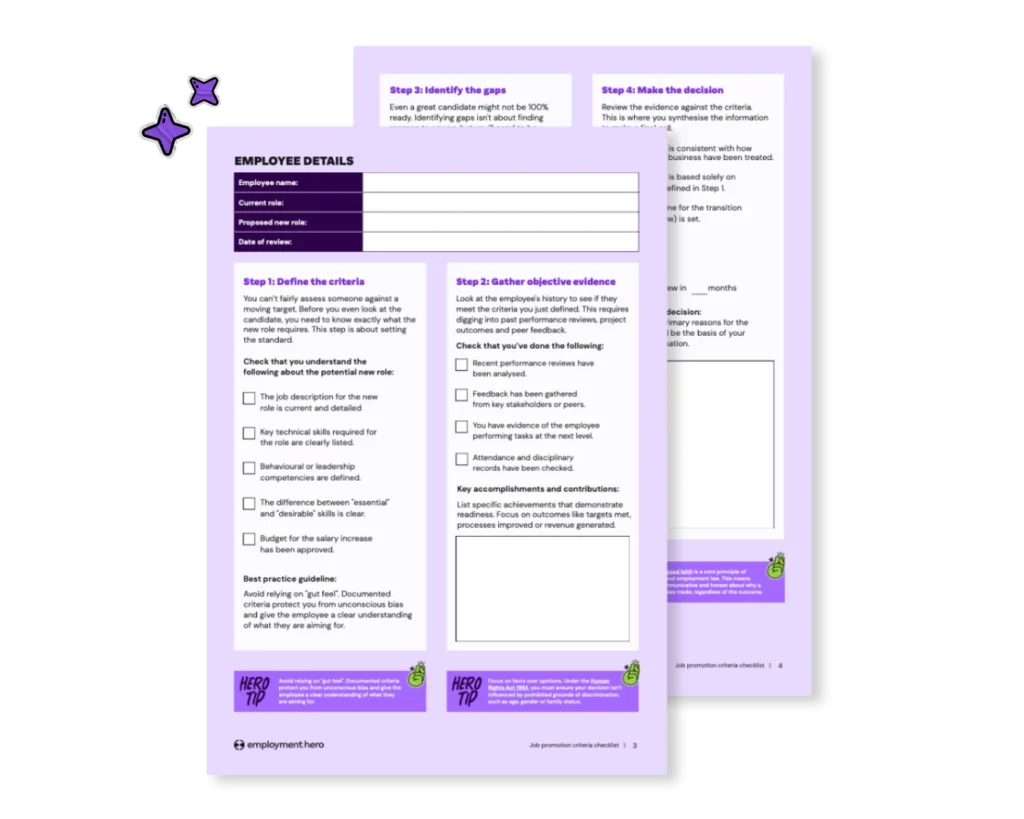
Our downloadable checklist is designed to help New Zealand employers promote fairly and consistently. You’ll find practical steps for setting standards, measuring readiness and guiding your staff through every stage of advancement.
To download the promotion checklist, fill in the form on the right.
What does promoting employees mean for your team?
Employee promotion means entrusting someone with more responsibility and the chance to grow within your organisation. Promotions are a formal recognition of an employee’s contribution and their readiness for expanded duties. For businesses, it’s about leveraging existing knowledge, securing critical roles and investing in talent with proven commitment.
Promotions don’t have to be purely vertical. Moving into a specialised project or a new area can also constitute advancement, especially when it builds new skills or drives impact for the business. Promotion is not just a reward for the past, but a belief in future value.
Why is promoting employees a win-win for everyone?
There are tangible financial and cultural benefits to internal promotions. When you promote from within, you avoid the direct and indirect costs of external recruitment. Existing employees need less time to onboard, understand your culture and make a difference quickly.
Promotions also demonstrate that your business values loyalty and hard work. This encourages staff to see their long-term future as part of your team. For the rest of your workforce, seeing clear opportunities for progression increases motivation and sets a positive example. It builds an environment where people strive to deliver meaningful results and grow knowing they will be recognised.
How can you boost employee engagement through career development?
If your team sees no pathway for growth, ambition fades and performance can drop. Regular career development discussions help staff align their aspirations with your business needs. This starts with small steps, such as quarterly development meetings or informal catchups on goals and interests.
Career growth is not just about moving up. It might mean gaining new skills, contributing to a special project or mentoring others. Focusing on development sends the message that you’re invested in your people beyond their current output. Engagement thrives where staff feel challenged and supported at every stage.
Why are employee promotions key to driving engagement and retention?
Internal promotion is a direct way to demonstrate that progress is possible. It signals that effort, skill and values are rewarded in a tangible way. When people know they can move forward, they are more likely to stay and invest extra energy into their roles.
Offering promotions is also a retention tool. Satisfied, motivated employees are less likely to seek new opportunities elsewhere. You keep institutional knowledge in the business and avoid the loss of experienced hands that can disrupt momentum.
Promotions also foster trust. When the process is clear and everyone believes opportunities are based on fair criteria, your team feels respected and secure in their possibilities for growth.
What are the four types of employee promotions and which one fits your team?
Choosing the right promotion path helps your business address needs while offering meaningful career growth to your team. The type of promotion depends on the individual and organisational priorities.
Vertical promotion
Uplifting an employee to a higher position with greater responsibility and pay. This works well when leadership or advanced skill is required.
Horizontal promotion
Moving someone into a new role at a similar level, perhaps in another department or specialty. This supports skill diversification and fresh perspectives.
Hybrid promotion
Combining vertical and horizontal movement, such as shifting to a new role while leading a project or team. This can help test future leaders and provide broader experience.
Merit-based salary increase
Sometimes you recognise mastery within an existing role with extra pay, rather than a new title. This is especially valuable for technical specialists who may not want to move into management.
How do you craft an employee promotion policy that works for everyone?
A robust policy removes ambiguity and strengthens confidence in the process. It should state its intent up front: to allocate advancement opportunities fairly and consistently. This reinforces business values and sets clear parameters for everyone involved.
Key ingredients of a strong policy:
- Transparent eligibility requirements (such as time in role or performance benchmarks)
- Step-by-step explanation of the process (including how to apply, who reviews and who decides)
- Links to role descriptions and criteria so applicants know what is expected
- A commitment to fairness, underpinned by New Zealand law
Aim to keep the policy a living document. Update it when business goals, team structures or external requirements change.
Avoid any criteria or process that could be unknowingly discriminatory. Review your policy against prohibited grounds under the Human Rights Act 1993.
Why is setting clear criteria essential for fair promotions?
Decisions based on gut feel or criteria that are only vaguely defined, invite claims of bias. Clear standards help you measure everyone objectively, reducing risk for the business and promoting a sense of trust throughout your workforce.
Specific criteria also help employees understand where they stand. Instead of guessing what it takes to be promoted, your team sees a mapped pathway and can focus their development efforts accordingly. This keeps expectations realistic for both staff and leaders.
Remember: clarity in your standards gives employees a sense of control over their career, and keeps your decisions defensible if challenged.
What are common eligibility criteria for a promotion?
Eligibility criteria shape who can realistically be considered for promotion. These should reflect business needs and fairness to all team members. Common elements to include are:
- Minimum time in the current role (so employees can master existing responsibilities)
- Strong performance record over several assessment periods
- Positive contribution to team culture and company values
- No outstanding disciplinary issues
These requirements should be communicated to all staff and revisited regularly as business demands change.
It’s important that these criteria are applied consistently to all team members, to avoid real or perceived favouritism.
How to use the job promotion criteria checklist
A checklist is more than a box-ticking exercise. It serves as your guide through an evidence-based, non-biased process.
Begin by reviewing the current job description for the role you’re considering promoting someone to. Highlight “must-have” and “nice-to-have” skills or experience. Next, gather all relevant performance data on the candidate. This could include recent reviews, feedback from other team members and any formal warnings or attendance issues.
Use the checklist to verify each step:
- Has the job description been updated and shared?
- Are the performance standards documented and matched to the candidate’s record?
- Have all business protocols (such as budget sign-off) been followed?
Alongside checkboxes, encourage your managers to record supporting examples, such as data points or scenarios that show readiness for advancement. This level of detail not only strengthens your case but also gives useful feedback to employees, whatever the outcome.
Our checklist also covers post-decision requirements, such as documenting the outcome, providing feedback and updating employment agreements if there’s a change.
Download the free job promotion criteria checklist by filling in the form on the right.
What role does employee performance play in promotions?
Strong performance in a current role is vital, yet it’s not the only thing that matters. In some cases, an exceptional employee in one role may lack the qualities or interest required for another. For example, the best technical expert may not want, or be suited, to people management.
It’s essential to review both achievements and how they were achieved. Did the employee not only hit targets but display qualities like initiative, collaboration and the ability to solve problems under pressure? These are often better predictors of success in a new role than individual numbers alone.
Quantitative data should be balanced with qualitative insights, such as feedback from peers or examples of leadership in action.
How can you design an effective employee promotion process?
Consistency and transparency are keys to a fair process. Start by identifying the business need — are you filling a vacancy or supporting career progression within an area of growth?
Make the opportunity visible to internal candidates first. This signals that advancement is genuinely open and accessible. Consider holding formal interviews for candidates stepping into new responsibilities.
Use the checklist at each review stage to stay objective and structured. At the end, seek input from other business leaders. This helps avoid decisions that could be clouded by a single person’s perspective, which is especially important in smaller organisations.
Document every step and keep channels of communication open throughout.
What does the entire promotion process look like from start to finish?
Promotions follow a logical sequence:
- Identify the opportunity: Whether due to work growth, a gap or staff aspirations.
- Define criteria: Update role descriptions and clarify requirements.
- Announce the opportunity: Share details internally and invite suitable candidates.
- Assessment: Use your promotion criteria checklist and interviews or practical assessments if needed.
- Decision: Review all evidence, discuss outcomes with leadership as required.
- Communicate outcome: Share the result with both the candidate and team.
- Transition: If approved, create a transition and onboarding plan. Update contracts as needed.
This lifecycle encourages planning, fairness and positive business outcomes.
What are the seven steps to make employee promotions seamless?
Keep promotions running smoothly with this practical framework:
- Plan the pipeline. Regularly review your team’s talent to map likely progression pathways.
- Be transparent. Share your process and criteria with all employees.
- Collect evidence. Use performance data, not just perceptions, to guide decisions.
- Communicate proactively. Set clear timelines and keep candidates informed.
- Prepare people managers. Train them to support and accurately assess their teams.
- Mark achievements. Recognise promotions publicly to build a culture of success.
- Support induction. Provide structure and clarity around the expectations in the new role.
How do you know when an employee is ready for a promotion?
Readiness for promotion combines track record with emerging leadership qualities. Sometimes, the best indicator is whether an employee is already taking on responsibilities beyond their job description.
Employees ready for promotion will typically:
- Display initiative, consistently stepping up when challenges arise
- Offer solutions, not just problems
- Build trust with colleagues and deliver constructive feedback
- Welcome change and show resilience under pressure
Listen for signs of ambition too. If someone seeks new challenges or expresses a desire for more responsibility, consider opportunities to test their readiness before a formal move.
How can employee growth align with your company goals?
Aligning development plans with business objectives keeps your team and strategy on track. Link individual ambitions to long-term goals, such as expanding services, improving client relations or adopting new technology.
Examples include promoting someone with digital expertise into a key project or encouraging a rising manager to lead a new service line.
Use career discussions to identify gaps between your current and future skills needs, then design training and mentoring accordingly.
When employees see their personal growth mapped to wider company goals, motivation grows and retention improves.
How can you help employees transition smoothly from their current role?
Supporting employees through promotion makes a big difference to their long-term success. Start with clear paperwork. Under New Zealand law, you need to issue a written variation or new agreement when terms change. For guidance, refer to Employment New Zealand.
Help your promoted employee understand their new remit. Outline responsibilities, priorities and the support available in their first three months. Hold regular check-ins to address questions, build confidence and encourage continuous learning.
Lastly, prepare the rest of the team. Make sure reporting lines and responsibilities are clear and provide any training needed for the employee’s old role.
For an actionable resource to help you organise your promotions, download the free job promotion checklist now.
The information in this article is current as at 22 January 2026, and has been prepared by Employment Hero Pty Ltd (ABN 11 160 047 709) and its related bodies corporate (Employment Hero). The views expressed in this article are general information only, are provided in good faith to assist employers and their employees, and should not be relied on as professional advice. Some information is based on data supplied by third parties. While such data is believed to be accurate, it has not been independently verified and no warranties are given that it is complete, accurate, up to date or fit for the purpose for which it is required. Employment Hero does not accept responsibility for any inaccuracy in such data and is not liable for any loss or damages arising directly or indirectly as a result of reliance on, use of or inability to use any information provided in this article. You should undertake your own research and seek professional advice before making any decisions or relying on the information in this article.
Register for downloadable
Related Resources
-
 Read more: HR documents checklist
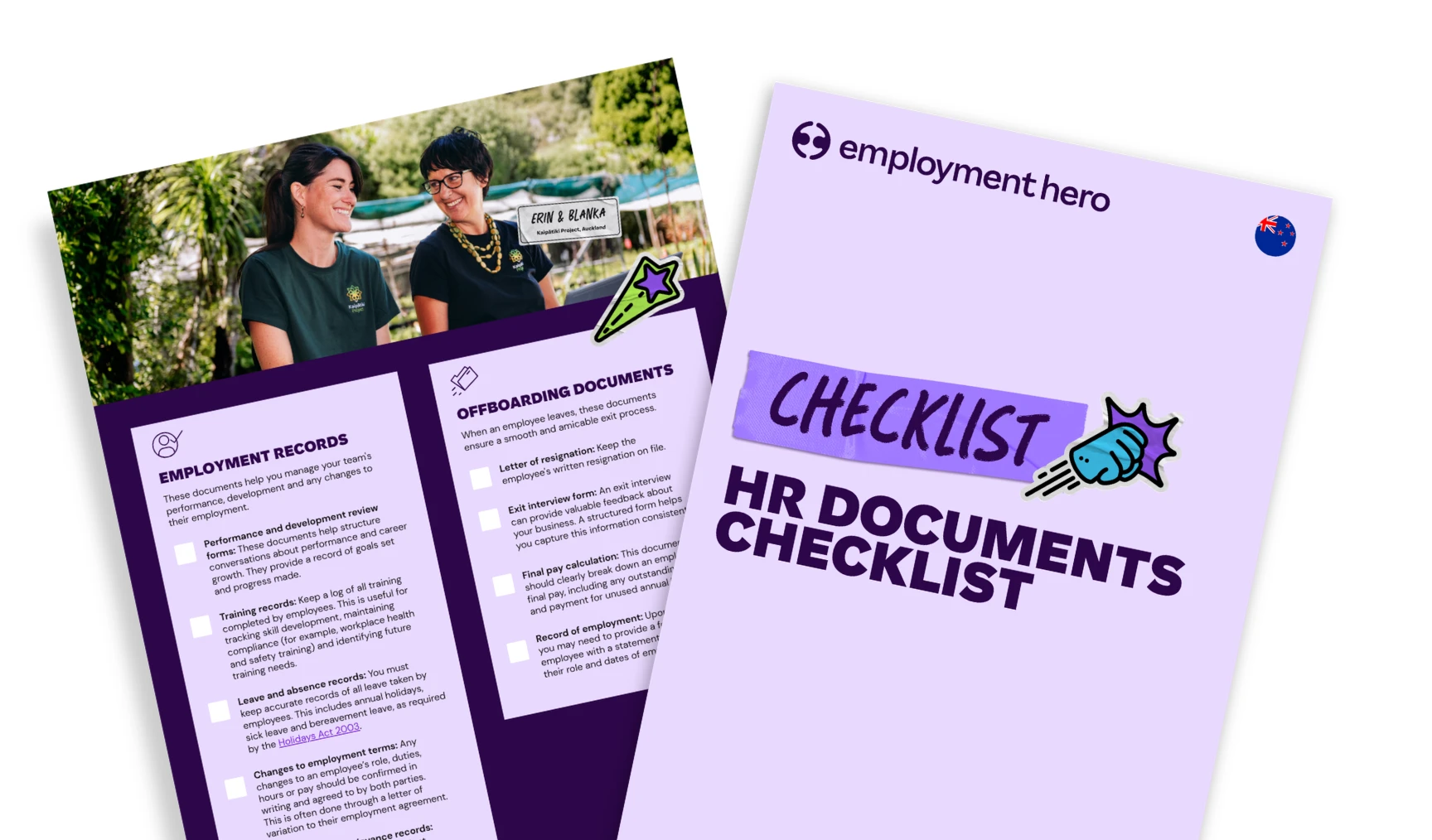
HR documents checklist
Use our HR documentation checklist to figure out what you’re missing. Make sure that every employee in your business is…
-
 Read more: How Employment Hero supports leave management
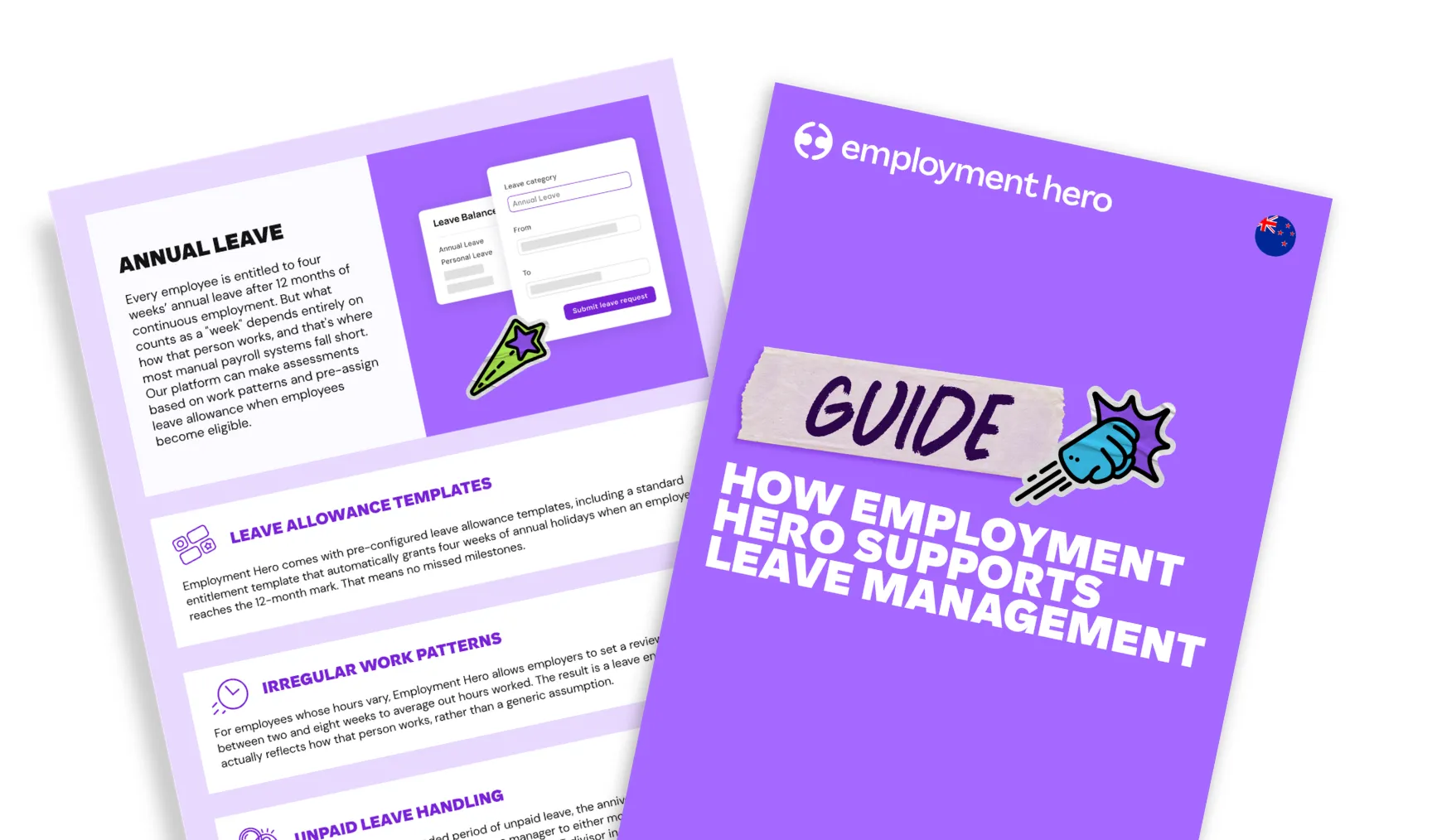
How Employment Hero supports leave management
We help you manage leave so you can focus on growth. Support your business with smart HR tools.
-
 Read more: How Employment Hero streamlines performance management
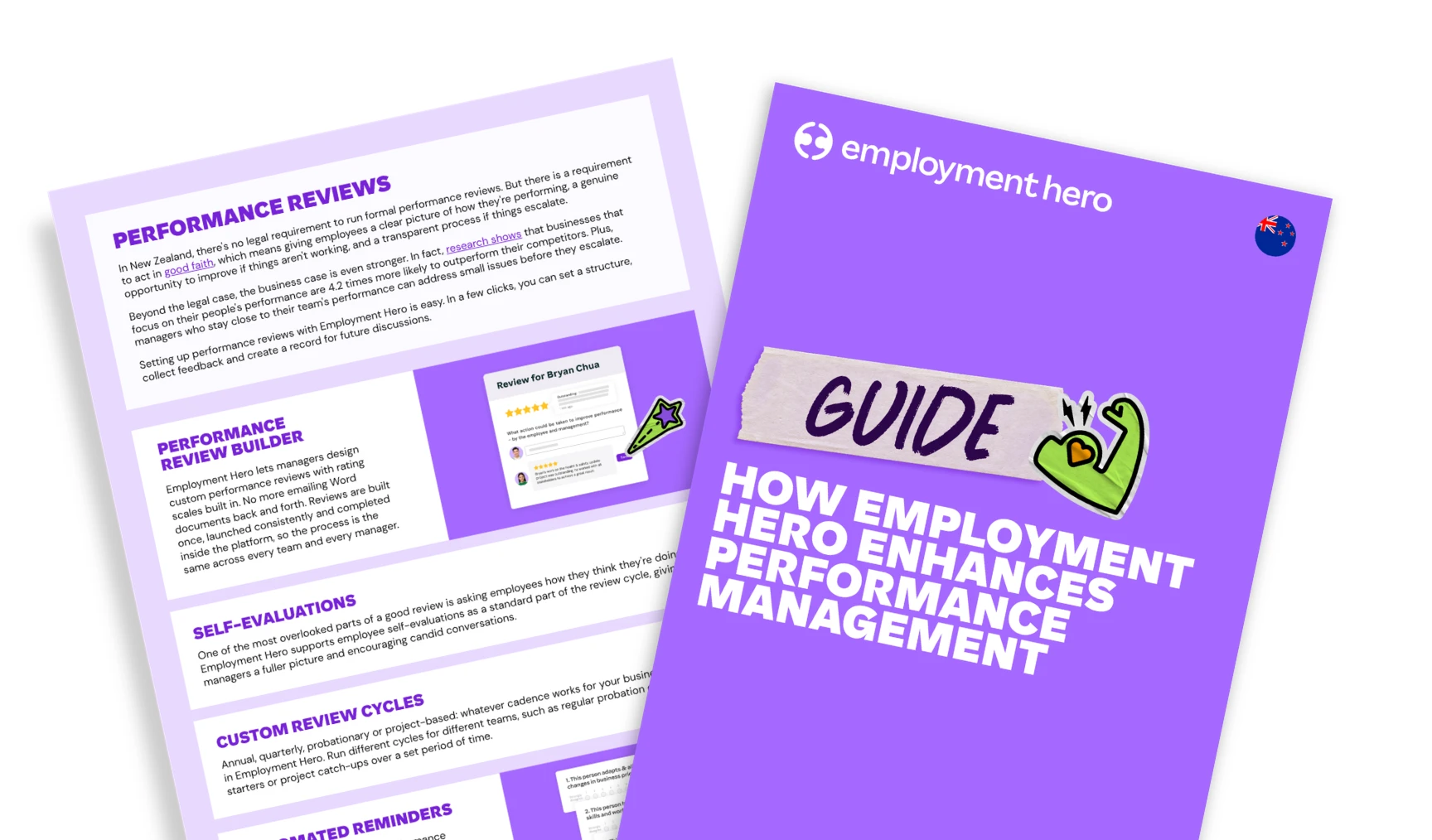
How Employment Hero streamlines performance management
Discover how Employment Hero streamlines performance management with tools to boost employee engagement, track progress and drive success.

